Call for Sessions: Mary Jaharis Center Sponsored Panel, 52nd Annual Byzantine Studies Conference

Call for Sessions: Mary Jaharis Center Sponsored Panel, 52nd Annual Byzantine Studies Conference

As part of its ongoing commitment to Byzantine studies, the Mary Jaharis Center for Byzantine Art and Culture seeks proposals for Mary Jaharis Center sponsored sessions at the 52nd Annual Byzantine Studies Conference to be held at the University of Notre Dame in South Bend, Indiana, October 22–25, 2026. We invite session proposals on any topic relevant to Byzantine studies.

Session proposals must be submitted through the Mary Jaharis Center website. The deadline for submission is May 8, 2026.

If the proposed session is accepted, the Mary Jaharis Center will reimburse a maximum of 5 session participants (presenters and chair) up to $800 maximum for scholars traveling from inside North America and up to $1400 maximum for those coming from outside North America. Funding is through reimbursement only; advance funding cannot be provided.

For further details and submission instructions, please visit https://maryjahariscenter.org/sponsored-sessions/52nd-bsc

Contact Brandie Ratliff (mjcbac@hchc.edu), Director, Mary Jaharis Center for Byzantine Art and Culture, with any questions.

Posted in Announcements | Leave a comment

Online Lecture: Contested Space: Land, Law and Society in Early Medieval Armenia

Online Lecture: Contested Space: Land, Law and Society in Early Medieval Armenia

The Mary Jaharis Center for Byzantine Art and Culture and the Mashtots Professor of Armenian Studies at Harvard University are pleased to announce the final lecture in the 2025–2026 East of Byzantium lecture series.

Contested Space: Land, Law and Society in Early Medieval Armenia
Tuesday, April 28, 2026 | 12:00 PM (EDT, UTC -4) | Zoom
Tim Greenwood, University of St Andrews

There are two visions of late Antique and medieval Armenia which sit uneasily together: as a site of longstanding political, cultural and confessional contention, often accompanied by violence and as a site of remarkable societal resilience in the face of repeated initiatives by hegemonic authorities – Arsacid, Sasanian, Roman, and Islamic – to assert control. Many of the leading houses prominent in the fourth century were also prominent in the seventh century and some retained their prominence, seemingly unbroken, into the eleventh century and beyond. Although scholars have analysed the complex historical narratives preserved in the rich Armenian literary tradition, the juridical landscape in which these narratives played out remains largely uncharted.

Through a series of case studies, this paper explores that landscape and analyses the ownership and transmission of land across late Antique and early medieval Armenia. It proposes that the Armenian elite utilised legal mechanisms deriving from Iranian jurisprudence to define and preserve inalienable family properties. It focuses on charitable foundations set up for the soul.

Tim Greenwood is Bishop Wardlaw Professor in the School of History at the University of St Andrews, Correspondant étranger of the Académie des Inscriptions et Belles-Lettres, Institut de France, and Fellow of the British Academy. He specialises in the study of late Antique and medieval Armenia, including interactions with, and reflections of, Sasanian Iran, Byzantium and the wider Persianate and Islamicate worlds.

Advance registration required. Register: https://eastofbyzantium.org/upcoming-events/

Contact Brandie Ratliff (mjcbac@hchc.edu), Director, Mary Jaharis Center for Byzantine Art and Culture with any questions.

An East of Byzantium lecture. EAST OF BYZANTIUM is a partnership between the Mashtots Professor of Armenian Studies at Harvard University and the Mary Jaharis Center that explores the cultures of the eastern frontier of the Byzantine empire in the late antique and medieval periods.

Posted in Announcements | Leave a comment

Online Lecture: The Spatial and Material Turn in Monastic Archaeology: A Retrospective

Online Lecture: The Spatial and Material Turn in Monastic Archaeology: A Retrospective

The Mary Jaharis Center for Byzantine Art and Culture and the Mashtots Professor of Armenian Studies at Harvard University are pleased to announce the next lecture in the 2025–2026 East of Byzantium lecture series.

The Spatial and Material Turn in Monastic Archaeology: A Retrospective
Tuesday, April 21, 2026 | 12:00 PM (EDT, UTC -4) | Zoom
Darlene L. Brooks Hedstrom, Brandeis University

Spatial readings of monuments and landscapes have fundamentally changed how archaeologists approach settlements and their relationship to the environment. On a more intimate scale, the evolution of materiality studies has further enriched how archaeologists interpret the creation, use, and disuse of objects within communities. In this lecture, I explore how the evolution of archaeological theory regarding space, placemaking, and the movement of things alters our understanding of the natural and cultural landscape associated with the early monastic movement in Egypt.

Darlene L. Brooks Hedstrom, Associate Professor, holds the Myra and Robert Kraft and Jacob Hiatt Chair in Christian Studies and has a joint appointment in the Departments of Near Eastern and Judaic Studies and Classical and Early Mediterranean Studies at Brandeis University. She is an archaeologist and historian of ancient and early Byzantine Christianity in the eastern Mediterranean world (circa 300–1000 CE) with a specialization in the archaeology and history of monasticism.

Advance registration required. Register: https://eastofbyzantium.org/upcoming-events/

Contact Brandie Ratliff (mjcbac@hchc.edu), Director, Mary Jaharis Center for Byzantine Art and Culture with any questions.

An East of Byzantium lecture. EAST OF BYZANTIUM is a partnership between the Mashtots Professor of Armenian Studies at Harvard University and the Mary Jaharis Center that explores the cultures of the eastern frontier of the Byzantine empire in the late antique and medieval periods.

Posted in Announcements | Leave a comment

3rd Porto Medieval and Early Modern Philosophy Summer School: Petrus Hispanus Tractatus: logic and philosophy from the Middle Ages to Modernity

The 3rd Porto Medieval and Early Modern Philosophy Summer School, on Petrus Hispanus Tractatus: Logic and Philosophy from the Middle Ages to Modernity,  will be held in Porto from 15 to 19 June 2026.

The call for participation is open until the 20th April.

No fees apply to the selected participants. Catering and all seminar materials will be provided by the organisation.
Participants from outside Porto can apply for a travel and accommodation grant (up to 500 euros).

More information can be found here: https://ifilosofia.up.pt/activities/3rd-porto-mempss

Posted in Announcements | Leave a comment

MAA News – 2026 MAA Annual Meeting Roundup

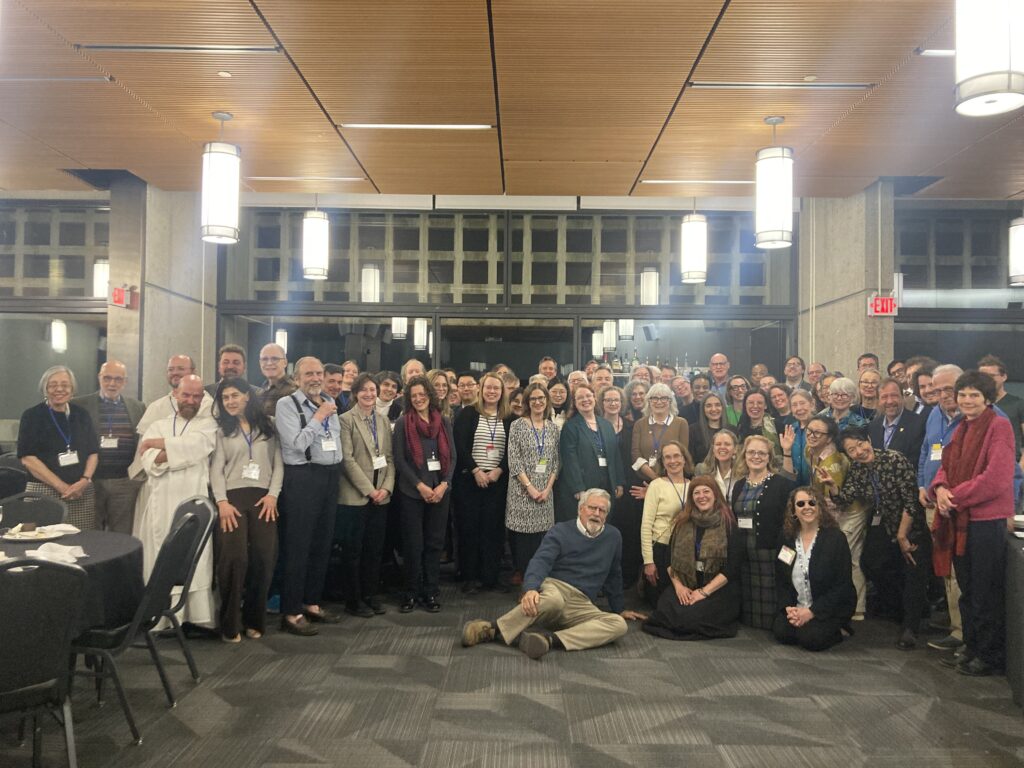
Banquet attendees

What an absolute joy to see so many of you at the 101st Annual Meeting of the Medieval Academy, hosted by the Five College consortium and held on the beautiful campuses of Amherst College and the University of Massachusetts, Amherst. The plenary lectures were splendid: in the opening plenary “Law, Speculation, Fiction,” Jesús Rodríguez Velasco (Yale University) presented several case studies demonstrating how legal thinkers responded to hypotheticals with legal ramifications (who knew there was so much to learn about the legal implications of the damage that could be inflicted by a wild boar?); Peggy McCracken (University of Michigan, in her Presidential Plenary “Echoes of Echo in Medieval France,” engaged with the various ways the character of Echo appears, or does not appear, in late medieval French versions of the Narcissus myth; and Elly R. Truitt (University of Pennsylvania), in her lecture “Before Science: The View from (and of) the Thirteenth Century,” explored the life, work, and reputation of Roger Bacon. The CARA session on Friday morning focused on finding “the medieval” (or pseudo-medieval) in North America, with presentations of projects and online resources stretching from Hawaiʻi to Boston. The 350 attendees were treated to exhibits, receptions, concerts, and nearly 200 lectures across fifty-five sessions. Publication, Teaching, Service, and Student Prizes were awarded, and Fellows were inducted.
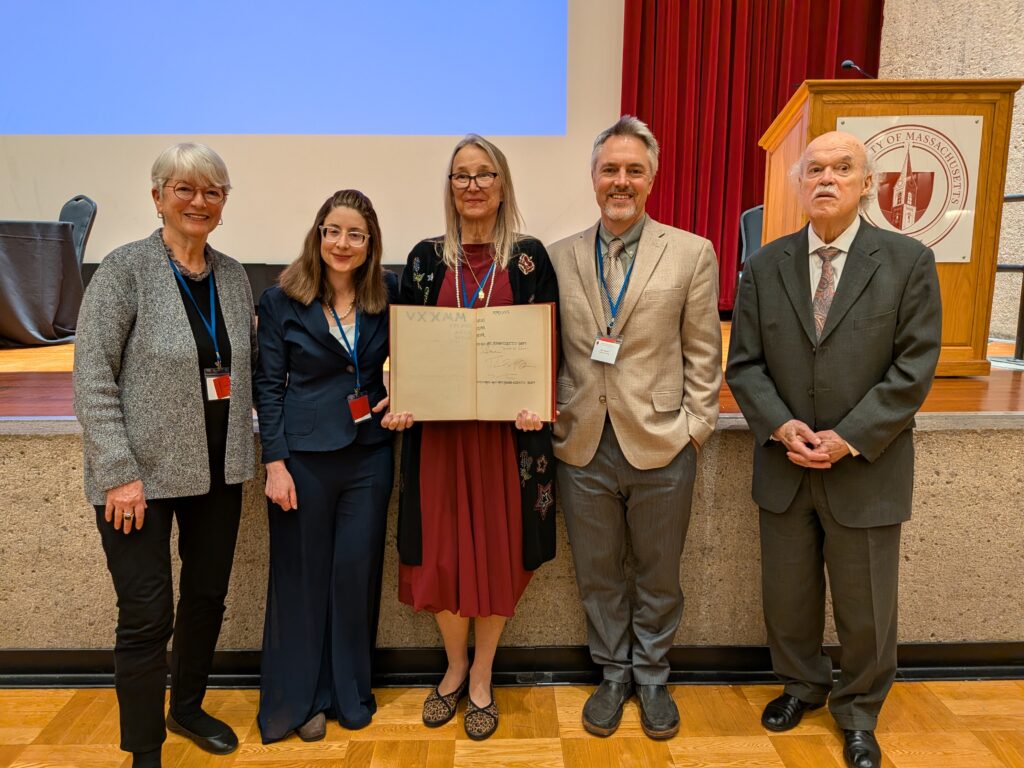
Fellows President Anne D Hedeman with newly-inducted Fellows Emily Steiner, Martha Driver, Tom Barton, and Calvin Bower

Of particular note was the beautiful encomium to the Humanities and to Medieval Studies delivered in welcome by Pawan Dhingra, Vice President for Equity and Inclusion at Amherst College. He has given me permission excerpt his words here.

“…Connections across difference are seen in your program for this year. You will encounter presentations across an array of disciplines, methods, and geographies. Topics include material culture, law and literature, science and technology, performance, religion, the environments of the medieval world, and more. Many sessions invite us to think about technologies of knowledge and the changing relationships between people and environments. As someone who works in diversity, equity, and inclusion, I appreciate how vital medieval studies is to these conversations, and vice versa. The Middle Ages are often imagined as distant, homogeneous, or even exclusionary. The only thing seemingly more outdated than “DEI” is the Middle Ages. But the scholarship in your field and in this conference reveal how history is present today. Medieval Studies asks us to confront how categories of belonging were constructed, how power operated, and how narratives of the past continue to shape inequalities in the present. And your conference is a testament to the fact that when scholarship in the humanities is done right, it draws out the themes of diversity, equity, and inclusion despite the political pushback and dismissiveness they are encountering today. These questions not only concern the past. We are meeting at a moment when the United States is engaged in a war with Iran. You, as scholars of the medieval past, have a key role to play, to elucidate how the regions at the center of today’s headlines – whether in Eastern Europe, Western Asia, and elsewhere – have deep histories of cultural exchange, intellectual production, inequality, and religious diversity. Medieval Studies helps us see those histories in their fullness. We need your scholarship in order to better navigate the challenges that we face today.”

I couldn’t agree more.

My thanks to the Program and Local Organizing Committees – led by Jenny Adams (UMass), Ingrid Nelson (Amherst College), Joshua Birk (Smith College), and Jessica Barr (UMass) – the army of volunteers, MAA Annual Meeting Representative Sean Gilsdorf, and the MAA staff. I hope to see you at the 102nd Annual Meeting at the University of Toronto!

– Lisa

Lisa Fagin Davis, Executive Director
LFD@TheMedievalAcademy.org

Posted in MAA Newsletter | Leave a comment

MAA News – MAA Book Subventions

The Medieval Academy Book Subvention Program provides two subventions of up to $2,500 each to university or other non-profit scholarly presses to support the publication of first books by Medieval Academy members. Click here for more information.

The Medieval Academy Inclusivity and Diversity Book Subvention Program provides one subvention of up to $5000 to university or other non-profit scholarly presses to support the publication of a book by a Medieval Academy member that will broaden the scope of medieval studies. Projects that focus on non-European regions or topics under the Inclusivity and Diversity Committee’s purview such as race, class, disability, gender, religion, or sexuality are particularly welcomed. Click here for more information.

Applications for subventions will be accepted only from the publisher and only for books that have already been approved for publication. Eligible Academy members who wish to have their books considered for a subvention should ask their publishers to apply directly to the Academy, following the guidelines outlined on the relevant webpage. The deadline for proposals is 1 May 2026.

Posted in MAA Newsletter | Leave a comment

MAA News – Season 5 of the Multicultural Middle Ages

Dear colleagues,

We are happy to announce that season 5 of The Multicultural Middle Ages has officially launched. This season promises to be our biggest one yet, and we are starting strong with our first episode: “Pandemic in the Medieval World: Teaching a New Black Death Narrative in the 21st Century.”

How do pandemics happen? In this episode, historians of medieval medicine Monica H. Green, Winston Black, and Lucy Barnhouse talk with Will Beattie about the genesis of a new open-access teaching module on the Black Death. Our understanding of the late medieval pandemic has been transformed not only because of advances in the biological sciences, but also because historians have recently discovered—or newly interpreted—written records from the 13th and 14th centuries. For the first time, the Islamicate world’s experience is centered in the narrative, allowing entirely new perspectives on the Afro-Eurasian pandemic to be revealed.

Please, tune in! You can find The Multicultural Middle Ages on Spotify, Apple Podcasts, and all major podcasting platforms. You can also listen through our website: https://www.multiculturalmiddleages.com/listen

And please follow us on social media: Bluesky (@mmapod.bsky.social) and Instagram (@multiculturalmiddleagespod).

All the best,
The Multicultural Middle Ages Team
Jonathan F. Correa Reyes
Assistant Professor of English
Clemson University
Co-producer The Multicultural Middle Ages Podcast

Posted in MAA Newsletter | Leave a comment

MAA News – 2026 Summer Programming Deadlines

Summer Skills Workshops

This summer, the MAA will offer four online Summer Skills Workshops: Old French (Terry Cullen, Vassar College); Latin Paleography (Sean Gilsdorf, Harvard Univ.), Medieval Latin (Diane Warne Anderson, University of Massachusetts, Boston), and Medieval Liturgy and Liturgical Books (Susan Boynton, Columbia University). Applications must be received by 15 April.

Click here for more information and to apply.

Posted in MAA Newsletter | Leave a comment

MAA News – MAA Grants and Fellowships: Guidelines for Applicants

Have you found yourself unsure about which MAA Grant or Fellowship is the right fit for you and your work? Thanks to MAA Special Projects Assistant Jon Dell Isola, you need wonder no more. Jon has recently written Guidelines for Applicants, and these have now been posted to our website: one for students, and one for everyone else. He will be presenting the student guidelines at an upcoming webinar sponsored by the MAA Graduate Student Committee; click here for more information and to register. We hope that this presentation and these documents will help members make decisions about which MAA grantmaking program they should look to for support.

As the MAA enters its second century, we continue to revisit all of our various programs and policies in order to ensure that we are serving our constituents and the field as best we can. The Ad Hoc Committee on Grants & Fellowships was convened in the fall of 2025 to review all of our grantmaking programs and recommend possible changes to eligibility, grant amounts, and adjudication procedures. The Committee members are: Joseph Ackley (Wesleyan Univ.), Richard Barton (Univ. of North Carolina, Greensboro), Cristina Maria Cervone (Univ. of Memphis), Sarah Davis-Secord (Univ. of New Mexico), and Craig Nakashian (Texas A&M Univ. – Texarkana). Their work is nearly complete and any changes approved by Council will be announced and implemented in the fall.

Posted in MAA Newsletter | Leave a comment

MAA News – MAA@KZoo

As ever, the Medieval Academy will have a strong presence at the International Congress on Medieval Studies at Western Michigan University, Kalamazoo. We hope you will join us for these sessions and special events:

1) For the first time, the MAA Plenary will take place on Friday evening instead of Friday morning. The lecture will be delivered by Michelle M. Sauer (University of North Dakota), “The Queerness of Solitude”, at 7 PM in Sangren Hall 1910. Two related sessions organized by Prof. Sauer will take place on Saturday at 10:30 AM, “Queerness of Solitude (1): Gender, Queerness, and Enclosure” and Saturday at 1:30 PM, “Queerness of Solitude (2): Sex, Gender, and Space in Mystical Literature,” both in Sangren Hall 1910.

2) The Graduate Student Committee Roundtable will take place on Saturday at 8:30 AM, “Ugly Books: How to Research Damaged or Fragmented Manuscripts,” in Sangren Hall 2710.

3) The MAA Digital Humanities and Multimedia Studies Committee is co-sponsoring a workshop on Saturday at 1:30 PM, “Digital Pedagogies for a Medieval World: A Workshop on Digital Humanities in the Classroom,” in Waldo Library 3014 (the Multipurpose Room).

4) Finally, we invite you to visit our staffed table in the exhibit hall to introduce yourself, transact any Medieval Academy business you may have, or pick up some chocolate to keep you going during those long afternoon sessions. As in the past, we will be giving away fifty free one-year memberships to new members, so spread the word!

See you at the ‘Zoo!

Posted in MAA Newsletter | Leave a comment