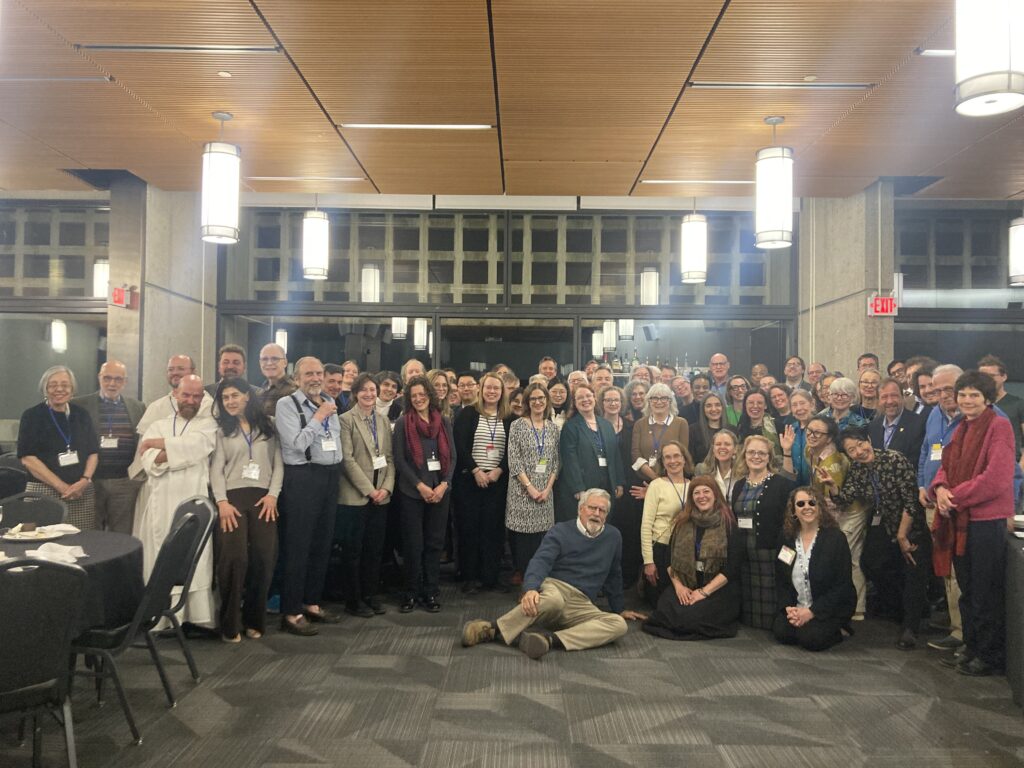
Banquet attendees
What an absolute joy to see so many of you at the 101st Annual Meeting of the Medieval Academy, hosted by the Five College consortium and held on the beautiful campuses of Amherst College and the University of Massachusetts, Amherst. The plenary lectures were splendid: in the opening plenary “Law, Speculation, Fiction,” Jesús Rodríguez Velasco (Yale University) presented several case studies demonstrating how legal thinkers responded to hypotheticals with legal ramifications (who knew there was so much to learn about the legal implications of the damage that could be inflicted by a wild boar?); Peggy McCracken (University of Michigan, in her Presidential Plenary “Echoes of Echo in Medieval France,” engaged with the various ways the character of Echo appears, or does not appear, in late medieval French versions of the Narcissus myth; and Elly R. Truitt (University of Pennsylvania), in her lecture “Before Science: The View from (and of) the Thirteenth Century,” explored the life, work, and reputation of Roger Bacon. The CARA session on Friday morning focused on finding “the medieval” (or pseudo-medieval) in North America, with presentations of projects and online resources stretching from Hawaiʻi to Boston. The 350 attendees were treated to exhibits, receptions, concerts, and nearly 200 lectures across fifty-five sessions. Publication, Teaching, Service, and Student Prizes were awarded, and Fellows were inducted.
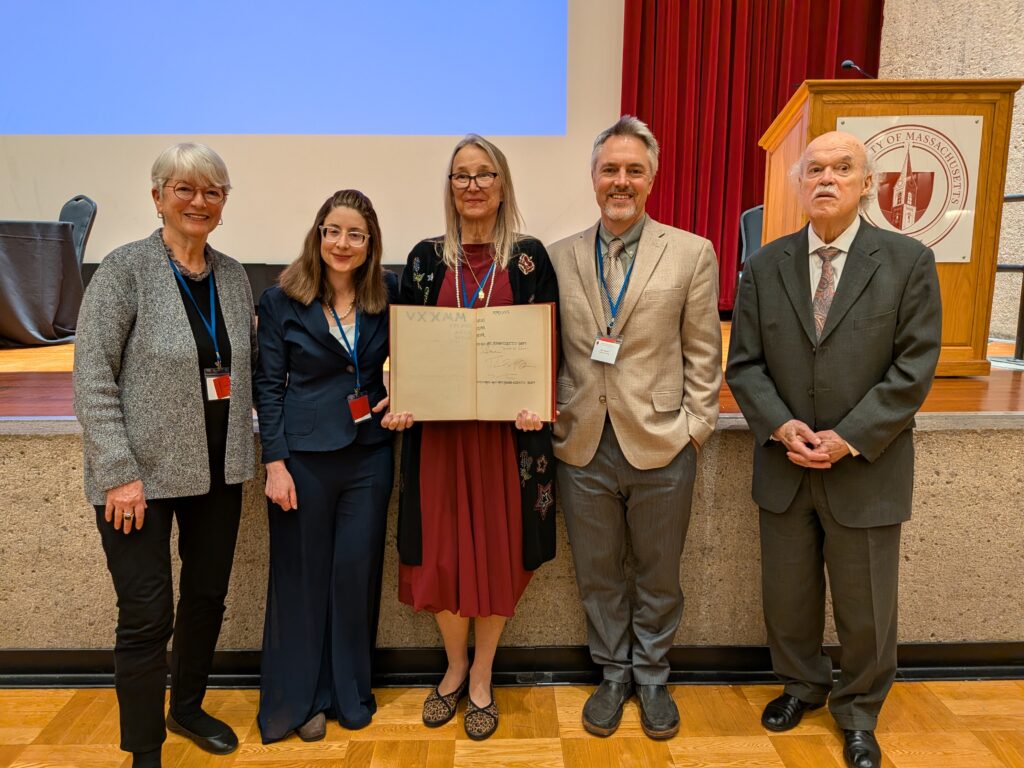
Fellows President Anne D Hedeman with newly-inducted Fellows Emily Steiner, Martha Driver, Tom Barton, and Calvin Bower
Of particular note was the beautiful encomium to the Humanities and to Medieval Studies delivered in welcome by Pawan Dhingra, Vice President for Equity and Inclusion at Amherst College. He has given me permission excerpt his words here.
“…Connections across difference are seen in your program for this year. You will encounter presentations across an array of disciplines, methods, and geographies. Topics include material culture, law and literature, science and technology, performance, religion, the environments of the medieval world, and more. Many sessions invite us to think about technologies of knowledge and the changing relationships between people and environments. As someone who works in diversity, equity, and inclusion, I appreciate how vital medieval studies is to these conversations, and vice versa. The Middle Ages are often imagined as distant, homogeneous, or even exclusionary. The only thing seemingly more outdated than “DEI” is the Middle Ages. But the scholarship in your field and in this conference reveal how history is present today. Medieval Studies asks us to confront how categories of belonging were constructed, how power operated, and how narratives of the past continue to shape inequalities in the present. And your conference is a testament to the fact that when scholarship in the humanities is done right, it draws out the themes of diversity, equity, and inclusion despite the political pushback and dismissiveness they are encountering today. These questions not only concern the past. We are meeting at a moment when the United States is engaged in a war with Iran. You, as scholars of the medieval past, have a key role to play, to elucidate how the regions at the center of today’s headlines – whether in Eastern Europe, Western Asia, and elsewhere – have deep histories of cultural exchange, intellectual production, inequality, and religious diversity. Medieval Studies helps us see those histories in their fullness. We need your scholarship in order to better navigate the challenges that we face today.”
I couldn’t agree more.
My thanks to the Program and Local Organizing Committees – led by Jenny Adams (UMass), Ingrid Nelson (Amherst College), Joshua Birk (Smith College), and Jessica Barr (UMass) – the army of volunteers, MAA Annual Meeting Representative Sean Gilsdorf, and the MAA staff. I hope to see you at the 102nd Annual Meeting at the University of Toronto!
– Lisa
Lisa Fagin Davis, Executive Director
LFD@TheMedievalAcademy.org


