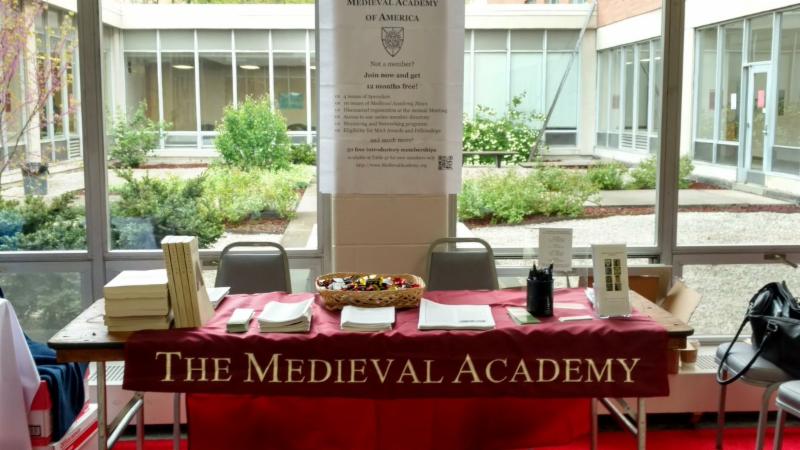
2017 Annual Meeting Registration

92nd ANNUAL MEETING OF THE MEDIEVAL ACADEMY OF AMERICA
Toronto, Ontario, Canada
April 6-8, 2017

Registration for the 92nd Annual Meeting of the Medieval Academy of America is now open.

Click here to register, or use this link:

https://medievalacademy.site-ym.com/events/register.aspx?id=924877

For the program and hotel information, please visit the conference website: https://maa2017.com/

The conference, which takes place 6-8 April 2017 (followed by the CARA meeting on 9 April), features three plenary speakers and over fifty concurrent sessions, including thematic threads such as ‘The Medieval Mediterranean,’ ‘Manuscript Studies,’ ‘Old English Studies’ and many others. Roundtable discussions focus on topics such as K-12 education, diversity in the medieval studies classroom, compatible careers, and scholarly publication in the age of Open Access. The conference location is the St. George Campus of the University of Toronto, with selected parts of the program held at the Art Gallery of Ontario and the closing plenary at the Aga Khan Museum.

We look forward to seeing you in Toronto!

Posted in Annual Meeting | Leave a comment

2017 Class of Fellows

The Medieval Academy of America is pleased to announce the 2017 Class of Fellows and Corresponding Fellows:

FELLOWS:
Uta-Renate Blumenthal (Emerita, The Catholic University of America)
Susan Einbinder (University of Connecticut)
Douglas Kelly (University of Wisconsin – Madison)
Thomas F. Kelly (Harvard University)

CORRESPONDING FELLOWS:
Nicole Bériou (Institut de recherche et d’histoire des textes, Paris)
Michael Clanchy (Emeritus, Institute of Historical Research, University of London)
Averil Cameron (University of Oxford)

These scholars are being honored for their notable contributions to the field of Medieval Studies and were elected by the current Fellows. More information about the Fellows of the Medieval Academy of America is available here. New Fellows will be officially inducted during the upcoming Annual Meeting of the Medieval Academy in Toronto. The induction ceremony will take place at 4:30 PM on Saturday, 8 April, at the Aga Khan Museum.

Posted in Fellows | Leave a comment

Ahmanson Research Fellowship

Ahmanson Research Fellowships support the use of UCLA Library Special Collections’ extensive holdings in medieval and Renaissance manuscripts and printed books. Graduate students or scholars holding a PhD (or the foreign equivalent) who are engaged in graduate-level, postdoctoral, or independent research are invited to apply by the deadline of March 1, 2017. More information is at the UCLA Center for Medieval and Renaissance Studies website at http://cmrs.ucla.edu/awards-fellowships/ahmanson/.

Posted in Fellowships | Leave a comment

Call for Papers – Mary Jaharis Center Sponsored Panel, 43rd Annual Byzantine Studies Conference

As part of its ongoing commitment to Byzantine studies, the Mary Jaharis Center for Byzantine Art and Culture seeks proposals for a Mary Jaharis Center sponsored session at the 43rd Annual Byzantine Studies Conference to be held at the University of Minnesota, Twin Cities, Minneapolis, MN, October 5–8, 2017. We invite session proposals on any topic relevant to Byzantine studies.

Session proposals must be submitted through the Mary Jaharis Center website site (https://maryjahariscenter.org/sponsored-sessions/43rd-annual-byzantine-studies-conference). The deadline for submission is February 15, 2017. Proposals should include:

—Proposed session title

—CV of session organizer

—300-word session summary, which includes a summary of the overall topic, the format for the panel (such as a debate, papers followed by a discussion, or a traditional session of papers), and the reasons for covering the topic as a prearranged, whole session

—Session chair and academic affiliation. Please note: Session chairs cannot present a paper in the session

—Information about the four papers to be presented in the session. For each paper: name of presenter and academic affiliation, proposed paper title, and 500-word abstract. Please note: Presenters must be members of BSANA in good standing

Session organizers may present a paper in the session or chair the session. If a co-organzier is proposed for the session, the co-organizer must also give a paper in the session or chair the session.

Applicants will be notified by February 20, 2017. The organizer of the selected session is responsible for submitting the session to the BSC by March 1, 2017. Instructions for submitting the panel proposal are included in the BSC Call for Papers (https://maryjahariscenter.org/assets/sponsored-sessions/2017_BSANA_Call_for_Papers_FINAL.pdf).

If the proposed session is approved, the Mary Jaharis Center will reimburse session participants (presenters and chair, if the proposed chair is selected by the BSC program committee) up to $600 maximum for North American residents and up to $1200 maximum for those coming from abroad. Funding is through reimbursement only; advance funding cannot be provided. Eligible expenses include conference registration, transportation, and food and lodging. Receipts are required for reimbursement.

Please contact Brandie Ratliff (mjcbac@hchc.edu), Director, Mary Jaharis Center for Byzantine Art and Culture with any questions.

Posted in Call for Papers | Leave a comment

2017 NEH Summer Seminar

John N. King of The Ohio State University and Mark Rankin of James Madison University will direct a National Endowment for the Humanities Summer Seminar for College and University Teachers on continuity and change in the production, dissemination, and reading of Western European books during the 200 years following the advent of printing with movable type. In particular, they plan to pose the governing question of whether the advent of printing was a necessary precondition for the Protestant Reformation. Participants will consider ways in which adherents of different religious faiths shared common ground in exploiting elements such as book layout, typography, illustration, and paratext (e.g., prefaces, glosses, and commentaries) in order to inspire reading, but also to restrict interpretation. Employing key methods of the History of the Book, our investigation will consider how the physical nature of books affected ways in which readers understood and assimilated their intellectual contents. This program is geared to meet the needs of teacher-scholars interested in the literary, political, or cultural history of the Renaissance and/or Reformation, the History of the Book, art history, women’s studies, religious studies, bibliography, print culture, library science (including rare book librarians), mass communication, literacy studies, and more.

This seminar will meet from 18 June until 15 July 2017 at The Huntington Library in San Marino, CA, one of the nation’s leading research and cultural centers. Among the Library’s 420,000 rare books and seven million manuscripts are major holdings in medieval manuscripts, books printed before 1501, Renaissance history and literature, maps, travel literature, and the history of science, medicine, and technology. The Huntington also boasts art galleries containing 650 paintings and 440 works of sculpture, as well as twelve botanical gardens containing 15,000 plant varieties.

Those eligible to apply include citizens of USA who are engaged in teaching at the college or university level and independent scholars who have received the terminal degree in their field (usually the Ph.D.). In addition, non-US citizens who have taught and lived in the USA for at least three years prior to March 2017 are eligible to apply. NEH will provide participants with a stipend of $3,300. Up to three spaces will be reserved for adjunct faculty.

Full details and application information are available at http://sites.jmu.edu/NEHformation-reformation-books2017/. For further information, please contact rankinmc@jmu.edu. The deadline for application is March 1, 2017.

Posted in Seminars | Leave a comment

Call for Papers – Reuse Reconsidered

Reuse Reconsidered
September 15-17, 2017
Brown University, Providence RI

Spolia. Appropriation. Palimpsests. Afterlives…These terms, and others, have been employed by scholars across disciplines to describe the reuse of architecture and material culture. This conference aims to advance current scholarship by exploring some of these terms and unpacking the phenomenon throughout history and across cultures. From the Mexica reuse of Olmec relics to the fascist appropriation of historic styles in building projects—to name two examples—societies have given new meanings to objects, architectonic fragments, buildings, and styles by repurposing them for new contexts.

The field of reuse studies has grown rapidly in the last three decades. In the United States, this is a more recent conversation, particularly as a result of 2006’s “The Mirror of Spolia: Premodern Practice and Postmodern Theory” colloquium at the Clark Art Institute. The colloquium, and subsequent edited volume Reuse Value, covered a wide range of fields and time periods. In the years since, other academic forums have taken a more focused approach, such as Wesleyan University’s “Monuments as Palimpsests” symposium and a College Art Association session on reuse in the ancient world.

While acknowledging the importance of these more focused conversations, this conference aims to broaden the conversation once again. It seeks to unite scholars, from graduate students to senior faculty members, that study a variety of time periods, cultures, and types of reuse. This cross-disciplinary conference will explore the complex and multivalent motivations behind the reuse of cultural heritage. It will also seek to expand how we understand the phenomenon of cultural identity in relationship to the appropriation, memorialization, and reimaging of the past.

We imagine that papers could address questions including, but not limited to:

  • How do cultures (re)employ objects, buildings, or styles from the past as part of the definition of themselves in their present?
  • What is the role of the architect/patron in the act of reuse?
  • How does the cultural biography of the reused object or building inform its use in new contexts?
  • Why do certain things (buildings, styles, time periods) get called upon for a new use while others do not?
  • Why and how are specific buildings or cities reimagined in new contexts?
  • How is the history of museums and antiquarianism connected to the motivations behind reuse?

Abstracts (up to 300 words) and a CV should be sent to: Reuse.Reconsidered@gmail.com by April 14, 2017. Applicants will be notified by mid-May. Papers should be approximately 20 minutes. Any questions should be addressed Lia Dykstra at Reuse.Reconsidered@gmail.com.

Posted in Call for Papers | Leave a comment

Beinecke Rare Book & Manuscript Library Professional Fellowship Program 2017

Yale University’s Beinecke Rare Book and Manuscript Library welcomes applications from current graduate students in library science, information studies, preservation, archives or a related program for its newly constituted professional fellowship program. The program has been designed to provide practical experience to current graduate students interested in pursuing a career in a special collections library setting.


The Beinecke Library is Yale’s principal repository for literary archives, early manuscripts, and rare books as well as strong collections of historical materials. Its collections are internationally known and heavily used by scholars from around the world. For further information about the Beinecke Library, consult the library’s web site at: http://www.library.yale.edu/beinecke.


Professional fellows will work in an area of their specific interest and have the opportunity to learn more about how special collection libraries and major research libraries are organized and function. Professional fellows will undertake and complete a project based on their interests and skills, as well as the needs of the Library.


The Beinecke Library has two professional fellowships available for the summer of 2017, and is looking to host a professional fellow in the following areas (see the list at end for additional details):


– Research services and teaching with special collections

– Rare book cataloging


Professional fellows will work closely with staff in each of these areas and will be integrated into the broader operations of the library through tours, meetings with staff in the Beinecke Library and the Yale University Library, and participation in special projects as available and necessary.


Eligibility and requirements


– Applicants must be current graduate students in good standing in a library science, information studies, preservation, archives or related program

– Applicants must have completed at least three courses before the start date of their professional fellowship

– Applicants must commit to 10 consecutive weeks of employment between June 1st and August 31st , 2017

– At the end of the professional fellowship, fellows will be required to submit a final report describing their experiences or participate in an exit interview

– Applicants must be eligible to work in the U.S.

– Successful applicants will need to pass a security background check


Professional Fellows will receive a stipend of $7,500 to be used for housing, travel and other expenses. The stipend will be divided into three payments: upon starting, halfway through, and upon completion of the professional fellowship.


Applicants should submit the items below by Feb. 28, 2017, with a decision made in the beginning of April. Successful candidates will be contacted in the beginning of April.

– Cover letter indicating professional fellowship area preference, as described below

– Current resume

– Three letters of reference and contact information, including one from your current institution

– List of completed classes (unofficial transcripts accepted)


After Feb. 1, 2017, apply online at https://yale.communityforce.com/Funds/Search.aspx


Please send any questions concerning the professional fellowships to Allison Van Rhee, Senior Administrative Assistant, Beinecke Library at allison.vanrhee@yale.edu


Projects


Research services and teaching with special collections

Working with the Research Services Librarian and the Assistant Head of Access Services, the professional fellow will:

– Provide research support for patrons and faculty in person and through email

– Be the Beinecke staff presence in select classes taught during the professional fellowship period

– Select materials for one or more “collection highlights” shows for later Beinecke staff use

– Give tours to interested groups


These duties will allow the professional fellow to develop skills in key aspects of public services in special collections and gain exposure to the complexities of providing those services in special collections settings, including using specialized databases, understanding legacy cataloguing, and remaining mindful of security considerations. The professional fellow will also assist Beinecke staff in their mission of making the library’s collections accessible and supporting the teaching and research mission of Yale University.


Rare book cataloging


Working with Catalog Librarians, the professional fellow will have a:

– Broad introduction to technical services functions for rare books with an emphasis on rare book cataloging for a wide range of material from the 15th century to the present

– Introduction and experience using Voyager, OCLC/Connexion and other bibliographic databases

– Introduction and experience with RDA, DCRM(B) (Descriptive Cataloging of Rare Materials (Books)), LCSH, genre headings, and authority control

– Specific projects will depend on a person’s language skills, cataloging background, and interests (e.g. early books, artist books, maps, serials, or music)


Yale University considers applicants for employment without regard to, and does not discriminate on the basis of, an individual’s sex, race, color, religion, age, disability, status as a veteran, or national or ethnic origin; nor does Yale discriminate on the basis of sexual orientation or gender identity or expression. Title IX of the Education Amendments of 1972 protects people from sex discrimination in educational programs and activities at institutions that receive federal financial assistance. Questions regarding Title IX may be referred to the University’s Title IX Coordinator, at TitleIX@yale.edu, or to the U.S. Department of Education, Office for Civil Rights, 8th Floor, Five Post Office Square, Boston MA 02109-3921. Telephone: 617.289.0111, Fax: 617.289.0150, TDD: 800.877.8339, or Email: ocr.boston@ed.gov.

Posted in Uncategorized | Leave a comment

Call for Papers – Big Data and Medieval Studies: the Present and Future of Medieval Text Archives

Big Data and Medieval Studies: the Present and Future of Medieval Text Archives
Trinity College Dublin, 27-28 June 2017

The last thirty years have seen the production of numerous large archives of medieval English texts, including the Dictionary of Old English Corpus (c. 3 million words), the York-Toronto-Helsinki Parsed Corpus of Old English Prose (c. 1.4 million words), the Manchester Eleventh Century Spellings Database (c. 300,000 words), the Linguistic Atlas of Early Middle English (c. 650,000 words) and the Corpus of Middle English Prose and Verse (c. 5 million words). Since each of these freestanding corpora was built for a different purpose, there is minimal interoperability, and the user must learn separate user interfaces and search protocols for each. Their extraordinary collective power as a tool for cultural, historical, literary and linguistic analyses thus remains to be exploited. Early publications using the materials produced by the Early English Books Online Text Creation Partnership (EEBO-TCP) have shown the revolutionary power of big data to reconfigure our understanding of the early modern, print past. This colloquium seeks to catalyse a similarly radical transformation in the possible methodologies for the study of the medieval period, by encouraging collaboration to increase the use and utility of existing text archives and setting a blueprint for their future development.

The colloquium will feature presentations from all the major text corpora of medieval English. A small number of places have been reserved for other contributors, and abstracts are now sought for 15-20 minute papers describing methodologically innovative, current research using these or other medieval text archives. Types of research particularly relevant to the aims of the colloquium include:
•    Research that spans multiple corpora that are non-congruent (e. g. parsed and     unparsed corpora, manuscript-focused and text-focused corpora, corpora of texts in     different languages)
•    The use of text archives for purposes beyond which they were designed
•    The use of text archives to address broader cultural, literary or historical research     questions

Abstracts of 250 words should be submitted to Mark Faulkner (faulknem@tcd.ie) by 26 February 2017.

Posted in Call for Papers | Leave a comment

Special opportunity for graduate students during the Medieval Academy Annual Meeting in Toronto:

Wednesday 5 April, Thursday 6 April, and Sunday 9 April feature a Graduate Student Workshop on Medieval Manuscripts, by invitation only. The official Call for Applicants is available to download here: maa-graduate-workshop-2017-call-for-applicants, and the application form is available here: maa-graduate-workshop-2017-application-form. For further information on the workshop, please contact Jessica Henderson (jess.henderson@mail.utoronto.ca).

Posted in Annual Meeting | Leave a comment

Medieval Academy of America Response to Immigration Executive Order

The Medieval Academy of America wishes to express its grave concern over the recent Executive Order suspending entry of all refugees to the United States for 120 days, barring Syrian refugees indefinitely, and blocking entry into the United States for 90 days for citizens of seven predominantly Muslim countries: Iran, Iraq, Libya, Somalia, Sudan, Syria, and Yemen. This order has, in practice, also been interpreted to deny legitimate green card holders and dual citizens from those countries re-entry to the United States.

This executive order not only directly impacts the transmission of knowledge and the free exchange of ideas – principles upon which this nation was founded – but also runs contrary to the work that we, as a scholarly community, do. As medievalists we critically engage the movement of peoples and the exercise of power across more than 1,000
years of human history. The European Middle Ages saw a range of approaches to religious and ethnic co-existence, including episodes of intolerance when religious minorities were subject to marking, restriction, and expulsion. We ask the Administration to learn from – rather than ignore – the past we work to illuminate.

In the days since the Executive Order was enacted, we have received several messages from members concerned that the EO may lead to a delay or denial of re-entry to the US if they attend our upcoming Annual Meeting in Toronto. To those members, please know that the governance of the Medieval Academy of America and the organizers of the meeting at the University of Toronto stand with you and share your concerns.

IF YOU ARE HESITANT ABOUT PARTICIPATING IN THE ANNUAL MEETING:

Please contact Executive Director Lisa Fagin Davis directly at <LFD@TheMedievalAcademy.org> and she will work with you and the University of Toronto team to ensure that your scholarship is presented as planned.

IF YOU ARE HESISTANT ABOUT SIMPLY ATTENDING THE MEETING:

We are committed to disseminating the content of the Annual Meeting and are working on finding feasible ways to do just that. We will be sure to let you know how you can follow along remotely should you choose not to attend.

Please do not hesitate to contact us with questions or concerns as this process moves forward.

Carmela Vircillo Franklin, President
Lisa Fagin Davis, Executive Director

On behalf of the Council of the Medieval Academy of America

Posted in Announcements | Leave a comment