
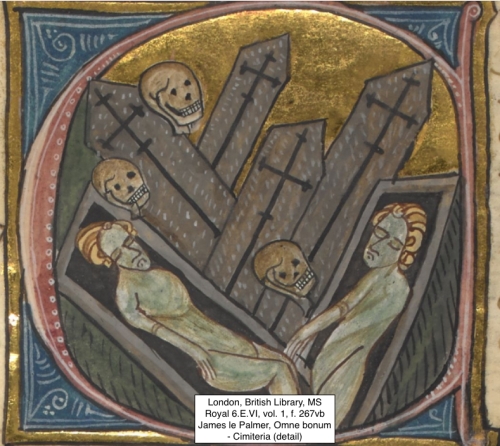
A crowded cemetery in London after the Black Death. From James le Palmer’s encyclopedia, Omne bonum (ca. 1360-ca. 1375). [London, British Library, MS Royal 6.E.VI , vol. 1, f. 267vb (detail)]
A crowded cemetery in London after the Black Death. From James le Palmer’s encyclopedia, Omne bonum (ca. 1360-ca. 1375). [London, British Library, MS Royal 6.E.VI , vol. 1, f. 267vb (detail)]
 Dear Colleague,
We hope you are well and are staying safe.
In the present crisis, as a growing number of our medievalist colleagues find themselves facing financial precarity, job insecurity, and difficulty accessing research resources, your Medieval Academy membership matters more than ever. Please renew by June 30 in order to avoid an interruption in your membership benefits.
With your help, the Academy increased its support of members in 2019, especially student, independent, and contingent scholars, through the numerous awards and fellowships offered annually. We have recently implemented programming in support of medievalists of color and of medievalists working in various professional contexts, and we are working to improve the representation of the Middle Ages in K-12 classrooms. As we work towards a more expansive Middle Ages, we are also working to build a more inclusive Medieval Studies. We sincerely hope that you will renew your valued membership in the Academy as we continue this work in 2020.
The combination of the dramatic recent downturn in the stock-market and an anticipated decrease in dues revenue will directly and significantly impact the MAA’s budget. If you are able to renew your membership for 2020, please do. Your membership dues will directly help us continue to award grants and fellowships in 2020 and beyond; keep dues at a lower level for independent, contingent, unemployed, and retired medievalists; and expand our programming.
You can easily pay your dues and/or make a donation through the MAA website where, after you sign into your account, you can also adjust your membership category if necessary. Please consider supplementing your membership by becoming a Contributing or Sustaining member or by making a tax-deductible donation. In order to make membership more affordable for those in financially precarious circumstances, we have recently revised our dues structure.
You may also wish to remember the Academy with a bequest as a member of our Legacy Society (for more information, please contact the Executive Director).
When you renew, please take a few minutes to update your profile page so that members with similar interests can find you, and you can find them. You can also check a box to indicate your interest in serving on a Medieval Academy committee or reviewing for Speculum. Your profile page now includes an option to indicate gender and racial/ethnic identity. This information will not be visible to other members, but it will help the Academy immensely as we strive to increase our understanding of member demographics and work to improve diversity and inclusivity in Medieval Studies. If you have forgotten your username and/or password, please contact us for assistance.
Thank you for your support. We look forward to working with you in 2020 and hope to see you at the 2021 Annual Meeting of the Medieval Academy at Indiana University, Bloomington.
Stay safe –
Renate Blumenfeld-Kosinski, President
Lisa Fagin Davis, Executive Director
p.s. if you have already renewed, please ignore this message and accept our thanks!
We are very pleased to announce that the 2020 MAA Publication Subventions have been awarded to: Athi Andronikou, Italy, Cyprus, and Artistic Exchange (Cambridge University Press) and Joyce Hendrickson, Leaving Iberia: Islamic Law and Christian Conquest in North West Africa (Harvard University Press).
Jonathan Fruoco has been awarded an MAA Travel Grant to present a paper titled “Geoffrey Chaucer et la plurivocalité urbaine” at the Moscow conference, “‘Littérature urbaine’: une donnée culturelle médiévale ou un concept de l’histoire littéraire contemporaine?”
Our congratulations to Mary Carruthers (F ’96), who has been elected to the American Academy of Arts and Sciences.
If you have good news to share, please send it to Executive Director Lisa Fagin Davis (LFD@themedievalacademy.org)
Although Boston is slowly reopening, the MAA Staff will continue to work from home through at least the end of August. In the meantime, we recommend that you contact us by email instead of by phone. We hope you are all well, and we look forward to greeting you in person when it is safe to do so.
York Festival of Ideas Online
Virtual Horizons
2-14 June 2020
The Brothers York: An English Tragedy
11am, Sunday 7 June 2020
Historian Thomas Penn explores how a dynasty that could have been as magnificent as the Tudors destroyed itself in the space of one generation.
http://yorkfestivalofideas.com/2020-online/calendar/brothers-york/
Warrior: A life of war in Anglo-Saxon Britain
1pm, Sunday 7 June 2020
Writers Edoardo Albert, and archaeologist Paul Gething, present the incredible story of a nameless Anglo-Saxon warrior whose bones were found at Bamburgh Castle.
http://yorkfestivalofideas.com/2020-online/calendar/warrior-life/
The Anglo-Saxon Origins of Whitby Fish and Chips
4pm, Sunday 14 June 2020
Historian, Tom Pickles, reveals a new interpretation of a curious medieval ritual – the Penny Hedge – which take place in Whitby each year.
http://yorkfestivalofideas.com/2020-online/calendar/fish-chips/
To view the full Festival programme, please go to http://yorkfestivalofideas.com/2020-online/
MAA 2021 Annual Meeting
Proposals Due June 1
Please submit your proposal using the portal on the Annual Meeting website:
Please note: if you chose to defer your presentation or session from 2020 to 2021, you must resubmit your proposal using the online portal, including a note about the deferral in the “abstracts” field.
We are aware that many of our members will see their travel funding (if they had any at all) curtailed if not eliminated entirely in the next academic year. We are working on putting additional Annual Meeting travel funding in place for those who need it. We will have more information about such funding in a few months.
Please contact the Program Committee (MAA2021@indiana.edu) with questions.
Be well, and stay safe.
Deborah Deliyannis and Diane Reilly, Program Committee Co-Chairs
Renate Blumenfeld-Kosinski, MAA President
Lisa Fagin Davis, MAA Executive Director
The Editorial Board of the Metropolitan Museum Journal invites submissions of original research on works of art in the Museum’s collection.
The Journal publishes Articles and Research Notes. All texts must take works of art in the collection as the point of departure. Articles contribute extensive and thoroughly argued scholarship, whereas research notes are often smaller in scope, focusing on a specific aspect of new research or presenting a significant finding from technical analysis. The maximum length for articles is 8,000 words (including endnotes) and 10–12 images, and for research notes 4,000 words with 4–6 images.
The process of peer review is double-blind. Manuscripts are reviewed by the Journal Editorial Board, composed of members of the curatorial, conservation, and scientific departments, as well as external scholars.
Articles and Research Notes in theJournal appear both in print and online, and are accessible via MetPublications and the Journal‘s home page on the University of Chicago Press website.
The deadline for submissions for Volume 56 (2021) is September 15, 2020.
Submission guidelines:www.journals.uchicago.edu/journals/met/instruct
Please send materials to:journalsubmissions@metmuseum.org
Inspiration from the Collection: www.metmuseum.org/art/collection
View the Journal: http://www.journals.uchicago.edu/loi/met
Dates: 6 – 10 July 2020. Application deadline: 8 June.
The Summer School in Latin and Greek Codicology and Palaeography is an
intensive, real time (CET), fully interactive online course using
Zoom. With a focus on intensive Latin and Greek palaeography seminars
in parallel tracks at both beginner and advanced levels, it also
provides instruction in textual criticism and diplomatics. It includes
seminars, thematic lectures, assignments, introduction to online
resources, a palaeography exam and opportunity for consultation. The
one-week course comprises two morning sessions and one afternoon
session each day. The course gives a certificate and ECTS credits.
With faculty regularly teaching at codicology and palaeography summer
schools in London, Rome and Budapest, the Summer School fills the gap
left this summer by the cancellations worldwide. The course is an
online adaptation of the Summer School with the same theme and
structure run previously in situ and is organised within the framework
of the Summer University of the Central European University, Budapest.
Fees: Standard 400 EUR, student 300 EUR, tuition waivers are available.
For detailed information and application see the Summer School’s website:
https://summeruniversity.ceu.edu/Latin-Greek-Codicology-2020


