Interoperability and Medieval Manuscripts: A Digital Humanities Workshop

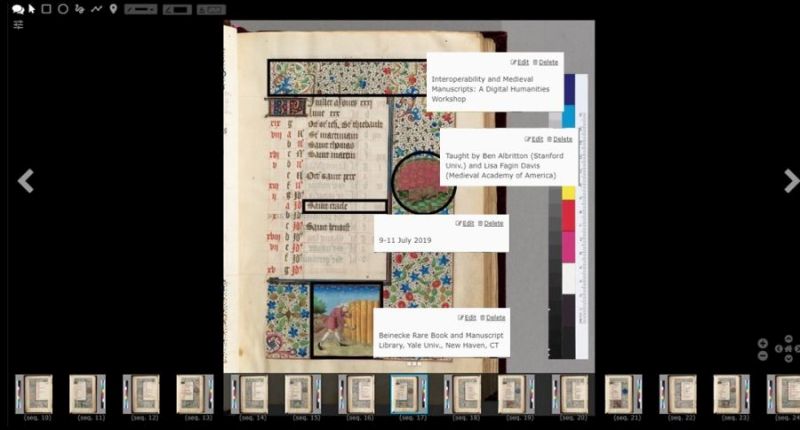
We are now accepting applications for “Interoperability and Medieval Manuscripts,” a three-day digital humanities workshop co-sponsored by The Medieval Academy of America and the Beinecke Rare Book and Manuscript Library. Co-taught by Benjamin Albritton (Computing Info Systems Analyst, Stanford University Libraries) and Lisa Fagin Davis (Executive Director, Medieval Academy of America), the workshop will take place at the Beinecke Rare Book and Manuscript Library at Yale University from 9-11 July 2019.

So much of the work currently being undertaken by medievalists is dependent on primary resources that may not be close at hand, and digital imagery alone can only take us so far. We have limited storage space for the enormous images we want to work with, and so we need to work in an online environment. In keeping with digital best-practices, we want to avoid siloing of files in sealed-off digital repositories. We need to make these images, and our work, discoverable, and so we need consistent metadata and annotation tools. We want to work with open data, including our own, data that can be shared, downloaded, manipulated, visualized, and mined. As scholars, we have limited funding and technical support, and so we need tools that are free, open-access, and easily implemented. The combination of the International Image Interoperability Framework (IIIF) and shared-canvas viewers opens new avenues for researchers and students to discover, access, compare, annotate, and share images of and data pertaining to artifacts and manuscripts in a context that is cloud-based, flexible, open-access, and easily implementable.

Participants in this three-day intensive workshop will be introduced to the International Image Interoperability Framework (IIIF) in combination with shared-canvas viewers and annotation servers, learning how this technology can facilitate new methodologies in manuscript and art history research. Working with their own images, participants will 1) upload their images into a IIIF server (if they aren’t already served by a IIIF-compliant platform); 2) present the images in a shared-canvas viewer; 3) work with the instructors to develop annotations and tags in keeping with their research project. Due to physical space limitations, the course is limited to twelve participants. Applications are welcomed from medievalists at all levels and will be judged primarily on the potential that interoperable images hold for the applicant’s research project or professional goals. Participants should already have access to or possession of the images they will be working with, if the images are not already online and IIIF-compliant. The workshop is tuition-free, but participants are responsible for travel, lodging, and incidental expenses. To help offset these costs, all participants traveling and staying overnight for the workshop will receive a $300 stipend courtesy of the Beinecke Rare Book and Manuscript Library.

Applications must be received by June 1. Click here for more information and to apply.

Instructors:

Benjamin Albritton is Associate Curator for Paleography and Digital Medieval Materials and is the Digital Manuscripts Program Manager at Stanford University Libraries. He oversees a number of digital manuscript projects, including Parker Library on the Web, and projects devoted to interoperability and improving access to manuscript images for pedagogical and research purposes. His research interests include the intersection of words and music in the fourteenth century, primarily in the monophonic works of Guillaume de Machaut; the uses of digital medieval resources in scholarly communication; and transmission models in the later Middle Ages.

Lisa Fagin Davis has been engaged in the development and implementation of manuscript metadata standards and the promotion of digital methodologies for twenty years, taking part in the original Electronic Access to Medieval Manuscripts workshops in the late 1990s and serving on advisory boards for Digital Scriptorium, Fragmentarium, the Schoenberg Database of Manuscripts, and Digital Medievalist. In addition to serving as Executive Director of the Medieval Academy of America, she is an Adjunct Professor at the Simmons School of Library and Information Science. IIIF and shared canvas workspaces are integral to her ongoing projects reconstructing dismembered medieval manuscripts in Fragmentarium (with her Simmons students) and reconstructing the Beauvais Missal as part of the Broken Books project.
Posted in Announcements | Leave a comment

“Sisters No Longer? Continuity and Change in Church and Synagogue”

If you’re attending the Medieval Academy of America Annual Meeting in Philadelphia next week and will be arriving early, don’t miss this lecture by Miri Rubin:

“Sisters No Longer? Continuity and Change in Church and Synagogue”
Miri Rubin, Professor of Early Modern History at Queen Mary University of London
Wednesday, March 6 at 4 p.m.
McShain Hall, 5th floor, Large Lapsley Conference Room One
Saint Joseph’s University
5600 City Avenue
Philadelphia, PA 19131

Professor Rubin will discuss the complexities of the relationship between Judaism and Catholicism from the Middle Ages to present through the changing role of the Ecclesia and Synagoga statues, including the Saint Joseph’s University sculpture, Ecclesia and Synagoga in Our Time.

Sponsored by the Saint Joseph’s University Department of English and the Institute for Jewish-Catholic Relations

Posted in Annual Meeting | Leave a comment

Medieval Latin Courses at the Centre for Medieval Studies at the University of Toronto

In 2019, the Centre for Medieval Studies at the University of Toronto will offer the following courses in Medieval Latin:

Beginning Latin (8 hours of instruction weekly, 21 May to 12 July 2019, with an optional three-week reading course thereafter). Textbook: Moreland and Fleischer, Latin: an Intensive Course.

Level One Medieval Latin (7.5 hours weekly, 27 May to 5 July 2019, with an optional two-week grammar review before the course).

Level Two Medieval Latin (7.5 hours weekly, 8 July to 16 August 2019).

Enrollment in the Level One and Level Two courses will be restricted and will depend on performance in the April Level One Latin examination. Information on the examinations and the summer program is available on line (medieval.utoronto.ca).

The fee for each course is $1,200 (Can) for Canadian residents, or its equivalent in US dollars for non-Canadian residents. The deadline to apply for all courses is 1 May 2019. Enrollment in each course is limited.

A limited number of stipends are available for graduate students participating in summer courses in medieval languages or manuscript studies, and Level One and Level Two Latin at the Centre for Medieval Studies. The stipend will be paid directly to the program to offset a portion of the tuition cost and is contingent on acceptance into the program. Applicants must be members of the Medieval Academy in good standing with at least one year of graduate school remaining and must demonstrate both the importance of the summer course to their program of study and their home institution’s inability to offer analogous coursework.

To apply, please submit a statement of purpose, CV, and two letters of recommendation, to:

MAA/CARA Summer Scholarships
Medieval Academy of America
17 Dunster St., Suite 202
Cambridge, Mass. 02138
USA

Applications must be received by 15 March and will be judged by the Committee for Professional Development and the Chair of the CARA Committee. There will be between four and eight awards yearly, depending upon the number of worthy applicants and the cost of the summer programs.

ASSESSMENT IN MEDIEVAL LATIN

The Centre for Medieval Studies in Toronto continues to offer its Level One and Level Two Medieval Latin examinations to external students. Examinations will be as follows: Level One, 15 April 2019 and 4 September 2019; Level Two, 17 April 2019 and 6 September 2019. Fee for examinations: $50 (US) for non-Canadians, $50 (Can.) for Canadians. For details and application forms, please visit the Centre’s website: medieval.utoronto.ca. Note that admission into the Summer Medieval Latin Level One and Level Two courses will be decided on the basis of the April Level One Latin examination.

Posted in Summer Programs | Leave a comment

Call for Papers – IIIF 2019 Conference

The Call for proposals for the 2019 IIIF conference in Göttingen, Germany is open until the Friday the 1st of March. We would welcome submissions showing the use of IIIF to support digital humanities research. We have the following slots available:

• Up to a ½ day workshop
• 7 to 10 minute lightning talks
• 20 minute presentations (plus 10 mins questions)
• 90 minute open block (Could be panel session or grouped presentations)

If you are working with IIIF in your research please consider submitting a proposal. If you have any questions feel free to get in contact with me or another member of the program committee. Further details on the conference can be seen at:

https://iiif.io/event/2019/goettingen/

And the link to submit your proposal is:

https://goo.gl/forms/qNOT6i2IAW75C6NS2

Thank you!

– IIIF 2019 Conference program committee:
Ben Albritton (Stanford University)
Glen Robson (IIIF-C)
Jack Reed (Stanford University)
Jeff Mixter (OCLC Research)
Josh Hadro (IIIF-C)
Julien A. Raemy (HES-SO University of Applied Sciences and Arts, Haute école de gestion de Genève)
Nuno Freire (Europeana)
Rachel Di Cresce (University of Toronto)
Rashmi Singhal (Harvard University)
Rebecca Hirsch (Yale University)
Regine Stein (Göttingen State and University Library)
Sara Brumfield (Brumfield Labs)
Scott Renton (University of Edinburgh)
Stacey Redick (Folger Shakespeare Library)

Posted in Call for Papers | Leave a comment

Call for Papers – Medieval Gateways: Threshold, Transition, Exchange

SEMA 2019
November 14-16, 2019
Greensboro, NC
~~~~~
Medieval Gateways: Threshold, Transition, Exchange

The Southeastern Medieval Association is pleased to announce the Call for Papers for its 2019 Conference to be held at UNC-Greensboro, co-sponsored by UNCG, North Carolina Wesleyan College and Wake Forest University. 

We invite proposals for individual papers, whole sessions, or round tables on the conference theme of “medieval gateways.” Papers might consider the notion of transforming places and identities within medieval history, literature, and culture; the role of liminality in literary and cultural productions; diaspora and migration in the medieval period; instances of ideological reform; transitions from the medieval to the modern; the rise of the vernacular, or iconoclasm.

The organizers are extremely proud that Greensboro was one of the earliest sites of the “sit-in” lunch counter protests that sparked the Civil Rights movement in the 1960s. Our downtown is home to the International Civil Rights Center and Museum, which is located in the Woolworth Building and houses the original lunch counter where non-violent protesters sat in early 1960. In honor of this important aspect of our area’s history, the conference organizers also propose a secondary thematic thread for the conference on “Resistance.” Papers on this sub-topic might consider the various means of transgressing the physical, religious, social, political, legal, and economic boundaries imposed during the Middle Ages and beyond.

Proposals for individual papers should be limited to 300 words. Session proposals or round tables should include abstracts for the three papers for a session, or 5-6 abstracts for a round table, as well as the contact information for all presenters.

Abstracts on any aspect of medieval studies are welcome, but we will give preference to submissions related to the conference theme. Please submit proposals to semagso2019@gmail.com no later than June 3, 2019.

Posted in Call for Papers | Leave a comment

Call for Papers – Panel on the Old English Alfredian Translations

Panel on the Old English Alfredian Translations
CALL FOR PAPERS

Deadline: June 1st, 2019
Babeș-Bolyai University (UBB), Cluj, Romania
Department of English Language and Literature
10th ‘Constructions of Identity’ International Conference
October 24-25, 2019

https://constructions10.wordpress.com/; http://lett.ubbcluj.ro/dell/?page_id=427

Panel on the Old English Alfredian Translations

In recent years, there has been a growing interest in the translations made under King Alfred’s patronage. The research leading to a new edition of the Old English Boethius (ed. by Malcolm Godden and Susan Irvine, Oxford UP, 2009) has reopened the discussion about Alfredian authorship, the Alfredian canon, the Latin and Anglo-Saxon manuscripts, the commentary tradition, translation strategies, the prefaces and epilogues to the Old English translations etc. The Brill Companion to Alfred the Great (ed. by Nicole Guenther Discenza and Paul E. Szarmach, Leiden/Boston, 2015) provides a useful status quaestionis, and opens new discussions about the Alfredian texts and their contexts. We invite papers on any aspect related to the Alfredian translations, or to their sources and influence.

Keynote Speaker: Prof. Susan Irvine (University College London) will give a talk on the Alfredian prefaces and epilogues (title tbc).

Please submit an abstract of 200 words and a short CV to Dr Adrian Papahagi at adrian.papahagi@lett.ubbcluj.ro by June 1st, 2019. Applicants will be notified by June 30th, 2019.

Conference fee: 100 EUR; 50 EUR for PhD students.

Accommodation can be provided at the University hotel (Hotel Universitas, 30 €/night).

After-conference excursion to Alba Iulia and other medieval sites from Transylvania on Saturday, 26th October.

The University of Cluj (est. 1581) is Romania’s leading and largest university (36,000 students). Cluj is the main city of Transylvania, and can be reached by direct flights operated by Wizzair, Lufthansa and Tarom from many major cities in Europe, including London Luton and Gatwick, Birmingham, Liverpool, Doncaster-Sheffield in the UK.

Posted in Call for Papers | Leave a comment

Call for Papers – “Languages, Literatures and Cultures German to 1700”

The MLA Forum “Languages, Literatures and Cultures German to 1700” and the Society for German Renaissance and Baroque Literature (SGRBL) are organizing three sessions at the MLA Convention, 9-12 January, 2020 in Seattle, WA. Please see information below.

  1. “Digital Humanities and Pre-Modern Germany: Roundtable” 

The brief contributions to this roundtable at the juncture of the Pre-Modern and Digital Humanities should address the full range of work at this exciting intersection. We welcome qualitative and quantitative approaches: cultural analytics, digital resources, theory, visualization, mapping, digitalization, gamification, and teaching. Topics can also address how the Digital Humanities can foster collaboration among researchers, new forms of multimodal scholarly publishing, and outward-facing projects that make the pre-modern accessible to broader audiences. The brief presentations will be followed by discussion.150-word abstract, 50-word CV, audio-visual requirements to Peter Hess (phess@austin.utexas.edu) and Karin Wurst (wurst@cal.msu.edu) by March 9, 2019.

  1. “Emotions in Pre-Modern German Literature and Culture” 

We invite papers on all aspects of emotions found in premodern (pre 1700) German or Latin works including: the role emotions play in constructing social identity, gender, and authority; attempts to control and categorize emotions; the significance of individual and/or collective experiences of emotions; the presentation of emotions in non-verbal media; the ways in which premodern expressions of emotions are studied and described. 150-word abstract, 50-word CV, AV requirements to Peter Hess (phess@austin.utexas.edu) and Karin Wurst (wurst@cal.msu.edu) by March 9, 2019.

  1. “Transnational Boundary Crossing”

We invite proposals for papers that focus on the myriad connections between multilingual and often peripatetic German poets, dramatists, and prose writers with literary works originating elsewhere in Europe, and the engagement of German writers in literary life across the continent (1450-1720). We seek to move beyond familiar questions of literary influence, or the probing of the various ancient, medieval, and Renaissance sources that informed German literary works, to uncover moments of intercultural literary and intellectual exchange between the German lands, Europe, and the world. Papers are welcome on any aspect concerning the interconnections between German and European literary practice that reveal German literature as an integral component of early modern European letters. Questions may concern such topics as the role of translation in creating and exporting German and Neo-Latin literature; the relationships between German and European members of the respublica litteraria; varieties of multilingualism among German writers; movement of German writers across European and global boundaries; the contribution of non-German residents in the German states to the shaping of German literature; and conversely the engagement of German writers with the development of Latin and vernacular writing in other European lands and beyond. 150-word abstract, 50-word CV, audio-visual requirements to James Parente (paren001@umn.edu) and Peter Hess (phess@austin.utexas.edu) by March 9, 2019.

Posted in Call for Papers | Leave a comment

2019 CARA Award Citations

CARA Kindrick Service Award:

This year the CARA Committee is delighted to honor Carol Symes, Associate Professor in the Department of History with joint appointments in Global Studies, Theater and Medieval Studies at the University of Illinois, Urbana-Champaign, with the CARA-Kindrick Service Award for her service to the profession and to Medieval Studies more broadly. As part of a core group of faculty at the University of Illinois, Professor Symes was instrumental in remaking the Medieval Studies Program and reimagining it as a part of a global project. In doing so, she “redrew the map for conceptualizing a global medieval program” at the University of Illinois, and beyond. Symes’s contribution went farther still: in 2012/13 she innovated a new scholarly journal dedicated to this approach, The Medieval Globe, published by ARC Humanities Press and open access. In the introductory issue Symes offered a lucid manifesto for global Medieval Studies that “lays out the stakes and the potentials for transforming our discipline.” Through her tireless work and dedication to a global conception of the Middle Ages, it is clear that Symes has changed our field and its orientation. She has offered a model for thinking broadly, reading widely and voraciously, and for seeing the medieval past in a dynamic framing that renders medieval studies a far richer, more complex and compelling field than previously conceived. Through her extraordinary leadership and dedication to new ideas, through her award-winning teaching and publication record, and in her dedication to mentoring graduate students, junior faculty, and colleagues, she has truly changed our field and pushed the boundaries of our disciplines. Carol Symes has provoked all of us to see the Middle Ages in a new global light and thus to see the potential for new kinds of scholarship, collaboration, and understanding.

CARA Awards for Excellence in Teaching Medieval Studies:

This year CARA is again very pleased to recognize two scholars for excellence in teaching. Elizabeth Sears is the George H. Forsyth Jr. Collegiate Professor of History of Art and Chair of the Department of History of Art at the University of Michigan. Over her three decades of teaching at Princeton University (1982-1989), Universität Hamburg (1991-1992) and the University of Michigan (1992-present) she has inspired and mentored undergraduate and graduate students in courses ranging from “The Medieval Book,” and “The Gothic Age” to “Medieval Image Theory” and “Aby Warburg and His Legacy,” all the while serving on numerous teaching and administrative committees. In her scholarly work she has managed to open up art history and the study of images for students of all levels as exemplified in her edited collection, Reading Medieval Images published in 2002 by combining concise discussions of methodology with in-depth case studies. Her teaching is inspired and seeks to explore the “rich ambiguity of medieval artifacts and texts of all kinds.” For this she also won the University of Michigan’s College of Literature, Science and the Arts’ Excellence in Teaching Award. As a teacher and graduate mentor, Professor Sears “fosters the individual.” In addition to serving as the editor of Gesta, Sears served as the publications chair for the International Center of Medieval Art (ICMA) and established a book series, Viewpoints. “Wise, measured, insightful, and dedicated, Professor Sears is a model for how to conduct ourselves in the field.”

The CARA Committee is also pleased to recognize Sonja Drimmer, Assistant Professor in the Department of Art History at the University of Massachusetts for her outstanding role teaching, mentoring, and inspiring undergraduate and graduate students. During her short time at UMass, Drimmer has created profound collaborations that have drawn together her colleagues at UMass as well as at Amherst, Smith, Mount Holyoke, and Hampshire Colleges, creating a vibrant medieval studies network. In the classroom, she is a brilliant and provocative teacher, often beginning lectures with a question or an object for discussion, provoking students to ask questions in turn. Quite simply, students in her classes have been “spellbound by her creativity.” In addition to her brilliant teaching, Sonja has developed a significant manuscript collection that her colleagues note “she has built seemingly out of thin air”. In collaboration with the librarians and archivists at Special Collections and the University Archives, she has assembled manuscripts and manuscript reproductions for faculty use with students in courses on early book history, medieval and late antique manuscripts, and textual transmission. She has created a “top-notch teaching collection” which makes possible a new kind of teaching at UMass. Bringing to bear her “capacious and elastic mind,” Professor Drimmer has fostered a form of teaching that is collaborative, generous, and exhilarating.

Posted in Announcements, CARA | Leave a comment

MAA News – 2020 Annual Meeting Call for Papers


The 95th Annual Meeting of the Medieval Academy of America will take place on the campus of the University of California, Berkeley on 26-28 March 2020. The meeting is jointly hosted by the Medieval Academy of America, the Program in Medieval Studies of the University of California, Berkeley, and the Medieval Association of the Pacific. The Call for Papers is now online here. The online submission system will be available as of 1 March 2019, and submissions are due on 1 June.

Posted in MAA Newsletter | Leave a comment

MAA News – 2019-20 Schallek Fellow

We are very pleased to announce that the 2019-20 Schallek Fellowship has been awarded to Maj-Britt Frenze (Medieval Institute, University of Notre Dame), “Nature and the Supernatural in Medieval Romance: Translation and Transmission in England and Scandinavia.” The Schallek Fellowship is funded by a gift to the Richard III Society-American Branch from William B. and Maryloo Spooner Schallek. The Fellowship supports an advanced graduate student who is writing a Ph.D. dissertation in any relevant discipline dealing with late-medieval Britain (ca. 1350-1500). The Fellowship brings with it an award of $30,000 and was adjudicated by the MAA’s Schallek Committee.

Frenze’s dissertation examines nature and the supernatural in medieval romance, specifically how romance motifs were transmitted and incorporated into translated and original Middle English romances and Old Norse-Icelandic romances and legendary sagas. These romance motifs include those which entered Middle English and Old Norse-Icelandic literature from French sources, including the romance garden and the forest of aventure, but also those with evident Celtic roots like the supernatural figure of the Loathly Lady. While Middle English romance has enjoyed much scholarly engagement over the past decades, Old Norse-Icelandic romance as a genre has suffered relative neglect. Moreover, very few scholars have compared how English and Scandinavian authors developed alongside each other during the thirteenth through fifteenth centuries, a period in which both cultures were engaging with the same romance materials despite the decline of direct contact after the end of the Viking Age. For generations, the natural pairing of texts has occurred between Old English and Old Norse, an assumption that this dissertation challenges in placing Middle English and Old Norse-Icelandic texts in conversation. This dissertation opens new avenues of research comparing literary development in late medieval England and Scandinavia, focusing on cultural inflections of the natural and supernatural motifs of romance.

The main argument of this dissertation is that authors of Middle English and Old Norse-Icelandic romances shared many significant romance motifs, including some not found in extant French sources, and that many of these were culturally inflected in each body of literature. I argue that English and Scandinavian authors re-contextualized many of the same motifs to reflect the priorities of their own cultures and, additionally, that depictions of landscapes in both cultures occur in highly gendered ways, females and males consistently performing particular roles in specific natural settings. For example, while a Middle English romance might portray a conventional romance garden, an Old Norse-Icelandic work might depict a hnotskógr (“nut-grove”). Where a Middle English romance might have a Loathly Lady who transforms into a beautiful lady at the end of the tale, an Old Norse-Icelandic work might have two separate characters play a similar role: the Loathly Giantess and the Lovely Giantess. Where either literature tends to portray a supernatural “other” in a negative light, Middle English romance might depict that other in the alterity of Islam, while Old Norse-Icelandic romance tends to cast the other in the guise of Germanic paganism. Such comparisons teach modern readers about the enormous potential of romance to be incorporated and adapted into seemingly disparate literary cultures. This dissertation thus engages with the fields of romance, comparative literature, translation studies, landscape studies, ecocriticism and gender studies.

Click here for more information about the Schallek Fellowship and the Schallek Awards.

Posted in MAA Newsletter | Leave a comment