
Call for Papers – Digital Humanities 2019: “Complexities”

DIGITAL HUMANITIES 2019: “COMPLEXITIES” – CALL FOR PAPERS
Alliance of Digital Humanities Organizations

Utrecht University (The Netherlands)

Paper/Poster/Panel deadline: 11:59pm GMT 27 November 2018

Workshop/Tutorial deadline: 11:59pm GMT, 10 January 2019

Workshops: 8-9 July 2019

Conference: 9-12 July 2019

http://dh2018.adho.org

@DH2019_NL

Email: dh2019@adho.org

I: GENERAL INFORMATION

The Alliance of Digital Humanities Organizations (ADHO) invites submission of proposals for its annual conference.

The theme of the 2019 conference is Complexities. This theme has a multifaceted connection with Digital Humanities scholarship. Complexities intends to inspire people to focus on DH as the humanist way of building complex models of complex realities, analysing them with computational methods and communicating the results to a broader public. The theme also invites people to think of the theoretical, social, and cultural complexity and diversity in which DH scholarship is immersed and asks our community to interact consciously and critically in myriad ways, through the conference and the networks, institutions and the enterprises interested in DH research. Finally, it means involving the next generation, teaching DH to students – the people who will need to deal with the complexities of the future.

Proposals related to these themes are particularly welcome, but the Conference will accept submissions on any other aspect or field of Digital Humanities. Possible topics include, but are not limited to:

*Theoretical, epistemological, methodological or historical aspects of Digital Humanities;
*Digital and computational approaches and applications in literary and linguistic fields, including computational text analysis, stylometry, authorship attribution, natural language processing and computational linguistics, digital philology and textual scholarship;
*Digital and computational approaches and applications in archaeology, architecture, and art history, including image processing, 3D modeling, digital restoration;
*Digital history, geographic information systems applications in spatial humanities and historical studies, public history;
*Digital approaches in music, film, theatre, and media studies; electronic art and literature, games studies, hacker culture, networked communities, digital divides, digital activism, open/libre networks and software, etc.;
*Cultural heritage, digital cultural studies and research undertaken by digital cultural institutions
*Social, cultural, and political aspects of Digital Humanities including digital feminisms, digital indigenous studies, digital cultural and ethnic studies, digital black studies, digital queer studies, digital geopolitical studies, multilingualism and multiculturalism in DH, eco-criticism and environmental humanities as they intersect with the Digital Humanities;
*Emerging technologies such as physical computing, single-board computers, minimal computing, wearable devices, and haptic technologies applied to humanities research;
*Institutional aspects of DH, interdisciplinary aspects of scholarship, open science, public humanities, societal engagement and impact of DH;
*Digital Humanities pedagogy and academic curricula;
*Digital Research infrastructures, digital libraries and virtual research environment, critical infrastructure studies, media archaeology, etc.;
*Any other theme pertaining to the Digital Humanities

The primary language of the conference will be English, but we warmly invite proposals written in other languages for which we have a sufficient pool of peer reviewers (German, Italian, French and Spanish).

Presentations may include:

*Posters (abstract maximum 750 words)
*Short papers (abstract maximum 1 000 words)
*Long papers (abstract maximum 1 500 words)
*Multiple-paper panels (500-word abstracts + 500-word overview)
*Pre-conference workshops and tutorials (proposal maximum 1 500 words)

The deadline for submitting poster, short paper, long paper, and multiple-paper panel proposals to the international Program Committee is 11:59pm GMT 27 November 2018. Presenters will be notified of acceptance by March 3 2019.

The deadline for submitting workshops and tutorials, , is 11:59pm GMT, 10 January 2019, with notice of acceptance by 3 March 2019.

Proposal must be submitted via https://www.conftool.pro/dh2019/.

DH2019 will use double-blind peer review. To facilitate this process, please remove all identifying information from your proposal submission including author name(s) and affiliation(s), project URLs, etc..

When submitting proposals, previous Digital Humanities conference participants and reviewers should use their existing ConfTool account rather than setting up new ones. If you have forgotten your username or password, please contact Program Committee Co-chairs Fabio Ciotti: fabio [dot] ciotti [at] uniroma2 [dot] it or Elena Pierazzo: elena [dot] pierazzo [at] univ-grenoble-alpes [dot] fr.

To facilitate the production of the conference abstract book, authors of accepted papers will be asked to submit final approved versions of their abstracts via the DHConvalidator, available through ConfTool, which creates a TEI text base of conference abstracts for further processing.

Presenters are encouraged to familiarize themselves with Global Outlook::Digital Humanities’ Translation Toolkit to prepare for a multilingual conference. This includes guidelines and best practices for multilingual slides/posters/handouts and ad hoc community translation: http://go-dh.github.io/translation-toolkit/conferences/.

Similarly, participants are strongly encouraged to make themselves aware of current recommendations for accessibility of presentations and multimedia-based materials. Please review the World Wide Web Consortium’s Web Initiative Guidelines on Presentation Accessibility: https://www.w3.org/WAI/training/accessible.

II: TYPES OF PROPOSALS

Proposals may be of five types: (1) poster presentations; (2) short paper presentations; (3) long papers; (4) multiple-paper panels; (5) pre-conference workshops and tutorials. Short paper and poster proposals are especially welcome and, based on peer review and its mandate to create a balanced and varied program, the Program Committee may offer acceptance in a different category from the one initially proposed. The committee will not normally accept more than a total of two submissions from one primary or co-author. Papers and posters may be given in English, French, German, Italian or Spanish.

All proposals should include relevant citations to sources in the appropriate literature. Citations are not to be included in the word count. Additionally, proposals that concentrate on a particular tool or digital resource should cite non-digital as well as computer-based approaches to the problem.

Poster Presentations
Poster proposals (abstract maximum: 750 words) may describe work on any specific topics or methods or present projects and software tools in any stage of development. Poster presentations are intended to be interactive with the opportunity to exchange ideas one-on-one with attendees. Posters are in no way considered lesser forms of presentation at the DH conference and are subject to the same strict peer review as other presentation types. Submissions in this category are strongly encouraged.

Short Papers
Short paper proposals (abstract maximum: 1000 words) are intended to be dynamic 10-minute presentations appropriate for reporting on experiments or works in progress or for describing tools or software in development. Short-paper sessions seek to open dialogues among scholars working on related topics. Short papers are in no way considered lesser forms of presentation at the DH conference and are subject to the same strict peer review as other presentation types. Submissions in this category are strongly encouraged.

Long Papers
Proposals for long papers (abstract maximum: 1500 words) should deal with substantial or completed research; report the development of significant new methodologies or digital resources; or present rigorous theoretical, speculative, or critical discussions. Individual papers will be allocated 20 minutes for presentation and 10 minutes for questions.
Proposals relating to the development of new computing methodologies or digital resources should indicate how the methods are applied to research and/or teaching in the humanities and what their impact has been in formulating and addressing research questions. They should also include critical assessments of their application in the humanities as well as of the computing methodologies used.

Multiple Paper Panels
Panels (abstract maximum: 500 words for overview, plus 500 words for each paper) should focus on a single theme and be inherently coherent in presenting a substantial body of research or a research question. Panel submissions which do not meet this criterion and which could function as individual papers will not normally be accepted. A panel should be conceived as a 90-minute session of four to six speakers.

Since the conference offers an important occasion to attract new scholars from diverse backgrounds to specific research areas, those submitting proposals for panels are advised to ensure that the constitution of the panel reflects the constitution of the field and/or research topic that is being addressed and ADHO’s expressed commitment to diversity or to explicitly address problems in those areas. In case the proposer’s own network is too limited, the Program Committee can advise them prior to submission on whom to contact to broaden the panel. Please contact the PC chairs Fabio Ciotti fabio [dot] ciotti [at] uniroma2 [dot] it or Elena Pierazzo elena [dot] pierazzo [at] univ-grenoble-alpes [dot] fr if you need advice.

Pre-Conference Workshops and Tutorials
Tutorials are normally half-day intensive introductions to specific techniques, software packages, or theoretical approaches with a small number of participants. Workshop proposals may take many forms, including proposals with a full slate of speakers and presentations, as well as proposals to issue an independent call for papers from which submissions will be chosen. Participants in pre-conference workshops and tutorials will be expected to register for the full conference as well as pay a small additional fee to the conference. Workshops are expected to be self-financing in terms of hardware and software needs.

Proposals should provide the following information:

Title and brief description of the content or topic and its relevance to the Digital Humanities community (not more than 1500 words);
Full contact information for all tutorial instructors or workshop leaders, including a one-paragraph statement summarizing their research interests and areas of expertise;
Description of target audience and expected number of participants (based, if possible, on past experience); and
Special requirements for technical support.
Additionally, tutorial proposals should include:

A brief outline showing that the core content can be covered in a half-day (approximately 3 hours, plus breaks). In exceptional cases, full-day tutorials may be supported.
And workshop proposals must include:

Intended length and format of the workshop (minimum half-day; maximum one-and-a-half days);
Any special requirements for attendees, including software installation (the conference will handle traditional technological support, but workshop organizers are expected to manage specific needs such as access to software, servers, etc.).
If the workshop is to have its own call for participation, a deadline and date for notification of acceptances, and a list of individuals who have agreed to be part of the workshop’s Program Committee.
As with Multiple Paper Panel proposals, those submitting proposals for pre-conference workshops are advised to ensure that the constitution of the workshop reflects the constitution of the field and/or research topic that is being addressed and ADHO’s expressed commitment to diversity, or explicitly address problems in those areas. In case the proposer’s own network is too limited, the Program Committee can advise them before submission on whom to contact to broaden the panel. Please contact the PC chairs Fabio Ciotti fabio [dot] ciotti [at] uniroma2 [dot] it or Elena Pierazzo elena [dot] pierazzo [at] univ-grenoble-alpes [dot] fr if you need advice.

N.B. Pre-conference workshops endorsed by ADHO Special Interest Groups (SIGs) will be considered via separate calls put out by SIG conveners and will not be evaluated in the general academic program review process.

III: ADHO CONFERENCE CODE OF CONDUCT

The Alliance of Digital Humanities Organizations (ADHO) is dedicated to creating a safe, respectful, and collegial conference environment for the benefit of everyone who attends and for the advancement of research and scholarship in fields supported by our constituent organizations. The ADHO Digital Humanities conference Code of Conduct is available at http://adho.org/administration/conference-coordinating-program-committee/adho-conference-code-conduct. All people submitting proposals to DH2018 should observe and uphold it.

IV: VENUE

DH2019 will take place at the TivoliVredenburg music theatre in the city centre of Utrecht, the Netherlands, and is hosted by the Faculty of Humanities at Utrecht University. The co-chairs of the local organization committee are Franciska de Jong and Joris van Eijnatten.

V: BURSARIES FOR EARLY-CAREER AND EMERGING SCHOLARS

The Alliance of Digital Humanities Organizations will offer a limited number of bursaries for early-career scholars presenting at the conference. Application guidelines will appear on the ADHO website early in 2019: http://www.adho.org.

VI: INTERNATIONAL PROGRAM COMMITTEE

Co-Chair: Elena Pierazzo
Co-Chair: Fabio Ciotti
Co-Vice Chair: Laura Estill
Co-Vice Chair: Jennifer Guiliano
aaDH representative: Paul Arthur
aaDH representative: Simon Musgrave
ACH representative: Meghan Ferriter
ACH representative: Thomas Padilla
centerNet representative: Francesca Benatti
centerNet representative: Nirmala Menon
CSDH/SCHN representative: Maureen Engel
CSDH/SCHN representative: Michael Ullyot
EADH representative: Claire Clivaz
EADH representative: Christian-Emil Ore
Humanistica representative: Clarisse Bardiot
Humanistica representative: Vincent Razanajao
JADH representative: Akihiro Kawase
JADH representative: Taizo Yamada

Posted in Call for Papers | Leave a comment

XXIe colloque international de paléographie latine, Florence, 19-21 février 2020: appel à communications (échéance: le 31 décembre 2018)

Le XXIe colloque du CIPL sur L’émergence des écrits en langue vulgaire.  La perspective paléographique aura lieu à Florence du 19 au 21 février 2020.  Veuillez en trouver l’appel à communications au site du CIPL:  http://palaeographia.org/cipl/firenze/index.htm (échéance le 31 décembre 2018).

Posted in Uncategorized | Leave a comment

Call for Papers – Book Chapter: Predicting the Past. Worldwide Medieval Dream Interpretation.

CFP – Book Chapter: Predicting the Past. Worldwide Medieval Dream Interpretation.

The volume “Predicting the Past. Worldwide Medieval Dream Interpretation” is planned to be published in Brill’s series Reading Medieval Sources and aims to give a high-level survey and analysis of dream-books in the Middles Ages (400-1500 CE), in different parts of the world: Europe, Asia, Africa, Oceania, and the Americas, and explore their development, dispersal, and typologies. We also intend to investigate issues such as production, use, and audience according to different disciplinary perspectives (e.g. history, literature, art, and religion). We would also welcome reflections on the field – where it currently is and what the future approaches and debates might be. We are looking for well-sculpted essays which take engagement with dream-books as their main focus, and use dream-books to shed light on particular aspects of medieval society and culture. To be part of the series Reading Medieval Sources, the source itself and its use, value, and application must be central to the essays.

For scholars interested in contributing an essay, please consider the sections of the volume:

1) the different traditions of dream-books and their presence / role in different countries over the Middle Ages (Europe, Africa, Asia, Oceania, the Americas) the materiality of the source, different formats, illustrations, etc.

2) intersections of dream-books with art, literature, censorship, interpretation, symbology, divination, etc.

Please submit your abstract (max. 500 words) and cv to:
Prof. Valerio Cappozzo (vcappozz@olemiss.edu) by Sunday, December 30, 2018.

Posted in Call for Papers | Leave a comment

Call for Papers – The 18th Vagantes Conference on Medieval Studies

The 18th Vagantes Conference on Medieval Studies, which will take place at the University of Toronto from March 20th-23rd, 2019, is seeking paper abstracts on any topic related to the Middle Ages.

Vagantes is North America’s largest graduate-student conference for medieval studies. Since its founding in 2002, Vagantes has nurtured a lively community of junior scholars from across all disciplines. The 18th Vagantes Conference on Medieval Studies in Toronto will feature thirty graduate-student papers and two keynote speakers.  On March 20th, we will also offer an intensive manuscript workshop that will use the collections of the Pontifical Institute for Mediaeval Studies Library and the Thomas Fisher Rare Book Library.  There will be a separate registration process for the workshop that will be circulated at a later time.

Graduate students in all disciplines are invited to submit an abstract of 300 words on any medieval topic. Please also include the paper title and a 1-2 page CV in your submission. Your abstract will be blind-reviewed by an interdisciplinary panel of graduate students, and it should provide a clear summary of your proposed paper with language that is accessible to non-specialists.  Since Vagantes is an interdisciplinary conference, your audience might not know the history of the Carolingian Empire, the corpus of Geoffrey Chaucer, or the theology of Peter Comestor.  Please make your abstract concise and accessible.  Both your abstract and CV should be submitted in a Word document to Lane Springer at lane.springer@mail.utoronto.ca .

Out of consideration for graduate students’ budgets, Vagantes never charges a registration fee. The deadline for submissions is Friday, November 9th, 2018.  Some travel bursaries will be available for presenters.  In your submission, please indicate if you would be interested in applying for one.

Posted in Call for Papers | Leave a comment

Call for Papers – Fashion as an Economic Engine: Process and Product innovation, Commercial Strategies, Consumer Behavior

Applications due: Nov. 1, 2018
Conference occurs: May 10-13, 2020
Where: Prato, Italy

Call for Papers

Fashion as an economic engine:  process and product innovation, commercial strategies, consumer behavior

For further information and the application form, see: http://www.istitutodatini.it/temi/htm/call.htm

Deadline for application form/abstract: Nov. 1, 2018

Fondazione Istituto Internazionale di Storia Economica “F. Datini”

Via ser Lapo Mazzei 37, I 59100 Prato, ITALY

The study of the textile industry has always been central in economic history, from reconstructions of dynamic growth in the medieval wool industry, to the success of silk processing and light and mixed draperies in the early modern period, and the role of cotton as a driving force in the process of industrialization. Although the dynamics which characterize the manufacture of textiles are closely connected with transformations in fashion, economic history has long neglected the role played by fashion as a factor in economic change, treating fashion primarily as a sort of exogenous catalytic element.  To examine these and other issues is the purpose of the 52nd Datini Study Week, which invites scholars to analyze the economic and commercial aspects of fashion in the pre-modern period (13th through 18th centuries) by considering the following questions. To what extent were innovations in products, technology, and marketing strategies for textiles and clothing during the pre-modern period responding to the social emulation and rapid pace of change characteristic of fashion? How did different types of consumers and behaviours stimulate the manufacture and trade in textiles, clothing, and dress accessories? Did particular price points or changing distributions of income allow consumers to make more choices about dress that supported individual aspirations? What role did cross-cultural contact play in the intensification of fashion in terms of the range of products available, new processes, and marketing strategies? How can economic historians draw on new methodologies and different types of sources for understanding the relationship between fashion and the economy?

Depending on the Institute’s financial resources, at least 25 scholars will be provided with travel subsidies and hospitality at Prato for the Study Week. The paper should represent an original contribution and either generally comparative or a specific case-study that speaks to the larger questions set out here. Papers proposed by projects or collaborative groups that link scholars from different countries and institutions will be assessed with particular interest if they offer a comparative analysis in geographical or diachronic terms across two or more related research themes. We will also consider innovative session formats for these types of proposals. Papers undergo a peer review process before being accepted for publication. All submitted contributions must be original and not previously published or translated from previous publications.

The provisional texts of the selected contributions or at least a synthesis must reach the Datini Foundation by 30 April 2020. They will be put online (with protected access reserved for the participants of the project and members of the Scientific Committee) in the Institute’s webpages before the Week of Studies in order to allow a deeper discussion of their contents. Authors and titles of provisional texts that have not reached the Fondazione that day can not be included in the final programme.

At the Settimana participants will offer a summary presentation of their contribution lasting 20 minutes.

Posted in Call for Papers | Leave a comment

Paul E. Szarmach Prize

The Medieval Institute draws your attention to the Paul E. Szarmach Prize for a first article published in the field of Anglo-Saxon studies. Inaugurated in 2017 by the Richard Rawlinson Center for Anglo-Saxon Studies and Manuscript Research, the Szarmach Article Prize is designed both to honor former Director of Western Michigan University’s Medieval Institute, Paul E. Szarmach, and to recognize new scholarship in his field.

wmich.edu/medieval/research/anglo-saxon/article-prize

Please consider making a nomination for the 2019 prize (deadline: November 1) and help us spread the word of this exciting opportunity.

If you prefer not to receive occasional notice of items of interest to Anglo-Saxonists from the Medieval Institute, please let us know by reply email message.

Posted in Announcements | Leave a comment

Jobs for Medievalists

DIRECTORS OF THE ASCSA SUMMER PROGRAMS
(GERTRUDE SMITH PROFESSORS)

Deadline: January 31, 2019

Six-Week Traditional ASCSA Summer Session: One or Two Positions
ASCSA Field Seminars: Two Positions

SIX-WEEK ASCSA SUMMER SESSION

Term: Summer 2020

Eligibility: Former membership in the School and at least two years of teaching in a post-secondary educational institution. Qualified applicants in all areas of classical studies, including history, art history, languages, epigraphy, and archaeology, are encouraged to apply. Some knowledge of modern Greek, stamina, good health, and a sense of humor.

Description: See more information about the ASCSA Summer Sessions: http://www.ascsa.edu.gr/index.php/programs/Summer.

Duties: Plan the itinerary of the session/seminar, in consultation with the staff in Athens, at least six months prior to the session; collaborate with the Committee on the Summer Sessions in the selection of participants; correspond with participants concerning travel, equipment, academic requirements, etc.; supervise all aspects of the program in Greece, including teaching, coordinating with on-site expert lecturers, keeping a detailed log of the sessions, managing incidental expenses, and submitting a report to the Director.

Compensation: Stipend of $9,064, plus travel and expenses, housing for the Summer Session leader(s) for eight weeks in total as available June 1 to August 15. See the policy in the attached bulletin.

Application: A letter of application, a curriculum vitae, and three letters of support should be sent to: Committee on the Summer Sessions. E-mail: ssapplication@ascsa.org

The appointments will be announced by March 29.

Posted in Jobs for Medievalists | Leave a comment

MAA News – Renew Your Membership for 2019!

The end of the year is fast approaching, and it is time to renew your membership in the Medieval Academy of America. You must be a member in good standing to apply for grants and fellowships given out by the Academy, to speak at the Medieval Academy Annual Meeting, or to participate in its governance.
With your help, the Academy increased its support of members in 2018, especially student, independent, and contingent scholars, through the numerous awards and fellowships offered annually. We sincerely hope that you will renew your valued membership in the Academy as we continue this work in 2019. You can easily pay your dues through the MAA website or by returning the paper form you will soon be receiving in the mail. We hope you will consider supplementing your membership by becoming a Contributing or Sustaining member or by making a gift. These membership categories, along with your donations, help subsidize lower membership dues for student, contingent, and unaffiliated medievalists. You may also wish to remember the Academy with a bequest as a member of our Legacy Society (for more information, please contact the Executive Director).

Thank you for your support. We look forward to working with you in 2019 and hope to see you at the Annual Meeting on March 7-9 in beautiful Philadelphia.

David Wallace, President

Lisa Fagin Davis, Executive Director

p.s. Please note that we no longer offer Joint Membership for members residing at the same address. If you have been a Joint Member in the past, you will need to select a different membership category for 2019 and beyond. If you share a residence with another member and wish to receive only one paper copy of Speculum, please contact us at info@themedievalacademy.org.

Posted in MAA Newsletter | Leave a comment

MAA News – Slate of Candidates for the 2019 Election

To the Members of the Medieval Academy,

Voting in the Medieval Academy governance election is one of the most important means that members have to impact both the Academy and the future of medieval studies in North America. I am very pleased to announce the names of the Medieval Academy members who have generously agreed to stand for election to office in 2019:

President:
Ruth Mazo Karras (History, Trinity College Dublin)

1st-VP:
Renate Blumenfeld-Kosinski (French, Univ. of Pittsburgh)

2nd-VP:
Thomas E. A. Dale (Art History, Univ. of Wisconsin)

Councillors (four seats available):
Lynda Coon (History, Univ. of Arkansas)
Hussein Fancy (History, Univ. of Michigan)
Fiona Griffiths (History, Stanford Univ.)
Elizabeth Papp Kamali (Law, Harvard Law School)
Adam J. Kosto (History, Columbia Univ.)
Karl Kügle (Musicology, Univ. of Oxford/Utrecht Univ.)
Anne Latowsky (French/Latin, Univ. of South Florida)
Catherine M. Mooney (Theology, Boston College)

Nominating Committee (two seats available):
Stephen Jaeger (German Lit., Emeritus, Univ. of Illinois Champaign-Urbana)
Kathy Lavezzo (English Literature, Univ. of Iowa)
Ann Marie Rasmussen (German and Slavic Studies, Univ. of Waterloo)
Sif Rikhardsdottir (Comparative Literature, Univ. of Iceland)

In addition to biographical information, each candidate has submitted a statement detailing their vision for the Academy and their reasons for wanting to participate in its governance. It is our hope that these statements will assist members in making informed choices about the governance of the Medieval Academy. These statements are online here:

https://www.medievalacademy.org/page/2019Ballot

There are eight candidates for four openings on the Council, the governing body of the Academy. There are four candidates for two openings on the Nominating Committee, tasked with proposing candidates for the annual Council and Officers’ election. As is our practice, the slate of three Presidential Officers is presented unopposed, although nominations by petition may be made as follows, in accordance with article 26 of the By-Laws:

Nominations of other members of the Academy for elected officers, Councillors, or members of the Nominating Committee may be made by written petition signed by at least seven members of the Academy. A nomination by petition may be for a single office, several offices, or an entire slate. Such petitions must be received by the Executive Director within twenty days of the circulation of the report of the Nominating Committee (article 25), unless the Council extends the period for making nominations by petition.

As the slate of candidates is being announced on 25 September, the closing date for nomination by petition has been set at 11:59 PM, 14 October 2018. Additional information about the governance of the Academy can be found on our FAQ page: http://medievalacademy.site-ym.com/page/FAQ

My thanks to the 2019 Nominating Committee for their work in establishing the slate of Council candidates: Ken Pennington (Chair), Robin Fleming, Bernice Kaczynski, Susan Kramer, and Catherine Saucier. My thanks as well to President David Wallace for proposing the slate of Nominating Committee candidates.

Electronic balloting will open on 16 October. If you would prefer to receive a paper ballot and have not received one in the past, please contact me at LFD@TheMedievalAcademy.org.

Please vote and let your voice be heard. I look forward to your participation in the election of the leadership of the Medieval Academy of America.

– Lisa Fagin Davis, Executive Director

Posted in MAA Newsletter | Leave a comment

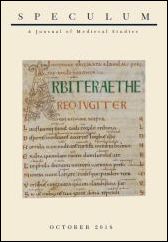
MAA News – Latest Issue of Speculum is Now Available Online

The latest issue of Speculum is now available on the University of Chicago Press Journals website.

To access your members-only journal subscription, log in to the MAA website using your username and password associated with your membership (contact us at  info@themedievalacademy.org if you have forgotten either), and choose “Speculum Online” from the “Speculum” menu.  As a reminder, your MAA membership provides exclusive online access to the full run of Speculum in full text, PDF, and e-Book editions – at no additional charge.

Speculum, Volume 93, Issue 4 (October 2018)

Articles

Vt hkskdkxt: Early Medieval Cryptography, Textual Errors, and Scribal Agency
Benjamin A. Saltzman

Dominicans and Demons: Possession, Temptation, and Reform in the Cult of Vincent Ferrer
Laura Ackerman Smoller

Doing Things beside Domesday Book
Carol Symes

Inspiration and Imagination: Visionary Authorship in the Early Manuscripts of the Revelations of Birgitta of Sweden
Thomas Luongo

Book Reviews

This issue of Speculum features more than 70 book reviews, including:

Joachim Yeshaya and Elisabeth Hollender, eds., Exegesis and Poetry in Medieval Karaite and Rabbanite Texts 
Reviewed by Esperanza Alfonso

Helen J. Swift, Representing the Dead: Epitaph Fictions in Late-Medieval France 
Reviewed by Ashby Kinch

Elizabeth M. Tyler, England in Europe: English Royal Women and Literary Patronage, c. 1000-c. 1150
Reviewed by Stacy S. Klein

Craig Williamson, trans., The Complete Old English Poems
Reviewed by R. M. Liuzza

Jana Madlen Schütte, Medizin im Konflikt: Fakultäten, Märkte und Experten in deutschen Universitätsstädten des 14. bis 16. Jahrhunderts 
Reviewed by Debra L. Stoudt

Patrick J. Murphy, Medieval Studies and the Ghost Stories of M. R. James 
Reviewed by Robert S. Sturges

Steven A. Schoenig, SJ, Bonds of Wool: The Pallium and Papal Power in the Middle Ages
Reviewed by Warren T. Woodfin

MAA members also receive a 30% discount on all books and e-Books published by the University of Chicago Press, and a 20% discount on individual Chicago Manual of Style Online subscriptions. To access your discount code, log in to your MAA account, and click here.  Please include this code while checking out from the University of Chicago Press website.

Sincerely,
The Medieval Academy of America

Posted in MAA Newsletter | Leave a comment