
Call for Proposals: MAA and the Digital Latin Library

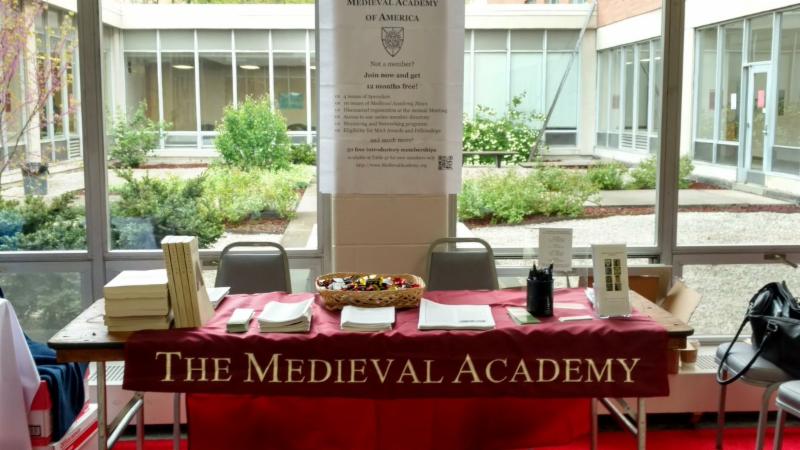
The Medieval Academy of America is pleased to announce a collaboration with the Digital Latin Library (DLL). This partnership demonstrates the Academy’s support of DLL’s open-access publishing model – in which text, apparatus, and image are made interoperable – and is in keeping with the Medieval Academy of America’s long-standing commitment to high-quality Latin editions. We offer this online platform in addition to our ongoing printed series Medieval Academy Books. The Medieval Academy of America will oversee the vetting and approval of DLL editions of medieval Latin texts, while the Digital Latin Library will facilitate XML encoding and online hosting. Vetted online editions will carry the imprimatur of the Medieval Academy of America and should be considered of equal status to similarly-vetted printed editions in application, promotion, or tenure dossiers.

The MAA’s Digital Humanities and Multimedia Studies Committee has established procedures and policies for the vetting and approval of DLL editions of medieval Latin texts, and we welcome the submission of pre-proposals. For information and guidelines, please visit our website or contact MAA Executive Director Lisa Fagin Davis.
Posted in Announcements | Leave a comment

Call for Papers – International Conference “The Medieval Literary Canon in the Digital Age”

Call for Papers
International Conference “The Medieval Literary Canon in the Digital Age”

Ghent University, 17–18 September 2018

We invite submission of abstracts for the international conference “The Medieval Literary Canon in the Digital Age,” to be held at Ghent University from 17-18 September 2018.

An often repeated promise of the digital humanities, in the wake of the “computational turn,” is that the wide availability and accessibility of historical texts would enable scholars to breach the restrictions of a literary canon. The present international conference wishes to explore how exactly the digital humanities can provide such insights for medieval studies, in which such a promise raises critical questions.

(1) In spite of the computational turn, much of the digital scholarship for the Middle Ages still seems to hinge on well-conserved and therefore well-known theological and literary authorities, whose texts have been reproduced continuously in subsequent editions and translations. To what extent does today’s computational research manage to escape the straitjacket of the traditional canon?

(2) Considering that in the past decades, medieval scholars have become increasingly sensitive to the materiality of textual transmission in the Middle Ages, the virtual, normative and reductive character of a digital environment are not always compatible to their research interests.

As the emancipation of the digital humanities from their merely supportive role is proclaimed increasingly, and as the tools for digital medieval studies proliferate (e.g. digital scholarly editing, computational stylistics, digital palaeography, digital stemmatology, …), this conference welcomes papers —based on either case studies or broader research questions— that both problematize the specialized character of medieval literary production and demonstrate the potential for computational criticism to “breach” or “widen” the medieval canon through digital tools.

Full details on the topic and discussion of the conference are available on the conference website: http://www.mcda.ugent.be​.

The conference, to which we will accept 8 scholars in addition to the confirmed speakers (cfr. infra) will consist exclusively of plenary sessions, with ample time for discussion. The conference committee encourages proposal submissions by both established and junior researchers. Please send abstracts (ca. 300 words) and a five line biography via email to Jeroen De Gussem (jedgusse.degussem@UGent.be) by the ​10th of May. Participants will receive a notification concerning the acceptance of their application by the end of May.

We expect from our applicants that they have the ability of covering their own travel costs. Accepted speakers are offered lunches and an invitation to our conference dinner. Accepted speakers from abroad (any country other than Belgium) will also be offered up to 3 hotel nights in Ghent.

The following invited speakers have confirmed their participation: Godfried Croenen (University of Liverpool) / Maciej Eder (Pedagogical University of Kraków) / Julie Orlemanski (University of Chicago) / Peter Robinson (University of Saskatchewan) / Karina van Dalen-Oskam (University of Amsterdam) / David J. Wrisley (New York University Abu Dhabi)​

Posted in Call for Papers | Leave a comment

Workshop & Study Day at the Armenian Museum of America, April 13, 2018

The Arthur H. Dadian and Ara Oztemel Chair of Armenian Art at Tufts University and the Mary Jaharis Center for Byzantine Art and Culture at Hellenic College Holy Cross in Brookline, MA, are pleased to announce our next East of Byzantium event:

Friday, April 13, 2018, 10:00 am – 12:30 pm

Armenian Museum of America, 65 Main Street, Watertown, MA

Workshop & Study Day at the Armenian Museum of America

A study day for students focusing on Armenian liturgy and Armenian liturgical objects. The morning will include a workshop and a handling session with liturgical objects from the Armenian Museum. Led by V. Rev. Fr. Daniel Findikyan, St. Nerves Armenian Seminary and Christina Maranci, Tufts University

Workshop seating is limited. Registration is required. Registration closes April 12 at noon. Additional information and registration at https://eastofbyzantium.org/upcoming-events/workshop-study-day-at-the-armenian-museum-of-america/.

A short group of pre-assigned readings will be circulated at least one week prior to the workshop. Participants are expected to complete the readings before the workshop.

Transportation between Harvard Square and Watertown will be provided.

East of Byzantium is a partnership between the Arthur H. Dadian and Ara Oztemel Chair of Armenian Art at Tufts University and the Mary Jaharis Center for Byzantine Art and Culture at Hellenic College Holy Cross in Brookline, MA, that explores the cultures of the eastern frontier of the Byzantine empire in the late antique and medieval periods.

Contact Brandie Ratliff (mjcbac@hchc.edu), Director, Mary Jaharis Center for Byzantine Art and Culture, with questions.

Posted in Workshops | Leave a comment

Digital Humanities: An Afternoon Symposium

Digital Humanities: An Afternoon Symposium

Date: Friday, April 6, 2:45-5:30pm

Location: Harvard Hall 102, 1465 Massachusetts Avenue More Info: http://darthcrimson.org/dh-afternoon-symposium/

This event is free and open to the public. The following invited speakers will share current research projects; presentations will be followed by a panel discussion.

Gregory Crane (Tufts University): Perseus Digital Library Lisa Fagin Davis (Medieval Academy of America): Medieval Scrolls Digital Archive Racha Kirakosian and students (Harvard University): Digital Editing at Harvard Gabriel Pizzorno (Harvard University): The Documentary Archaeology of Late Medieval Europe Michael Stolz (University of Bern): Parzival-Projekt Jeffrey Witt (Loyola University Maryland): The Scholastic Commentaries and Texts Archive

Moderation: William Stoneman (Harvard University)

For further information, contact Racha Kirakosian at rkirakosian@fas.harvard.edu.

Funded by the Barajas Dean’s Innovation Fund for Digital Arts and Humanities and supported by the Digital Scholarship Support Group.

Posted in Symposiums | Leave a comment

MAA News – MAA @ Kalamazoo

As always, the Medieval Academy of America will have a strong presence at the 2018 International Congress on Medieval Studies  (May 10-13).
1) The Friday morning plenary, sponsored by the Academy, will be delivered by Sara Ritchey (Univ. of Tennessee-Knoxville), “‘Salvation is Medicine’: The Medieval Production and Gendered Erasures of Therapeutic Knowledge” (Friday, 8:30 AM, Bernhard, East Ballroom). Two related sessions  organized by Prof. Ritchey and Prof. Monica Green will take place on Friday at 10 AM (Session 211) and 3:30 PM (Session 326). Both sessions will take place in the Bernhard Brown & Gold Room.

2) On Friday at 10 AM, the Graduate Student Committee is sponsoring a roundtable titled “Meet the Editors: Tips and Techniques on Article Submission for Graduate Students (Session 183, Schneider 1220). The GSC reception will take place on Thursday at 5:30 PM in Fetzer 1035.

3) The Committee on Centers and Regional Associations (CARA) is sponsoring two panels this year. The first, “The Twenty-First-Century Medievalist: Digital Methods, Career Diversity, and Beyond,” will take place on Thursday at 1:30 PM (Session 47, Valley III, Eldridge 309). The second, “Teaching a Diverse and Inclusive Middle Ages,” will take place on Saturday at 10 AM (Session 388, Bernhard 208).

4) The annual CARA Luncheon will take place on Friday at noon (Bernhard, President’s Dining Room). If you would like to attend as a representative of your program or institution, please register online. There is no fee to attend, but pre-registration is required. All are welcome!

5) Finally, we invite you to stop by our staffed table in the exhibit hall to introduce yourself, transact any Medieval Academy business you may have, or pick up some chocolate to keep you going during those long afternoon sessions.

See you at the ‘Zoo!

Posted in MAA Newsletter | Leave a comment

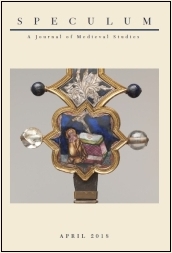
MAA News – Latest Issue of Speculum is Now Available Online

The latest issue of Speculum is now available on the University of Chicago Press Journals website.
To access your members-only journal subscription, log in to the MAA website using your username and password associated with your membership (contact us at info@themedievalacademy.org  if you have forgotten either), and choose “Speculum Online” from the “Speculum” menu.  Please refer to this video tutorial if you are having difficulty. As a reminder, your MAA membership provides exclusive online access to the full run of Speculum in full text, PDF, and e-Book editions – at no additional charge.

Speculum, Volume 93, Issue 2 (April 2018)

Articles
Raymond Peraudi in Zerbst: Corpus Christi Theater, Material Devotion, and the Indulgence Microeconomy on the Eve of the Reformation
Glenn Ehrstine

The Women and the Inquisitor: Peacemaking in Bologna, 1299
Melissa Vise

The Giant of Bremen: Roland and the “Colossus Imagination”
Assaf Pinkus

Edward I, Exodus, and England on the Hereford World Map
Debra Higgs Strickland

Book Reviews
This issue of Speculum features 81 book reviews, including:

Megan Cavell, Weaving Words and Binding Bodies: The Poetics of Human Experience in Old English Literature (2016)
Reviewed by Emily Thornbury

Andrew Hicks, Composing the World: Harmony in the Medieval Platonic Cosmos (2017)
Reviewed by Elizabeth Eva Leach

Tyler Lange, Excommunication for Debt in Late Medieval France: The Business of Salvation (2016)
Reviewed by Felicity Hill

Elizabeth Lapina, Warfare and the Miraculous in the Chronicles of the First Crusade (2015)
Reviewed by Cecilia Gaposchkin

Hela Ouardi, Les derniers jours de Muhammad (2016)
Reviewed by John Tolan

Dan Lord Smail, Legal Plunder: Households and Debt Collection in Late Medieval Europe (2016)
Reviewed by Guy Geltner

MAA members also receive a 30% discount on all books and e-Books published by the University of Chicago Press, and a 20% discount on individual  Chicago Manual of Style Online subscriptions. To access your discount code, log in to your MAA account, and click here.  Please include this code while checking out from the University of Chicago Press website.

Sincerely,
The Medieval Academy of America

Posted in MAA Newsletter | Leave a comment

MAA News – Mirador for Medievalists: IIIF, Shared Canvas, and Digital Images

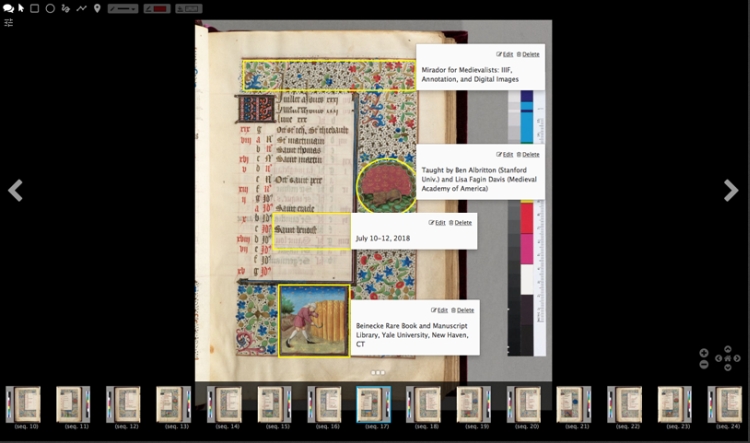
We are now accepting applications for this digital humanities workshop co-sponsored by The Medieval Academy of America and the Beinecke Rare Book and Manuscript Library. Co-taught by Benjamin Albritton (Computing Info Systems Analyst, Stanford University Libraries) and Lisa Fagin Davis (Executive Director, Medieval Academy of America), the workshop will take place at the Beinecke Rare Book and Manuscript Library at Yale University from 10-12 July 2018.
So much of the work currently being undertaken by medievalists is dependent on primary resources that may not be close at hand, and digital imagery alone can only take us so far. We have limited storage space for the enormous images we want to work with, and so we need to work in an online environment. In keeping with digital best-practices, we want to avoid siloing of files in sealed-off digital repositories. We need to make these images, and our work, discoverable, and so we need consistent metadata and annotation tools. We want to work with open data, including our own, data that can be shared, downloaded, manipulated, visualized, and mined. As scholars, we have limited funding and technical support, and so we need tools that are free, open-access, and easily implemented. The combination of the International Image Interoperability Framework (IIIF) and a shared canvas viewer such as Mirador opens new avenues for researchers and students to discover, access, compare, annotate, and share images of and data pertaining to artifacts and manuscripts. Cloud-based, flexible, open-access, and easily implementable, IIIF and Mirador are a particularly powerful combination.

Participants in this three-day intensive workshop will have the opportunity to learn about the International Image Interoperability Framework and Mirador, and learn how this technology can facilitate new methodologies in manuscript and art history research. Working with their own images, participants will 1) upload their images into a IIIF server (if they aren’t already served by a IIIF-compliant platform); 2) work with the instructors to develop annotations and tags in keeping with their research project; 3) save the annotation layers for future use.

Click here for more information and to apply. Applications must be received by June 1.

Posted in MAA Newsletter | Leave a comment

MAA News – Belle Da Costa Greene Fund

The Medieval Academy of America is very pleased to announce the establishment of the Belle Da Costa Greene Fund.

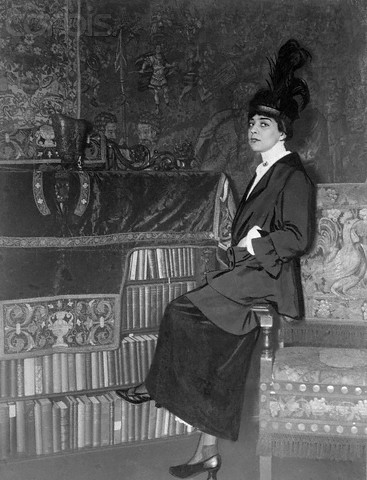
Belle Da Costa Greene (1883-1950) was a prominent art historian and the first manuscript librarian of the Pierpont Morgan collection. She was also the first known person of color and second woman to be elected a Fellow of the Medieval Academy of America (1939). According to the Morgan Library & Museum website, “Greene was barely twenty when Morgan hired her, yet her intelligence, passion, and self-confidence eclipsed her relative inexperience, [and] she managed to help build one of America’s greatest private libraries.” She was, just as importantly, a black woman who had to pass as white in order to gain entrance and acceptance into the racially fraught professional landscape of early twentieth-century New York. Her legacy highlights the professional difficulties faced by medievalists of color, the personal sacrifices they make in order to belong to the field, and their extraordinary contributions to Medieval Studies.

Once the endowment goal of $45,000 has been reached, the Belle Da Costa Greene Award of $2,000 will be granted annually to a member of the Medieval Academy of America for research and travel. This is one of several incipient actions designed to make the Medieval Academy of America a more welcoming place for all medievalists.

Click here to donate to the Belle Da Costa Greene Fund.

Posted in MAA Newsletter | Leave a comment

MAA News – Seeking Editor of Speculum

The Medieval Academy of America seeks to appoint an Editor for Speculum.  The position is configured as part-time, requiring around 25 hours per week. The Editor is appointed for an expected five-year term, subject to acceptable yearly performance reviews, with the possibility of a second five-year term by mutual agreement. The editor should be an established scholar with academic credentials in some field(s) of medieval studies, broadly defined, with good organizational and decision-making skills. Experience in journal or book editing will be helpful but not necessary. The new editor should plan on taking office in the late Spring of 2019, and at the latest by July 1, 2019. Terms and conditions are to be negotiated, as is the physical location of the Editor.

Applications should be sent to the MAA by July 30, 2018. There will be electronic interviews in Fall 2018 and interviews with finalists in early December, 2018. Cover letters may be addressed to David Wallace, Chair of the Search Committee. In addition to a curriculum vitae, the cover letter should include ideas about future directions for the journal, and discussion of how s/he envisions setting up the position, either in the MAA office, now in Cambridge, MA, or by moving the operation to a university campus. If the latter, s/he will describe possible institutional support. The search committee wants to identify the best pool of candidates, and the MAA is willing to be flexible in finding ways to accommodate the various modes of professional life encountered in the searching process. However, wherever the ultimate location of the Editor, there will need to be access to a major research library and to graduate students who can be hired for assistance. Candidates should also include the names and email addresses of three scholars who can speak to the candidate’s editorial experience and scholarship; these references will only be contacted for long-listed candidates. The MAA President would be happy to respond to immediate questions about the duties involved, but candidates should also consult the fuller description of duties posted on the Academy website. The MAA also encourages nominations for the position, and there is a place to submit these on the website as well; all nominees will be sent a letter encouraging application.

For additional information, contact:
EditorSearch@TheMedievalAcademy.org

Click here for a full job description and to apply.

Click here to submit a nomination.

Posted in MAA Newsletter | Leave a comment

MAA News – 2018 Olivia Constable Awards

The four Constable Awards, presented in memory of Olivia Remie Constable, support the research of junior, contingent, or unaffiliated scholars:

Lindsay Cook (Columbia Univ.), “The Geography, Architecture, and Visual Culture of the Trinitarian Order”

Sarah Ifft Decker (Indiana Univ.), “Jewish and Christian Women’s Economic Activities in Medieval Catalonia”

Sarah Bridget Lynch (Angelo State Univ.), “Pupils, Teachers, and Schools in Late-Medieval French Wills”

Paul Bernard Sturtevant (The Public Medievalist), “The Public Medievalist: Bringing Medieval Studies to a Broader Audience”

Posted in MAA Newsletter | Leave a comment