The Division of Preservation and Access of the National Endowment for the Humanities is accepting applications for grants in its Humanities Collections and Reference Resources (HCRR) program, with a deadline of July 19, 2018. With maximum award amounts ranging from $50,000 (planning) to $350,000 (implementation), these grants support projects to preserve and create intellectual access to collections such as books, journals, manuscript and archival materials, maps, still and moving images, sound recordings, art, and objects of material culture. Awards also support the creation of reference works, online resources, and research tools of major importance to the humanities. Eligible activities include digitizing collections; arranging, describing, or cataloging materials, performing conservation treatment, and facilitating persistent access to born-digital sources, in addition to producing databases, virtual collections, encyclopedias, linguistic works, and resources for geospatial representation of humanities data.
To encourage collaboration between smaller and larger institutions, the Partnership/Mentorship Opportunity in HCRR provides up to $60,000 for planning and pilot-level projects that could help to propel lasting collaborative relationships. These awards might be especially well suited for community-based cultural heritage initiatives, though they are not limited in geographic or topical scope.
New for 2018: In conjunction with NEH’s encouragement Protecting Our Cultural Heritage, applicants to HCRR may also request support to create, preserve, and make available oral history interviews with individuals who can provide first-hand accounts or reflections on events or experiences of cultural devastation. Informants could include survivors or other witnesses of natural disasters as well as circumstances of social unrest or armed occupation, during which cultural heritage was at extreme risk. The program continues to support a related opportunity for the creation of oral histories in conjunction with NEH’s Standing Together initiative, on the humanities and the experience of war.
Further details, including links to the application guidelines and other resources, are available online. Also, several of the most recent HCRR awards are described on NEH’s Funded Projects database. Inquiries are always welcome; contact the Division of Preservation and Access by phone at 202-606-8570 or via email at preservation@neh.gov.
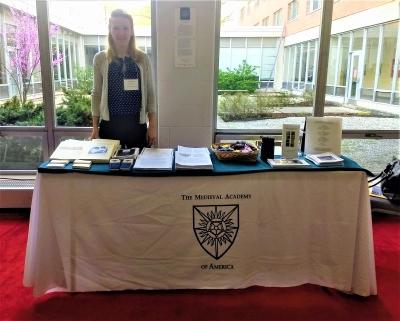 Like many of you, we’ve just returned from another splendid International Congress on Medieval Studies in Kalamazoo. Speculum Editor Sarah Spence, Associate Editor Agnieszka Rec, Assistant Editor Laura Ingallinella, and Executive Director Lisa Fagin Davis all enjoyed chatting with current and potential members at our table in the exhibit hall. We are particularly pleased to welcome the new members who benefited from our annual “Fifty Free” program, in which we give away fifty one-year introductory MAA memberships at Kalamazoo.
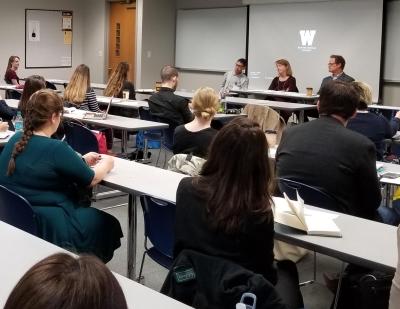 Three distinguished journal editors offered tips on publication to a room full of graduate students and advisors during a session organized and moderated by the MAA Graduate Student Committee: “Meet the Editors: Tips and Techniques on Article Submission for Graduate Students (A Roundtable).” Sarah Spence (Speculum), Michael Cornett (Journal of Medieval and Early Modern Studies), and Chris Africa (Medieval Feminist Forum) helped reframe the publication process as one of collaboration and conversation. They reminded the room that all journals have a niche, a mission, and a specific audience that graduate researchers should keep in mind when crafting manuscripts. The best way to learn about these aspects of the journal, of course, is to read recent issues! They also advised graduate students to know the current state of the field, to position their arguments within the discourse, and to have a candid conversation with their advisor about whether the piece is ready for submission. Lastly, they reaffirmed the basics: Be professional in all your communications and proofread! Thanks again to all the panelists and to those who attended for helping to facilitate conversation between graduate student writers and editors. (with thanks to GSC Chair Theodore Chelis (Pennsylvania State Univ.) for this summary)
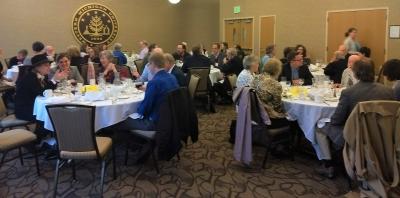 The annual CARA (Committee on Centers and Regional Associations) Luncheon enjoyed a record attendance of more than forty delegates who participated in discussions of practical topics such as budgeting, fundraising, libraries, public advocacy, and improving medieval studies in K-12 curricula. If you would like to participate in the networking and advisory opportunities afforded by CARA, please join us at the annual CARA Meeting (on the Sunday after the MAA Annual Meeting) and at the CARA luncheon at the ICMS in Kalamazoo.
 The 94th Annual Meeting of the Medieval Academy of America will take place in Philadelphia on the campus of the University of Pennsylvania, from 7-9 March 2019. The meeting is jointly hosted by the Medieval Academy of America, Bryn Mawr College, Delaware Valley Medieval Association, Haverford College, St. Joseph’s University, the University of Pennsylvania, and Villanova University.
 The Medieval Academy of America seeks to appoint an Editor for Speculum. The position is configured as part-time, requiring around 25 hours per week. The Editor is appointed for an expected five-year term, subject to acceptable yearly performance reviews, with the possibility of a second five-year term by mutual agreement. The editor should be an established scholar with academic credentials in some field(s) of medieval studies, broadly defined, with good organizational and decision-making skills. Experience in journal or book editing will be helpful but not necessary. The new editor should plan on taking office in the late Spring of 2019, and at the latest by July 1, 2019. Terms and conditions are to be negotiated, as is the physical location of the Editor.


