Call for Papers – Medieval Unfreedoms: Slavery, Servitude, and Trafficking in Humans before the Trans-Atlantic Slave Trade

Medieval Unfreedoms: Slavery, Servitude, and Trafficking in Humans before the Trans-Atlantic Slave Trade

October 19 – 20, 2018

Across the medieval world (c. 500 — c. 1500), multiple forms and degrees of unfreedom—slavery, serfdom, forced concubinage, coerced labor, captivity, and bondage—co-existed. Slaves and other unfree people made crucial, but often obscured, marks on societies that accorded them varying degrees of power even as they constrained and exploited them. Trade in humans tied together distinct cultural zones, religions, and geographic regions. Shifting definitions of freedom and unfreedom shaped evolving social systems, and helped to shape developing concepts of race, ethnicity, social status, and cultural difference and belonging from Iberia to Ethiopia and from Iceland to Persia and beyond. Scholars have long pondered the decline of an ancient Roman slave society and the legacy of both Roman and late-medieval forms of unfreedom for the emergence of the trans-Atlantic slave trade (and the concomitant transformation of slavery) and of colonial systems of race, power, and government. This interdisciplinary conference, hosted by the Center for Medieval and Renaissance Studies (CEMERS) at Binghamton University, seeks to bring together scholars whose research relates to unfreedom before the advent of the trans-Atlantic slave trade. We hope to foster conversations across traditional disciplinary boundaries about the definitions, cultural significance, and evolution of unfreedom in disparate parts of the medieval world. How does examining conceptions of freedom and unfreedom inform our understanding of medieval cultures? What is the legacy of medieval definitions of liberty and bondage? We particularly welcome comparative perspectives on unfreedom across religious and geographical frontiers.

We invite papers from a variety of disciplinary and methodological perspectives on any topic related to medieval unfreedom, including:

*      Forms of unfreedom after the end of ancient slavery and on cultural frontiers

*      Unfreedom in the Byzantine, Islamic, and Latin Christian worlds

*      Trafficking in humans across political and religious frontiers

*      Concepts of humanity, race, ethnicity, religion, and freedom

*      Gender, sexuality, and unfreedom

*      The interaction between slaving zones and centers of power

*      The unfree at royal and aristocratic courts

*      Textual and artistic unfreedoms

*      Law, rights, and unfree status

*      Manumission, social capital, and social mobility

*      Varieties of coerced and unfree labor

*      Raiding, piracy, and unfreedom

*      Resistance and rebellion against bondage

Abstracts for individual papers and for sessions are invited. Papers should be 20 minutes in length. Send abstracts to cemers@binghamton.edu. For information, contact Elizabeth Casteen (ecasteen@binghamton.edu).

Deadline: May 1, 2018

Posted in Call for Papers | Leave a comment

Rare Book School Fall and Winter Course Announcement

Rare Book School (RBS) is now accepting applications for two winter courses in New York City! RBS offers five-day, intensive courses focused on the history of manuscript, print, and digital materials taught by world-renowned scholars and professionals. RBS is also still accepting applications on a rolling basis for our fall courses in Charlottesville and New York City.

22–27 October in Charlottesville

– B-10 “Introduction to the History of Bookbinding,” taught by Jan Storm van Leeuwen

Introduction to the History of Bookbinding

– I-20 “Book Illustration Processes to 1900,” taught by Terry Belanger

Book Illustration Processes to 1900

– M-70 “The Handwriting & Culture of Early Modern English Manuscripts,” taught by Heather Wolfe

The Handwriting & Culture of Early Modern English Manuscripts

29 October–3 November at the Grolier Club

– H-40 “The Printed Book in the West since 1800,” taught by Eric Holzenberg

The Printed Book in the West since 1800

7–12 January at the Grolier Club

– C-30 “Developing Collections: Donors, Libraries & Booksellers,” taught by Tom Congalton, Johan Kugelberg & Katherine Reagan

Developing Collections: Donors, Libraries & Booksellers

– H-90 “Teaching the History of the Book,” taught by Michael F. Suarez, S.J.

http://rarebookschool.org/courses/history/h90/

To be considered in the first round of admissions decisions, course applications should be received no later than 8 September. Applications received after that date will be released for review on a rolling basis.

Visit our website at rarebookschool.org or email rbsprograms@virginia.edu for details.

We hope to see you at an RBS course soon!

Posted in Announcements | Leave a comment

Manuscript Studies

Manuscript Studies: A Journal of the Schoenberg Institute for Manuscript Studies brings together scholarship from around the world and across disciplines related to the study of pre-modern manuscript books and documents. This peer-reviewed journal is open to contributions that rely on both traditional methodologies of manuscript study and those that explore the potential of new ones. We publish articles that engage in a larger conversation on manuscript culture and its continued relevance in today’s world and highlight the value of manuscript evidence in understanding our shared cultural and intellectual heritage. Studies that incorporate digital methodologies to further understanding of the physical and conceptual structures of the manuscript book are encouraged. A separate section, entitled Annotations, features research in progress and digital project reports. For more information, go to http://mss.pennpress.org.

The editors of Manuscript Studies are pleased to make the following announcements:

  • Thanks to a generous agreement with the University of Pennsylvania Press, all issues of Manuscript Studies will be available on an open access basis after one year from the date of publication. Articles and Annotations from our inaugural issue (Spring 2017) are now available for downloading and sharing. To access the pdfs, go to: http://repository.upenn.edu/mss_sims/.
  • The Spring 2017 special issue “Collectors and Collections in the History of Thai Manuscripts,” guest-edited by Justin McDaniel, Professor of Religious Studies at the University of Pennsylvania, is now available on Project Muse through a subscription basis at https://muse.jhu.edu/issue/36157
  • We are seeking submissions for the Fall 2018 issue and beyond. For submission details and to subscribe, go to http://mss.pennpress.org.

For direct inquiries, please don’t hesitate to contact the editors at sims-mss@pobox.upenn.edu .

Posted in Announcements | Leave a comment

Conferences – Telling Tales out of School: Latin Education and European Literary Production

Telling Tales out of School: Latin Education and European Literary Production
14-16 September 2017
Ghent University

Organised by RELICS (Research of European Literary Identity, Cosmopolitanism and the Schools) in cooperation with the Research Foundation – Flanders (FWO), the Ghent Institute for Classical Studies (GICS), the Henri Pirenne Institute for Medieval Studies, and the Group for Early Modern Studies (GEMS).

Keynote Speakers are Anders Cullhed (Stockholm University), Erik Gunderson (University of Toronto) and Rita Copeland (University of Pennsylvania). Papers will range from the first to the twentieth century, all focusing on the dynamics between the system of Latin education and the writing of literature.

Information and registration on our website: http://www.tellingtalesoutofschool.ugent.be/

Posted in Conferences | Leave a comment

2017-2018 Franklin Research Grant program

Franklin Research Grants

Scope

This program of small grants to scholars is intended to support the cost of research leading to publication in all areas of knowledge. The Franklin program is particularly designed to help meet the cost of travel to libraries and archives for research purposes; the purchase of microfilm, photocopies or equivalent research materials; the costs associated with fieldwork; or laboratory research expenses.

Eligibility

Applicants are expected to have a doctorate or to have published work of doctoral character and quality. Ph.D. candidates are not eligible to apply, but the Society is especially interested in supporting the work of young scholars who have recently received the doctorate.

Award

From $1,000 to $6,000.

Deadlines

October 2, December 1; notification in January and March.

Full Information and Online Application Access

www.amphilsoc.org/grants/franklin. Please direct all questions to Linda Musumeci, Director of Grants and Fellowships, atLMusumeci@amphilsoc.org or 215-440-3429.

Posted in Grants | Leave a comment

Call for Sessions: Mary Jaharis Center Sponsored Panel at Leeds 2018

The Mary Jaharis Center for Byzantine Art and Culture seeks proposals for a Mary Jaharis Center sponsored session at the 25th International Medieval Congress, University of Leeds, July 2–5, 2018. We invite session proposals on any topic relevant to Byzantine studies.

The thematic strand for the 2018 IMC is “Memory.” See the IMC Call for Papers (https://www.leeds.ac.uk/ims/imc/imc2018_call.html) for additional information about the theme and suggested areas of discussion.

Session proposals should be submitted through the Mary Jaharis Center website (https://maryjahariscenter.org/sponsored-sessions/25th-imc). The deadline for submission is September 1, 2017. Proposals should include:

**Title

**100-word session abstract

**Session moderator and academic affiliation

**Information about the three papers to be presented in the session. For each paper: name of presenter and academic affiliation, proposed paper title, and 100-word abstract

**CV

Successful applicants will be notified by mid-September if their proposal has been selected for submission to the International Medieval Congress. The Mary Jaharis Center will submit the session proposal to the International Medieval Congress and will keep the potential organizer informed about the status of the proposal.

If the proposed session is approved, the Mary Jaharis Center will reimburse session participants (presenters and moderator) up to $600 maximum for European residents and up to $1200 maximum for those coming from outside Europe. Funding is through reimbursement only; advance funding cannot be provided. Eligible expenses include conference registration, transportation, and food and lodging. Receipts are required for reimbursement.

The session organizer may act as the moderator or present a paper. Participants may only present papers in one session.

Please contact Brandie Ratliff (mjcbac@hchc.edu), Director, Mary Jaharis Center for Byzantine Art and Culture with any questions.

Posted in Call for Papers | Leave a comment

Call for Papers – Architectural Representation in the European Middle Ages

CFP FOR AN EDITED COLLECTION:
Architectural Representation in the European Middle Ages
Edited by Hannah Bailey, Karl Kinsella, and Daniel Thomas

The architectural remnants of the Middle Ages—from castles and cathedrals to village churches—provide many people’s first point of contact with the medieval period and its culture. Such concrete survivals provide a direct link to the material experience of medieval people. At the same time, exploring the ways in which architecture was conceptualized and depicted can contribute to our understanding of the ideological and imaginative worldview of the period.

This volume seeks to investigate all aspects of architectural representation in the medieval period, encompassing actual, symbolic, or imaginary architectural features, whether still standing today, observable in the archaeological record, or surviving only through depiction in literature or art. Topics of interest might include (but are not limited to) the social and symbolic value of architecture, architectural metaphor or imagery, architecture in visual representations, architecture in the depiction of other spaces, memory and architecture, and architectural style.

The volume is interdisciplinary in outlook and we welcome contributions from across the spectrum of academic disciplines, including literature, history, art, theology, and archaeology.

Please send abstracts of no more than 250 words, with a brief biographical blurb, to the editors at: architecturalrepresentations@gmail.com by 1st November, 2017.

Posted in Call for Papers | Leave a comment

MAA News – From the President

The following stories are all true. I am used to such claims, as my focus is on the study of saints, their lives, their liturgical veneration, and the purposes underlying their contents, be they textual, musical, iconographical, gendered or political. So then, onto the narratives, which are about our institution – that is the scholarly discipline of Medieval Studies – and inscribed to offer encouragement as well as warning. I myself have seen and heard these things.

A junior medievalist and I sat over dinner. After discussing forays into the wondrous world of medieval liturgiology, I asked, “So why aren’t you more involved with the Medieval Academy?” Reasons came as swift as swords: 1) the three-year rule, and you got rid of that; it was keeping lots of people away from the Annual Meeting; 2) it seems the professional meetings of my discipline are mandatory, and I don’t have time and money for the MAA too; 3) there is no opportunity to participate in governance as you have to be a Fellow to run things or serve on committees; 4) and lastly, then, the MAA is elitist and stodgy.

Exegesis: Yes, there is no longer a wait before a scholar can speak or participate in the Annual Meeting: gone, done. Yes, the professional meetings of the disciplines in these hard financial times are upstaging the MAA, hurting membership and attendance at our annual meeting. We are tackling this problem now, and ideas are welcome. But as to 3 and 4, no and no. Election to fellowship in the MAA is honorary, and Fellows have no direct responsibilities for governance of the MAA. Fellows pay for their own ways to the meeting, for their housing, and pay for their own dinner. Your dues do not subsidize them. They are senior scholars who want to help the field they have spent their lives serving. As to no. 4, the MAA works tirelessly to engage all those who study the Middle Ages: seniors; juniors; independent scholars; unaffiliated scholars; students; Europeanists; global medievalists. We give out $100,000 in scholarships and awards every year. We are passionate about post-docs, having recently funded a new one. So run for something! Ask to be on a committee! We solicit volunteers by interests from the members every year. But do keep up your membership, for when we try to tap you, if your name isn’t there, we can’t. So I asked my friend, “Do you keep up your membership?” “Yes.” “Then go for it. It’s a great way to build the field, and your CV!”

Two other tales. At another dinner last week, this with a visiting PhD student to discuss the upcoming dissertation research, questions were asked of me and a colleague. Answers were given of the kind that save time and energy for someone starting out. All were involved in the sheer delight of sharing information, discussing the best ways to find things out: “who is out there writing about these topics now, and where are the best writings, editions?” “Oh, I know that person, and that one, and that one too. Would you like an email-introduction?” Another meeting with an undergrad from a nearby college concerning research on a saint’s office, working with a wonderful MS, and he been studying for a year (now we’re talking!). “Have you seen these tools, these, these?” “What should I do now?, he asked.” “Here’s a possible plan for you, one that might work and not overwhelm you, and lead to something concrete. Here’s where you could publish this eventually. I know the editor, would you like an introduction? Come by the conference in September and we’ll have coffee. Email me, let me know how it’s going.”

Exegesis: There is nothing like a fruitful exchange between an undergrad or grad student and a senior scholar with no skin the game (not an advisor or a professor in the school or university; neither a grade giver or ref writer). Say anything you want; ask any question, especially the one that is really bugging you and that you didn’t dare raise in class. “How do you figure out X, I mean how can you?” And the answers are there, just as they would be if you wanted to build a dinghy and have it cross the lake, without taking on any water; and then, later, a ship to sail the seas. Senior medievalists are craftspeople of thought; we know how to build in our field; our ships sail. What do we seniors get out of such exchanges: EVERYTHING. We are the lucky ones, actually, to meet young people starting out who can use the craftsmanship that we have spent our lives refining. And we are learning too, for the fresh and new questions make us think in ways we hadn’t before. New innovations! How can we build these exchanges in to the MAA, for the MAA can do this most successfully. The Zoo is wonderful, swirling, whirling, but just too big for this kind of deliberate intimate exchange. We are going to try something, this year even, continuing to build on mentorship ideas from the past. Anyone want to help? Email me!

The third set of tales, these very personal. The first I put in my textbook Music in the Medieval World because it was so astounding, and, in my mead hall, it will always be front and center. I was on a plane coming back from the MAA, and I happened to sit with a historian who was coming from his professional meeting, too. “So what do you work on?: he asked. “Oh, I start in the 400’s, with a long-time interest in Augustine, and a lot in-between, and I stop in the late Middle Ages, around 1400.” “Wow, so narrow!” “So how about you? What do you work on?” “1945.” (Stunned silence before I spoke.) “Well, it was a good year.” Another short narrative: I was at a wedding reception, and met a grad student in the field of musicology, and I knew she was working in the twentieth century. So I told her about a job I had just read about and she: “no, that’s for someone who works in the early twentieth century, and I work in the middle twentieth century. You need three, one for each part of the century.” And not unrelated: “Mom, you know all the stuff you and Dad know (my husband is a medievalist).” “Yes.” “Well, you have to teach it to our generation, because we don’t know anything.” I laughed uproariously. “Mom, it’s not funny.” This is a young man who loved The Hobbit and The Lord of the Rings; his juniors in high school now are hooked on the “Game of Thrones” and Rowling. They love the Middle Ages, but they don’t know it. And all this in a time when our field is hemorrhaging positions, supposedly, it’s said, because students just aren’t interested.

Exegesis: We live in a presentist world, the quick buzz, and the decade seems too long a unit of time. People say, “you can’t study ‘the nineties,’ gotta be ‘the early nineties.'” Time gets shorter and shorter spiraling inward, until we are only looking at ourselves, blogging the moment without past or future. Augustine’s view of memory has imploded, and we have uncovered an eternal present, but one that does not move because it has no future and no past. It is indeed hard to know anything, to acquire wisdom in the short time frames now imposed on education, and complexity has been lost, or at least minimized.

It used to be that scholars were accused of knowing more and more about less and less. But now, there is so much information in every field, that we seemingly know less and less about more and more. I was recently wondering again about all the handbooks that Brill, Brepols, Oxford, and Cambridge are publishing. I’ve been asked to write for at least 20 and said yes to 6 or 7. Why? It is because there is so much misinformation out there, especially on the Internet, that you need to find responsible scholars to offer guides. It is time for medievalists, alone or in groups, to reach out with their knowledge and their materials to the young people in our communities. Two things are most heartening to me: our new standing committee on the digital humanities and multimedia studies; and our new standing committee on K-12 education. The sessions and the plenary we had in Toronto on these subjects were enlightening, as was the CARA meeting. There is so much joy, so much hope! But if we don’t do the hard work of organizing and of reaching out, it won’t happen, and the MAA is here to facilitate just that. We need small grants for innovative medievalists, especially for lone medievalists, showing eager young eyes a manuscript facsimile; putting on a play; singing a troubadour tale. Now it’s time for something completely different, and something different could change a life by inspiring the new ways of thinking so needed in today’s world.

Margot E. Fassler, University of Notre Dame
President, Medieval Academy of America
margot.fassler@nd.edu

Posted in MAA Newsletter | Leave a comment

MAA News – MAA@Leeds

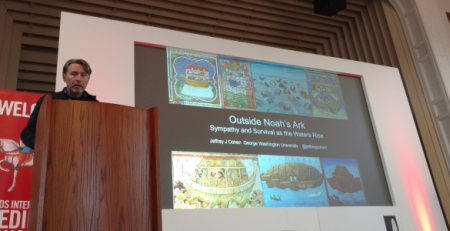
Jeffrey J. Cohen (George Washington Univ.) presented the Medieval Academy Annual Lecture at the Leeds International Medieval Congress on 4 July. His paper, titled “Outside Noah’s Ark: Sympathy and Survival as the Waters Rise,” explored medieval ideas about those left behind by the Great Flood and considered how Noah and his family were thought to have responded to the dead and dying. The Medieval Academy reception afterwards was well-attended and gave our European colleagues an opportunity to meet members of the Academy staff and governance and to learn more about who we are and what we do. The Graduate Student Committee hosted a successful reception on Monday evening.

Posted in MAA Newsletter | Leave a comment

MAA News – Upcoming Grant Deadlines

The Medieval Academy of America invites applications for the following grants. Please note that applicants must be members in good standing as of September 15 in order to be eligible for Medieval Academy awards.

Birgit Baldwin Fellowship
The Birgit Baldwin Fellowship provides a grant of $20,000 to support a graduate student in a North American university who is researching and writing a dissertation for the Ph.D. on any subject in French medieval history that can be realized only by sustained research in the archives and libraries of France. It may be renewed for a second year upon demonstration of satisfactory progress. (Deadline 15 November 2017)

Schallek Fellowship
The Schallek Fellowship provides a one-year grant of $30,000 to support Ph.D. dissertation research in any relevant discipline dealing with late-medieval Britain (ca. 1350-1500). (Deadline 15 October 2017)

Travel Grants
The Medieval Academy provides a limited number of travel grants to help Academy members who hold doctorates but are not in full-time faculty positions, or are contingent faculty without access to institutional funding, attend conferences to present their work. (Deadline 1 November 2017 for meetings to be held between 16 February and 31 August 2018)

Please feel free to print and post this announcement.

Posted in MAA Newsletter | Leave a comment