
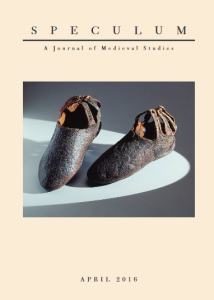
MAA News – Speculum (April 2016) is Available Online

speculumapril16The latest issue of Speculum is now available on the new University of Chicago Press Journals website.

To access your members-only journal subscription, log in to the MAA website using your username and password associated with your membership (contact us at info@themedievalacademy.org if you have forgotten either), and choose “Speculum Online” from the “Speculum” menu. As a reminder, your MAA membership provides exclusive online access to the full run of Speculum in full text, PDF, and e-Book editions – at no additional charge.

Speculum, Volume 91, Issue 2 (April 2016)

Articles

Torture and Confession in the Templar Interrogations at Caen, 28-29 October 1307
Sean L. Field

The Earls of Leicester, Sygerius Lucanus, and the Death of Seneca: Some Neglected Evidence for the Cultural Agency of the Norman Aristocracy
Paul Antony Hayward

The Sabatati: The Significance of Early Waldensian Shoes, c. 1184 -c. 1300
Adam L. Hoose

Reflecting (on) the Other: Jewish-Christian Relations in Cligès and MS Michael 569(*)
Naomi Howell

The Politics of Grief in the Outbreak of Civil War in France, 1407-1413
Emily J. Hutchison 

Book Reviews
This issue of Speculum features more than 70 book reviews, including:

Anthony Kaldellis, The Byzantine Republic
Reviewed by Leonora Neville

Erik Kwakkel, ed., Manuscripts of the Latin Classics
Reviewed by Erika Kihlman

Alastair Minnis, The Cambridge Introduction to Chaucer
Reviewed by Peter Brown

Christian Raffensperger, Reimagining Europe: Kievan Rus’ in the Medieval World
Reviewed by David Goldfrank

Claire Sponsler, The Queen’s Dumbshows
Reviewed by Anthony Bale

Chris Wickham, Medieval Rome: Stability and Crisis of a City
Reviewed by Thomas F. X. Noble

 MAA members also receive a 30% discount on all books and e-Books published by the University of Chicago Press, and a 20% discount on individual Chicago Manual of Style Online subscriptions. To access your discount code, log in to your MAA account, and click here.  Please include this code while checking out from the University of Chicago Press website.

Posted in MAA Newsletter | Leave a comment

Jobs for Medievalists

Lecturer in Medieval Latin

School of History, Classics & Archaeology
The University of Edinburgh

Applications are invited from scholars of the highest calibre with research interests and teaching experience in Medieval Latin (ca. AD 500–1500). The successful candidate is expected to contribute to teaching and supervision at undergraduate and postgraduate levels, including potentially the MSc programmes in Classics, Medieval History, and Late Antique, Islamic and Byzantine Studies, and to take a lead in the teaching of Medieval Latin to postgraduates in various fields across the University of Edinburgh’s College of Humanities and Social Science.  The ability to teach Latin Palaeography will be advantageous. The post-holder will actively engage in research of high quality that will make a substantive contribution to the School’s profile, and will be open to interdisciplinary collaboration.

This is a full-time, open-ended, post with a salary of £38,896 – £46,414

Closing date: 5pm (GMT) on Friday 6th May 2016

https://www.vacancies.ed.ac.uk/pls/corehrrecruit/erq_jobspec_version_4.jobspec?p_id=035966

Posted in Jobs for Medievalists | Leave a comment

IAS Opportunitites for Scholars for the Academic Year 2017-2018

INSTITUTE FOR ADVANCED STUDY, School of Historical Studies, Opportunities for Scholars 2017-2018.  The Institute is an independent private institution founded in 1930 to create a community of scholars focused on intellectual inquiry, free from teaching and other university obligations.  Scholars from around the world come to the Institute to pursue their own research.  Candidates of any nationality may apply for a single term or a full academic year.  Scholars may apply for a stipend, but those with sabbatical funding, other grants, retirement funding or other means are also invited to apply for a non-stipendiary membership.  Some short-term visitorships (for less than a full term, and without stipend) are also available on an ad-hoc basis.  Open to all fields of historical research, the School of Historical Studies’ principal interests are the history of western, near eastern and Asian civilizations, with particular emphasis upon Greek and Roman civilization, the history of Europe (medieval, early modern, and modern), the Islamic world, East Asian studies, art history, the history of science and philosophy, modern international relations, and music studies.   Residence in Princeton during term time is required.  The only other obligation of Members is to pursue their own research.  The Ph.D. (or equivalent) and substantial publications are required.  Further information can be found in the announcement on the web at http://www.hs.ias.edu/mem_announcement, or on the School’s web site, www.hs.ias.edu.  Inquiries sent by post should be addressed to the School of Historical Studies, Institute for Advanced Study, Einstein Dr., Princeton, N.J. 08540 (E-mail address: mzelazny@ias.edu).  Deadline: November 1 2016.

Click here for more information.

Posted in Uncategorized | Leave a comment

Jobs for Medievalists

Applications are now being accepted for a one year postdoctoral fellow to serve as editorial assistant at Speculum from July 1, 2016 – July 31, 2017. This position offers qualified individuals an opportunity to develop as scholars and editors. The postdoc will receive a $43,000 stipend, health benefits, and limited research and travel funds and will be expected to assume  responsibilities for certain editorial tasks at Speculum 35 hours/week, including, but not limited to: coordinating reviews with book review editors; contacting reviewers; checking citations for accepted articles; proofreading reviews, Brief Notices, Books Received, and Tables of Contents; and proofing full issues of Speculum. In addition, the assistant will be encouraged to continue to develop a research program and participate in the cultural life of medieval studies in the Boston area. The term is subject to the postdoc’s continuing, acceptable performance of the duties required, as determined by the Editor of Speculum.

Eligible candidates must meet the following requirements and demonstrate the following qualifications:

* PhD in some field of medieval studies before July 1, 2016 but no earlier than January 1, 2011;
* Attention to detail and evidence of a high level of scholarly precision, particularly with regards to proofreading and bibliographic detail;
* Strong work ethic.

All interested candidates should write to Sarah Spence, Editor of Speculum (sspence@themedievalacademy.org), and should include the following:

* One-page cover letter;
* Curriculum vitae;
* Unofficial transcript;
* Two letters of recommendation, one of which should directly address the applicant’s editing ability.

The deadline for applications is May 1, 2016. Assistants must be resident in Cambridge, MA during the year.

Posted in Jobs for Medievalists, Speculum | Leave a comment

Author’s Response to Speculum Review

A response to: Robert, Aurélien. Review of Richard de Mediavilla, Questions disputées, tome VI, Questions 38–45, ed. and trans. Alain Boureau.

Speculum 91/1 [2016]:248–50; doi:10.1086/684468.

Author’s Response (Alain Boureau, École des hautes études en sciences sociales)

  • En premier lieu, le compte-rendu n’expose pas l’entreprise: six volumes formant 2539 pages pour un texte inédit et important.
  • En deuxième lieu: le 9 mai 2013, j‘avais expédié à l’auteur par mail la totalité du texte de ce tome VI en lui signalant que le texte, qui a paru un an plus tard, n’avait pas été revu dans le détail, ce qui impliquait une possibilité de discussion. Ce discussion a deroulé à l’occasion d’une journée de débats sur Richard de Mediavilla et Dietrich de Freiberg le 8 juin 2013. L’auteur y a parlé, en présentant précisément le tome VI de Mediavilla.
  • En troisième lieu, le désaccord porte sur la notion de L’auteur a qualifié ma position de “terrible misunderstanding” [p. 249 of the review]. Or, cette position, je l’ai exprimée clairement et longuement dans un article des Archives d’Histoire Doctrinale et Littéraire du Moyen Âge, tome 77, 2010, p. 157-191, “Un débat sur l’inné et l’acquis dans l’intellect des anges: La question disputée 12 de Richard de Mediavilla.” Cette position, réitérée dans l’introduction du tome VI, est présentée au lecteur de la recension comme une faute de traduction. Il en va de même pour les mots virtus, spiritus, et subiectum, tous glosés et analysés. Je l’ai toujours dit: l’avantage d’une édition bilingue est de permettre des traductions qui osent des choix, par ailleurs expliqués, qui sont interdits aux traductions qui ne proposent pas le texte en regard.
  • En quatrième lieu, l’auteur a prétendu que mes principes d’édition “are not clearly expressed: the choice of the manuscripts and their respective values are not explained with a stemma codicum” [p. 248]. Cela a été fait au tome I en sept pages de l’introduction (p. XXIV-XXXI): j’y indiquais l’utilisation de 16 manuscrits. J’ai raffiné cette comparaison et ce stemma des manuscrits au tome III (p. X-XIII) et au tome V (p. XII-XIII). Il est vrai que je suis prudent sur la notion, par ailleurs contestable de stemma, en raison du système franciscain de reproduction des manuscrits par ce que j’appelle la pecia gratuite des franciscains (voir mon article “Un scribe philologue: La détection erronée de fautes par homéotéleutes dans le Ms. 82 d’Assise,” Scriptorium 65, 2011, p. 348-351). De même sont mentionnées, dans les 568 pages du volume, une faute graphique (le æ classique pour le e médiéval) et une absence de référence en note, présentées comme de simples exemples d’un problème generalisé. La rectification en note d’une référence erronée de Mediavilla est donnée comme une substitution [p. 248].

Reviewer’s Response: It is Speculum’s policy to print letters from authors of reviewed books together with a response from the reviewer. In this case, the reviewer (Aurélien Robert, Centre d’Études Supérieures de la Renaissance-CNRS) chose not to respond.

Posted in Letters to the Editor | Leave a comment

Call for Papers – 2016 New England Medieval Conference

The organizers of the annual New England Medieval Conference, to be hosted by Dartmouth College on Saturday 19 November 2016, invite papers that address the 2016 theme “Lives and Afterlives in the Middle Ages.” Whether one studies historical figures, relics, art, literature, theology, music or myriad other topics, the notion of “life and afterlife” serves as an almost universal conceit through which to interpret the Middle Ages. Some of the questions that might be addressed by speakers at the conference include: how did the awareness of mortality condition medieval beings? How did time change the appearance, reception and meaning of events or artifacts?  Why and how did medieval works endure and remain relevant in cultural contexts far removed from that in which they first existed? The advantages to framing the Middle Ages in this fashion include the ability to ponder biography and hagiography; the value of life and the matter of death; the promise of paradise and the specter of damnation. Likewise, from the perspective of a cultural historian, this year’s theme encourages synchronic and diachronic approaches that might address the making and reception of cultural artifacts or other key moments in an artifact’s life-history. Paper proposals of c. 400 words should be sent by June 15th to NEMC.2016@dartmouth.edu.

Posted in Call for Papers | Leave a comment

Call for Sessions: Mary Jaharis Center Sponsored Panel, 52nd International Congress on Medieval Studies

As part of its ongoing commitment to Byzantine studies, the Mary Jaharis Center for Byzantine Art and Culture seeks proposals for a Mary Jaharis Center sponsored session at the 52nd International Congress on Medieval Studies, Western Michigan University, Kalamazoo, May 11–14, 2017. We invite session proposals on any topic relevant to Byzantine studies.

Session proposals must be submitted through the Mary Jaharis Center website (http://www.maryjahariscenter.org/sponsored-sessions/52nd-international-congress-on-medieval-studies). The deadline for submission is April 25, 2016. Proposals should include:

*Title
*Session abstract (300 words)
*Intellectual justification for the proposed session (300 words)
*Proposed list of session participants (presenters and session presider)
*CV

The session organizer may act as the presider or present a paper.

Successful applicants will be notified by May 6, 2016, if their proposal has been selected for submission to the International Medieval Congress.

If the proposed session is approved, the Mary Jaharis Center will reimburse session participants (presenters and presider) up to $600 maximum for North American residents and up to $1200 maximum for those coming abroad. Funding is through reimbursement only; advance funding cannot be provided. Eligible expenses include conference registration, transportation, and food and lodging. Receipts are required for reimbursement.

Please contact Brandie Ratliff (mjcbac@hchc.edu), Director, Mary Jaharis Center for Byzantine Art and Culture with any questions.

Posted in Call for Papers | Leave a comment

Lecture: “Medieval Manuscripts in the Library of Congress”

“Medieval Manuscripts in the Library of Congress”

 with Kluge Fellow Ilya Dines

Thursday, March 31, 2016, 4:00 p.m.
Room LJ-119, First floor, Thomas Jefferson Building

Kluge Fellow Ilya Dines discusses his current project to catalogue 150 medieval manuscripts and fragments held by the Library of Congress. In his presentation, Dines will analyze in detail the importance of the Library’s medieval manuscript collection and outline the role it could play in expanding and deepening understandings of the medieval era.

For more information: http://www.loc.gov/loc/kluge/news/index.html#Mar-31  

Posted in Lectures | Leave a comment

Save the date: “What Is Islam?” symposium, 29 April

Dear colleagues,

You are invited to join us on the afternoon of Friday, 29 April for “What is Islam? A Symposium in Memory of Shahab Ahmed.” This symposium, which will begin with lunch from noon to 1 pm and continue with presentations until 6 pm or so, honors the memory of our friend, colleague, and teacher Shahab Ahmed. While Shahab’s too-early death robbed all of us of a brilliant scholar, the publication of his groundbreaking and challenging book What Is Islam? The Importance of Being Islamic (Princeton University Press) offers a wonderful opportunity to consider his intellectual legacy from a variety of disciplinary perspectives. Those who will reflect on Shahab’s book and its impact include Michael Cook, Noah Feldman, Cemal Kafadar, Gülru Necipoğlu, Parimal Patil, and Nicholas Watson. We are waiting for final confirmation of the symposium’s location on the Harvard campus, and will send out this information under separate cover in the next week or so. In the meantime, please mark your calendars for this important event, which is sponsored by the Standing Committee on Medieval Studies, the Mahindra Humanities Center, the Center for Middle Eastern Studies, the Aga Khan Program for Islamic Architecture, the Committee on the Study of Religion, with support of the Rabbi Joseph S. Shubow Memorial Fund, the South Asia Initiative, the Department of Near Eastern Languages and Civilizations, the Prince Alwaleed bin Talal Islamic Studies Program, and the Islamic Legal Studies Program. Questions? Please contact Nora Lessersohn (noralessersohn@g.harvard.edu)

Yours,
Nicholas Watson, Nora Lessersohn, and Sean Gilsdorf, symposium co-organizers

Posted in Symposiums | Leave a comment

Harlaxton Medieval Symposium 2016: The Great Household, 1000-1500

Harlaxton Manor, Grantham, Lincolnshire. The theme of the 2016 Symposium is the medieval great household, from the eleventh to the early sixteenth century, with a focus on elite contexts in the British Isles. Papers will look at changing structures within the household; household membership, lords and their servants; domestic material culture; literature, music and entertainment in the household; the role of the household chapel; sensory environments, consumption and the routines of the household. Delegates will be given a guided tour of Harlaxton Manor (our own ‘Great Household’) and our afternoon outing will be to Gainsborough Old Hall, one of the finest and best-preserved fifteenth-century manor houses in England. Our conference banquet will feature food inspired by authentic medieval cuisine. Our keynote will be delivered by Chris Dyer (University of Leicester). Booking information can be found on our website (harlaxton.org)

We are pleased to offer two postgraduate scholarships in remembrance of our founder, Barrie Dobson. Further details can be found on our website (http://harlaxton.org.uk/the-barrie-dobson-scholarships)

Email: harlaxtonsymposium@gmail.com

Posted in Symposiums | Leave a comment