Call for Papers – ‘All the World’s a Stage’: Performing Identity in Everyday Life, one-day inter-disciplinary conference

 ‘All the World’s a Stage’: Performing Identity in Everyday Life, one-day inter-disciplinary conference, University of Bristol, 1st July 2016.

Keynote Speakers: Dr Angela McShane, Royal College of Art/ V&A
Dr Eleanor Standley, University of Oxford/ Ashmolean Museum

This conference will explore the concept of performance and its role in the construction of individual and communal identities. From a person’s choice of dress in the morning to what they eat at night: When and how should we conceive of such everyday actions as having a role in the performance and construction of identities? How have public acts and rituals been used to construct and contest group identities? And how have the meanings of these performative acts endured or changed over time?

This conference seeks to interrogate the diverse ways in which performance theory can enhance our understanding of the construction of identities. It aims to draw together researchers from a broad range of disciplines, including: History, Art History, History of Design and Material Culture, Anthropology and Archaeology, Theatre, English, Classics and Film Studies.

Possible themes for 20 minute papers include (but are not limited to):

  • Materiality, objects and works of art as Performance
  • Performative violence
  • Ritual, ceremony and festivity
  • Sports and Recreation
  • Space and place
  • Performing gender
  • Food and drink
  • Memory

Speakers are invited to submit abstracts of 200 words in English, along with a short biography (approx. 100 words) to performingidentity2016@gmail.com by 31st March 2016.

For further information, please visit our website at: www.bristol.ac.uk/history/events/conferences/all-the-world-is-a-stage/

Posted in Call for Papers | Leave a comment

Schoenberg Institute for Manuscript Studies Visiting Research Fellowships-Call for applications

The Schoenberg Institute for Manuscript Studies (SIMS) Visiting Research Fellowship program seeks applications for the 2016-2017 academic year. Guided by the vision of its founders, Lawrence J. Schoenberg and Barbara Brizdle Schoenberg, SIMS aims to bring manuscript culture, modern technology, and people together to provide access to and understanding of our shared intellectual heritage. Part of the Penn Libraries, SIMS oversees an extensive collection of pre-modern manuscripts from around the world, with a special focus on the history of philosophy and science, and creates open-access digital content to support the study of its collections.  SIMS also hosts the Schoenberg Database of Manuscripts and the annual Schoenberg Symposium on Manuscript Studies in the Digital Age.

The SIMS Visiting Research Fellowships have been established to encourage research relating to the pre-modern manuscript collections at the University of Pennsylvania Libraries, including the Schoenberg Collection.  Affiliated with the University of Pennsylvania, located near other manuscript-rich research collections (the University of Pennsylvania Museum of Archaeology and Anthropology, the Free Library of Philadelphia, the Chemical Heritage Foundation, and the Rosenbach Museum and Library, among many others), and linked to the local and international scholarly communities, SIMS offers fellows a network of resources and opportunities for collaboration. Fellows will be encouraged to interact with SIMS staff, Penn faculty, and other medieval and early modern scholars in the Philadelphia area. Fellows will also be expected to present their research at Penn Libraries either during the term of the fellowship or on a selected date following the completion of the term.

Applicants can apply to spend 1, 2, or 3 months at SIMS. Project proposals should demonstrate that the Libraries’ pre-modern manuscript resources are integral to proposed research topics. Recipients will be expected to work on-site at Penn Libraries for the duration of their fellowship, excluding possible short research trips in support of the proposed project to nearby institutions. Proposals with a digital component are encouraged though not required. A total of $15,000 per year will be divided among up to 3 fellows in increments of $5,000 per month. Awards must be used between July 1, 2016, and June 30, 2017.

Applications are due May 15, 2016. For more information on eligibility and the application process, go to: http://schoenberginstitute.org/visiting-research-fellowships.

For more information on SIMS, go to http://schoenberginstitute.org/. For more information on the Schoenberg Collection of Manuscripts, go to http://sceti.library.upenn.edu/schoenberg. On Penn’s pre-modern manuscript holdings in general, go to: http://dla.library.upenn.edu/dla/medren.

Posted in Fellowships | Leave a comment

International Opportunity for Medieval Studies Students

CARMEN Annual Meeting in Essen, 9-11 September 2016:
Notice for Students

As you prepare for what we hope are productive and happy careers in medieval studies, we’d like to invite you to participate in an international organization for the promotion of our discipline. CARMEN, as stated on its website, is a worldwide network of medievalists, its name being an acronym for the ‘Co-operative for the Advancement of Research through a Medieval European Network.’  It links a number of research institutions, universities, interest groups, and individuals with common scholarly interest in the study of the Middle Ages, including the Medieval Academy of America. While based in Europe, it reaches out to all continents to create an open and truly international platform of co-operation in the field of medieval research and teaching.  CARMEN has an annual meeting in the fall, the next one being in Essen, Germany, 9-11 September 2016, and scholars and administrators from all over the world will meet to exchange ideas and develop projects in medieval studies. If you’re interested in attending the meeting or learning more about CARMEN, please get in touch with CARMEN’s Early Career liaison,  Robert Bjork.

Posted in Announcements | Leave a comment

Medieval Academy/CARA Summer Scholarships

Medieval Academy/CARA Summer Scholarships

A limited number of stipends are available for graduate students and particularly promising undergraduate students who plan to participate in summer courses in medieval languages or manuscript studies. The stipend will be paid directly to the program to offset a portion of the tuition cost and is contingent on acceptance into the program. Applicants must be members of the Medieval Academy in good standing with at least one year of graduate school remaining and must demonstrate both the importance of the summer course to their program of study and their home institution’s inability to offer analogous coursework.

Applications must be received by 15 April 2016 and will be judged by the Committee for Professional Development and the Chair of the CARA Committee. There will be between four and eight awards yearly, depending upon the number of worthy applicants and the cost of the summer programs.

Visit our website for further information and to apply: https://medievalacademy.site-ym.com/page/CARA_Scholarships

Please contact the Medieval Academy at info@themedievalacademy.org with any questions about this program.

Posted in Announcements | Leave a comment

Conferences – Philippe de Mézières and the Concept of Europe in the Middle Age

Philippe de Mézières and the Concept of Europe in the Middle Ages
Where: Université du Maine, Le Mans, France
When: May 26-27, 2016

Description:
Loosely centered on the great writer and political thinker Philippe de Mézières (1327-1405), this international colloquium explores the concept of Europe in the later Middle Ages from a variety of angles: political, ideological, linguistic, spiritual, and geographic. Experts from different countries and disciplines interrogate the notion of “Europe” in relation to such topics as external and internal threats; the crusades; the Church Councils; travel literature, explorations, and maps; varieties of European languages and cultural spaces. We will also offer an update on new editorial projects of the works of Philippe de Mézières.

For more information please contact Joël Blanchard (jblanchard3@wanadoo.fr) or Renate Blumenfeld-Kosinski (renate@pitt.edu).

Posted in Conferences | Leave a comment

MAA News – The Medieval Academy Annual Meeting

gardnerWe asked Speculum editorial staff Erin Pomeroy and Melissa Reynolds for their impressions of last week’s Annual Meeting. Here’s what they had to say:

*****

As assistant editor of Speculum and first time attendee of the annual meeting of the Medieval Academy of America, it was incredible to see everything come together for this extremely successful meeting. There were 526 total registrants at the meeting–much higher than we had anticipated given the shell shock left over from last year’s almost snowpocalyptic February. This is a testament to the strong and committed membership base that we have at the Academy and the wonderful people behind the scenes who worked tirelessly to organize and run the meeting.

I spent most of my weekend working at the registration desk with our graduate student volunteers and running around to make sure things were progressing smoothly. Our corps of volunteers was spectacular and many went above and beyond by showing up for extra shifts because they wanted to help. Not only was their assistance greatly appreciated, but I also thoroughly enjoyed getting to spend some time with my peers discussing what everyone was studying and what projects they are working on. At the registration desk and at the banquet on Friday evening, I also had the opportunity to meet many people whose names I have only seen on book covers or whom I have emailed with in regards to book reviews for Speculum. It was wonderful to be able to finally put faces to the many names of scholars whom I had corresponded with previously through Speculum but had not yet had the chance to meet in person.

The closing reception at the Isabella Stewart Gardner museum was the perfect end to a wonderful weekend. It was breathtaking to see the museum illuminated at night for our enjoyment. I was thoroughly impressed with my first experience at the annual meeting of the Medieval Academy of America and it will not soon be forgotten.

– Erin Pomeroy, Assistant Editor, Speculum

*******

Those who remember last year’s Boston winter were likely nervous when they received their invitation to attend the 91st Annual Meeting of the Medieval Academy of America at the Hyatt Regency in downtown Boston from February 25-27, but thankfully this year’s weather cooperated and Boston, with its numerous top-tier medieval studies institutions, proved to be the perfect setting for this year’s conference. This was my first year to attend the annual meeting, and as the current Editorial Assistant at Speculum and a doctoral candidate in History at Rutgers University, the conference gave me the chance to put faces to the names of senior scholars whose work has informed my own research, as well as to connect with other junior scholars who share my research interests.

Over the course of the weekend, conference attendees were challenged to push against established narratives and trajectories in medieval studies. Plenary talks from Laura A. Smoller and Richard Kieckhefer challenged audience members to reconceptualize the triad of religion, science, and magic in the Middle Ages, while Robin Fleming’s talk on Britain’s transformation from Roman to Medieval reimagined models of periodization. This year’s meeting once again offered participants a glimpse at the future of medieval studies: the opening plenary from William Noel reflected on the “Future of Medieval Manuscript Studies” through access to digital content. Four panels on digital humanities and medieval studies–including one standing-room-only “interactive” session–invited attendees to continue to think about the medievalist’s role in digital scholarship. Panels on ecocriticism, disability studies, and women’s and gender studies, along with Barbara Newman’s Presidential Address on “Annihilation and Authorship: Three Women Mystics of the 1290s,” all reflected the Academy’s commitment to diversity both in scholarship and membership. This commitment was further affirmed in a Statement on Diversity and Academic Freedom read by the Medieval Academy’s President Barbara Newman and distributed to participants at the close of the annual business meeting.

The MAA meeting offers young scholars like myself a chance to see first-hand a diverse and far-reaching network of scholars working in medieval studies. Often in our own departments medieval studies can feel marginalized, but there is nothing quite so invigorating as listening to an engaging paper or sharing a glass of wine with a like-minded scholar from an institution across town or across the Atlantic. At 526 registered attendees, this conference was one of the largest ever in MAA history, but even so, I had numerous opportunities to develop relationships with other participants as we crossed paths over the course of the weekend. In short, I urge other junior scholars to consider attending next year’s meeting in Toronto, which surely will be another opportunity for us to forge connections with our fellow scholars and use our shared interest and expertise to conceive of new ways of thinking about and, just as importantly, teaching about the Middle Ages.

Melissa Reynolds, Editorial Assistant, Speculum

Posted in MAA Newsletter | Leave a comment

MAA News – MAA Issues Values Statement

shieldAt its recent meeting, the Council of the Medieval Academy drafted and approved the following values statement:
Membership in the Medieval Academy is open to all persons concerned with the study and teaching of the Middle Ages, including, but not limited to, independent scholars, secondary teachers, graduate students, curators, librarians, and college and university professors of all ranks and at all types of institutions. We aim to foster an environment of diversity, inclusion, and academic freedom for all medievalists. Further, we affirm the right of students and junior faculty to receive supportive, professional mentoring that respects their intellectual freedom and personal integrity.

Posted in MAA Newsletter | Leave a comment

MAA News – One-Year Editorial Position at Speculum for Recent PhD in Medieval Studies to Start July 2016

speculumWe are launching a search for a one year postdoctoral fellow to serve as editorial assistant at Speculum from July 1, 2016 – July 31, 2017. This position offers qualified individuals an opportunity to develop as scholars and editors. The postdoc will receive a $43,000 stipend, health benefits, and limited research and travel funds and will be expected to assume  responsibilities for certain editorial tasks at Speculum 35 hours/week, including, but not limited to: coordinating reviews with book review editors; contacting reviewers; checking citations for accepted articles; proofreading reviews, Brief Notices, Books Received, and Tables of Contents; and proofing full issues of Speculum. In addition, the assistant will be encouraged to continue to develop a research program and participate in the cultural life of medieval studies in the Boston area. The term is subject to the postdoc’s continuing, acceptable performance of the duties required, as determined by the Editor of Speculum.

Eligible candidates must meet the following requirements and demonstrate the following qualifications:

  • PhD in some field of medieval studies before July 1, 2016 but no earlier than January 1, 2011.
  • Attention to detail and evidence of a high level of scholarly precision, particularly with regards to proofreading and bibliographic detail.
  • Strong work ethic

All interested candidates should write the Editor of Speculum, sspence@themedievalacademy.org, and should include the following:

  • One-page cover letter
  • Curriculum vitae
  • Unofficial transcript
  • Two letters of recommendation, one of which should directly address the applicant’s editing ability

The deadline for applications is May 1, 2016. Assistants must be resident in Cambridge, MA during the year.

Posted in MAA Newsletter | Leave a comment

MAA News – 2017 Call for Papers

univtorontoThe 92nd Annual Meeting of the Medieval Academy of America will be held in Toronto, Ontario, on 6-8 April 2017, hosted by the University of Toronto and The Pontifical Institute for Mediaeval Studies.
The Organizing Committee invites proposals for papers on all topics and in all disciplines and periods of medieval studies. Any member of the Medieval Academy may submit a paper proposal, excepting those who presented papers at the annual meetings of the Medieval Academy in 2015 or 2016; others may submit proposals as well but must become members in order to present papers at the meeting. Special consideration will be given to individuals whose field would not normally involve membership in the Medieval Academy. The due date for proposals is 15 June 2016.

Rather than an overarching theme, the 2017 meeting will provide a variety of thematic connections among sessions. The Medieval Academy welcomes innovative sessions that cross traditional disciplinary boundaries or that use various disciplinary approaches to examine an individual topic. To both facilitate and emphasize interdisciplinarity, the Call for Papers is organized in “threads.” Sessions listed under these threads have been proposed to or by the Organizing Committee but the list provided in the Call for Papers is not meant to be exhaustive or exclusive.

The complete Call for Papers, with proposed threads and sessions as well as instructions for submitting proposals, can be found here:
http://medievalacademy.site-ym.com/?page=2017Meeting.

Please contact the organizing committee if you have further questions about the meeting, at MAA2017@TheMedievalAcademy.org.

Posted in MAA Newsletter | Leave a comment

MAA News – Upcoming Deadlines: MAA Grants and Awards

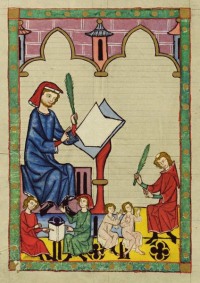
Der Schulmeister von Eßlingen, from Heidelberg, Cod. Pal. germ. 848, Große Heidelberger Liederhandschrift (Codex Manesse), Zürich, c.1300-c.1340, fol. 292v.

Der Schulmeister von Eßlingen, from Heidelberg, Cod. Pal. germ. 848, Große Heidelberger Liederhandschrift (Codex Manesse), Zürich, c.1300-c.1340, fol. 292v.

MAA/CARA Summer Language Scholarships
The MAA/CARA Summer Language Scholarships support graduate students and especially primising undergraduate students participating in summer courses in medieval languages or manuscript studies. The Medieval Academy of America’s Committee on Area and Regional Associations (CARA) is pleased to announce that the Summer Language Scholarship program has been expanded to allow more students to apply for support. The MAA/CARA Summer Language Scholarships support students participating in summer courses in medieval languages or manuscript studies.

Applicants must be members of the Medieval Academy in good standing with at least one year of graduate school remaining and must demonstrate both the importance of the summer course to their program of study and their home institution’s inability to offer analogous coursework. Click here for more information. The due date for applications is 15 April.

Travel Grants
Medieval Academy Travel Grants allow independent scholars and unaffiliated faculty to travel to conferences to present their work. The deadline for meetings taking place between
1 September 2016 and 28 February 2017 is May 1. Click here for more information.

Posted in MAA Newsletter | Leave a comment