

MAA News – President’s Column

UngerIn the aftermath of Olympic hype it is all the more clear the degree to which spectator sports have in the twenty-first century invaded the lives of otherwise sensible people. It is then with apologies that I add to the intrusion, in this case into the world of the Academy, but I think that there may be something for medievalists to learn from the career of George William James.

Bill James, a graduate of the University of Kansas in English and Economics, was interested in baseball and in statistics. Since the rules of the game remained more or less the same for almost a century and since there were detailed records for lots of players and lots of games baseball was a fount of massive data. James realized the potential for analysis of those numbers in novel and more complex ways with the growth in easily accessible computing power in the 1970s. He matched computers and baseball statistics and used the information to evaluate teams and so predict their future success. His work became increasingly sophisticated controlling for things like size of ballparks and developed new measures of performance. His approach was to deal in numbers and comparative analysis, a shift from the personality-centred and sometimes flowery prose that was at the time the standard of writing about baseball. He was not alone and the ability to handle ever larger datasets led to the acceptance of the new methods by some administrators, not without resistance as chronicled in Michael Lewis’ 2004 book Moneyball and the eponymous 2011 film.

In 1977 James began to publish his Abstract loaded with figures from the previous baseball season. Each year a new version brought sharply increased sales. By 1988 he was the leading proponent of sabermetrics, the use of statistics in analyzing baseball performance. The name was taken from the Society of American Baseball Research (SABR) founded back in 1971 by like-minded followers of the game. In the midst of a rising tide of interest in the maturing methods and the wider use of computers to examine data in ever more detailed ways in 1988 James stopped creating his annual Abstract.   There were too many numbers, too much data in various forms swamping readers and making for potential frustration.

Medievalists were ahead of baseball writers in seeing the potential of computing power to help in their work. Economic historians have long tried to manipulate the limited available figures on prices and taxes paid. Social historians did demographic studies in more depth and reconstructed ever larger populations and made more telling comparisons.   The rise of the world wide web made possible the easier distribution of data and made available new data series. More and more instructors developed websites, posting various documents for easy access for their students and for anyone interested. Scholars working with texts were not far behind the economic and social historians, developing concordances of major works, digitizing texts for easy searching and exploiting computing power in complex and exhaustive dictionary projects. They turned to harvesting fragments, juxtaposing different texts, finding common patterns, identifying the roots of types of expression and, in the process, uncovering new ways of reading a variety of documents. Art historians set out to make available images on the web. Libraries and archives put up manuscripts. The potential for digital humanities seemed massive, the possibilities for creating new tools that would generate a new range of medieval scholarship almost infinite. There was suddenly a mass of information. There were also problems, problems which only seemed to multiply.

Disintermediation, the laudable desire to have users confront the original documents and data, often meant no or minimal editorial control. Standards of presentation varied. Software inconsistencies and changes in platforms could make access clumsy. They could also lead to expensive and time consuming recasting of projects. The skill sets needed by scholars changed with changes in software and hardware so retooling could become a necessity. Maintaining continuity and on-going support for work in digital humanities dogged many efforts. The images of manuscripts and of works of art were not of consistent quality and access was in some cases limited in an effort to charge for use and so recoup some of the substantial cost of digitizing. The enthusiasm of early adopters and the many medievalists who continued to explore what the new digital world had to offer led to a mass of work, a flood of material, a broad range of findings and what could easily become TMI (too much information). A search for ‘computers in the humanities’ now yields 515,000 hits. The temptation to withdraw, to take a step or two or three back, grew as each new project added to a massive feast that seemingly could only end in indigestion.

Bill James’ choices may be a guide for medievalists. Though he stopped adding to the annual overpowering flow of data he did not stop writing about baseball or in developing methods of analysis made possible and easier in a world of digitalization.   He has even gone back to publishing an annual handbook along with other books recalling both his earlier Abstracts and looking at his topic in ways more like his predecessors. He now acts as an advisor to the Boston Red Sox where he and the team have enjoyed very good times, and some truly bad times, in recent years. Sports data mining is now the norm, thanks to James and others, in almost every phase of every game. The work is more sophisticated thanks to critical debate among practitioners. New measures and forms of analysis are tested and then rejected or moved to a lesser or greater place in the hierarchy of tools for understanding. The same pattern prevails now in the work of medievalists. The tsunami of information, the sheer quantity of what has been done, the overlap and duplication can be daunting. There are reasons just to give up and return to the proven methods that have long yielded results of indisputably high quality. Continued engagement of medievalists in the digital humanities has improved and will continue to improve the calibre of what is done, to eliminate unnecessary effort and to make the most effective use of the growing range of things that information technology can do for scholars.

The Academy will serve as a guide in identifying what might be most helpful in teaching and research about and on the Middle Ages. The Digital Initiatives Advisory Board, chaired by Jim Ginther who is a prominent practitioner in the digital humanities world, and includes Lisa Bitel, Caroline Bruzelius, Todd Chavez, Scott Kleinman, and Tim Stinsonis is monitoring what the Academy can do to assist, guide and promote potentially productive projects. The recently formed sub-committee of the Board, chaired by Maryanne Kowaleski, devoted to exploring what can be done about developing a digital taxonomy, will create ways to help members evaluate what is available to them. The goal is to mediate, to offer not a barrier but a filter which will aid members in evaluating what sites, sources, methods will best suit their needs. The Board and its sub-committee will also be able to offer advice in the future on the direction not only the Academy but also individual scholars should take to maximize benefit for our field. Just as baseball writers have at their fingertips masses of numbers the best of them understand that there is much more to good work than just the figures. Data is more than just numbers just as knowledge is much more than information. Medievalists know full well that the digital humanities will help them in employing methods and approaches that have always worked well. Plagued by a paucity of sources compared to scholars working in most other fields medievalists have a greater both practical and theoretical understanding of how to deal with the raw material before them. Most medievalists are now used to exploiting some part of the digital world. Most also know the frustration of promises and lengthy discussion of potential when their goal is to get optimum use from information technology. The Academy is going to help in that pursuit of what continues to be a moving target. Enjoying a greater understanding of the character and nature of sources, medievalists can be guides to everyone, possibly even Bill James, on how to exploit what is possible without forgetting what is already known.

Richard W. Unger
President
Posted in MAA Newsletter | Leave a comment

Last Day to Register Online for the MAA Annual Meeting

Online registration for the 2014 Annual Meeting of the Medieval Academy of America closes TODAY. Onsite registration for the meeting will be payable by check only and will be subject to the late registration fee.

Onsite registration for special events (luncheon, banquet, and closing reception) will be limited and on a space-available basis only. You must pre-register if you wish to attend the closing reception at the Getty Villa in Malibu. http://www.cmrs.ucla.edu/medieval_academy/index.html

Posted in Annual Meeting | Leave a comment

Call for Papers – Maximus the Confessor as a European Philosopher

Paper proposals are welcome  (presentation duration: 20 minutes) on Maximus the Confessor’s thought, work and relevance to any area of Philosophy by scholars in Philosophy, Byzantine Studies, Theology and related disciplines. Papers may examine the relationship of Maximus’ thought to that of other thinkers, but the paper must focus on Maximus the Confessor’s contribution. All papers must be presented in English.

Please send us the title and a short abstract of your presentation (200-400 words) in English, along with a short CV, until Sunday, May 11, 2014 via e-mail to maximus2014berlin@gmail.com. You will be informed concerning your possible acceptance on Monday, May 12, 2014, and you will be asked to submit the registration fee via bank transfer.

A volume on Maximus the Confessor as a Philosopher based on the colloquium is planned to be published.

Further details can be found at http://maximus2014.eu.

Posted in Call for Papers | Leave a comment

MAA News – Summer Stipends

Deadlines are approaching for the CARA Summer Scholarships. CARA members sponsor a number of summer programs in Latin, paleography, manuscript studies, etc. CARA awards full tuition scholarships to students participating in several of these programs; other programs are funded entirely by or jointly with the hosting institution. Details are provided here.

Posted in MAA Newsletter | Leave a comment

MAA News – 2014 Medieval Academy Annual Meeting

annualmeeting2014Online registration for the Annual Meeting closes on 24 March. On-site registration for the conference will be available, but with limited additional options. You must pre-register if you wish to attend the closing reception at the Getty Villa in Malibu.

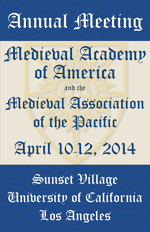
The 2014 Annual Meeting of the Medieval Academy of America will be held jointly with the annual meeting of the Medieval Association of the Pacific at UCLA on April 10-12, 2014. The meeting’s theme is “Empires and Encounters.”

The program will include four plenary sessions:

Presidential Address: Richard Unger, University of British Columbia
Opening Plenary Session: Susan Boynton, Columbia University
Fellows Plenary Session: Margaret Mullett, Dumbarton Oaks
CARA Plenary Session

The meeting will conclude with a private reception at the Getty Villa in Malibu on Saturday evening. The annual meeting of CARA delegates will take place on Sunday.

Registration is now open. The Program, registration link and hotel information can be found here.

We hope you will join us for what promises to be a very successful and well-attended meeting.

Posted in MAA Newsletter | Leave a comment

Mary Jaharis Center Lecture Series: The Reliquary-Enkolpia of Saint Demetrios and the Wonder of Art, April 3

The Mary Jaharis Center for Byzantine Art and Culture is pleased
to announce ​the second lecture​ in its 2013-2014 lecture series. On April 3, 2014, at 4pm, Dr. Ivan Drpić (University of Washington) will present “The Reliquary-Enkolpia of Saint Demetrios and the Wonder of Art.” Professor Drpić will explore the intersection of personal piety, art, and aesthetics in his discussion of the reliquary-enkolpia of Saint Demetrios.

Please join us afterward for wine and refreshments.

Thursday, April 3, 2014, 4:00–5:00 pm
Archbishop Iakovos Library Reading Room
Hellenic College Holy Cross
50 Goddard Avenue
Brookline, MA 02445

The lecture is free and open to the public.

Please visit maryjahariscenter.org ​or contact Brandie Ratliff (mjcbac@hchc.edu), Director, Mary Jaharis Center for Byzantine Art and Culture, for additional information.​

Posted in Announcements | Leave a comment

Patricia Fleming Visiting Fellowship in Bibliography and Book History

The Patricia Fleming Visiting Fellowship in Bibliography and Book History will again be awarded this year.

The award is for a scholar outside the University of Toronto to work in the city during 2014-2015. The amount of the award is $2000, with University of Toronto library privileges, and office space at the Faculty of Information. The area of research interest for 2014 is open, but preference may be given to those working in non-Canadian subjects.

For further information, please see:

http://www.ischool.utoronto.ca/patricia-fleming-visiting-fellowship-bibliography-and-book-history

Posted in Fellowships | Leave a comment

Jobs for Medievalists

ACMRS (Arizona Center for Medieval and Renaissance Studies)
Arizona State University   
Job # 10670

The Arizona Center for Medieval and Renaissance Studies (ACMRS) invites applications for an Assistant Administrative Professional position as Assistant Director to begin spring, 2014.  This is a full-time, benefits-eligible appointment subject to annual renewal contingent upon performance and the needs of the university.

The successful candidate will be expected to demonstrate a commitment to medieval and Renaissance studies while developing/overseeing general operations including budgets, coordinating and/or representing ACMRS at relevant events, and coordinating effective communication with partners and constituents both within and external to Arizona State University.

Minimum/Required Qualifications:

  • Master’s degree in area relevant to medieval and Renaissance studies
  • Two years’ experience in scholarly publishing and/or editing

Desired Qualifications:

  • Ph.D. in area relevant to medieval and Renaissance studies
  • Experience developing and/or managing budgets
  • Experience coordinating and/or managing general operations in an administrative setting
  • Demonstrated success writing, applying for and managing grants
  • Demonstrated success representing an organization at university, academic, and/or public functions
  • Demonstrated ability to work collaboratively at the unit and university levels

Application Deadline/Procedures:
To apply, please send – in a single PDF – a cover letter describing qualifications, complete CV and the names and contact information for three professional references to:  Robert E. Bjork, Director, at acmrs@asu.edu.  Only electronic applications will be accepted.  The initial application deadline is
March 14, 2014; if not filled, application review will occur every two weeks thereafter until the search is closed.  A background check is required for employment.

Arizona State University is an affirmative action/equal employment opportunity employer committed to excellence through diversity. Women and minorities are encouraged to apply. http://www.asu.edu/titleIX/.

ASU does not pay for travel expenses associated with interviews, unless otherwise indicated.

Posted in Jobs for Medievalists | Leave a comment

Jobs for Medievalists

Curator of Rare Books and Special Collections
University of Minnesota Law Library,
Minneapolis, Minnesota

Salary: $70,000 to $90,000

Status: Full-time

Posted: 02/28/14

Deadline: 04/30/14

Curator of Rare Books and Special Collections

The University of Minnesota Law Library is accepting applications for the position of Curator of Rare Books and Special Collections. The Curator of Rare Books and Special Collections directs, manages, and promotes all aspects of the Law Library’s rare books and special collections.  The Law Library’s rare books collection contains over 25,000 volumes, and is recognized as one of the finest legal rare book collections in the nation.  The collection resides in the Riesenfeld Rare Books Research Center, a state of the art climate controlled research and archive facility.

A complete job posting and online application for this position is available at https://employment.umn.edu/ applicants/Central?quickFind= 117931.

Posted in Jobs for Medievalists | Leave a comment

Postdoc: History of the Western Mediterranean, 300-1650CE (2014-15, Bates College)

The Department of History, Bates College, in Lewiston, Maine, invites applications for a two-year postdoctoral fellow, with a particular emphasis on pedagogical innovation. The fellowship is funded by the Andrew Mellon Foundation and begins August 1, 2014. Candidates must complete the Ph.D. by September 1, 2014, and should be no more than three years out of their doctorate. This is a half-time teaching position with salary and benefits of a full-time assistant professor. The fellow will teach three courses during the academic year 2014-15 and two courses in 2015-16. The reduced teaching load is designed to support innovation in teaching and on-going professional research. Some funds to support scholarly work are also available. Bates is a highly selective liberal arts college and will provide an excellent climate for professional development and scholarship.

We seek historians of the western Mediterranean between 300 and 1650 C.E., with strong preferences for those who study Spain before 1500. The following areas of specialization are of particular interest: interfaith relations, the Mediterranean world, and/or the Atlantic world. We anticipate a close integration of this position among programs in History and Classical and Medieval Studies, so applicants should explain how their own work might complement some of the work of relevant members of these departments. The successful candidate must be interested in, and will conduct faculty workshops on, innovative teaching and research. The department recognizes that innovation can take many forms. Some possibilities could include techniques in the digital humanities; methods for attracting diverse groups to the study of history; pedagogies focused on different learning styles; creative ways of structuring assignments and the use of classroom time; techniques for connecting student learning to wider local and global communities; or creative approaches to promoting student engagement and interest in History at Bates. The college, the History Department, and the Classical and Medieval Studies Program are committed to enhancing the diversity of the campus community and the curriculum. The search committee expects candidates who can contribute to this goal to identify their strengths and experiences in this area.

Applicants should submit electronically, in PDF format, to Nancy LePage, Project Specialist, 207-786-6480 at academicservices@bates.edu, a letter of application, C.V., writing sample, teaching statement, and three letters of recommendation. Please include your last name and R2527 in the subject line of all submissions. Consideration of applications will begin on March 17, 2014, and continue until the position is filled. Employment is contingent upon successful completion of a background check.
For more information about the college, please visit the Bates website: www.bates.edu.

Posted in Announcements | Leave a comment