
Call for Papers – Robert Grosseteste and the Pursuit of Religious and Scientific Learning in the Middle-Ages

It is intended that this conference will explore the relationship between the pursuit of scientific and religious knowledge in the middle-ages, with a particular focus on the British scholar, theologian, scientist, astronomer and philosopher, Robert Grosseteste (c. 1175-1253). It will discuss Grosseteste’s theological and scientific understanding, particularly of the new Greek and Arab learning, and how

this influenced his theological/philosophical investigations. Whilst it is anticipated that the main focus will be on Grosseteste, it will also be an important part of the conference’s rationale to discuss contemporaries as well as later writers who drew on his learning in order to advance the study of science and religion. In addition to this rationale it will be an over-riding aim of the conference to discuss in general the relationship between science and religion and to discuss whether our present era has anything to learn from the middle-ages in this respect. Key note speakers will include Prof. Tom McLeish and Dr Giles Gasper from Durham University’s Order Universe Project and Dr Amanda Power from Sheffield University. It is expected that the proceedings of this conference will be published.

Proposals for 40 minutes papers or enquiries should be directed by 10th February to Dr Jack Cunningham, j.p.cunningham@bishopg.ac.uk, Bishop Grosseteste University, Lincoln, LN1 3DY, UK. Proposal should be 300-400 words in length and should include you telephone number or e-mail address, as well as your academic affiliation (if any).
Posted in Call for Papers | Leave a comment

Call for Papers – The Art And Archaeology of Lusignan and Venetian Cyprus (1192-1571): Recent Research and New Discoveries

The art and archaeology of the Latin East have regularly been marginalised in broader accounts of medieval material culture, largely because they cannot fit within the restrictive parameters established for either the Byzantine East or the Latin West. Over the years, the art and archaeology of Lusignan and Venetian Cyprus (1192-1571) have attracted both western medievalists and Byzantinists, each group bringing its own methodological prejudices to the study of the subject. In the last twenty years, a number of international conferences, collaborative research initiatives and other events, culminating in last year’s exhibition Chypre entre Byzance et l’Occident IVe-XVIe siècle (2012-3) at the Louvre, have paved the way for a more fruitful interchange between scholars coming at the art and archaeology of Lusignan and Venetian Cyprus from a Byzantine or western medieval background.

Increasing specialisation within any given field being a virtual necessity in the modern academic world, students of medieval material culture West and East are called upon to broach the issue with an open mind to neighbouring fields, and to cooperate among themselves to bring about a synthetic, integrated vision of the complex history of Cypriot material culture in the later Middle Ages and of the society that produced it. Nevertheless, there is still much ground to cover. The brisk pace of current research activities has overtaken that of publication; a number of important excavations are still ongoing or under preparation for publication; and a host of new doctoral theses are in development. Now, more than ever, there is urgent need for the sustained exchange of new ideas and information regarding fresh discoveries, as well as for the rethinking of received knowledge and the renewal of approaches that this may entail.

This conference is the third in a series focusing on recent archaeological and art historical research on Cyprus from the Hellenistic period onwards. It aims at providing a forum for the discussion of the art and archaeology of Cyprus during the Lusignan and Venetian periods. Art historians and archaeologists engaged in research on this particular topic, both of the ‘eastern’ and ‘western’ persuasions, are encouraged to contribute by presenting the results of their recent work. We invite papers on subjects ranging from archaeological excavation, post-excavation finds analysis and field survey to monumental art (architecture, sculpture, painting), metalwork, ceramics, numismatics and other aspects of the island’s material life in the late medieval period.

We are planning a three-day event, with individual contributions up to 20 minutes in length. The conference will take place in Nicosia in 12-14 December 2014. Due to budgetary constraints, the speakers’ travel costs cannot be covered by the conference, but every effort will be made to secure conference rates at hotels near the conference venue. There is no registration fee for participation or attendance.

Prospective speakers are invited to submit a title and a 500-word abstract for consideration electronically, by 30 April 2014. Please send all materials and address all queries to Michalis Olympios (olympios.michalis@ucy.ac.cy) and Maria Parani (mparani@ucy.ac.cy).

The Organisers
Michalis Olympios
Maria Parani

Posted in Call for Papers | Leave a comment

Viking and Medieval Norse Studies and Medieval Icelandic Studies

The University of Iceland is now accepting applications for Viking and Medieval Norse Studies and Medieval Icelandic Studies:

(1) Medieval Icelandic Studies is a three-semester (90 ECTS) graduate program, with two semesters’ (60 ECTS) worth of course work and one semester’s worth (30 ECTS) master’s thesis. The summer semester is the thesis semester, which means that the program can be completed in 12 months.

See http://english.hi.is/school_of_humanities/faculty_of_icelandic_and_comparative_cultural_studies/medieval_icelandic

(2) Viking and Medieval Norse Studies is a four-semester (120 ECTS) graduate program run in cooperation with the University of Oslo in Norway, Aarhus University and Copenhagen University in Denmark. The first year–60 ECTS’ worth of course work–takes place in Iceland, but the third semester is spent either in Oslo, Aarhus, or Copenhagen, completing 30 ECTS of courses. The fourth semester is devoted to writin the master’s thesis, and can be spent in Iceland or Oslo.

See http://oldnorse.is/

Application deadline for both programs is February 1, 2014.

Posted in Announcements | Leave a comment

Call for Papers – Language as Culture in the Eastern Mediterranean (330-2013)

Language as Culture in the Eastern Mediterranean (330-2013)

The students of the Centre for Byzantine, Ottoman and Modern Greek Studies at the University of Birmingham are proud to announce the 15th Annual Postgraduate Colloquium, which will take place on Saturday, 24th May 2014.

Keynote speaker: Dr Maria Georgopoulou

(Director of the Gennadius Library, The American School of Classical Studies at Athens)

The colloquium will bring postgraduate students together to discuss the significance of language in the eastern Mediterranean from Late Antiquity to the Modern Age. Beginning with the observation that all studies are routinely possessed by language, it is important to understand the relationship between language and culture. A major goal is to examine the role of culture in linguistic meaning, language use and, conversely, the role of linguistic form and culture in social action and in cultural practices. Language is a key to understanding the social, symbolic and expressive lives of members of society.

How, we will ask, can we learn more about language, and, what can we say about language in the Mediterranean basin?

Studies of ritual and performance, of patronage and status often draw on linguistic evidence to talk about various forms of cultural production: attesting to the crucial and hitherto unacknowledged role of language in the creation of cultural subjectivities. Language as a term should not be limited to literary forms, as verbal products, but may be extended to encompass a broader range of visual narratives, including, potentially, painting, architecture and other kinds of material culture. We are interested in the production, interpretation and reproduction of social meanings, as expressed and accrued through language and in exploring the relation to culture and society.

We invite proposals for 20-minute papers in all fields of Byzantine, Ottoman and Modern Greek Studies. Topics may include but are not limited to:

*   Language ideology
*   Ideological context of architecture
*   Visual culture
*   Literacy and education
*   Literary analysis
*   Multicultural communities
*   Objects and words as symbols of identity
*   Representation, power and social status
*   Theories and practices of image-making
*   Ideas about communication or trade
*   Perceptions and sounds of speech
*   Cultural history of texts

Please send an abstract of no more than 250 words to George Makris at GTM036@bham.ac.uk by Monday, 24th March 2014.


Registration is free.

Posted in Call for Papers | Leave a comment

Applications Open for London Rare Books School

Applications are now invited for London Rare Books School (LRBS), from 23 – 27 June 2014 and 30 June – 4 July 2014.

The application form is available from the LRBS website: http://www.ies.sas.ac.uk/london-rare-books-school

Courses are £600, and a £100 deposit is requested upon application.

Early bird special: Two courses for £1000 (until 15 April 2014)

A limited number of partial bursaries are available. Placements are offered on a first-come, first-served basis, and courses are restricted to a maximum of twelve students. Courses may be taken for academic credit toward a postgraduate diploma in the History of the Book, or as part of the Institute’s MA in the History of the Book.

The courses are taught by internationally renowned scholars, using the unrivalled library and museum resources of London, including the British Library, the British Museum, the Victoria and Albert Museum, Senate House Libraries, and many more.

Applications should be submitted to IESEvents@sas.ac.uk.

The course programme is below. For further details, see the LRBS website or contact the Institute of English Studies, School of Advanced Study, University of London at IESEvents@sas.ac.uk or +44 020 7862 8679

WEEK ONE: 23 – 27 June 2014
Children’s Books, 1470-1980
European Bookbinding, 1450-1820
A History of Maps and Mapping
The History of Readers and Reading, 1770-2010 *new course
An Introduction to Bibliography
The Medieval Book
The Printed Book in Europe, 1450-2000

WEEK TWO: 30 June – 4 July 2014
The Book in the Ancient World
The Early Modern Book in England
The History and Practice of Hand Press Printing
An Introduction to Illustration and its Technologies
Modern First Editions: Dealing, Collecting, and the Market
The Printed Book in the East: China, India, and Japan *new course
Western Historical Scripts from Antiquity to 1600

Posted in Summer Programs | Leave a comment

Call for Papers – 41st Saint Louis Conference on Manuscript Studies

41st Saint Louis Conference on Manuscript Studies, 17–18 October 2014

Vatican Film Library—Saint Louis University Libraries Special Collections

Saint Louis University
St. Louis, MO

The Saint Louis Conference on Manuscript Studies is organized annually by the Vatican Film Library and its journal, Manuscripta, and is the longest running conference in North America devoted exclusively to medieval and Renaissance manuscript studies. The two-day program each year offers sessions on a variety of themes relating to medieval book production, distribution, reception, and transmission in such areas as paleography, codicology, illumination, textual transmission, library history, cataloguing, and more.

2014 Guest Speaker: Richard H. Rouse (University of California, Los Angeles)

CALL FOR PAPERS

The Vatican Film Library invites submissions of papers in the following sessions at the 41st Saint Louis Conference on Manuscript Studies, to be held at Saint Louis University in St. Louis, MO, 17–18 October 2014.

  • Captions and their Functions in Medieval Manuscripts
    Captions may be found in a variety of manuscript genres and fulfill a range of functions. Papers could address their roles in explicating or defining texts and images and their transmitted messages—or could suggest and discuss their alternate dimensions.
  • The Good, the Bad, and the Ugly: Depicting (and Stereotyping) Gender and Race
    Papers in this session will focus on visual, rather than textual representations, drawing on images that illustrate chronicles, maps, narratives, and other expository works.
  • Games People Played
    Medieval leisure hours were frequently spent in recreational activities: board and dice games, sporting events, and hunting and trapping excursions. Rather than simply describing these games and their activities, this session could be devoted to exploring the material and conceptual technology supporting these pursuits: traps, weapons, jousting equipment, dice and chess/checker pieces; strategies, procedures, and techniques—as expressed in medieval and Renaissance manuscripts.

Please send a title and an abstract of not more than 200 words to Susan L’Engle (lengles@slu.edu) by 15 February 2014. Each session consists of three 20-minute papers. If you are interested in organizing one of these sessions yourself, please contact us as soon as possible. Those whose proposals are accepted are reminded that travel and accommodation expenses for the conference are the responsibility of speakers and/or their institutions.

For more information, contact Erica Lauriello, Library Associate for Special Collections Administration, at 314-977-3090 or elauriel@slu.edu .  Conference information is posted at http://libraries.slu.edu/special_collections/stl_conf_manu.

Posted in Call for Papers | Leave a comment

MAA News – Slate of Candidates for 2014 MAA Election

The 22 November deadline for Nomination by Petition has passed, and so the slate of candidates for election to office in 2014 is set. The list of candidates with their photos and brief biographies appears online on the MAA website at:

http://www.medievalacademy.org/?page=2014Elections

Electronic balloting will open in December. If you would like to receive a paper ballot, please let us know.

Voting in the MAA elections is one of the most important means that members have to impact both the MAA and the future of medieval studies in North America. We look forward to your participation in the election of the leadership of the Medieval Academy.

Posted in MAA Newsletter | Leave a comment

MAA News – Medieval Academy Receives Bequest

Initial N: from James I of Aragon Overseeing a Court of Law: Unknown Spanish, about 1290 - 1310. MS. LUDWIG XIV 6, FOL. 72V

Initial N: from James I of Aragon Overseeing a Court of Law: Unknown Spanish, about 1290 – 1310. MS. LUDWIG XIV 6, FOL. 72V

The Medieval Academy has received a generous bequest from longtime member Theodore M. Norton (d. Feb. 7, 2013). For many years a professor of political science at San Jose State University, Prof. Norton had been a member of the Medieval Academy since 1947, taking Honorary Life Membership in 2010. The Academy gratefully acknowledges Prof. Norton’s generosity. For information about remembering in the Academy in your own estate plans, please contact Acting Executive Director Lisa Fagin Davis. The Academy acknowledges such commitments with membership in our Legacy Society.

Posted in MAA Newsletter | Leave a comment

MAA News – The Benefits of Membership: A Reminder

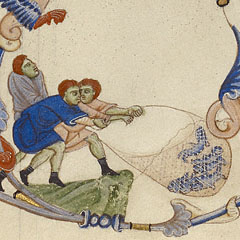
Fishermen. Abbey Bible. J. Paul Getty Museum, MS 107. Italian, probably Bologna, about 1250 - 1262. Tempera and gold leaf on parchment.

Fishermen. Abbey Bible. J. Paul Getty Museum, MS 107. Italian, probably Bologna, about 1250 – 1262. Tempera and gold leaf on parchment.

As membership renewal season is upon us, we want to remind members to visit our website where you will find: information about the Academy’s governance, policies and procedures; a list of publications, many of which are available digitally; a link to the online edition of Speculum (for members only); an online directory of members (also accessible only to members); and detailed information about our grants, fellowships and prizes. Academy members are also entitled to discounted subscriptions to several online bibliographies  and the ACLS Humanities E-Book library.

Posted in MAA Newsletter | Leave a comment

MAA News – Membership Renewals

shieldAll members should have received by now the following message from the Academy with information about membership renewal for 2014:

To the Members of the Medieval Academy,

The end of the year is now quickly approaching, and we encourage you to renew your membership in the Medieval Academy for 2014 as soon as possible. If you have not already paid your 2014 membership dues, please do so by 31 December 2013. Remember to take advantage of the reduced subscriptions to several online bibliographies and the ACLS Humanities E-Book Library that are available to Medieval Academy members.

We are pleased to report that in 2013, with your contribution, the Academy increased its support of members, especially graduate students, through the numerous awards and fellowships offered annually. Funds awarded to graduate students topped $100,000 this year, and we are poised to do even more in 2014. The Academy will also be able to give increased support to the efforts of its numerous volunteer committees that are responsible for so much of the work of the Academy, from the Speculum boards to the many awards committees, from the Committee on Centers and Regional Associations (CARA) to the Graduate Student Committee. We are doing all this while continuing to streamline administrative functions and expand digital offerings.

Since the Medieval Academy is a membership organization not affiliated with any other institution, we rely upon the income received annually from member dues to maintain our program of publications, awards, grants, and conferences.

You can now pay your dues through the robust and expanded MAA website. You will need to sign in with your username and password to renew online. If you have forgotten either, please contact us at info@themedievalacademy.org. The dues and donations categories are outlined on the website with links you can follow for further explanation. If you have already renewed, thank you. If you are a Corresponding Fellow, an Honorary Life Member, or a Life Member, no dues are payable, but we hope that you will consider making a gift to the Academy here. We encourage all members to consider supplementing their membership by becoming a Sustaining or Contributing member or by remembering the Academy with a bequest as part of our Legacy Society.

If you prefer to renew by mail, our traditional paper membership form can be printed here.

With a healthy fiscal outlook, increased digital offerings, and expanded services, the Medieval Academy has more to offer members than ever before. We sincerely hope that you will renew soon and continue your valued membership in the Academy. We look forward to working with you in developing the future of the Medieval Academy of America and of medieval studies in North America and beyond.

Richard Unger, President
Lisa Fagin Davis, Acting Executive Director

Posted in MAA Newsletter | Leave a comment