Call for Papers – Textual Heritage and Information Technologies

Textual Heritage and Information Technologies
El’Manuscript-2022
Innsbruck, Austria
5-9 September 2022
https://www.uibk.ac.at/congress/elmanuscript2022-slawistik/

We are pleased to invite submissions of abstracts for the
El’Manuscript-2022 international conference on the creation and
development of information systems for storage, description, processing,
analysis, and publication of medieval and early modern hand-written and
printed texts and documentary records. Any person involved in the
creation or application of these resources —including researchers;
instructors; staff of libraries, museums, and archives; programmers, and
undergraduate and graduate students— is welcome to participate.

El’Manuscript 2022 is the ninth in a series of biennial international
conferences entitled “Textual Heritage and Information Technologies”.
The conferences bring together linguists, specialists in historical
source criticism, IT specialists, and others involved in studying and
publishing our textual heritage. Along with the lectures, a summer
school will be part of the conference, which will allow practitioners to
become familiar with various systems and methods for working with
manuscripts and texts.

The working language of the 2022 conference is English. In the
philological sections talks in Russian are welcome but must be
accompanied by powerpoint slides in English. Accepted abstracts will be
published in print and online before the conference.

Papers presented at the conference will be published in the 2023 volume
of the peer reviewed journal Scripta & e-Scripta and on the
textualheritage.org website.

Click here for more information.
Posted in Call for Papers | Leave a comment

Call for Papers – Multilingual Dynamics of Medieval Literature in Western Europe

Multilingual Dynamics of Medieval Literature in Western Europe
Utrecht University
21–23 September 2022

The medieval world was by no means monolingual. Languages flourished and grew, circulated and travelled across geo-political frontiers. This was true of vernacular languages and perhaps especially so for Latin, a cosmopolitan language par excellence. The multilingualism of the medieval world has been at the forefront of research agendas over the past decade across medieval studies. But what were the stakes and consequences of multilingualism for literary culture? And how do these change if we think of multilingualism through cultural, social, artistic, or material lenses? As part of the NWO-funded research project ‘The Multilingual Dynamics of the Literary Culture of Medieval Flanders, c. 1200- c. 1500’, we invite proposals for 20 minute papers addressing any aspect of medieval literature and literary culture. Papers should address not only what has been missed in previous scholarship, but also ask where the study of the multilingual in medieval literary culture should turn its attention in the future. Possible topics of interest include, but are not limited to:

  • court and urban communities and their language(s)
  • administrative multilingualism
  • monastic multilingualism
  • commercial issues
  • reception milieux
  • genre and linguistic frontiers
  • contact zones

We welcome proposals from scholars at all career stages—and from all disciplinary backgrounds. We particularly encourage applications by early career researchers. To this end, younger colleagues and those without permanent positions will be eligible to apply for financial support with the costs of accommodation and travel. At the time of publishing this Call, it is our intention to hold the conference in person in Utrecht. The working language will be English. Speakers may be invited after the conference to contribute to a book of essays, which we hope to publish in Open Access in early 2023. Proposals of no more than 250 words should be sent to the project team at multilingualdynamics@gmail.com by 1st April 2022.

For further information about the NWO ‘Multilingual Dynamics’ project at Utrecht University, visit: https://multilingualdynamics.sites.uu.nl/.

Posted in Call for Papers | Leave a comment

SIMS Online Lecture Series – Bryan C. Keene, “Masters in Miniature” Feb. 11

The Schoenberg Institute for Manuscript Studies is pleased to announce the next lecture in its Online Lecture Series, presented in partnership with Center for Italian Studies and the Italian Studies section of the Department of Romance Languages at the University of Pennsylvania:

Masters in Miniature: Future Horizons for Italian Manuscript Studies

Bryan C. Keene, Riverside City College

Friday, February 11, 2022
1:00 – 2:30 pm via Zoom

This lecture centers on the historiography and future of Italian manuscript illumination with the goal of suggesting new methods of attribution and assessment for art historians, dealers, and collectors. The Philadelphia area collections and BiblioPhilly initiative provide ample inspiration for scholars of this material and will form a cornerstone of this presentation. Within the corpus of Giorgio Vasari’s Lives of the Most Excellent Painters, Sculptors, and Architects (1550 and 1568), one reads the biographies of several illuminators, including Lorenzo Monaco, Fra Angelico, the painters of service books for the Sistine Chapel, and Giulio Clovio, the last of whom Vasari called “Michelangelo in miniature.” A present-day counterpart to the Lives is the Dizionario biografico dei miniatori italiani (ed. Milvia Bollati, 2004), which provides biographies of nearly four hundred named artists working from the 9th through 16th century. About one third are documented as illuminators, while another third are recorded as painters and as illuminators, separately, and the final third are assigned by art historians (based on signatures, connoisseurship, or other means). In addition, there are over two hundred and fifty anonymous maestri christened by scholars. Many studies have been informed by the Dizionario and dozens of new artists have since come to light.

 A specific focus of this paper will be an assessment of the geographic organization by “schools” in the published catalogues of various collections, such as Cambridge (UK), the Cini Foundation, and Kupferstichkabinett collections, and several private holdings. In each, the collaborative nature of manuscript production—by artists, scribes, and other craftspeople from different neighborhoods or regions—is often overshadowed by the career of individual illuminators. A discussion of exhibitions will also be offered, and a vision for future digital collaborations will form the conclusion.

For more information and to register, please visit Masters in Miniature | Penn Libraries (upenn.edu).

Posted in Lectures | Leave a comment

Mary Jaharis Center Lectures: February 15 & 17

The Mary Jaharis Center for Byzantine Art and Culture is pleased to announce two upcoming lectures:

Tuesday, February 15, 2022 | 12:00 pm | Zoom
Syriac Villages in the Tur Abdin: A Microhistory of the Medieval Middle East
Marica Cassis, University of Calgary

Marica Cassis explories the significance of colonialism in the study of Tur Abdin, the importance of microhistory in understanding archaeological material, and the overall underdiscussed material present in the region.

Advance registration required. Register: https://eastofbyzantium.org/upcoming-events/

An East of Byzantium lecture. East of Byzantium is a partnership between the Arthur H. Dadian and Ara Oztemel Chair of Armenian Art at Tufts University and the Mary Jaharis Center for Byzantine Art and Culture that explores the cultures of the eastern frontier of the Byzantine empire in the late antique and medieval periods.

Thursday, February 17, 2022 | 5:00 pm | Zoom
The History and Significance of the Byzantine Prothesis Ritual
Nina Glibetić, University of Notre Dame

Nina Glibetić discusses the history and development of Byzantine Prothesis ritual.

Advance registration required. Register: https://maryjahariscenter.org/events/history-significance-byzantine-prothesis-ritual

Sponsored by the Mary Jaharis Center for Byzantine Art and Culture and Harvard University Standing Committee on Medieval Studies.

Contact Brandie Ratliff (mjcbac@hchc.edu), Director, Mary Jaharis Center for Byzantine Art and Culture with any questions.

Posted in Lectures | Leave a comment

Upcoming Grant Writing Workshop via Zoom

Dear colleagues,

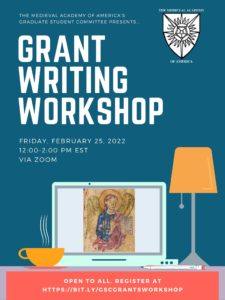
Interested in getting better acquainted with the grants writing process? We want to invite you to a Grants Writing Workshop organized by the Graduate Student Committee. Join us on February 25, from 12pm-2pm (EST). You can register for the event here. The event is open to all. Help us spread the word.

Speakers:

Elina Gertsman
Marcia Kupfer
Roger Martínez-Dávila
Sebastian Sobecki
Mark Cruse

Best,

Jonathan Correa and Reed O’Mara

Posted in Webinars | Leave a comment

Call for Papers: MAA@AHA 2023

Call for MAA Session Proposals
2023 AHA Annual Meeting, Philadelphia

Proposals due 15 February

The Medieval Academy of America invites proposals for sessions at the upcoming annual meeting of the American Historical Association in Philadelphia, January 5-8, 2023.

Each year the Medieval Academy co-sponsors sessions at the AHA’s annual meeting. This year, we aim to sponsor sessions that address an overarching theme of interest both to MAA members and broader audiences:

(Re)Constructing the Middle Ages through Migrations, Mobilities, Mediations.” We offer this theme in encompassing terms. We imagine that panels might address a range of topics that include: indigenous and global perspectives that extend and challenge previous conceptions of the period; considerations of the field from historical scales that reveal temporal, geographic, or conceptual incongruities, from microhistories to civilizational studies; new narrations of the medieval past from unexpected or previously de-centered locales, objects, or persons; configurations of the field that blur or eradicate geographic, temporal, conceptual, or linguistic boundaries; reckonings of the medieval that jettison or expose its medievalist, nationalist, and colonialist legacies. How does your work invite reconsiderations of what is medieval? We’d love to hear from you!

We invite all manner of session programming, and strongly encourage MAA members to think beyond traditional paper panels. Roundtables, lightning talks, interviews, field conversations, pedagogical workshops, digital labs, performances, working sessions, and any other experimental and inclusive forms of knowledge-sharing you might propose will be received with enthusiasm.

We especially encourage session proposals from scholars representing a variety of identity positions and academic ranks and affiliations, including graduate students and independent scholars. We also encourage session proposals from scholars whose work features sources, geographies, and populations that are under-represented in traditional reckonings of “the medieval.”

The committee is happy to provide feedback on draft session proposals; please reach out to us at ahacommittee@themedievalacademy.org. In addition, MAA members may receive feedback on proposals as part of the review process.

How to submit a session proposal

There is a two-stage process for submitting a session proposal for MAA and AHA co-sponsorship.

1) Members of the Medieval Academy submit session proposals to the MAA’s AHA Program Committee through the online submission form by 11:59 p.m., February 1, 2022.

2) If the session proposal is approved by the MAA’s AHA Committee, the session organizer will be informed by February 11 and will then be responsible for submitting the proposal directly to the AHA before the deadline of 11:59 p.m., February 15, 2022, indicating that the session has the sponsorship of the Medieval Academy of America.

For more information, please see FAQ: Organizing MAA/AHA Sessions.

Posted in Call for Papers | Leave a comment

Rare Book School Summer Course Applications Opening Soon

Expand your understanding of book history during a Rare Book School course this summer. Our five-day intensive courses on the history of manuscript, print, and digital materials will be offered online and in person at the University of Virginia and other partner institutions.

Among our thirty-nine courses, we are pleased to offer several pertinent to those interested in the history of the book. The following is a sample of the breadth of the RBS offerings:

— H-180v: Six Degrees of Phillis Wheatley, taught by Tara Bynum (of the University of Iowa)

— H-185v: African American Print Cultures in the Nineteenth-Century United States, taught by Derrick R. Spires (of Cornell University)

— H-120: Textual Mobilities: Works, Books & Reading Across Early Modern Europe, taught by Roger Chartier and John Pollack (both of the University of Pennsylvania)

— H-105: The Bible and Histories of Reading, taught by Peter Stallybrass (Professor Emeritus of the University of Pennsylvania)

Course applications will open the week of February 7th. To be considered in the first round of admissions decisions, course applications should be submitted no later than March 7th. Applications received after that date will be reviewed on a rolling basis. Visit our website at www.rarebookschool.org for course details, instructions for applying, and evaluations by past students. Contact us at rbsprograms@virginia.edu with questions.

Posted in Summer Programs | Leave a comment

Upcoming Grant Deadlines: Apply by February 15

The Medieval Academy of America invites applications for the following grants. Please note that applicants must be members in good standing to be eligible for Medieval Academy awards.

For Medievalists of Color:

Belle Da Costa Greene Award

The Belle Da Costa Greene Award of $2,000 will be granted annually to a member of the Medieval Academy of America for research and travel. The award may be used to visit archives, attend conferences, or to facilitate writing and research. The award will be granted on the basis of the quality of the proposed project, the applicant’s budgetary needs (as expressed by a submitted budget and in the project narrative), and the estimation of the ways in which the award will facilitate the applicant’s research and contribute to the field. Special consideration will be given to graduate students, emerging junior scholars, adjunct, and unaffiliated scholars. Click here for more information. Click here to make a donation in support of the Greene Award. (Deadline 15 February 2022)

For Independent Scholars and ECRs:

Olivia Remie Constable Awards

Four Olivia Remie Constable Awards of $1,500 each will be granted to emerging junior faculty, adjunct or unaffiliated scholars (broadly understood: post-doctoral, pre-tenure) for research and travel. Click here for more information. (Deadline 15 February 2022)

For Graduate Students:

MAA Dissertation Grants

The nine annual Medieval Academy Dissertation Grants support advanced graduate students who are writing Ph.D. dissertations on medieval topics. The $2,000 grants help defray research expenses. Click here for more information. (Deadline 15 February 2022)

Schallek Awards

The five annual Schallek awards support graduate students conducting doctoral research in any relevant discipline dealing with late-medieval Britain (ca. 1350-1500). The $2,000 awards help defray research expenses. Click here for more information. (Deadline 15 February 2022)

MAA/GSC Grant for Innovation in Community-Building
and Professionalization

The MAA/GSC Grant(s) will be awarded to an individual or graduate student group from one or more universities. The purpose of this grant is to stimulate new and innovative efforts that support pre-professionalization, encourage communication and collaboration across diverse groups of graduate students, and build communities amongst graduate student medievalists. Click here for more information. (Deadline 15 February 2022)

Applicants for these and other MAA programs must be members in good standing of the Medieval Academy. Please contact the Executive Director for more information about these and other MAA programs.

Posted in Grants & Prizes | Leave a comment

Jobs for Medievalists

Harvard University invites applications and nominations for the Philip Hofer Curator of Printing and Graphic Arts (P&GA) at Houghton Library. Reporting to the Associate Librarian for Collections and Programs, the Curator provides vision, leadership, advocacy, interpretation and passion for the collection, and serves as catalyst and coordinator for a dynamic group of activities and people dedicated to connecting P&GA’s holdings to Harvard faculty, students, and an international community of scholars, artists, and other researchers and enthusiasts.

The Curator will have enthusiasm and demonstrated ability for sharing and interpreting the collection in the classroom, in the reading room, in the digital sphere, in publications, and through exhibitions and programming and for communicating the value, power, and contemporary relevance of printing and the graphic arts to expert and general audiences. The Curator will have an extraordinary opportunity to build and shape the collection and will develop and implement a strategy that incorporates diverse cultures, new and evolving technologies, and the role of printing and graphic arts in social and political change.

The successful candidate will possess deep knowledge of printing history and graphic processes particularly as these relate to book illustration; the ability to master over time the broad range of formats, subjects, and time periods represented in the collection; enthusiasm for working with faculty and students; proclivity for adopting new technologies and methods that will improve access to and use of P&GA holdings; and a collaborative and collegial outlook.

The Department of Printing and Graphic Arts was founded at Harvard in 1938 by legendary curator, collector, and connoisseur Philip Hofer. The department holds an extensive collection of original artifacts from all periods illustrating the book arts and the materiality and historical development of the book, whether manuscript or printed. In addition to facilitating teaching and research based in the collection, the department administers a vibrant set of programs including the Frances and Philip Hofer lecture series, the Philip Hofer Prize for Collecting Books or Art, workshops on letterpress printing, and other activities core to the department’s mission and spirit.

The Department of Printing and Graphic Arts is one of the main curatorial departments of Houghton Library, Harvard’s principal repository for rare books and manuscripts, literary and performing arts archives, and more. The library is a destination for students and scholars on campus and around the world, and each year welcomes thousands of researchers and students into its reading room and classrooms. Houghton Library’s collections represent the scope of human experience from ancient Egypt to twenty-first century America. With strengths primarily in North American and European history, literature, and culture, collections range in media from printed books and handwritten manuscripts to maps, drawings and paintings, prints, posters, photographs, film and audio recordings, and digital media, as well as costumes, theater props, and a wide range of other objects. To learn more about the collections and Houghton Library, please visit our website at https://library.harvard.edu/libraries/houghton.

Read the full job description and apply here:
https://sjobs.brassring.com/TGnewUI/Search/Home/Home?partnerid=25240&siteid=5341#jobDetails=1939639_5341
Minimum salary: $92k per year.

Although the position will remain posted until filled, applicants are strongly encouraged to apply by end of day on February 25, 2022.

Posted in Jobs for Medievalists | Leave a comment

Call for Proposals – Attending to Women, 1100-1800: Performance

September 30-October 1, 2022
Newberry Library

Proposal Deadline: Tuesday, March 15, 2022

In 2018, “Attending” asked how Early Modern women’s action and agency shaped their lives and world. In 2022, we will turn to performance, asking how women’s performances of power, gender, and art before 1800 provide powerful paths towards understanding their lives and our own today. The conference will ask such questions as: How do medieval, early modern, and Indigenous women draw on various forms of power, from the racial to the religious, to perform different roles? How was the category of “woman” itself contested, reinforced, and complicated through the performance of gender? What did women choose to perform through music, dance, and visual art? Lastly, what responsibilities and possibilities do we have as scholars who teach and share our work with the public?

The conference will retain its innovative format, using a workshop model for most of its sessions to promote dialogue, augmented by a keynote lecture and a plenary panel on each of the four conference topics: power, gender, art, and public humanities/pedagogy.

We welcome proposals for workshop sessions. The submission deadline is Tuesday, March 15, 2022.

Workshops are 90-minute sessions organized by a group of two to four leaders who circulate readings, questions, and other materials in advance through the conference website. Leaders spend no more than twenty minutes framing the issues and opening up the conversation, then facilitate active participation and focused discussion. The best workshops are often comparative and interdisciplinary, and all allow participants to share information, pass on knowledge, ask advice, and learn something new. All workshop organizers are expected to register for, attend, and participate in the entire conference, not just their workshop.

For more information about the conference, including a list of plenary speakers and information about submitting a workshop proposal, please visit the conference website here: https://www.newberry.org/09302022-attending-women-1100-1800-performance

If you have any questions about the conference, please send an email to attending@newberry.org

Posted in Call for Papers | Leave a comment