
MAA News – 2022 Medieval Academy of America Publication Prizes

The Medieval Academy of America congratulates the winners of the
2022 Medieval Academy of America Publication Prizes:

Haskins Medal: Marina Rustow, The Lost Archive: Traces of a Caliphate in a Cairo Synagogue (Princeton: Princeton University Press, 2020)

Karen Gould Prize in Art History: Joan Holladay, Genealogy and the Politics of Representation in the High and Late Middle Ages (Cambridge: Cambridge University Press, 2019)

Digital Humanities and Multimedia Studies Prize: The Documentary Archaeology of Late Medieval Europe (DALME). Principal Investigators: Daniel Lord Smail, Gabe Pizzorno, and Laura K. Morreale (Harvard University) (https://dalme.org/)

John Nicholas Brown Prize: Elias Muhanna, The World in a Book: Al-Nuwayri and the Islamic Encyclopedic Tradition (Princeton: Princeton University Press, 2018)

Article Prize in Critical Race Studies: Nahir Otaño Gracia, “Towards a decentered Global North Atlantic: Blackness in Saga af Tristram ok Ísodd,” Literature Compass. 2019; 16:e12545. https://doi.org/10.1111/lic3.12545

Van Courtlandt Elliott Prize: Brenna Duperron, “Ghostly Consciousness in The Book of Margery Kempe,” English Language Notes 58 (2020), 121-135; and Patrick Meehan, “Recontextualizing Indigenous Knowledge on the Prussian-Lithuanian Frontier, ca. 1380-1410,” The Medieval Globe (2020), 93-119.

The Publication Prizes will be presented at the 2022 Annual Meeting of the Medieval Academy of America, hosted by the University of Virginia. The presentation of the Prizes will take place preceding the Presidential Address on Saturday, 12 March, at 10:45 AM Eastern Time. We hope you will join us – in person or virtually – as we honor these scholars and acknowledge their important work.

We will make a final determination about the format of the Annual Meeting in the coming weeks. Updated information about the Annual Meeting may be found here: https://www.medievalacademy.org/page/2022AnnualMeeting
Posted in MAA Newsletter | Leave a comment

MAA News – Graduate Student Committee Announces Community-Building Awards

As part of the GSC’s ongoing efforts to think creatively about increasing accessibility of the wider public to the knowledge that we, as scholars of the Middle Ages, are producing, five special 2022 Community-Building Awards have been granted in support of these projects:

“Living with the Medieval and Letting it Live: High Schoolers and Historical Learning at the Sheesh Mahal, Delhi” (Anurag Advani, Aparajita Das, Sonia Wigh, Sourav Ghosh)

“Coding Codices” (Aylin Malcolm, Tessa Gengnagel, and Caitlin Postal)

“The Medievalist Toolkit” (Claire Dillon, Carly Quijano, Sam Dobberstein, Sarina Kuersteiner, Adam Matthews, and Robin Reich)

“Meeting in the Middle Ages Podcast” (Will Beattie and Benjamin Pykare)

“Middle School Paleography Workshop” (Rosann Marie Gage and Lanson Wells)

Posted in MAA Newsletter | Leave a comment

MAA News – Upcoming Grant Deadlines

The Medieval Academy of America invites applications for the following grants. Please note that applicants must be members in good standing to be eligible for Medieval Academy awards.

For Medievalists of Color:

Belle Da Costa Greene Award

The Belle Da Costa Greene Award of $2,000 will be granted annually to a member of the Medieval Academy of America for research and travel. The award may be used to visit archives, attend conferences, or to facilitate writing and research. The award will be granted on the basis of the quality of the proposed project, the applicant’s budgetary needs (as expressed by a submitted budget and in the project narrative), and the estimation of the ways in which the award will facilitate the applicant’s research and contribute to the field. Special consideration will be given to graduate students, emerging junior scholars, adjunct, and unaffiliated scholars. Click here for more information. Click here to make a donation in support of the Greene Award. (Deadline 15 February 2022)

For Independent Scholars and ECRs:

Olivia Remie Constable Awards

Four Olivia Remie Constable Awards of $1,500 each will be granted to emerging junior faculty, adjunct or unaffiliated scholars (broadly understood: post-doctoral, pre-tenure) for research and travel. Click here for more information. (Deadline 15 February 2022)

For Graduate Students:

MAA Dissertation Grants

The nine annual Medieval Academy Dissertation Grants support advanced graduate students who are writing Ph.D. dissertations on medieval topics. The $2,000 grants help defray research expenses. Click here for more information. (Deadline 15 February 2022)

Schallek Awards

The five annual Schallek awards support graduate students conducting doctoral research in any relevant discipline dealing with late-medieval Britain (ca. 1350-1500). The $2,000 awards help defray research expenses. Click here for more information. (Deadline 15 February 2022)

MAA/GSC Grant for Innovation in Community-Building
and Professionalization

The MAA/GSC Grant(s) will be awarded to an individual or graduate student group from one or more universities. The purpose of this grant is to stimulate new and innovative efforts that support pre-professionalization, encourage communication and collaboration across diverse groups of graduate students, and build communities amongst graduate student medievalists. Click here for more information. (Deadline 15 February 2022)

Applicants for these and other MAA programs must be members in good standing of the Medieval Academy. Please contact the Executive Director for more information about these and other MAA programs.

Posted in MAA Newsletter | Leave a comment

MAA News – Book Subventions Call for Proposals

The Medieval Academy Book Subvention Program provides grants of up to $2,500 to university or other non-profit scholarly presses to support the publication of first books by Medieval Academy members. Click here for more information.

The Medieval Academy Inclusivity and Diversity Book Subvention Program provides subventions of up to $5,000 to university or other non-profit scholarly presses to support the publication of books concerning the study of inclusivity and diversity in the Middle Ages (broadly conceived) by Medieval Academy members. Click here for more information.

Applications for subventions will be accepted only from the publisher and only for books that have already been approved for publication. Eligible Academy members who wish to have their books considered for a subvention should ask their publishers to apply directly to the Academy, following the guidelines outlined on the relevant webpage. The deadline for proposals is 1 May 2021.

Posted in MAA Newsletter | Leave a comment

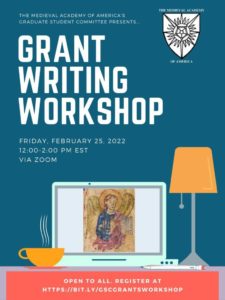
MAA News – Upcoming Grant Writing Workshop

Dear colleagues,

Interested in getting better acquainted with the grants writing process? We want to invite you to a Grants Writing Workshop organized by the Graduate Student Committee. Join us on February 25, from 12pm-2pm (EST). You can register for the event here. The event is open to all. Help us spread the word.

Speakers:
Elina Gertsman
Marcia Kupfer
Roger Martínez-Dávila
Sebastian Sobecki
Mark Cruse

Best,

Jonathan Correa and Reed O’Mara

Posted in MAA Newsletter | Leave a comment

MAA News – GSC Mentorship Program: Deadline 18 February

REMINDER: DEADLINE TO REGISTER AS A MENTOR OR MENTEE:
Wednesday, February 18th

*Please note that since the 97th Annual Meeting of the Medieval Academy of America will be conducted in a hybrid format due to the COVID-19 pandemic, we will be running the mentorship program virtually. Because of this, anybody can participate, regardless of their MAA Annual Meeting attendance plans*

The Graduate Student Committee (GSC) of the Medieval Academy of America invites both those attending the 97th Annual Meeting of the Medieval Academy of America, hosted by the University of Virginia (March 10- 13), as well as any other interested medievalists to participate in the GSC Mentoring Program.

The GSC Mentoring Program facilitates networking between graduate students or early career scholars and more established scholars by pairing students and scholars according to common interest or academic discipline.

Mentorship exchanges are intended to help students establish professional contacts with scholars who can offer them career advice. The primary objective of this exchange is for the relationship to be active during the conference, though mentors and mentees are encouraged to continue communication after a conference has ended.

We have recorded an increased interest in the GSC Mentorship Program since it has been held virtually due to COVID-19 restrictions. We will attempt to match all those who register as a mentee with mentors; however, if need be, preference will be granted in order of form submission.

To volunteer as a mentor (faculty, librarians, curators, independent scholars) or to sign up as a mentee, please submit the online form, linked here, by Wednesday, February 18th.

On behalf of the committee, thank you and our best,

Mary M. Alcaro& Lauren Van Nest
2021-2022 Mentoring Program Coordinators

Posted in MAA Newsletter | Leave a comment

2022 Annual Meeting Update

General registration is now open for virtual attendance at the 2022 Annual Meeting of the Medieval Academy of America, to be held March 10-13 on the grounds of the University of Virginia and online. Due to the overwhelming response by those on the program, we been forced to limit registration for in-person attendance to speakers, presiders, and officers, staff, and incoming Fellows of the Academy. While this will come as a disappointment to many of our colleagues, on-site institutional constraints during the pandemic have required us to cap the total number of in-person attendees at 175. Virtual participation, however, is available to the entire membership, and we hope that members will take some consolation in the hybrid format of this year’s Annual Meeting as a promise of larger gatherings in years to come. Click here to register.

Please contact the Program Committee <MAA2022cville@gmail.com> with questions. Check this page regularly for updates and for a PDF of the program: https://www.medievalacademy.org/page/2022AnnualMeeting

We look forward to seeing you in Charlottesville, whether in-person or online!

Posted in Annual Meeting | Leave a comment

Call for Papers – Textual Heritage and Information Technologies

Textual Heritage and Information Technologies
El’Manuscript-2022
Innsbruck, Austria
5-9 September 2022
https://www.uibk.ac.at/congress/elmanuscript2022-slawistik/

We are pleased to invite submissions of abstracts for the
El’Manuscript-2022 international conference on the creation and
development of information systems for storage, description, processing,
analysis, and publication of medieval and early modern hand-written and
printed texts and documentary records. Any person involved in the
creation or application of these resources —including researchers;
instructors; staff of libraries, museums, and archives; programmers, and
undergraduate and graduate students— is welcome to participate.

El’Manuscript 2022 is the ninth in a series of biennial international
conferences entitled “Textual Heritage and Information Technologies”.
The conferences bring together linguists, specialists in historical
source criticism, IT specialists, and others involved in studying and
publishing our textual heritage. Along with the lectures, a summer
school will be part of the conference, which will allow practitioners to
become familiar with various systems and methods for working with
manuscripts and texts.

The working language of the 2022 conference is English. In the
philological sections talks in Russian are welcome but must be
accompanied by powerpoint slides in English. Accepted abstracts will be
published in print and online before the conference.

Papers presented at the conference will be published in the 2023 volume
of the peer reviewed journal Scripta & e-Scripta and on the
textualheritage.org website.

Click here for more information.

Posted in Call for Papers | Leave a comment

Call for Papers – Multilingual Dynamics of Medieval Literature in Western Europe

Multilingual Dynamics of Medieval Literature in Western Europe
Utrecht University
21–23 September 2022

The medieval world was by no means monolingual. Languages flourished and grew, circulated and travelled across geo-political frontiers. This was true of vernacular languages and perhaps especially so for Latin, a cosmopolitan language par excellence. The multilingualism of the medieval world has been at the forefront of research agendas over the past decade across medieval studies. But what were the stakes and consequences of multilingualism for literary culture? And how do these change if we think of multilingualism through cultural, social, artistic, or material lenses? As part of the NWO-funded research project ‘The Multilingual Dynamics of the Literary Culture of Medieval Flanders, c. 1200- c. 1500’, we invite proposals for 20 minute papers addressing any aspect of medieval literature and literary culture. Papers should address not only what has been missed in previous scholarship, but also ask where the study of the multilingual in medieval literary culture should turn its attention in the future. Possible topics of interest include, but are not limited to:

  • court and urban communities and their language(s)
  • administrative multilingualism
  • monastic multilingualism
  • commercial issues
  • reception milieux
  • genre and linguistic frontiers
  • contact zones

We welcome proposals from scholars at all career stages—and from all disciplinary backgrounds. We particularly encourage applications by early career researchers. To this end, younger colleagues and those without permanent positions will be eligible to apply for financial support with the costs of accommodation and travel. At the time of publishing this Call, it is our intention to hold the conference in person in Utrecht. The working language will be English. Speakers may be invited after the conference to contribute to a book of essays, which we hope to publish in Open Access in early 2023. Proposals of no more than 250 words should be sent to the project team at multilingualdynamics@gmail.com by 1st April 2022.

For further information about the NWO ‘Multilingual Dynamics’ project at Utrecht University, visit: https://multilingualdynamics.sites.uu.nl/.

Posted in Call for Papers | Leave a comment

SIMS Online Lecture Series – Bryan C. Keene, “Masters in Miniature” Feb. 11

The Schoenberg Institute for Manuscript Studies is pleased to announce the next lecture in its Online Lecture Series, presented in partnership with Center for Italian Studies and the Italian Studies section of the Department of Romance Languages at the University of Pennsylvania:

Masters in Miniature: Future Horizons for Italian Manuscript Studies

Bryan C. Keene, Riverside City College

Friday, February 11, 2022
1:00 – 2:30 pm via Zoom

This lecture centers on the historiography and future of Italian manuscript illumination with the goal of suggesting new methods of attribution and assessment for art historians, dealers, and collectors. The Philadelphia area collections and BiblioPhilly initiative provide ample inspiration for scholars of this material and will form a cornerstone of this presentation. Within the corpus of Giorgio Vasari’s Lives of the Most Excellent Painters, Sculptors, and Architects (1550 and 1568), one reads the biographies of several illuminators, including Lorenzo Monaco, Fra Angelico, the painters of service books for the Sistine Chapel, and Giulio Clovio, the last of whom Vasari called “Michelangelo in miniature.” A present-day counterpart to the Lives is the Dizionario biografico dei miniatori italiani (ed. Milvia Bollati, 2004), which provides biographies of nearly four hundred named artists working from the 9th through 16th century. About one third are documented as illuminators, while another third are recorded as painters and as illuminators, separately, and the final third are assigned by art historians (based on signatures, connoisseurship, or other means). In addition, there are over two hundred and fifty anonymous maestri christened by scholars. Many studies have been informed by the Dizionario and dozens of new artists have since come to light.

 A specific focus of this paper will be an assessment of the geographic organization by “schools” in the published catalogues of various collections, such as Cambridge (UK), the Cini Foundation, and Kupferstichkabinett collections, and several private holdings. In each, the collaborative nature of manuscript production—by artists, scribes, and other craftspeople from different neighborhoods or regions—is often overshadowed by the career of individual illuminators. A discussion of exhibitions will also be offered, and a vision for future digital collaborations will form the conclusion.

For more information and to register, please visit Masters in Miniature | Penn Libraries (upenn.edu).

Posted in Lectures | Leave a comment