
Mellon Junior Faculty Fellowship in Medieval Studies at the University of Notre Dame’s Medieval Institute

Mellon Junior Faculty Fellowship in Medieval Studies
at the University of Notre Dame’s Medieval Institute

Application Deadline: February 1, 2022

The University of Notre Dame invites applicants for a one-year Mellon Postdoctoral Fellowship in Medieval Studies. This Fellowship is designed for junior faculty who currently hold a position in a North American university as an assistant professor. It is open to qualified applicants in all fields of Medieval Studies. The fellowship holder will pursue research in residence at Notre Dame’s famed Medieval Institute during the academic year (this is a nine-month position).

The intent of this Fellowship is to enable its holders to complete research and writing on a book manuscript in advance of tenure. The Fellowship carries no teaching responsibilities, but holders are expected to participate in the multidisciplinary intellectual life of the Institute and to reside in South Bend. The Fellow will be provided with a private carrel in the Medieval Institute, enjoy full library and computer privileges, and have access to all the Institute’s research tools.

In addition, towards the conclusion of their residency the Fellow’s work will be at the center of a half-day conference. Three senior scholars, chosen in cooperation with the Medieval Institute, will be invited to campus for a half-day public seminar treating the subject matter of the Fellow’s research. The senior scholars will also read and discuss a draft version of the Fellow’s work in an extended private session, a one-to-one conversation following a close reading of the draft, with a view to improving the manuscript before its submission to a press.

Eligibility: Applicants must hold a tenure-track appointment at a U.S. institution, obviously with a completed Ph.D., and should not be more than six years beyond receiving their Ph.D. at the time of application.

Stipend: $50,000 (paid directly to Fellow’s home institution).

Start Date: approximately August 22, 2022 | End Date: approximately May 15, 2023

Application procedure: Applicants should submit a letter of application (cover letter), a project proposal of no more than 2500 words, a current C.V., and three confidential letters of recommendation. Submit applications via Interfolio via http://apply.interfolio.com/97294. Further details regarding materials are available at https://medieval.nd.edu/research/grants-fellowships/#Mellon-fellowship.

Posted in Fellowships | Leave a comment

Byzantine Studies Postdoctoral Fellowship

Byzantine Studies Postdoctoral Fellowship

Application Deadline: February 1, 2022

Following substantial investment in the area of Byzantine Studies at the University of Notre Dame, including the acquisition of the Milton V. Anastos Library of Byzantine Civilization and generous support from the Stavros Niarchos Foundation, the Mellon Foundation, and the National Endowment for the Humanities, the Medieval Institute at the University of Notre Dame is delighted to invite applicants for a nine-month Postdoctoral Fellowship in Byzantine Studies. This fellowship is designed for junior scholars with a completed doctorate whose research deals with some aspect of the Byzantine world. The fellow is expected to pursue promising research towards scholarly publication and/or the development of new subject areas. This Fellowship is open to qualified applicants in all fields and sub-disciplines of Byzantine Studies, such as history (including its auxiliary disciplines), archaeology, art history, literature, theology, and liturgical studies, as well as the study of Byzantium’s interactions with neighboring cultures. The fellowship holder will pursue research in residence at the University of Notre Dame’s famed Medieval Institute during the academic year.

The intent of this Fellowship is to enable its holder to do innovative research drawing on the rich resources held in the Milton V. Anastos Collection, the Medieval Institute, and the Hesburgh Library more broadly. This may include the completion of book manuscripts and articles, work on text editions, or the development of new trajectories of research in one of the aforementioned fields. The Fellowship carries no teaching responsibilities, but the fellow will have the opportunity to participate in the multidisciplinary activities of Notre Dame faculty related to Byzantium, Eastern Christianity, and the history of the Levant. The Fellow will be provided with a private workspace in the Medieval Institute, enjoy full library and computer privileges, and have access to all the Institute’s research tools.

In addition, towards the conclusion of the fellowship period the fellow’s work will be at the center of a workshop organized within the framework of the Byzantine Studies Seminar. Senior scholars, chosen in cooperation with the Medieval Institute, will be invited for this event treating the fellow’s subject matter. The senior scholars will discuss draft versions of the fellow’s book manuscript or articles or discuss the further development of ongoing research projects.

Eligibility: Byzantine Studies fellows must hold a Ph.D. from an internationally recognized institution. The Ph.D. must be in hand by the beginning of the fellowship term.

Stipend: $36,000, plus benefits

Start Date: Approximately August 16, 2022 | End Date: Approximately May 15, 2023

Application procedure: Applicants should submit a letter of application (cover letter), a project proposal of no more than 2500 words, a current C.V., and three confidential letters of recommendation. Submit applications via Interfolio at http://apply.interfolio.com/97303. Further details regarding materials are available at https://medieval.nd.edu/research/grants-fellowships/#Byzantine-fellowship.

Posted in Fellowships | Leave a comment

Call for Applications: MAA Summer Research Program

About: The Medieval Academy of America (MAA) is excited to announce the launch of a new Summer Research Program for early PhD or early PhD-track students. Organized by the Mentoring Program Committee, the Summer Research Program is designed to mentor early graduate students in fields intersecting with medieval studies by providing sustained mentorship to better help graduate students succeed in their doctoral programs and establish promising careers.
Format: The 2022 Summer Research Program will convene over Zoom, with a hybrid culminating event. Over the course of six weeks in July and August, students will attend a series of skills development panels that will showcase the various careers available to medievalists (e.g. academic research, publishing, museums, libraries, auction houses), as well as the skills necessary to succeed in these different careers. Students will also participate in specific workshops designed to teach about and support the development of specific types of academic work: 1) the conference paper or presentation; 2) the dissertation proposal; and, 3) the grant proposal. Based on their stage in their doctoral program, students will work closely with mentors to craft one of these academic texts. The Summer Research Program will culminate with an in-person event, at which students will present the work they have been developing in their workshops.

Eligibility: We seek graduate students who are in the pre-dissertation phases of their PhD or PhD-track program (typically the 1st-3rd years), with an expressed interest in researching a topic that intersects with medieval studies. Eligible students may be pursuing degrees in any discipline (e.g. Art History, Comparative Literature, Music, Education), and focusing in any geographic region of the world. Preference will be given to students who do not already have access to the resources this program provides. We especially encourage students to apply from communities and backgrounds that have been traditionally underrepresented or marginalized within medieval studies. Students do not need to be current MAA members or U.S. citizens to apply.

Funding: Students will receive a stipend of $1000, and round-trip travel costs up to $500 (with more funds available for longer distances) to attend the in-person culminating event (those unable to attend in-person will be able to participate virtually via Zoom). Students will also receive a one-year free membership to the MAA.

Application: Applications are due January 15, 2022.  Applicants will be notified of decisions via email by March 15, 2022. For any questions, please email ananunez@stanford.edu.

To apply click here.

Posted in MAA, Summer Programs | Leave a comment

Call for Papers – 21st Vagantes Conference on Medieval Studies

The 21st Vagantes Conference on Medieval Studies invites abstracts from current graduate students and recently graduated Masters students from all disciplines on any topic that is related to the long Middle Ages, including those focusing on non-Eurocentric geographies and medievalism(s). We encourage proposals for papers (20 minutes) as well as lecture-performances (25 minutes).

Keynote lectures will be given by Elina Gertsman (CWRU) and Daniel Smail (Harvard University). The conference will also offer attendees an exciting array of activities including a medieval music concert, tours of the Cleveland Museum of Art’s collection, and a guided augmented-reality visit to the Red Monastery Church in Upper Egypt.

An award(s) will be given for the best paper(s)! Papers must be submitted in advance to be considered for the prize. For more information see: vagantesconference.org/conference-information-2021/paper-prize. 

Submission Requirements
Vagantes is a multidisciplinary conference. Therefore, please provide a clear summary of your proposed paper using language that is accessible to non-specialists. Anonymized submissions will be reviewed by a panel of graduate students.

Abstracts of 300 words with paper title and a 1–2 page CV (including applicant’s preferred name and pronouns) in one PDF are due Monday, November 29th, 2021 to vagantesboard@gmail.com.

Location
The conference will take place in-person at the Cleveland Museum of Art and Case Western Reserve University in Cleveland, Ohio from March 24th–26th, 2022. The event will be moved online pending Covid-19 pandemic conditions.

ADA Accommodations
Vagantes is committed to providing equal access to all conference activities in compliance with the Americans with Disabilities Act of 1990 (ADA) and CWRU policy. Please contact us if you require specific accommodations.

For more information, please click here.

Posted in Call for Papers | Leave a comment

(Re)Ordering the Gods – Online Workshop, Warburg Institute, 25-26 November

(Re)Ordering the Gods. The Mythographic Web through Times

Online Workshop, Warburg Institute, SAS, University of London

25th-26th November 2021

https://warburg.sas.ac.uk/events/reordering-the-gods

Names and epithets, historical facts, images and attributes, rituals and monuments, bibliographical data, textual fragments, allegories, plants, places and recipes: these are samples of the wide material that the mythographic tradition deals with. How organise it? What data to choose, how to present it and what for?

This workshop will question the different forms of mythographic compilation. Many of them baffle our sense of order and classification. Interminable lists, crowded catalogues, fanciful genealogies, images saturated with symbols are far from the arborescent model that has organised knowledge since the Enlightenment, and it is tempting to close the case by referring to them as confused bundles.

We know, however, that the formatting of information plays a determining role in its meaning. By orchestrating the collection of ancient texts and/or images, by assigning an order to them, by transmitting certain sources or motives rather than others, and thus arranging different circulations in the treasure of ancient knowledge, the mythographic tradition presents itself as a creative enterprise. Manipulation makes sense. Reorder means updating and, to a certain extent, recreating the ancient heritage. Indeed, it could be argued that compilation is a form of thought and representation inherent in mythological creation, even in its artistic forms. Homer’s poems are themselves based on different modes of assemblage, and, as Ovid’s Metamorphoses, they were received as a mythographic encyclopaedia up to the threshold of the eighteenth century.

By visiting some of the compilation models developed since Antiquity, we will question the ways in which they re-arrange and give new meanings to the ancient pantheon. Poetics, iconology, hermeneutic and anthropology are intimately linked here. How could we describe the forms of mythographic compilation? What mental procedures underlie them? What intellectual operations do they require of their users/readers? To what extent a conception of the order of things can be read through their specific arrangement of data, how do they reflect a specific state of culture?  These issues need to be raised through images and texts. Although these two domains obey their own logic, an important part of mythographic production is found at their interface, from the textual description of ancient works of art to the conception of new iconographic programs based on mythographic sums. Thus, we will be able to explore their specificities and connections through time.

Posted in Workshops | Leave a comment

ARCE Fellowships 2022-2023

For more than six decades the American Research Center in Egypt (ARCE) has supported American scholars to undertake research in Egypt through its Fellowship Program. Doctoral candidates (ABD), postdoctoral scholars, independent scholars and faculty in humanities and social science disciplines are invited to apply.

ARCE provides fellows with funding, administrative support and practical, sound advice to ease access to museums, monuments, archaeological sites, research libraries, archives and collections. The Cairo Center provides a welcoming environment where fellows are encouraged to engage in the academic life of the center.

Funding is available for: CAORC funded Research Fellowships; the Pre-dissertation Travel Grant; the Short-Term Research Grant for Postdoctoral, Adjunct Faculty and Independent Scholars; the Theodore N. Romanoff Prize; and the William P. McHugh Memorial Fund.

New for 2022 is the ARCE Annual Meeting Grant for Underrepresented Students; a travel grant created to diversify and increase participation at the ARCE Annual Meeting from underrepresented undergraduate and graduate students with an interest in Egyptian history and culture.

Additional information is available on all funding opportunities the ARCE website.

Applications for the 2022-2023 academic year open October 1, 2021 and close January 16, 2022. The portal for online: https://orcfellowships.smapply.org/

Fellowship funding is generously provided by Bureau of Educational and Cultural Affairs, US State Department (through the Council of American Overseas Research Centers). Additional funding from the National Endowment for the Humanities is currently under review and will be determined by April 2022.

Posted in Fellowships | Leave a comment

MAA News – Call for CARA Award Nominations

Kindrick-CARA Award for Outstanding Service to Medieval Studies
The Robert L. Kindrick-CARA Award for Outstanding Service to Medieval Studies recognizes Medieval Academy members who have provided leadership in developing, organizing, promoting, and sponsoring medieval studies through the extensive administrative work that is so crucial to the health of medieval studies but that often goes unrecognized by the profession at large.

CARA Award for Excellence in Teaching
The CARA Award for Excellence in Teaching Medieval Studies recognizes Medieval Academy members who are outstanding teachers and who have contributed to the profession by inspiring students at the undergraduate or graduate levels or by creating innovative and influential textbooks or other materials for teaching medieval subjects.

The CARA Awards will be presented at the 2022 MAA Annual Meeting (Univ. of Virginia, 10-13 March). Nominations and supporting materials must be received by Nov. 15.

Posted in MAA Newsletter | Leave a comment

MAA News – Upcoming Deadlines

The Medieval Academy of America invites applications for the following grants. Please note that applicants must be members in good standing as of September 15 in order to be eligible for Medieval Academy awards.

The Inclusivity and Diversity Research Grant
The Inclusivity and Diversity Research Grant of up to $3,000 will be granted annually to a scholar, at any stage in their career, who seeks to pursue innovative research that will broaden the scope of medieval studies. Projects that focus on non-European regions or topics under the Inclusivity and Diversity Committee’s purview such as race, class, disability, gender, religion, or sexuality are particularly welcomed. The grant prioritizes applicants who are students, ECRs, or non-tenured. For the current round of applications, we encourage proposals that address the challenges of conducting research during the Covid-19 era. (Deadline 31 December 2021)

Belle Da Costa Greene Award
The Belle Da Costa Greene Award of $2,000 will be granted annually to a medievalist of color for research and travel. The award may be used to visit archives, attend conferences, or to facilitate writing and research. The award will be granted on the basis of the quality of the proposed project, the applicant’s budgetary needs (as expressed by a submitted budget and in the project narrative), and the estimation of the ways in which the award will facilitate the applicant’s research and contribute to the field. Special consideration will be given to graduate students, emerging junior scholars, adjunct, and unaffiliated scholars. Click here for more information. Click here to make a donation in support of the Greene Award. (Deadline 15 February 2022)

Olivia Remie Constable Award
Four Olivia Remie Constable Awards of $1,500 each will be granted to emerging junior faculty, adjunct or unaffiliated scholars (broadly understood: post-doctoral, pre-tenure) for research and travel. Click here for more information. (Deadline 15 February 2022)

MAA Dissertation Grants:
The nine annual Medieval Academy Dissertation Grants support advanced graduate students who are writing Ph.D. dissertations on medieval topics. The $2,000 grants help defray research expenses. Click here for more information. (Deadline 15 February 2022)

Schallek Awards
The five annual Schallek awards support graduate students conducting doctoral research in any relevant discipline dealing with late-medieval Britain (ca. 1350-1500). The $2,000 awards help defray research expenses. Click here for more information. (Deadline 15 February 2022)

MAA/GSC Grant for Innovation in Community-Building and Professionalization
The MAA/GSC Grant(s) will be awarded to an individual or graduate student group from one or more universities. The purpose of this grant is to stimulate new and innovative efforts that support pre-professionalization, encourage communication and collaboration across diverse groups of graduate students, and build communities amongst graduate student medievalists. Click here for more information. (Deadline 15 February 2022)

Applicants for these and other MAA programs must be members in good standing of the Medieval Academy. Please contact the Executive Director for more information about these and other MAA programs.

Posted in MAA Newsletter | Leave a comment

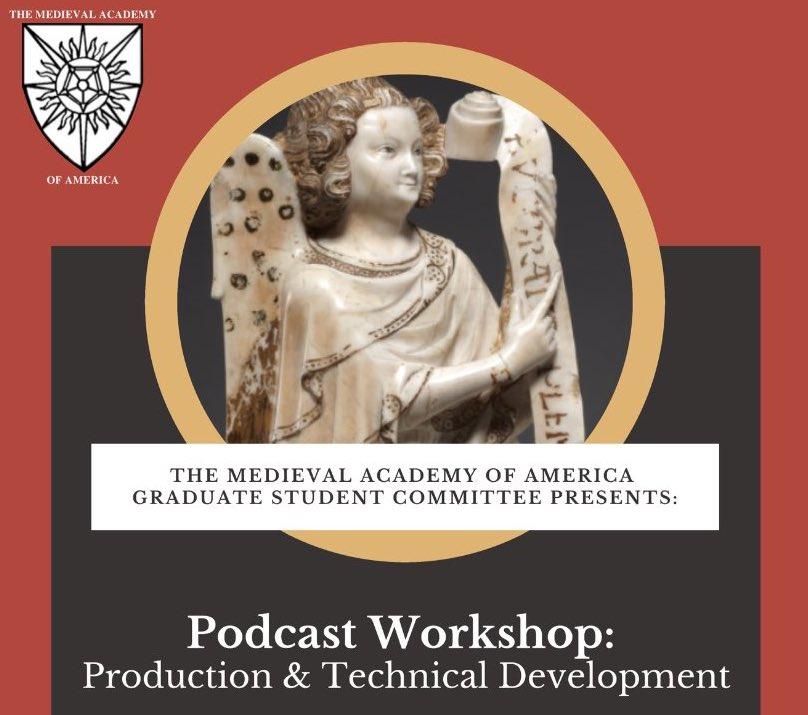
MAA News – Upcoming Podcast Workshop Series

Please join us for these Podcasting Workshops organized by the Graduate Student Committee, with the support of the MAA. The workshops will be led by Hayley Bowman, and will offer an introduction to podcasting for people with little to no experience using the medium. Interested attendants need not be medievalists or graduate students to apply. Please help us spread the word. Participation is free, but prior registration is required.

Production & Technical Development
Monday, November 8 from 11AM to 1PM (Eastern)
Register at: https://bit.ly/30hQotp

In this workshop, Hayley Bowman will discuss best practices for organizing and embarking on podcast production; how to navigate common obstacles in early production/episode development; tips for successful and entertaining episode construction; recommended technologies; and insights drawn from experience that would be useful for people with little to no experience in podcasting.

Post-Production
Monday, December 6 from 2PM to 4PM (Eastern)
Register at: https://bit.ly/3mFTKxP

In this workshop, Hayley Bowman will walk us through the final stages of producing a podcast. What does it take for a podcast episode to be ready? Hayley will discuss how to edit a sound file and other common issues that arise in the post-production stages of podcasting.

About Hayley Bowman:

Bowman is a Ph.D. candidate in the Department of History at the University of Michigan. She studies the early modern Spanish world and is broadly interested in the history of women and gender, religious communities, and place and space studies. Bowman has also served as the host and season producer of U-M’s podcast Reverb Effect, which explores how past voices resonate in the present moment.

Posted in MAA Newsletter | Leave a comment

MAA News – Good News From Our Members

Two MAA members were recently awarded publication prizes by the American Society of Church History: Laura Saetveit Miles, for The Virgin Mary’s Book at the Annunciation: Reading, Interpretation, and Devotion in Medieval England (Boydell and Brewer, 2020); and Katie Bugyis, for “Women Priests at Barking Abbey in the Late Middle Ages”, published in Women Intellectuals and Leaders in the Middle Ages (D.S. Brewer, 2020).

If you have good news to share, please contact the Executive Director.

Posted in MAA Newsletter | Leave a comment