Reminder: Deadline to Register as a Mentor or Mentee

REMINDER: DEADLINE TO REGISTER AS A MENTOR OR MENTEE:
June 8, 2020

*Please note that since IMC Leeds has been cancelled due the COVID-19 pandemic, we will be running the mentorship program digitally. Because of this, anybody can participate, regardless of their Leeds 2020 attendance plans*

The Graduate Student Committee (GSC) of the Medieval Academy of America invites both those who would have attended the 2020 International Medieval Congress, hosted by the University of Leeds (6-9 July 2020), and any other interested medievalists to participate in the GSC Virtual Mentoring Program.

The GSC Mentoring Program facilitates networking between graduate students or early career scholars and established scholars by pairing student and scholar according to discipline.

Mentorship exchanges are intended to help students establish professional contacts with scholars who can offer them career advice. The primary objective of this exchange is that the relationship be active during the conference, although mentors and mentees sometimes decide to continue communication after a conference has ended.

To volunteer as a mentor (faculty, librarians, curators, independent scholars) or to sign up as a mentee, please submit the online form, linked here, by 8 June 2020.

On behalf of the committee, thank you and our best,

Julia King & Lauren Van Nest
2020-2021 Mentoring Program Coordinators

Posted in Announcements, Graduate Students | Leave a comment

Statement from the Medieval Academy of America Presidential Officers

The Medieval Academy of America unequivocally condemns the murders of George Floyd, Ahmaud Arbery, and Breonna Taylor. Together with the fact that the current coronavirus pandemic disproportionately affects people of color, these murders have heightened our collective awareness of the pervasive reality of racism and inequality in America. For us as medievalists this should be a moment to reflect on the extent that many aspects of medieval culture contributed to these longstanding problems. As a scholarly organization we have defined our identity and our mission in a recent statement that highlights what we do and the values we strive to embrace:

Founded in 1925, the Medieval Academy supports research, publication, and teaching in medieval art, archaeology, history, law, literature, music, philosophy, religion, science, social and economic institutions, and all other aspects of the Middle Ages.

Membership in the Medieval Academy is open to all persons concerned with the study and teaching of the Middle Ages, including, but not limited to, independent scholars, secondary teachers, graduate students, curators, librarians, and college and university professors of all ranks and at all types of institutions. We aim to foster an environment of diversity, inclusion, and academic freedom for all medievalists.

Our efforts towards inclusion and diversity as medievalists – in the classroom, in our scholarship, and in our professions – must continue.  But in this moment of grave crisis, we also recognize the great responsibility we have as scholars, teachers, and leaders to model the kind of just behavior in our own communities that must also translate to our society at large.

And it is not enough to simply signal our support.  The Medieval Academy of America acknowledges that as teachers and scholars we have a particular responsibility to show how many of the technologies and structures of racism are deeply rooted in the medieval past, and further to reveal how medieval culture is too often weaponized by white supremacists to support racist ideologies.  Over the coming months we will be initiating new projects and resources to aid all teachers and scholars in addressing racism in all our endeavors.

Renate Blumenfeld-Kosinski, President
Thomas Dale, 1st Vice-President
Maureen Miller, 2nd Vice-President

Posted in Announcements | Leave a comment

MAA News – From the President

Dear members of the Medieval Academy of America,

When I had the honor of accepting the nomination as Second Vice President in 2018 the word pandemic evoked for me a long-distant past or far-away regions. Now we are all living through one of the worst pandemics in history, and we have to find ways of surviving and coping. The organizers of the 2020 annual meeting at UC Berkeley, Maureen Miller and Katherine O’Brien O’Keeffe and their team, showed what this coping could look like: with amazing speed and efficiency they managed to transform a good part of the program into Zoom meetings. Speakers and session chairs adapted quickly and generously, and although we could not meet and chat in person, the intellectual excitement was palpable as we all participated in little rectangular boxes, our new normal, it seems.

The Medieval Academy is made up of many groups: a permanent staff and a large number of volunteers serving on over twenty committees. We are all working together, trying to provide assistance and encouragement in this time of crisis. An extraordinary anonymous gift has made it possible for us to pay the annual membership fees of all of our members who at present do not have full-time faculty positions, which is almost 50% of our total membership. As we all know, medievalists work in many different professions. As we move forward, we want to know more about all the different pathways medievalists have embarked on, and this is why Laura Morreale and I are starting a project that we hope will contribute to making us aware of the many different ways medievalists work: a series of blogs written by medievalists in a variety of professions. How have their paths developed? Is their medieval expertise useful in their current professions? What advice can they share? Look for these blog posts to begin soon.

Our two recent webinars exemplify two of the directions the Medieval Academy wants to pursue more explicitly in the future: “In and Beyond the Digital: Career Pathways for Humanists” featured a digital specialist from the NEH, Hannah Alpert-Abrams, who presented the many avenues of digital work in the humanities, for both research and job development. There are many professions out there that many of us may not even know about and that would be happy to use the special skills of medievalists. The webinar and the forthcoming blog are part of our initiative to highlight and find new ways to support medievalists who are not working in traditional teaching positions. The second webinar “The Mother of All Pandemics: The State of Black Death Research in the Era of COVID-19,” organized by Monica Green and Winston Black, exemplifies our goal of including areas of the world that have not always been at the forefront of medievalists’ interests: experts on China, Africa, and the Ottoman Empire as well as medieval Europe shared the stage, drawing on recent DNA research, archeological finds, and many different artifacts to compose a nuanced picture of the centuries of the Black Plague in relation to our current pandemic. As did so many sessions at the 2019 meeting at Penn with its global focus, this model of interdisciplinary cooperation showed what can be achieved by bringing together people from many areas of expertise. A big thank you to all the organizers and panelists. As I embark on this year of my presidency, I am hopeful that we can all weather this crisis together through the team work and openness that have characterized my first two months on the job. Take care and stay safe!

Renate Blumenfeld-Kosinski, President

Posted in MAA Newsletter | Leave a comment

MAA News – Digital Content

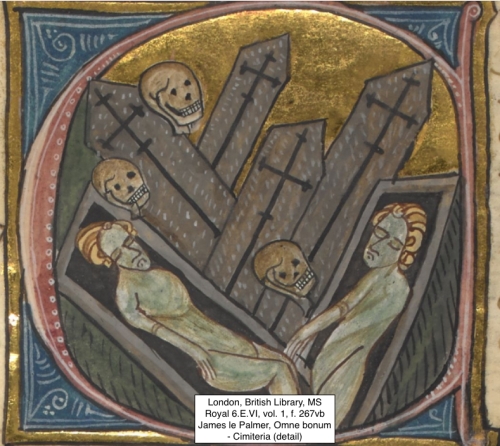
A crowded cemetery in London after the Black Death. From James le Palmer’s encyclopedia, Omne bonum (ca. 1360-ca. 1375). [London, British Library, MS Royal 6.E.VI , vol. 1, f. 267vb (detail)]

Because we cannot greet each other in person this spring or summer, the Medieval Academy has been busily developing, hosting, and promoting scholarship in a digital environment. Development of the Database of Medieval Digital Resources is ongoing, with a streamlined vetting and cataloguing process that will see resources entered into the database in a much more efficient manner. The 2020 Annual Meeting and the ongoing series of MAA Webinars can be viewed on our website or on our YouTube channel. More content will be coming soon, so watch these spaces!

Posted in MAA Newsletter | Leave a comment

MAA News – Please renew your MAA membership by June 30

Dear Colleague,

We hope you are well and are staying safe.

In the present crisis, as a growing number of our medievalist colleagues find themselves facing financial precarity, job insecurity, and difficulty accessing research resources, your Medieval Academy membership matters more than ever.  Please renew by June 30 in order to avoid an interruption in your membership benefits.

With your help, the Academy increased its support of members in 2019, especially student, independent, and contingent scholars, through the numerous awards and fellowships offered annually. We have recently implemented programming in support of medievalists of color and of medievalists working in various professional contexts, and we are working to improve the representation of the Middle Ages in K-12 classrooms. As we work towards a more expansive Middle Ages, we are also working to build a more inclusive Medieval Studies. We sincerely hope that you will renew your valued membership in the Academy as we continue this work in 2020.

The combination of the dramatic recent downturn in the stock-market and an anticipated decrease in dues revenue will directly and significantly impact the MAA’s budget. If you are able to renew your membership for 2020, please do. Your membership dues will directly help us continue to award grants and fellowships in 2020 and beyond; keep dues at a lower level for independent, contingent, unemployed, and retired medievalists; and expand our programming.

You can easily pay your dues and/or make a donation through the  MAA website where, after you sign into your account, you can also adjust your membership category if necessary. Please consider supplementing your membership by becoming a Contributing or Sustaining member or by making a tax-deductible donation. In order to make membership more affordable for those in financially precarious circumstances, we have recently revised our dues structure.

You may also wish to remember the Academy with a bequest as a member of our Legacy Society (for more information, please contact the Executive Director).
When you renew, please take a few minutes to update your profile page so that members with similar interests can find you, and you can find them. You can also check a box to indicate your interest in serving on a Medieval Academy committee or reviewing for Speculum. Your profile page now includes an option to indicate gender and racial/ethnic identity. This information will not be visible to other members, but it will help the Academy immensely as we strive to increase our understanding of member demographics and work to improve diversity and inclusivity in Medieval Studies. If you have forgotten your username and/or password, please contact us for assistance.

Thank you for your support. We look forward to working with you in 2020 and hope to see you at the 2021 Annual Meeting of the Medieval Academy at Indiana University, Bloomington.

Stay safe –

Renate Blumenfeld-Kosinski, President
Lisa Fagin Davis, Executive Director

p.s. if you have already renewed, please ignore this message and accept our thanks!
Posted in MAA Newsletter | Leave a comment

MAA News – Publication Subventions Awarded

We are very pleased to announce that the 2020 MAA Publication Subventions have been awarded to: Athi Andronikou, Italy, Cyprus, and Artistic Exchange  (Cambridge University Press) and Joyce Hendrickson, Leaving Iberia: Islamic Law and Christian Conquest in North West Africa (Harvard University Press).

Posted in MAA Newsletter | Leave a comment

MAA News – Travel Grant Awarded

Jonathan Fruoco has been awarded an MAA Travel Grant to present a paper titled “Geoffrey Chaucer et la plurivocalité urbaine” at the Moscow conference, “‘Littérature urbaine’: une donnée culturelle médiévale ou un concept de l’histoire littéraire contemporaine?”

Posted in MAA Newsletter | Leave a comment

MAA News – Good News from our Members

Our congratulations to Mary Carruthers (F ’96), who has been elected to the American Academy of Arts and Sciences.

If you have good news to share, please send it to Executive Director Lisa Fagin Davis (LFD@themedievalacademy.org)

Posted in MAA Newsletter | Leave a comment

MAA News – Office Closure Update

Although Boston is slowly reopening, the MAA Staff will continue to work from home through at least the end of August. In the meantime, we recommend that you contact us by email instead of by phone. We hope you are all well, and we look forward to greeting you in person when it is safe to do so.

Posted in MAA Newsletter | Leave a comment

York Festival of Ideas Online

York Festival of Ideas Online
Virtual Horizons
2-14 June 2020

The Brothers York: An English Tragedy
11am, Sunday 7 June 2020
Historian Thomas Penn explores how a dynasty that could have been as magnificent as the Tudors destroyed itself in the space of one generation.
http://yorkfestivalofideas.com/2020-online/calendar/brothers-york/

Warrior: A life of war in Anglo-Saxon Britain
1pm, Sunday 7 June 2020

Writers Edoardo Albert, and archaeologist Paul Gething, present the incredible story of a nameless Anglo-Saxon warrior whose bones were found at Bamburgh Castle.

http://yorkfestivalofideas.com/2020-online/calendar/warrior-life/

The Anglo-Saxon Origins of Whitby Fish and Chips
4pm, Sunday 14 June 2020

Historian, Tom Pickles, reveals a new interpretation of a curious medieval ritual – the Penny Hedge – which take place in Whitby each year.
http://yorkfestivalofideas.com/2020-online/calendar/fish-chips/

To view the full Festival programme, please go to http://yorkfestivalofideas.com/2020-online/

Posted in Announcements | Leave a comment