
Postdoctoral Research Assistant – A Consolidated Library of Anglo-Saxon Poetry
University of Oxford – Faculty of English Language and Literature
| Location: | Oxford |
| Salary: | £31,604 to £38,833 p.a. |
| Hours: | Full Time |
| Contract Type: | Fixed-Term/Contract |
| Placed on: | 5th June 2018 |
| Closes: | 4th July 2018 |
| Job Ref: | 135232 |
Gibson Building, Radcliffe Observatory Quarter, Oxford
Grade 7: £31,604 – £38,833 p.a.
Following the award of a European Research Council Advanced Grant to Professor Andy Orchard (‘A Consolidated Library of Anglo-Saxon Poetry’), the Faculty of English Language and Literature is seeking to appoint a Postdoctoral Research Assistant to work on the project. This post will be fixed-term until 31 August 2021, and it is anticipated that the appointee will start on 1 October 2018 or as soon as possible thereafter.
The project involves the creation of an interactive online edition of the 60,000 or so lines of verse, roughly half in Old English and half in Latin, that comprise the entire combined corpus of Anglo-Saxon poetry. This will be marked up through TEI P5 XML to facilitate the identification of idiosyncratic features of sound, metre, spellings, diction, syntax, formulas, themes, and genres across the corpus. The project will produce a linked series of conferences, workshops, and print publications, including monographs, conference-proceedings, and a themed issue of an academic journal. CLASP will use the full panoply of digital resources, including sound- and image-files where relevant, to make the oldest surviving poetry from Anglo-Saxon England available to a modern audience for unprecedented kinds of exploration, comprehensive analysis, and interrogation. Further details of the project are included at Appendix 1 of the Further Particulars.
The researcher will have training in both Old English and Latin, and will focus on integrating and cross-referencing material both within and across languages. Throughout the project, the RA will be expected to present their research at several conferences a year, to produce articles, and to co-edit conference proceedings and other publications. They will also help to organise the seminars, workshops, and conferences, and will co-edit the conference proceedings and special journal issue.
Applicants should possess a PhD in Anglo-Saxon Literary and Linguistic Studies or a related field (the PhD must have been awarded by the time the individual takes up the post); experience of work with Anglo-Saxon texts and manuscripts, including accuracy in translation; proficiency in both Old English and Latin, especially with regard to language and metre; the ability to work flexibly, and in a team; a willingness to participate in the overall running of the project and public engagement activities; a high level of communication skills, including the ability to address a range of audiences; a high level of organisational skills and an ability to meet deadlines; excellent computer skills; and the capability to work independently, and across disciplinary boundaries.
Further Particulars (which all applicants must consult) are available below.
Applications should include a CV and a supporting statement explaining your suitability for the post. Candidates shortlisted for interview will be asked to submit a sample of written work (8,000 – 10,000 words) in advance of the interview, and will be requested to give a short presentation as part of the assessment process. Two references will be sought for shortlisted candidates.
The closing date for applications is 12.00 noon on 4 July 2018. Interviews are expected to be held in Oxford during week beginning 16 July 2018.
https://www.recruit.ox.ac.uk/pls/hrisliverecruit/erq_jobspec_version_4.jobspec?p_id=135232
Closing Date: 04-JUL-2018 12:00
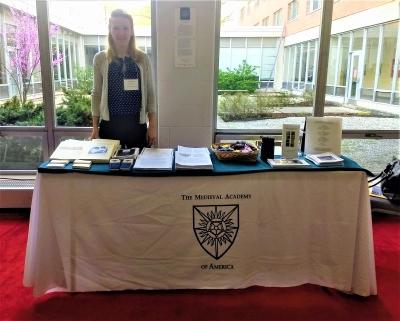 Like many of you, we’ve just returned from another splendid International Congress on Medieval Studies in Kalamazoo. Speculum Editor Sarah Spence, Associate Editor Agnieszka Rec, Assistant Editor Laura Ingallinella, and Executive Director Lisa Fagin Davis all enjoyed chatting with current and potential members at our table in the exhibit hall. We are particularly pleased to welcome the new members who benefited from our annual “Fifty Free” program, in which we give away fifty one-year introductory MAA memberships at Kalamazoo.
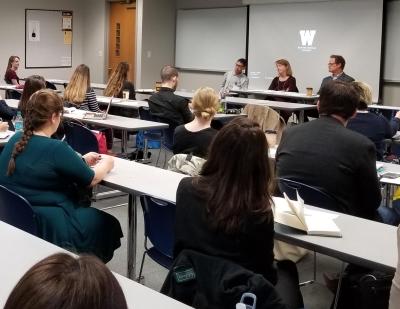 Three distinguished journal editors offered tips on publication to a room full of graduate students and advisors during a session organized and moderated by the MAA Graduate Student Committee: “Meet the Editors: Tips and Techniques on Article Submission for Graduate Students (A Roundtable).” Sarah Spence (Speculum), Michael Cornett (Journal of Medieval and Early Modern Studies), and Chris Africa (Medieval Feminist Forum) helped reframe the publication process as one of collaboration and conversation. They reminded the room that all journals have a niche, a mission, and a specific audience that graduate researchers should keep in mind when crafting manuscripts. The best way to learn about these aspects of the journal, of course, is to read recent issues! They also advised graduate students to know the current state of the field, to position their arguments within the discourse, and to have a candid conversation with their advisor about whether the piece is ready for submission. Lastly, they reaffirmed the basics: Be professional in all your communications and proofread! Thanks again to all the panelists and to those who attended for helping to facilitate conversation between graduate student writers and editors. (with thanks to GSC Chair Theodore Chelis (Pennsylvania State Univ.) for this summary)
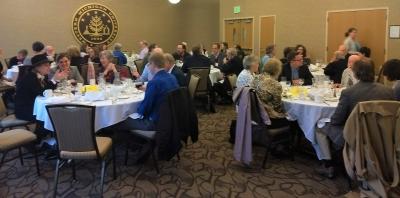 The annual CARA (Committee on Centers and Regional Associations) Luncheon enjoyed a record attendance of more than forty delegates who participated in discussions of practical topics such as budgeting, fundraising, libraries, public advocacy, and improving medieval studies in K-12 curricula. If you would like to participate in the networking and advisory opportunities afforded by CARA, please join us at the annual CARA Meeting (on the Sunday after the MAA Annual Meeting) and at the CARA luncheon at the ICMS in Kalamazoo.
 The 94th Annual Meeting of the Medieval Academy of America will take place in Philadelphia on the campus of the University of Pennsylvania, from 7-9 March 2019. The meeting is jointly hosted by the Medieval Academy of America, Bryn Mawr College, Delaware Valley Medieval Association, Haverford College, St. Joseph’s University, the University of Pennsylvania, and Villanova University.
 The Medieval Academy of America seeks to appoint an Editor for Speculum. The position is configured as part-time, requiring around 25 hours per week. The Editor is appointed for an expected five-year term, subject to acceptable yearly performance reviews, with the possibility of a second five-year term by mutual agreement. The editor should be an established scholar with academic credentials in some field(s) of medieval studies, broadly defined, with good organizational and decision-making skills. Experience in journal or book editing will be helpful but not necessary. The new editor should plan on taking office in the late Spring of 2019, and at the latest by July 1, 2019. Terms and conditions are to be negotiated, as is the physical location of the Editor.


