
Statement of Aims
Contributors are sought for an edited collection, under contract with publishers Taylor and Francis, that illuminates the many worlds of the Medieval Mediterranean, from 470 to 1350. In addition to narrative essays contributors will provide primary source materials, written and/or visual, illustrative of their argument and meant to engage students more deeply into the topic. In total, the editor seeks three contributors for each of eleven chapters. Final essays will vary between 2000 and 3000 words, depending on the type of primary source. In making the final selection, the editor seeks to balance primary texts (or selections of texts) and images. Chapters with general (yet flexible) essay themes are as follows:
The Mediterranean and its Environmental History: natural history, geography, geology, plants and animals, biodiversity
The Mediterranean of Antiquity: first inhabitants, Phoenicians and their contemporaries, the Roman Mediterranean
Daily Life in the Medieval Mediterranean: Women, men, marriage, and families, sexuality and gender, the culinary world
A Space of Conflict: warfare (religious and secular), slavery, imperialism, race, and identity
Corsairs and Pirates: this chapter is wide open
A Space of Convergence and Cooperation: the importance of hospitality, narratives of travel – religious, secular, mercantile, etc., emerging ideas of the “Other”
A Profitable Mediterranean: commerce and trade, the world of the merchant, the demand and proliferation of goods
Religion in the Medieval Mediterranean: faith before the emergence of monotheism, the religious descendants of Abraham, religious influences from the Silk Road, faith at the intersections of discord and concord
Cultural and Cultural Exchanges in the Medieval Mediterranean: poetry and stories, art, architecture, and music, technology, the lessons of archaeology
Meeting in the Middle: the meeting of East and West in the emporiums of Arabia, the spread of language and communication, Silk Road/Mediterranean connections
Toward a Renaissance Mediterranean: plague, illness, and death, a changing Mediterranean world, legacies of the Medieval Mediterranean
Please send 300 to 500-word abstracts that address a specific chapter, along with initial thoughts on appropriate primary sources to Jeanette M. Fregulia at jfregulia@carroll.edu by September 7, 2018. Authors will be notified of a decision by September 17, 2018, and final essays are due by December 31, 2018. Must be previously unpublished material.
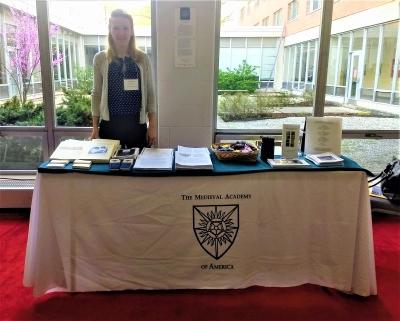 Like many of you, we’ve just returned from another splendid International Congress on Medieval Studies in Kalamazoo. Speculum Editor Sarah Spence, Associate Editor Agnieszka Rec, Assistant Editor Laura Ingallinella, and Executive Director Lisa Fagin Davis all enjoyed chatting with current and potential members at our table in the exhibit hall. We are particularly pleased to welcome the new members who benefited from our annual “Fifty Free” program, in which we give away fifty one-year introductory MAA memberships at Kalamazoo.
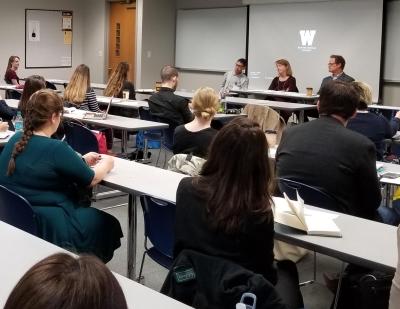 Three distinguished journal editors offered tips on publication to a room full of graduate students and advisors during a session organized and moderated by the MAA Graduate Student Committee: “Meet the Editors: Tips and Techniques on Article Submission for Graduate Students (A Roundtable).” Sarah Spence (Speculum), Michael Cornett (Journal of Medieval and Early Modern Studies), and Chris Africa (Medieval Feminist Forum) helped reframe the publication process as one of collaboration and conversation. They reminded the room that all journals have a niche, a mission, and a specific audience that graduate researchers should keep in mind when crafting manuscripts. The best way to learn about these aspects of the journal, of course, is to read recent issues! They also advised graduate students to know the current state of the field, to position their arguments within the discourse, and to have a candid conversation with their advisor about whether the piece is ready for submission. Lastly, they reaffirmed the basics: Be professional in all your communications and proofread! Thanks again to all the panelists and to those who attended for helping to facilitate conversation between graduate student writers and editors. (with thanks to GSC Chair Theodore Chelis (Pennsylvania State Univ.) for this summary)
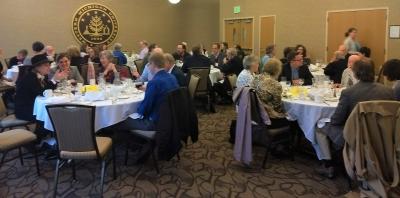 The annual CARA (Committee on Centers and Regional Associations) Luncheon enjoyed a record attendance of more than forty delegates who participated in discussions of practical topics such as budgeting, fundraising, libraries, public advocacy, and improving medieval studies in K-12 curricula. If you would like to participate in the networking and advisory opportunities afforded by CARA, please join us at the annual CARA Meeting (on the Sunday after the MAA Annual Meeting) and at the CARA luncheon at the ICMS in Kalamazoo.
 The 94th Annual Meeting of the Medieval Academy of America will take place in Philadelphia on the campus of the University of Pennsylvania, from 7-9 March 2019. The meeting is jointly hosted by the Medieval Academy of America, Bryn Mawr College, Delaware Valley Medieval Association, Haverford College, St. Joseph’s University, the University of Pennsylvania, and Villanova University.
 The Medieval Academy of America seeks to appoint an Editor for Speculum. The position is configured as part-time, requiring around 25 hours per week. The Editor is appointed for an expected five-year term, subject to acceptable yearly performance reviews, with the possibility of a second five-year term by mutual agreement. The editor should be an established scholar with academic credentials in some field(s) of medieval studies, broadly defined, with good organizational and decision-making skills. Experience in journal or book editing will be helpful but not necessary. The new editor should plan on taking office in the late Spring of 2019, and at the latest by July 1, 2019. Terms and conditions are to be negotiated, as is the physical location of the Editor.


