International Medieval Society Paris

Over the past fifteen years, the International Medieval Society-Paris (IMS-Paris) has promoted interdisciplinary intellectual exchange among international scholars of medieval studies and colleagues in France.  A bi-lingual non-profit association founded in Paris in 2002 by Meredith Cohen (UCLA) and Danielle Johnson (Wells College, Paris), the IMS-Paris has grown to count a dynamic group of art and architectural historians, historians, musicologists, and literary scholars from all over the world among its members.  We organize a number of activities throughout the year to benefit medievalists who are carrying out research in France, and to help French academics gain visibility at international conferences in Europe and the Americas.

Throughout the year, the society organizes monthly meetings in Paris where scholars can present their research.  This is incredibly beneficial to those from abroad who are visiting France to work in libraries and archives, and offers them an opportunity to share their works in progress for discussion, and exchange ideas socially.  Those taking part in our monthly activities include graduate students, junior and senior scholars, and independent scholars. While our meetings tend to draw many visitors who are in France temporarily, a number of French scholars take part in our activities.  This network offers ideal opportunities for help with any number of questions an international scholar might face while doing research in French institutions.  The first meeting of the year gives an overview of research resources in Paris, which is incredibly important for those doing work there for the first time.  This meeting is also very beneficial for more seasoned researchers, as it provides the most up-to-date information.

One very important series of activities taking place throughout the year, the Campus Condorcet, is organized in conjunction with the Laboratoire de médiévistique occidentale de Paris (LAMOP) of Paris I-Sorbonne, with whom we have been affiliated since 2009.  This series of seminars, sponsored by a consortium of Parisian universities, features internationally recognized scholars from all fields, and it is attended not only by IMS members, but also by students and scholars from institutions throughout the Paris region and beyond.  This year’s theme was Les Techniques Digitales au Moyen Âge, which featured three full days of workshops, including a visit to the medieval galleries of the Louvre with a thematic talk on gestures.

In addition to our monthly activities, the society organizes an annual three-day international interdisciplinary symposium on a designated theme every June.  The symposium normally accepts abstracts primarily on French or francophone topics, but also has accepted submissions from other areas in medieval studies as they fit the theme.  Our 2018 symposium is on Truth and Fiction, with keynotes Maureen Boulton (University of Notre Dame) and Patrick Boucheron (Collège de France).  Published proceedings from several of our conferences include:  Difference and Identity in Francia and Medieval France (Routledge, 2010), Memory and Commemoration in Medieval Culture (Routledge, 2013), L’Humain et l’Animal (Brill, 2014), and Space in the Medieval West (Routledge, 2014).

An equal part of the IMS-Paris’ mission is to help French and other foreign researchers in France gain an audience in the United States at the International Congress on Medieval Studies at the University of Western Michigan in Kalamazoo.  Most recently, we have had a number of French scholars participate in our co-sponsored sessions with the Centre d’Etudes Supérieures de Civilisation Médiévale (CESCM) of the Université de Poitiers.  Equally important to our international presence are our sponsored sessions in the UK at the International Medieval Congress at the University of Leeds.  In addition to providing an opportunity to present at these conferences, the IMS helps these researchers navigate the application process, and can help to assist as an orientation mechanism for officially collaborating with research structures in the United States and the UK.

The International Medieval Society-Paris is a cooperative association that relies on the participation of its members to achieve its goals.  Membership is open to all scholars with a specialization in the Middle Ages.  We welcome anyone who might find themselves in the Paris region to take part in our activities.  For more information on our activities, workshops, meetings, and publications, consult our website: http://www.ims-paris.org/#

Dr. Sarah Ann Long, President
Assistant Professor of Musicology
Michigan State University

Posted in CARA | Leave a comment

39th Annual Medieval and Renaissance Forum

39th Annual Medieval and Renaissance Forum:
Image and Visual Experience in the Middle Ages and Renaissance
Keene State College
Keene, NH, USA

Friday and Saturday April 13-14, 2018

Call for Papers and Sessions

We are delighted to announce that the 39th Medieval and Renaissance Forum: Image and Visual Experience in the Middle Ages and Renaissance will take place on April 13 and 14, 2018 at Keene State College in Keene, New Hampshire.

We welcome abstracts (one page or less) or panel proposals that discuss images and visual experience in the Middle Ages and the Renaissance.

Papers and sessions, however, need not be confined to this theme but may cover other aspects of medieval and Renaissance life, literature, languages, art, philosophy, theology, history, and music.

This year’s keynote speaker is Jeffrey F. Hamburger, Kuno Francke Professor of German Art and Culture at Harvard University who will speak on “The Diagram Paradigm in the Middle Ages—and Beyond.”

Professor Hamburger’s teaching and research focus on the art of the High and later Middle Ages. Among his areas of special interest are medieval manuscript illumination, text-image issues, the history of attitudes towards imagery and visual experience, German vernacular religious writing of the Middle Ages, especially in the context of mysticism, and, most recently, diagrams, the topic of his forthcoming book: From Cross to Crucifix: Typology, Diagrams and Devotion in Berthold of Nuremberg’s Commentary on Hrabanus Maurus’ In honorem sanctae crucis.  Dr. Hamburger is also the author of several other books, including St. John the Divine: The Deified Evangelist in Medieval Art and Theology (Berkeley-Los Angeles: University of California Press, 2002), The Visual and the Visionary: Art and Female Spirituality in Late Medieval Germany (New York: Zone Books, 1998), Nuns as Artists: The Visual Culture of a Medieval Convent (Berkeley-Los Angeles: University of California Press, 1996), and The Rothschild Canticles: Art and Mysticism in Flanders and the Rhineland circa 1300 (New Haven: Yale University Press, 1990).

All papers presented at this year’s Forum are eligible for inclusion in Selected Proceedings of the 39th Medieval and Renaissance Forum, to be published by Cambridge Scholars Press.  Contributors interested in publishing their work in this volume should submit their revised essays by May 15, 2018.

Students, faculty, and independent scholars are welcome. Please indicate your status (undergraduate, graduate, or faculty), affiliation (if relevant), and full contact information, including email address on your proposal.

We welcome undergraduate sessions, but require faculty sponsorship.

Please submit abstracts, audio/visual needs, and full contact information to Dr. Robert G. Sullivan, Assistant Forum Director at sullivan@german.umass.edu.

Abstract deadline: January 15, 2018

Presenters and early registration: March 15, 2018

We look forward to greeting returning and first-time participants to Keene in April!

Posted in Call for Papers | Leave a comment

Mary Jaharis Center Dissertation Grants 2018–2019

The Mary Jaharis Center for Byzantine Art and Culture is pleased to announce its 2018–2019 grant competition. Our grants reflect the Mary Jaharis Center’s commitment to fostering the field of Byzantine studies through the support of graduate students.

Mary Jaharis Center Dissertation Grants are awarded to advanced graduate students working on Ph.D. dissertations in the field of Byzantine studies broadly conceived. These grants are meant to help defray the costs of research-related expenses, e.g., travel, photography/digital images, microfilm.

The application deadline is February 1, 2018. For further information, please see https://maryjahariscenter.org/grants/dissertation-grant-20182019.

Contact Brandie Ratliff (mjcbac@hchc.edu), Director, Mary Jaharis Center, with any questions.

Posted in Grants | Leave a comment

Call for Papers – 18th Annual North Carolina Colloquium in Medieval and Early Modern Studies: Forms of Dissent in the Medieval and Early Modern World

Conference: 18th Annual North Carolina Colloquium in Medieval and Early Modern Studies: Forms of Dissent in the Medieval and Early Modern World

March 9-10, 2018, Duke University

CFP Deadline: January 22, 2018

Website: https://sites.duke.edu/nccmems2018/

Keynote Speakers: Dr. Sara S. Poor, medieval studies, Princeton University and 2017-18 NHC Fellow; Dr. Roseen Giles, musicology, Duke University

The Annual North Carolina Colloquium in Medieval and Early Modern Studies invites graduate students to submit proposals for twenty-minute paper presentations to an interdisciplinary audience that consider the forms and functions of dissent (broadly conceived) throughout the medieval and early modern world. In addition to investigations of forms of dissent against established structures, hierarchies, and institutions, we especially invite papers which seek to explore how forms of dissent operated as turning points or pivots, as “sites of conversions,” within and as an integral part of those same structures. In this sense, we invite participants to consider in what ways dissent might be imagined not only as a rupture or a break, but also as an ongoing process of conversion or even innovation. With support from the international Early Modern Conversions Project (for more information, see earlymodernconversions.com), we are interested in considering dissent in all its forms–social, religious, political, artistic–and especially in its points of contact with conceptions of conversion, broadly considered.

We welcome graduate students working in all fields of inquiry concerned with the period from late antiquity to the end of the 17th century, including but not limited to history, literature, theology, philosophy, musicology, cultural studies, anthropology, art history, gender and sexuality studies, religion, and political theory. Topics for papers might consider dissent’s interaction with one or more of the following broad categories, but all pertinent submissions are warmly welcomed:

  • Religion, theology, and ecclesiology
  • Literature, textuality, hermeneutics
  • Politics, law, and legal thought
  • Gender and sexuality
  • The creative and performing arts
  • Intellectual history and philosophy
  • Social history and material culture

Interested participants should submit a 250-word abstract no later than January 22, 2018. Applicants will be notified of their acceptance by February 1, 2018. Free accommodations and local travel assistance during the conference with host students may be available for interested participants traveling from outside the Triangle area; please indicate in your application if you might be interested in staying with a graduate student host. All applications and inquiries should be sent to dissentconference@gmail.com. Please include the presenter’s name, institutional affiliation, and contact information in the body of the email; abstracts should be attached as a separate PDF or Word document.

Posted in Call for Papers | Leave a comment

MAA GSC Annual Meeting Travel Bursaries

Are you interested in attending the 2018 Medieval Academy Annual Meeting but need some financial assistance to get to Atlanta?

Thanks to the generosity of the Graduate Student Committee, which has opted to re-allocate a portion of its annual budget towards this program, the Medieval Academy is offering graduate student travel bursaries of $200-300 to support attendance at the Medieval Academy Annual Meeting at Emory University, 1-3 March 2018. To apply, you must be a graduate student member of the Medieval Academy and explain why attendance at the meeting is important to your research. The Annual Meeting program is available here.

Applications must be received by January 15. Click here to apply!

N.B.: This travel funding is for students who are NOT presenting at the meeting but would like to attend. If you are PRESENTING at the Annual Meeting, do NOT apply for this bursary; you are eligible for a different program run by the Annual Meeting Program Committee. Contact the Program Committee for more information.

Posted in Annual Meeting, Graduate Students | Leave a comment

Seeking Editor of Speculum

The Medieval Academy of America seeks to appoint an Editor for Speculum.  The position is configured as part-time, requiring around 25 hours per week. The Editor is appointed for an expected five-year term, subject to acceptable yearly performance reviews, with the possibility of a second five-year term by mutual agreement. The editor should be an established scholar with academic credentials in some field(s) of medieval studies, broadly defined, with good organizational and decision-making skills. Experience in journal or book editing will be helpful but not necessary. The new editor should plan on taking office in the late Spring of 2019, and at the latest by July 1, 2019. Terms and conditions are to be negotiated, as is the physical location of the Editor.

Applications should be sent to the MAA by July 30, 2018. There will be electronic interviews in Fall 2018 and interviews with finalists in early December, 2018. Cover letters may be addressed to David Wallace, Chair of the Search Committee. In addition to a curriculum vitae, the cover letter should include ideas about future directions for the journal, and discussion of how s/he envisions setting up the position, either in the MAA office, now in Cambridge, MA, or by moving the operation to a university campus. If the latter, s/he will describe possible institutional support. The search committee wants to identify the best pool of candidates, and the MAA is willing to be flexible in finding ways to accommodate the various modes of professional life encountered in the searching process. However, wherever the ultimate location of the Editor, there will need to be access to a major research library and to graduate students who can be hired for assistance. Candidates should also include the names and email addresses of three scholars who can speak to the candidate’s editorial experience and scholarship; these references will only be contacted for long-listed candidates. The MAA President would be happy to respond to immediate questions about the duties involved, but candidates should also consult the fuller description of duties posted on the Academy website. The MAA also encourages nominations for the position, and there is a place to submit these on the website as well; all nominees will be sent a letter encouraging application.

For additional information, contact: EditorSearch@TheMedievalAcademy.org

Click here for a full job description and to apply.

Click here to submit a nomination.

Posted in Jobs for Medievalists, Speculum | Leave a comment

MAA News – From the Executive Director

At the recent American Council of Learned Societies Executive Officers’ meeting in Ft. Worth, I met with the directors of more than sixty of our sister societies, ranging from small volunteer organizations with a few hundred members that run on a shoestring to mega-organizations with dozens of paid staffers, tens of thousands of members, and multi-million-dollar budgets. The Academy falls somewhere in the middle, with six paid staff members, 3,500 members, and an annual budget of around $850,000. And while our goals may be somewhat different from those of, say, the American Society for Aesthetics, over the course of the three-day meeting we found that we have much in common. In particular, we are all determined to support our members in their work and in their humanity.
At the EO meeting, we spoke about these issues at length and discussed how we might advocate for our members more effectively. Members of the Medieval Academy are facing many of the same challenges as members of our sister societies. It is not only medievalists who have recently faced painful issues of harassment and racism on campus and online:
classicists and eighteenth-century scholars, among others, have struggled with similar issues in recent months. Fiscal challenges to the humanities at the federal level have also hit close to home.

Many of the ACLS affiliates are comprised primarily of academics, and so the stresses of the job market affect us all. You may have seen recent reports from the American Historical Association and the Modern Language Association comparing the number of PhDs granted in recent years with the number of tenure track and other academic jobs on offer. The news was discouraging, to say the least.

The Medieval Academy will be addressing these pressing issues with sessions at our upcoming Annual Meeting at Emory University (1-3 March): a stand-alone panel and discussion, “Building Inclusivity and Diversity: Challenges, Solutions, and Responses in Medieval Studies” (Thursday at 5 PM); and the Graduate Student Roundtable, “A Future Outside of Academia: Alternative Careers for Graduate Students in Medieval Studies” (Friday at 4 PM). We hope that you will join us in Atlanta to take part in these valuable conversations, both of which, we hope, will lead to ongoing discussions and development of policy that will help make the Medieval Academy a more welcoming place for medievalists of all backgrounds and all career paths.

It is hard enough for students to face an uncertain job market without also facing the possibility of seeing their student debt increase due to the recent House of Representatives tax proposal that would make graduate student tuition waivers taxable federal income. It was this concern, in particular, that prompted ACLS affiliates, with the leadership of the American Philosophical Association, to sign a joint statement condemning this provision. We will continue to work with our sister societies to advocate for our members through a formal network of Executive Officers.

We cannot do this work without your support, however. If you haven’t yet renewed for 2018, please do so as soon as possible. You will also be hearing from me this week by mail with an end-of-year fundraising appeal. Please give if you can. Your gift and your membership fee directly support our grantmaking and subvention initiatives. I thank you in advance for your support.

On behalf of the staff and governance of the Medieval Academy of America, I wish you a very happy holiday season. The Office will be closed from December 25 – January 1. We look forward to working with you in 2018.

– Lisa

Lisa Fagin Davis, Executive Director
LFD@TheMedievalAcademy.org

p.s. Here’s an easy way to support the Medieval Academy of America when you shop at Amazon.com this holiday season: go to smile.amazon.com , select the Medieval Academy as your charity of choice, and shop as usual! Amazon will contribute .5% of your purchase amount to the Medieval Academy of America.

Posted in MAA Newsletter | Leave a comment

MAA News – The Digital Middle Ages

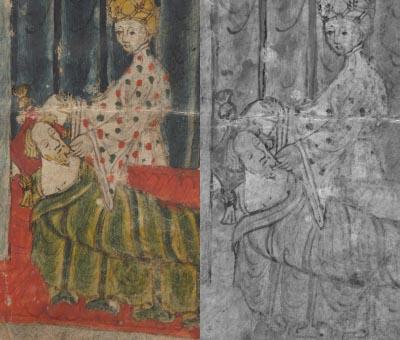
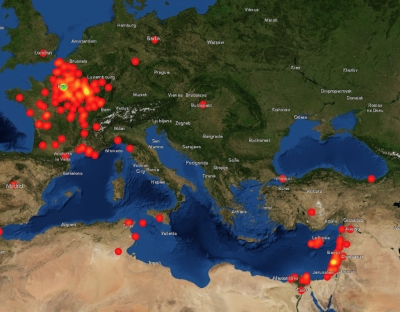
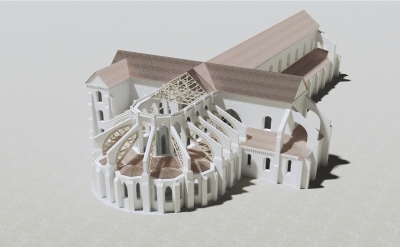
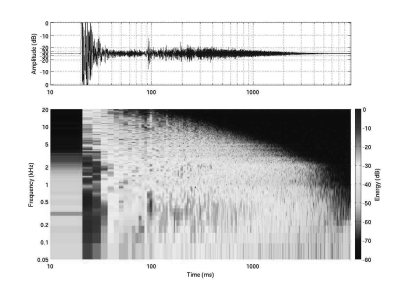
In their introduction to the The Digital Middle Ages (Speculum 92S1), issue editors David J. Birnbaum, Sheila Bonde, and Mike Kestemont wrote: “Our aims in this supplement of Speculum are frankly immodest….[W]e hope, by bringing together a diversity of projects, to showcase for the Academy membership the wide range of exciting possibilities afforded by digital humanities….This supplement is the first issue of Speculum devoted to digital medieval projects, and it is offered in an online, open-access format that reinforces the openness to which the digital aspires and which it encourages.” The supplement–different, of course, from the electronic version of the October issue–is a stand-alone issue available to all but only in digital format, since it demonstrates, through resources available online, the wealth of methodologies increasingly available to medievalists. We hope you have had a chance to delve into it, and we offer a few images from its pages as inducements:

Stones: British Library, MS Add. 10294, fol. 44. Miniature (© British Library Board; GIS © Alison Stones).

McGillivray and Duffy: Detail of MS Cotton Nero A.x. fol. 90/94r (with and without infrared).

Wrisley: A heat map of place names found in Joinville’s Vie de saint Louis, created using the Geographic Information System software ArcGIS.

Bonde, Coir, and Maines: Notre-Dame d’Ourscamp, 3D reconstruction of stage 44 showing the beginning of roofing of the Gothic chevet (Bonde, Coir, and Maines).

Pentcheva and Abel: Hagia Sophia, Istanbul, balloon-pop response (above) and associated spectrogram (below), December 2010 (diagram by Jonathan S. Abel)

Posted in MAA Newsletter | Leave a comment

MAA News – Join Us at the 93rd Annual Meeting in Atlanta

We are very pleased to announce that the program for the 93rd Annual Meeting of the Medieval Academy of America is now online here. Mark your calendars for March 1-3 at Emory University, and stay tuned for the opening of registration and hotel reservations in early January.

Posted in MAA Newsletter | Leave a comment

MAA News – Membership Renewal

If you haven’t already renewed your Medieval Academy membership, please do so by 31 December. You can renew online here or by printing and returning this form.

Posted in MAA Newsletter | Leave a comment