2017-2018 Residential Fellowships at the National Humanities Center

NATIONAL HUMANITIES CENTER
Residential Fellowships 2017-18

The National Humanities Center invites applications for academic-year or one-semester residencies. Fellowship applicants must have a PhD or equivalent scholarly credentials. Mid-career as well as senior scholars from all areas of the humanities are welcome; emerging scholars with a strong record of peer-reviewed work are also invited to apply. The Center does not normally support the revision of a doctoral dissertation. Located in the progressive Triangle region of North Carolina, the Center affords access to the rich cultural and intellectual communities supported by the area’s research institutes, universities, and dynamic arts scene. Fellows have private studies; the library service delivers all research materials. Scholars from all parts of the globe are eligible; a stipend and travel expenses are provided. The deadline for applications is October 18, 2016. http://nationalhumanitiescenter.org/become-a-fellow/

The National Humanities Center does not discriminate on the basis of race, color, sex, gender identity, religion, national or ethnic origin, handicap, sexual orientation, or age. We are dedicated to fair treatment, diversity, and inclusion.

Posted in Fellowships | Leave a comment

MAA News – MAA Centennial Committee

maa100Dear MAA Members:

At our February 2016 Annual Meeting in Boston, the Council of the MAA, in anticipation of the upcoming centenary of the founding of the Academy in 1925, voted to constitute a long-range planning committee to review our role in medieval studies as we move forward into our second century. I was charged with the constitution of that committee. I write to inform you that this Centennial Planning Committee is now in place as follows:

Richard Unger (Univ. of British Columbia), Chair
Patrick Geary (Institute for Advanced Study)
Anne Lester, CARA Chair (Univ. of Colorado, Boulder)
Eugene Lyman, MAA Treasurer
Elizabeth Morrison (The Getty Museum)
Kathryn Reyerson (Univ. of Minnesota)
Barbara Shailor (Yale Univ.)
Jerry Singerman (Univ. of Pennsylvania Press)
Nicholas Watson (Harvard Univ.)
Lisa Fagin Davis (Ex-officio, Medieval Academy of America)

I am most grateful to all the members of the Centennial Planning Committee for their willingness to serve for the three-year duration of the Committee, and especially to Richard Unger, a very active member and former President of the MAA, for taking on the additional burden of chairing it. Richard is already developing strategies to reach out to the entire MAA community as the committee works to discern its tasks; you will hear from him directly within the next few weeks.

With best wishes for a restful and productive summer,

Carmela Vircillo Franklin, President, Medieval Academy of America

Posted in MAA Newsletter | Leave a comment

MAA News – Speculum Editorial Postdoc Appointed

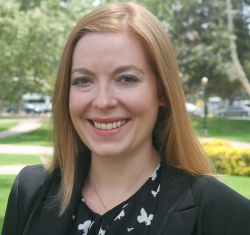
SaraTorresSara V. Torres (2014 Ph.D. UCLA) has been awarded the 2016-17 editorial postdoctoral fellowship at Speculum. Sara was selected from a pool of more than forty applicants. She will join the Speculum team in July and work as a full-time editorial assistant for one year. During this time she will oversee the book review process and contribute to the editing and production of the entire journal.

Dr. Torres is currently a Lecturer in English at the University of California, Los Angeles, with interests in global and comparative medieval studies and history of the book. Her research focuses on the cultural exchange between England and Iberia during the fourteenth, fifteenth, and sixteenth centuries and traces the movement of dynastic narratives over political borders.

Sara brings to the postdoctoral fellowship strong editorial experience, having served as assistant editor of the University of California Press quarterly Boom; freelance copyeditor; editorial research assistant for Prof. Barbara Fuchs; cataloguer of a collection of 17th- and 18th-century British religious pamphlets, including late medieval and colonial American legal documents; and member of the editorial board of Comitatus: A Journal of Medieval and Renaissance Studies.

In addition to receiving a Medieval Academy Shallek Award in 2010, Sara has been the recipient of numerous grants and fellowships, including a travel grant from the Institute for the Editing of Historical Documents and a scholarship from the Gladys Krieble Delmas Foundation.

We are thrilled to welcome her to the staff and look forward to working with her.

Posted in MAA Newsletter | Leave a comment

MAA News – Kalamazoo Report

kzooAs always, the Medieval Academy of America had a strong presence at Kalamazoo. The Medieval Academy plenary lecture delivered by Jane Chance (Rice Univ.) was well-attended and -received, generating much discussion and comment about Tolkien and his take on female characters in Anglo-Saxon literature. The two associated sessions on “How We Read” were very well-attended as well.

The two roundtables sponsored by CARA addressed important topics and sparked lively discussions: “Writing the Middle Ages for Multiple Audiences” and “Addressing Career Diversity for Medievalists.” The annual CARA Luncheon followed the same model as last year. Each of the more than forty attendees was assigned to a table at which facilitated discussions of various topics took place. Participants shared issues of concern and helped each other brainstorm solutions and strategies. Some discussions have continued by email as participants follow-up on ideas and suggestions. Finally, the Graduate Student Committee hosted its own roundtable, “The Modern Grail: Insider Tips from Search Committees to Land That Academic Job,” followed by a reception.

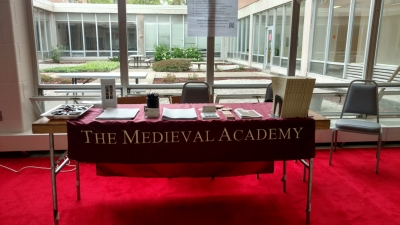
Even though the wine hours had been relocated from Valley III to Bernhard, our staffed table in the exhibit hall served as a lively homebase, with many Congress attendees stopping by to conduct business, ask questions, or just say hello. We want to send a warm welcome to the fifty new MAA members who received free one-year memberships. We look forward to working with you all in the coming year.

Posted in MAA Newsletter | Leave a comment

MAA News – MAA@Leeds

If you’re going to be at Leeds this year, please join us Tuesday evening (5 July) at 7 PM for the MAA Annual Lecture, to be presented by Elaine Treharne (Stanford Univ.), “Manuscript Edges, Marginal Time: Why Medieval Matters.” Afterwards, join Executive Director Lisa Fagin Davis and Speculum Editor Sarah Spence for the Medieval Academy’s open-bar wine reception.

The Graduate Student Committee is sponsoring a roundtable on Monday (4 July) at 7 PM titled “More Famine than Feast?: Preparing for the Academic Job Search,” followed by a reception.

We hope to see you there!

Posted in MAA Newsletter | Leave a comment

MAA News – July Speculum

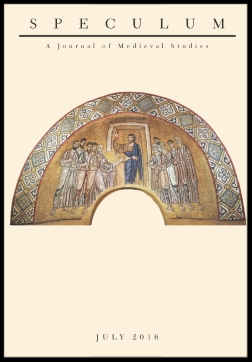
julyThe July issue of Speculum is now available online and will soon be at your door. In  addition to book reviews, Memoirs, and the Proceedings of the Annual Meeting, the issue includes the following articles:

Speculum
91:3 (JULY 2016)

Barbara Newman (Presidential Address)
“Annihilation and Authorship: Three Women Mystics of the 1290s”

Victoria McAlister
“Castles and Connectivity: Exploring the Economic Networks between Tower Houses, Settlement, and Trade in Late Medieval Ireland”

Roland Betancourt
“Tempted to Touch: Tactility, Ritual, and Mediation in Byzantine Visuality”

Katherine Lindeman
“Fighting Words: Vengeance, Jews, and Saint Vicent Ferrer in Late Medieval Valencia”

Charles Russell Stone
“Proud Kings, Polyglot Scribes, and the I3 Historia de preliis: The Origins of Latin Alexander Romance in Norman and Staufen Italy”

To access Speculum online, follow these steps:

1) Go to http://medievalacademy.org;
2) Sign in to your MAA account;
3) Open the Speculum pulldown menu and click on “Speculum online”;
4) Follow the link on that page.

Posted in MAA Newsletter | Leave a comment

MAA News – MAA/CARA Summer Scholarships Awarded

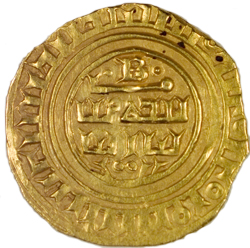
Tripoli, Bohemond VI or VII, gold bezant, 1251-87. Courtesy of Princeton University Numismatic Collection.

Tripoli, Bohemond VI or VII, gold bezant, 1251-87. Courtesy of Princeton University Numismatic Collection.

We are very pleased to announce the winners of the 2016 MAA/CARA Summer Scholarships, supporting student participation in summer courses in medieval languages or manuscript studies:

Lorenzo Bondioli (Oxford Univ. and Princeton Univ.): Classical Arabic (Qasid Arabic Language Institute, Amman, Jordan)

Hayley R. Bowman (Univ. of Michigan): Reading Aljamiado (University of Colorado, Boulder)

Joseph Michael Genens (Univ. of Missouri, Columbia): Paleography and Codicology: A Seminar on Medieval Manuscript Studies (University of New Mexico)

Amanda Nerbovig (Univ. of Colorado at Boulder): International Summer Paleography School (University of London)

Sarah Rose Shivers (Univ. of North Texas): Ancient Latin (King’s College London)

Sarah J. Sprouse (Texas Tech Univ.): Paleography and Codicology: A Seminar on Medieval Manuscript Studies (University of New Mexico)

Cameron Joseph Wachowich (Univ. of Toronto, NUI Galway): Level 2 Breton (University of Western Brittany)

Manon C. Williams (Univ. of Colorado at Boulder): Paleography and Codicology: A Seminar on Medieval Manuscript Studies (University of New Mexico)

Posted in MAA Newsletter | Leave a comment

MAA News – Members Garner Awards

Last month’s call for good news resulted in the following announcements:

Sarah Bromberg (Suffolk Univ.) has received the Newberry Library-John Rylands Research Institute Exchange fellowship for her book project, Art and Exegesis: Nicholas of Lyra’s Postilla.

Lilla Kopar (The Catholic Univ. of America) reports that Project Andvari: A Portal to the Visual World of Early Medieval Northern Europe (andvari.org) has received an NEH ODH Level II start-up grant. This is the second NEH grant for Andvari. The project is co-directed by Nancy Wicker (Univ. of Mississippi) and Kopar, in collaboration with Worthy Martin and Daniel Pitti at IATH at UVA.

Nicole Marafioti (Trinity Univ, San Antonio) has been awarded an ACLS Burkhardt Fellowship for 2016-17, with a residency at the National Humanities Center.

Cary J. Nederman (Texas A&M) was recently elected President of the Board of Directors of the Journal of the History of Ideas.

Nina Rowe (Fordham Univ.) was awarded twelve-month fellowships from the National Endowment for the Humanities and the American Council of Learned Societies, as well as a Franklin Research Grant from the American Philosophical Society, to work on her new project, The World in a Book: Weltchroniken and Society at the End of the Middle Ages.

Corine Schleif (Arizona State Univ.) was awarded a Berlin prize and  is currently John P. Birkelund Fellow in the Humanities at the American  Academy in Berlin.

Zrinka Stahuljak (Univ. of California, Los Angeles) has received a Guggenheim Fellowship to support her book project, “Medieval Fixers: Translation in the Mediterranean (1250-1500).”

Alison Stones (Emerita, Univ. of Pittsburgh) was recently elected a Correspondant étranger honoraire of the Société nationale des antiquaires de France.

Nancy Wicker (Univ. of Mississippi) has been awarded the Allen W. Clowes Fellowship from the National Humanities Center at Research Triangle, North Carolina, where she will be in residence for the 2016-2017 academic year, working on Viking Art in Scandinavian and across the Viking Diaspora: Patrons, Producers, and Consumers from the Fifth through the Eleventh Centuries.

Congratulations to all! If you have something you’d like to share, please send your good news to Executive Director Lisa Fagin Davis (LFD@TheMedievalAcademy.org).

Posted in MAA Newsletter | Leave a comment

MAA News – CARA News

Check out the latest CARA newsletter to see what’s happening in Medieval Studies on North American campuses:

http://c.ymcdn.com/sites/www.medievalacademy.org/resource/resmgr/pdfs/June_2016_CARA_news.pdf

Posted in MAA Newsletter | Leave a comment

Call for Papers – “Getting Medieval”: Medievalism in Contemporary Popular Culture

This conference, organized at the Jean-François Champollion National University Institute (“Champollion University”) in the historic episcopal city of Albi, France – site of the thirteenth-century Albigensian Crusades – will take place on 25-26 November 2016.  Please send proposals of 100-250 words for 20-minute papers (in English or French) to john.ford@univ-jfc.fr along with a brief CV before 31 July 2016 for full consideration.

Cette journée d’étude aura lieu les 25 et 26 novembre 2016 à l’Institut National Universitaire Jean-François Champollion dans la ville épiscopale d’Albi dans le Tarn.  Les propositions de communications (250-500 mots, en anglais ou français) sont à envoyer accompagné d’un court CV à john.ford@univ-jfc.fr avant le 31 juillet 2016.

PRESENTATION:

Today’s “pop” culture is rich with allusions to the Middle Ages, not only in literature and visual arts – as it always has been in past centuries (e.g., the pre-Raphaelites or Twain’s Connecticut Yankee in King Arthur’s Court, Tennyson’s Idylls of the King, Tolkien’s Hobbit and Lord of the Rings, etc.) – but also in graphic novels and comics, on the big screen and the little one, not to mention the computer screens of electronic gamers as well as amusement parks, festivals and fairs.

But how much of what is presented in a medieval context – either as actual “remakes” of old accounts or simply loosely employing a medieval setting or theme – accurately reflects the Middle Ages, and to what extent do these medieval constructs change or distort the reality of the age? When changed, to what extent is the epoch romanticised as, for example, an idealized Camelot where “the rain may never fall till after sundown?” To what extent is it vilified, making the expression “to get medieval on [somebody]” suggest a horrific vengeance? How do these constructs inform our understanding of the Middle Ages, and how important is it (if at all) to be entirely accurate? Finally, to what extent do such alterations update the texts or tales, keeping them alive and evolving, and why is it a perennial favourite, replayed year after year, decade after decade, indeed, century after century?

This conference hopes to respond to some of these questions by opening a dialogue between various disciplines: literature, history, historical linguistics, visual arts, cinema, theatre, television, etc., in order to study the enduring popularity of medieval themes and the ways in which medieval tales and texts are transmitted, preserved, distorted, renewed and built upon in the creation of new, decidedly modern popular culture in Europe, North America and the world of the 21st century.

This conference hopes to explore ways in which medieval texts, tales and traditions are used (or abused!) and used to fashion entirely new works that ultimately form part of contemporary pop culture in its own right, not only in the modern age, but in ages past. It might also address ways in which authors from the Renaissance until now (e.g., Spenser, Shakespeare, Yeats, etc.) have contributed to our modern conception of the Middle Ages, both myth and reality.

Some aspects to consider might include the importance of accuracy in portrayals purportedly based on actual texts (such as the Vikings series, or various remakes of Beowulf), and to what extent is liberal treatment acceptable, even to be encouraged?  To what extent is received wisdom, often quite dubious, employed in original works with a medieval feeling or theme, though not necessarily a medieval setting like Game of Thrones or Harry Potter?

In addition to the works listed above, the conference is open to any proposition addressing the use of medieval works or themes in any aspect of popular culture in any subsequent age, leading to its entrenched place in the pop culture of today – not only in fiction and art, but in any form of entertainment or representation.  Finally, the value of both medieval literature and culture, as well as popular culture, and the interdependence of both, is to be explored.

PRESENTATION:

La culture populaire d’aujourd’hui est riche en allusions au Moyen Age, non seulement dans la littérature et les arts visuels – comme elle l’a toujours été dans les siècles passés (par exemple, les préraphaélites ou Connecticut Yankee dans la cour du roi Arthur de Twain, Idylles du roi de Tennyson, ou le Hobbit et le Seigneur des Anneaux de Tolkien, etc.) – mais aussi dans les romans graphiques et dans les bandes dessinées, sur le petit comme sur le grand écran, ainsi que sur les écrans d’ordinateur des amateurs de jeux vidéos, les parcs d’attractions, les festivals et les foires.

Mais combien de ces références dont le contexte est médiéval – présentées comme de nouvelles versions de vieux récits ou tout simplement utilisant de manière plus libre un cadre ou un thème médiéval – reflètent fidèlement le Moyen Age ? Et de quelle manière et dans quelle mesure ces références médiévales modifient-elle ou déforment-elle la réalité de cette époque ? A quel point cette époque est-elle romancée comme, par exemple, dans un Camelot idéalisé où «la pluie ne peut  tomber qu’après le coucher du soleil »? Dans quelle mesure est-elle, comme l’atteste l’expression « Jouer à la flamme bien moyenâgeuse » qui implique la menace d’une vengeance féroce, diabolisée, vilipendée? Dans quelle mesure et à quel point ces constructions, ces références, influencent-elles sur notre compréhension du Moyen Age? Est-il donc important d’être exact ? Enfin, dans quelle mesure ces modifications mettent-elles à jour les textes et les récits en leur permettant de rester en vie et en constante évolution ? Et pourquoi le Moyen Age est-il l’éternel sujet favori, exploité année après année, décennie après décennie, siècle après siècle?

Cette journée d’étude va tenter de répondre à ces questions en ouvrant le dialogue par le biais de différentes disciplines : histoire, littérature, linguistique diachronique, arts visuels, cinéma, théâtre, télévision, mais aussi via les jeux vidéos et les parcs d’attraction, etc. Il s’agira d’étudier la popularité durable des thèmes médiévaux et la manière dont les récits et les textes médiévaux sont transmis, conservés, déformés, renouvelés et utilisés pour construire la nouvelle culture populaire résolument moderne, de l’Europe, de l’Amérique du Nord et du monde du 21ème siècle.

Il est important de considérer l’importance de la précision dans les représentations prétendument basées sur des textes réels, comme par exemple la série Vikings, ou les divers remakes de Beowulf. Et, dans quelle mesure ce libre traitement est-il acceptable, ou même à encourager? Dans quelle mesure les idées reçues, souvent douteuses, sont-elles employées dans des œuvres originales au contexte médiéval, mais pas forcément dans un cadre véritablement médiéval comme Game of Thrones ou Harry Potter?

Outre les ouvrages mentionnés ci-dessus, la conférence est ouverte à toute proposition portant sur l’utilisation des œuvres ou des thèmes médiévaux dans tous les aspects de la culture populaire actuelle ou antérieure, les conduisant à une place ancrée dans la culture populaire moderne – non seulement dans la fiction et l’art, mais dans toute forme de divertissement ou de représentation. Enfin, la valeur de la littérature et de la culture médiévales, de la culture populaire, ainsi que leur interdépendance, sera étudiée.
Posted in Call for Papers | Leave a comment