

MAA News – The Medieval Academy Annual Meeting

gardnerWe asked Speculum editorial staff Erin Pomeroy and Melissa Reynolds for their impressions of last week’s Annual Meeting. Here’s what they had to say:

*****

As assistant editor of Speculum and first time attendee of the annual meeting of the Medieval Academy of America, it was incredible to see everything come together for this extremely successful meeting. There were 526 total registrants at the meeting–much higher than we had anticipated given the shell shock left over from last year’s almost snowpocalyptic February. This is a testament to the strong and committed membership base that we have at the Academy and the wonderful people behind the scenes who worked tirelessly to organize and run the meeting.

I spent most of my weekend working at the registration desk with our graduate student volunteers and running around to make sure things were progressing smoothly. Our corps of volunteers was spectacular and many went above and beyond by showing up for extra shifts because they wanted to help. Not only was their assistance greatly appreciated, but I also thoroughly enjoyed getting to spend some time with my peers discussing what everyone was studying and what projects they are working on. At the registration desk and at the banquet on Friday evening, I also had the opportunity to meet many people whose names I have only seen on book covers or whom I have emailed with in regards to book reviews for Speculum. It was wonderful to be able to finally put faces to the many names of scholars whom I had corresponded with previously through Speculum but had not yet had the chance to meet in person.

The closing reception at the Isabella Stewart Gardner museum was the perfect end to a wonderful weekend. It was breathtaking to see the museum illuminated at night for our enjoyment. I was thoroughly impressed with my first experience at the annual meeting of the Medieval Academy of America and it will not soon be forgotten.

– Erin Pomeroy, Assistant Editor, Speculum

*******

Those who remember last year’s Boston winter were likely nervous when they received their invitation to attend the 91st Annual Meeting of the Medieval Academy of America at the Hyatt Regency in downtown Boston from February 25-27, but thankfully this year’s weather cooperated and Boston, with its numerous top-tier medieval studies institutions, proved to be the perfect setting for this year’s conference. This was my first year to attend the annual meeting, and as the current Editorial Assistant at Speculum and a doctoral candidate in History at Rutgers University, the conference gave me the chance to put faces to the names of senior scholars whose work has informed my own research, as well as to connect with other junior scholars who share my research interests.

Over the course of the weekend, conference attendees were challenged to push against established narratives and trajectories in medieval studies. Plenary talks from Laura A. Smoller and Richard Kieckhefer challenged audience members to reconceptualize the triad of religion, science, and magic in the Middle Ages, while Robin Fleming’s talk on Britain’s transformation from Roman to Medieval reimagined models of periodization. This year’s meeting once again offered participants a glimpse at the future of medieval studies: the opening plenary from William Noel reflected on the “Future of Medieval Manuscript Studies” through access to digital content. Four panels on digital humanities and medieval studies–including one standing-room-only “interactive” session–invited attendees to continue to think about the medievalist’s role in digital scholarship. Panels on ecocriticism, disability studies, and women’s and gender studies, along with Barbara Newman’s Presidential Address on “Annihilation and Authorship: Three Women Mystics of the 1290s,” all reflected the Academy’s commitment to diversity both in scholarship and membership. This commitment was further affirmed in a Statement on Diversity and Academic Freedom read by the Medieval Academy’s President Barbara Newman and distributed to participants at the close of the annual business meeting.

The MAA meeting offers young scholars like myself a chance to see first-hand a diverse and far-reaching network of scholars working in medieval studies. Often in our own departments medieval studies can feel marginalized, but there is nothing quite so invigorating as listening to an engaging paper or sharing a glass of wine with a like-minded scholar from an institution across town or across the Atlantic. At 526 registered attendees, this conference was one of the largest ever in MAA history, but even so, I had numerous opportunities to develop relationships with other participants as we crossed paths over the course of the weekend. In short, I urge other junior scholars to consider attending next year’s meeting in Toronto, which surely will be another opportunity for us to forge connections with our fellow scholars and use our shared interest and expertise to conceive of new ways of thinking about and, just as importantly, teaching about the Middle Ages.

Melissa Reynolds, Editorial Assistant, Speculum

Posted in MAA Newsletter | Leave a comment

MAA News – MAA Issues Values Statement

shieldAt its recent meeting, the Council of the Medieval Academy drafted and approved the following values statement:

Membership in the Medieval Academy is open to all persons concerned with the study and teaching of the Middle Ages, including, but not limited to, independent scholars, secondary teachers, graduate students, curators, librarians, and college and university professors of all ranks and at all types of institutions. We aim to foster an environment of diversity, inclusion, and academic freedom for all medievalists. Further, we affirm the right of students and junior faculty to receive supportive, professional mentoring that respects their intellectual freedom and personal integrity.

Posted in MAA Newsletter | Leave a comment

MAA News – One-Year Editorial Position at Speculum for Recent PhD in Medieval Studies to Start July 2016

speculumWe are launching a search for a one year postdoctoral fellow to serve as editorial assistant at Speculum from July 1, 2016 – July 31, 2017. This position offers qualified individuals an opportunity to develop as scholars and editors. The postdoc will receive a $43,000 stipend, health benefits, and limited research and travel funds and will be expected to assume  responsibilities for certain editorial tasks at Speculum 35 hours/week, including, but not limited to: coordinating reviews with book review editors; contacting reviewers; checking citations for accepted articles; proofreading reviews, Brief Notices, Books Received, and Tables of Contents; and proofing full issues of Speculum. In addition, the assistant will be encouraged to continue to develop a research program and participate in the cultural life of medieval studies in the Boston area. The term is subject to the postdoc’s continuing, acceptable performance of the duties required, as determined by the Editor of Speculum.

Eligible candidates must meet the following requirements and demonstrate the following qualifications:

  • PhD in some field of medieval studies before July 1, 2016 but no earlier than January 1, 2011.
  • Attention to detail and evidence of a high level of scholarly precision, particularly with regards to proofreading and bibliographic detail.
  • Strong work ethic

All interested candidates should write the Editor of Speculum, sspence@themedievalacademy.org, and should include the following:

  • One-page cover letter
  • Curriculum vitae
  • Unofficial transcript
  • Two letters of recommendation, one of which should directly address the applicant’s editing ability

The deadline for applications is May 1, 2016. Assistants must be resident in Cambridge, MA during the year.

Posted in MAA Newsletter | Leave a comment

MAA News – 2017 Call for Papers

univtorontoThe 92nd Annual Meeting of the Medieval Academy of America will be held in Toronto, Ontario, on 6-8 April 2017, hosted by the University of Toronto and The Pontifical Institute for Mediaeval Studies.
The Organizing Committee invites proposals for papers on all topics and in all disciplines and periods of medieval studies. Any member of the Medieval Academy may submit a paper proposal, excepting those who presented papers at the annual meetings of the Medieval Academy in 2015 or 2016; others may submit proposals as well but must become members in order to present papers at the meeting. Special consideration will be given to individuals whose field would not normally involve membership in the Medieval Academy. The due date for proposals is 15 June 2016.

Rather than an overarching theme, the 2017 meeting will provide a variety of thematic connections among sessions. The Medieval Academy welcomes innovative sessions that cross traditional disciplinary boundaries or that use various disciplinary approaches to examine an individual topic. To both facilitate and emphasize interdisciplinarity, the Call for Papers is organized in “threads.” Sessions listed under these threads have been proposed to or by the Organizing Committee but the list provided in the Call for Papers is not meant to be exhaustive or exclusive.

The complete Call for Papers, with proposed threads and sessions as well as instructions for submitting proposals, can be found here:
http://medievalacademy.site-ym.com/?page=2017Meeting.

Please contact the organizing committee if you have further questions about the meeting, at MAA2017@TheMedievalAcademy.org.

Posted in MAA Newsletter | Leave a comment

MAA News – Upcoming Deadlines: MAA Grants and Awards

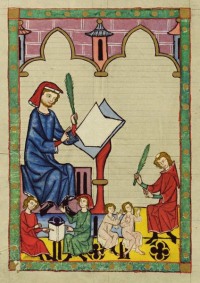
Der Schulmeister von Eßlingen, from Heidelberg, Cod. Pal. germ. 848, Große Heidelberger Liederhandschrift (Codex Manesse), Zürich, c.1300-c.1340, fol. 292v.

Der Schulmeister von Eßlingen, from Heidelberg, Cod. Pal. germ. 848, Große Heidelberger Liederhandschrift (Codex Manesse), Zürich, c.1300-c.1340, fol. 292v.

MAA/CARA Summer Language Scholarships
The MAA/CARA Summer Language Scholarships support graduate students and especially primising undergraduate students participating in summer courses in medieval languages or manuscript studies. The Medieval Academy of America’s Committee on Area and Regional Associations (CARA) is pleased to announce that the Summer Language Scholarship program has been expanded to allow more students to apply for support. The MAA/CARA Summer Language Scholarships support students participating in summer courses in medieval languages or manuscript studies.

Applicants must be members of the Medieval Academy in good standing with at least one year of graduate school remaining and must demonstrate both the importance of the summer course to their program of study and their home institution’s inability to offer analogous coursework. Click here for more information. The due date for applications is 15 April.

Travel Grants
Medieval Academy Travel Grants allow independent scholars and unaffiliated faculty to travel to conferences to present their work. The deadline for meetings taking place between
1 September 2016 and 28 February 2017 is May 1. Click here for more information.

Posted in MAA Newsletter | Leave a comment

MAA News – Medieval Academy Receives Bequest

The Medieval Academy has received a generous bequest from the estate of longtime member Frederic L.  Cheyette (d. 4/14/15). One of the foremost scholars of his generation in the study of medieval France, Prof. Cheyette was elected a Fellow of the Medieval Academy in 2007. The Academy gratefully acknowledges Prof. Cheyette’s generosity. For information about remembering the Academy in your own estate plans, please contact Executive Director Lisa Fagin Davis at LFD@TheMedievalAcademy.org. The Academy acknowledges such commitments with membership in our Legacy Society, recorded each year in the July issue of Speculum.

Posted in MAA Newsletter | Leave a comment

Postdoctoral Fellowship at Speculum

We are launching a search for a one year postdoctoral fellow to serve as editorial assistant at Speculum from July 1, 2016 – July 31, 2017. This position offers qualified individuals an opportunity to develop as scholars and editors. The postdoc will receive a $43,000 stipend, health benefits, and limited research and travel funds and will be expected to assume  responsibilities for certain editorial tasks at Speculum 35 hours/week, including, but not limited to: coordinating reviews with book review editors; contacting reviewers; checking citations for accepted articles; proofreading reviews, Brief Notices, Books Received, and Tables of Contents; and proofing full issues of Speculum. In addition, the assistant will be encouraged to continue to develop a research program and participate in the cultural life of medieval studies in the Boston area. The term is subject to the postdoc’s continuing, acceptable performance of the duties required, as determined by the Editor of Speculum.

Eligible candidates must meet the following requirements and demonstrate the following qualifications:

  • PhD in some field of medieval studies before July 1, 2016 but no earlier than January 1, 2011.
  • Attention to detail and evidence of a high level of scholarly precision, particularly with regards to proofreading and bibliographic detail.
  • Strong work ethic

All interested candidates should write to Sarah Spence, Editor of Speculum (sspence@themedievalacademy.org), and should include the following:

  • One-page cover letter
  • Curriculum vitae
  • Unofficial transcript
  • Two letters of recommendation, one of which should directly address the applicant’s editing ability

The deadline for applications is May 1, 2016. Assistants must be resident in Cambridge, MA during the year.


Posted in Jobs for Medievalists | Leave a comment

Call for Papers – Texts and Contexts

CALL FOR PAPERS: Texts and Contexts, October 21-22, 2016, Ohio State University, Columbus, OH

Texts and Contexts is an annual conference held on the campus of the Ohio State University devoted to Medieval and Renaissance manuscripts, incunables and early printed texts in Latin and the vernacular languages. The conference solicits papers particularly in the general discipline of manuscript studies, including palaeography, codicology, reception and text history. In addition to the general papers (of roughly 20 minutes), the conference also hosts the Virginia Brown Memorial Lecture, established in memory of the late Virginia Brown, who taught paleography at the Pontifical Institute of Mediaeval Studies for some 40 years.  We also welcome proposals for sessions of two to three papers which might treat a more focused topic. Please send abstracts to epig@osu.edu.  Deadline for abstracts: August 15, 2016.

Posted in Call for Papers | Leave a comment

Jobs for Medievalists

The Kress Foundation Department of Art History at the University of Kansas seeks a Visiting Assistant Professor specializing in the history of early modern visual arts in Italy with strengths between 1300 and 1700.  The appointment is a non-tenure track, limited term appointment for one academic year, expected to begin as early as August 18, 2016 and through May 16, 2017.  Subject to satisfactory performance and contingent upon final budgetary approval, the position may be renewed for one additional year.  For more information and to apply, see:

https://sjobs.brassring.com/TGWEbHost/jobdetails.aspx?partnerid=25752&siteid=5539&AReq=5539BR

Posted in Jobs for Medievalists | Leave a comment

Call for Papers – Methodology, Interpretation and Typology of Maritime Graffiti in the Mediterranean

Methodology, Interpretation and Typology of

Maritime Graffiti in the Mediterranean.

Nicosia, 14-15 October 2016

Pictorial and textual graffiti have attracted the attention of archaeologists, anthropologists,
epigraphists, historians and philologists since the very early stages in the development of
humanities as academic disciplines. Such graffiti have been considered as unique testimonies of everyday life in antiquity, otherwise very hard to detect. Moreover, the practice of writing messages and making drawings on any surface available for scratching has been diachronic and surprisingly perennial; if the thousands of graffiti documented in Pompeii can be considered as indicative, then it seems probable that the graffiti phenomenon was as widespread in antiquity as it is in modern times. Recent monographs, such as Langner 2001, Baird and Taylor 2011 and Keegan 2014 have provided a particularly rich body of new data as well as a holistic approach to this particular body of evidence.

Graffiti depicting ships, in particular, have been extensively used by specialists as important ship iconography sources, which provide information on ancient ship types, rigging and gear, or naval architecture (e.g. Crumlin-Pedersen and Munch-Thyem 1995; Auger-Sergent 1996, Gonzales and Font 2007), with Lucien Basch’s (1987) work still being the most comprehensive publication for the ancient Mediterranean. For the historical periods that followed the Roman Empire, especially in the eastern Mediterranean, numerous studies have resulted in a significant body of evidence (see e.g. Goudas 1911, Basch 1986, Ovtcharov 1995, Imhaus 2009, Babuin and Nakas 2011, Damianidis 2014), and ship graffiti have appeared in diverse publications with a broader scope, regarding ship iconography or graffiti in general. A comprehensive study to address the multilevel significance of their analysis, however, is still lacking.

In 2014, a new research programme was initiated in the University of Cyprus, funded by the Leventis Foundation, entitled KARAVOI: The Ship Graffiti on the Medieval and post-
Medieval Monuments of Cyprus: Mapping, Documentation and Digitisation. One of the main objectives of the project is to create a corpus of the island’s ship graffiti, thus allowing for a holistic approach to their study which could involve not only standard aspects of it, such as ship’s types and provenance, seafaring, trade connections and maritime activities, but also human behavior and identity, religious practices, ritual, ideology and social identity in Medieval Cyprus. This conference is one of the project’s deliverables and aspires to bring
together for the first time scholars that work in the eastern Mediterranean in order to discuss diverse aspects of ship graffiti, such as:

1. Maritime graffiti other than ships
2. Typology and shipbuilding analysis
3. Spatial distribution
4. Interpretation of the maritime graffiti in their multiple contexts (anthropological,
historical, geographical, spatial, symbolic, religious or other)
5. Recording and documentation methodologies
6. Theoretical approaches to graffiti.

English will be the official language of the conference and each paper should last no longer
than 15-20 minutes.

We invite specialists and researchers to submit titles and abstracts (300 words
maximum) for a presentation related to one of the above mentioned subjects or to new
material.

Please send your application and title no later than 15 April 2016 to: demesticha@ucy.ac.cy.

Abstracts will be submitted by 15 May 2016.

Posted in Call for Papers | Leave a comment