

MAA News – 2016 Candidates for Council and the Nominating Committee

"Dante and Virgil in Conversation," from Oxford: Bodleian Library, MS. Holkham Misc. 48, p. 67. © Bodleian Library, University of Oxford.

“Dante and Virgil in Conversation,” from Oxford: Bodleian Library, MS. Holkham Misc. 48, p. 67. © Bodleian Library, University of Oxford.

We are pleased to announce the slate of candidates for the 2016 Medieval Academy election:

President:
Carmela Vircillo Franklin (Classics, Columbia Univ.)

1st Vice-President:
Margot E. Fassler (Music History and Liturgy, Univ. of Notre Dame)

2nd Vice-President:
David Wallace (English and Comparative Literature, Univ. of Pennsylvania)

Council (four seats available):

Rick Barton (History, Univ. of North Carolina at Greensboro)
María Bullón-Fernández (English, Seattle Univ.)
Emily C. Francomano (Spanish, Georgetown Univ.)
Matthew Gabriele (History, Virginia Tech.)
Matthew Giancarlo (English, Univ. of Kentucky)
Sharon Kinoshita (French, Univ. of California, Santa Cruz)
Amy Livingstone (History, Wittenberg Univ.)
Jerry Singerman (Comparative Literature, Univ. of Pennsylvania Press)

Nominating Committee (two seats available):

Roland Betancourt (Art History, Univ. of California, Irvine) Joyce Coleman (English, Univ. of Oklahoma)
Sean L. Field (History, Univ. of Vermont)
Fiona Griffiths (History, Stanford Univ.)

The list of candidates with their photos and brief biographies appears online here:

http://medievalacademy.site-ym.com/?page=2016Ballot

There are eight candidates for four openings on the Council, the governing body of the Academy. There are four candidates for two openings on the Nominating Committee, tasked with proposing candidates for the annual election. As is our practice, the slate of presidential officers is presented unopposed, although nominations by petition may be made as follows, in accordance with article 26 of the By-Laws:

Nominations of other members of the Academy for elected officers, Councillors, or members of the Nominating Committee may be made by written petition signed by at least seven members of the Academy. A nomination by petition may be for a single office, several offices, or an entire slate. Such petitions must be received by the Executive Director within twenty days of the circulation of the report of the Nominating Committee (article 25), unless the Council extends the period for making nominations by petition.

As the slate of candidates was announced by email on 15 September, the closing date for nomination by petition has been set at 11:59 PM, 5 October 2015. Additional information about the governance of the Academy can be found here.

Electronic balloting will open on November 1. If you would like to receive a paper ballot, please contact Executive Director Lisa Fagin Davis at LFD@TheMedievalAcademy.org.

Voting in the Medieval Academy election is one of the most important means that members have to impact both the Academy and the future of medieval studies in North America. Please vote and let your voice be heard. We look forward to your participation in the election of the leadership of the Medieval Academy.
Posted in MAA Newsletter | Leave a comment

MAA News – Fellows’ Nominations

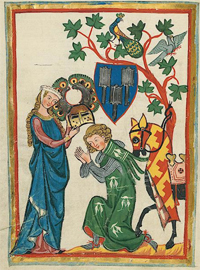
Cod. Pal. germ. 848, Große Heidelberger Liederhandschrift (Codex Manesse), Zürich, c.1300-c.1340, fol. 82v.

Cod. Pal. germ. 848, Große Heidelberger Liederhandschrift (Codex Manesse), Zürich, c.1300-c.1340, fol. 82v.

Fellows and Corresponding Fellows of the Medieval Academy are scholars who have made notable contributions to the field of medieval studies. Elections are held each year and new Fellows and Corresponding Fellows are inducted during the Annual Meeting.

Members are hereby invited to submit nominations for the 2016 Class of Fellows and Corresponding Fellows. Current Fellows will cast ballots in November and December for the 2016 election, which will operate under by-laws and procedures adopted in 2013 and revised in 2015. Under the established rules, the number of slots available in 2015 for new Fellows is seven, for which there must be at least fourteen nominations. There is no established minimum number of nominations for Corresponding Fellows, although there are nine openings.

Nominations for the 2016 elections must be received by 1 November 2015.

Instructions for nominations are available here:

http://www.medievalacademy.org/?page=Election_Procedure
Lists of Fellows, Corresponding Fellows, and Emeriti/ae Fellows are available here:

http://www.medievalacademy.org/?page=Fellows

Nominations should be submitted to the Executive Director at LFD@TheMedievalAcademy.org or mailed to:

Lisa Fagin Davis, Executive Director

Medieval Academy of America

17 Dunster St., Suite 202

Cambridge, Mass., 02138

Please note that nominations are to be kept in strictest confidence, from the nominee as well as from others.

Posted in MAA Newsletter | Leave a comment

MAA News – Upcoming MAA Grant Deadlines

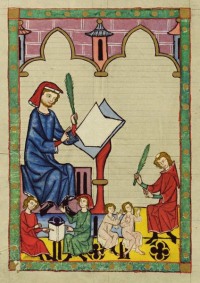
Der Schulmeister von Eßlingen, from Heidelberg, Cod. Pal. germ. 848, Große Heidelberger Liederhandschrift (Codex Manesse), Zürich, c.1300-c.1340, fol. 292v.

Der Schulmeister von Eßlingen, from Heidelberg, Cod. Pal. germ. 848, Große Heidelberger Liederhandschrift (Codex Manesse), Zürich, c.1300-c.1340, fol. 292v.

The Medieval Academy of America has long provided a variety of benefits of membership, including numerous fellowships, prizes and grants for travel, research and publications. Please see the list below for prizes and fellowships with looming deadlines, then follow the links for complete descriptions and application information. We encourage all eligible members to apply for these grants.

We are pleased to announce that as of August 2015 all applications for Medieval Academy prizes, awards, and fellowships can (and must) be submitted using our online application system. Links to each form can be found on the Awards section of our website.

Graduate Student Fellowships and Awards

Schallek Fellowship The Schallek Fellowship provides a one-year grant of $30,000 to support Ph.D. dissertation research in any relevant discipline dealing with late-medieval Britain (ca. 1350-1500). (Deadline 15 October 2015)


Baldwin Fellowship The Baldwin Fellowship provides a grant of $20,000 to support a graduate student in a North American university who is researching and writing a significant dissertation for the Ph.D. on any subject in French medieval history that can be realized only by sustained research in the archives and libraries of France. (Deadline 15 November 2015)

GSC/MAA Grant

The MAA/GSC Grant(s) will be awarded annually to an individual or graduate student group from one or more universities. The purpose of this grant is to stimulate new and innovative efforts that support pre-professionalization, encourage communication and collaboration across diverse groups of graduate students, and build communities amongst graduate student medievalists. (Deadline 15 February 2016)

Service Award

Kindrick-CARA Award for Outstanding Service to Medieval Studies

The Robert L. Kindrick-CARA Award for Outstanding Service to Medieval Studies recognizes Medieval Academy members who have provided leadership in developing, organizing, promoting, and sponsoring medieval studies through the extensive administrative work that is so crucial to the health of medieval studies but that often goes unrecognized by the profession at large. This award of $1000 is presented at the Annual Meeting of the Medieval Academy. (Deadline 15 November 2015)

Teaching Award

CARA Award for Excellence in Teaching

The CARA Award for Excellence in Teaching Medieval Studies recognizes Medieval Academy members who are outstanding teachers who have contributed to the profession by inspiring students at the undergraduate or graduate levels or by creating innovative and influential textbooks or other materials for teaching medieval subjects. (Deadline 15 November 2015)

Independent/Junior Scholars

Olivia Remie Constable Awards

Four Olivia Remie Constable Awards of $1,500 will be granted annually in memory of Remie Constable, each to an emerging junior faculty member, adjunct or unaffiliated scholar (broadly understood: post-doctoral, pre-tenure) for research and travel. (Deadline 15 February 2016)

Travel Grants

The Medieval Academy provides a limited number of travel grants to help Academy members who hold doctorates but are not in full-time faculty positions, or are adjuncts without access to institutional funding, attend conferences to present their work. (Deadline 1 November 2015 for meetings to be held between 16 February and 31 August 2016)

Please see the MAA website for other grants and prizes offered by the Academy.

Posted in MAA Newsletter | Leave a comment

MAA News – Book Prize Deadlines

Tripoli, Bohemond VI or VII, gold bezant, 1251-87. Courtesy of Princeton University Numismatic Collection.

Tripoli, Bohemond VI or VII, gold bezant, 1251-87. Courtesy of Princeton University Numismatic Collection.

Please note that as of August 2015 the submission instructions for these prizes have changed. Please see the appropriate webpage for details.

Haskins Medal

The Haskins Medal is awarded annually by the Medieval Academy of America for a distinguished book in the field of medieval studies. First presented in 1940, the award honors Charles Homer Haskins, the noted medieval historian, who was a founder of the Medieval Academy and its second President. The award is announced at the annual meeting of the Academy each spring. The medal was designed in 1939 by Graham Carey. (Deadline 15 October 2015)

John Nicholas Brown Prize

The John Nicholas Brown Prize, established by the Medieval Academy of America in 1978, is awarded annually for a first book or monograph on a medieval subject judged by the selection committee to be of outstanding quality. To be eligible, the author must be resident in North America. John Nicholas Brown was one of the founders of the Medieval Academy and for fifty years served as its Treasurer. The prize established in his name consists of a certificate and a monetary award of $1,000. It is announced at the annual meeting of the academy each spring. (Deadline 15 October 2015)

Van Courtlandt Elliott Prize

The Van Courtlandt Elliott Prize, established by the Medieval Academy of America in 1971, is awarded annually for a first article in the field of medieval studies, published in a scholarly journal, judged by the selection committee to be of outstanding quality. To be eligible, the author must be resident in North America. Van Courtlandt Elliott was Executive Secretary of the Academy and Editor of Speculum from 1965 to 1970. The prize that bears his name consists of a certificate and a monetary award of $500. It is announced at the annual meeting of the academy each spring. (Deadline 15 October 2015)

Posted in MAA Newsletter | Leave a comment

MAA News – Graduate Student Committee News

Want to know what our graduate student Members have been up to? Check out the fall issue of the Graduate Student Committee newsletter, and feel free to share the link with any of your students who may be interested.

Posted in MAA Newsletter | Leave a comment

Jobs for Medievalists

Research Associate Emotions on the Medieval and Early Modern Stage in Britain and Ireland
at The University of Western Australia

Applications close: Sunday 25 October 2015, 11.55pm Australian Western Standard Time (AWST).

FACULTY OF ARTSARC Centre of Excellence for the History of Emotions

Job No:  495817
Work type: Full-time
Location: Crawley Campus (Perth) of UWA
Categories: Arts

  • 2 year appointment
  • Level A Step 8 $88,520 p.a.
  • Research support of $16,000 per annum

The University of Western Australia is a member of Australia’s prestigious Group of Eight and ranked among the top 100 universities in the world, with a broad and balanced coverage of disciplines in the arts, sciences and major professions.

For the past 100 years, UWA has contributed significantly to the intellectual, cultural and economic development of the State of Western Australia and the nation as a whole.

The Australian Research Council (ARC) Centre of Excellence for the History of Emotions, in collaboration with The University of Western Australia, The University of Adelaide, The University of Melbourne, The University of Sydney and The University of Queensland, seeks to appoint an exceptional postdoctoral research fellow at The University of Western Australia to contribute to research projects in the history of emotions in Europe, c.1100-1800.

The successful candidate will develop a project relating to the role of emotions on the theatrical stage in Britain and Ireland, from within the period 1300-1800. This prestigious fellowship (with an additional $16K pa research support) offers an exciting opportunity for innovative and enthusiastic scholars with demonstrated track records in medieval and/or early modern studies and a capacity to engage in interdisciplinary research.

Applications with projects of various kinds are welcome, including studies of emotions in relation to space and staging, performance practice, audience, patronage and sponsorship, dramatic construction, and other contexts of theatrical production and reception.

Contact: Professor Andrew Lynch by email: andrew.lynch@uwa.edu.au

To be considered for this role, you will demonstrate:

  • A PhD in a relevant discipline in medieval or early modern studies
  • A strong track record (relative to opportunity) in research and publication
  • Basic familiarity with research trends in the history of emotions
  • Demonstrated ability to engage in interdisciplinary research discussions
  • Knowledge of the appropriate language(s) and linguistic skills required for successful completion of research
  • Effective written and verbal communication skills
  • Interpersonal skills which facilitate collaborative research
  • Capacity to work with an academic research team and administrative staff

This position is open to international applications.

Application Details: Applications must be submitted online.  Full details of the position’s responsibilities and the selection criteria are outlined in the position description and applicants should clearly demonstrate they meet the selection criteria.

Please see the position description prior to applying: 314471.pdf

Posted in Jobs for Medievalists | Leave a comment

Call for Papers – Fourth Annual Symposium on Medieval and Renaissance Studies

Call for Papers: Fourth Annual Symposium on Medieval and Renaissance Studies, Saint Louis University

The Annual Symposium on Medieval and Renaissance Studies provides a convenient summer venue in North America for scholars in all disciplines to present papers, organize sessions, participate in roundtables, and engage in interdisciplinary discussion. The goal of the symposium is to promote serious scholarly investigation of the medieval and early modern worlds.

We invite proposals for papers, sessions, and roundtables on all topics and in all disciplines of medieval and early modern studies. Proposals from learned societies and scholarly associations are particularly welcome. The deadline for proposals submissions is December 31.

The plenary speakers for this year will be Barbara Newman, of Northwestern University, and Teofilo Ruiz, of the University of California, Los Angeles.

The Symposium is held on the beautiful midtown campus of Saint Louis University, hosted by the Center for Medieval and Renaissance Studies. On-campus housing options include affordable, air-conditioned apartments and a luxurious boutique hotel. Inexpensive dorm meal plans are available.

All sessions take place in state-of-the-art classrooms and auditoriums with complete audiovisual facilities. All sessions, events, meals, and housing are located within easy walking distance of each other. A rich variety of restaurants, bars, and cultural venues are also only a short walk away.

During their stay, participants are welcome to utilize the Vatican Film Library as well as the rare book and manuscript collections of the nearby Pius XII Library. Those interested in using the Vatican Film library, should contact Susan L’Engle (lengles@slu.edu) by email or phone at 314-977-3090. Participants may also use the library’s regular collections, which are especially strong in medieval and early modern studies.

All sessions are 90 minutes long. A variety of session formats are welcome. Preference will be given to organized sessions that involve participants from multiple institutions.

https://www.regonline.com/Register/Checkin.aspx?EventID=1725510

Posted in Call for Papers | Leave a comment

2016 Rome Prize

The 2016 Rome Prize online application is available on the American Academy in Rome
website at www.aarom.org.

The American Academy in Rome invites applications for the 2016 Rome Prize.

For over a century, the Academy has awarded the Rome Prize to support innovative work in the arts and humanities. Through a national juried competition, Rome Prizes are awarded to emerging and established artists and scholars working in the following disciplines:

  • Ancient Studies
  • Architecture
  • Design (includes graphic, industrial, interior, exhibition, set, costume, and fashion design, urban design, city planning, engineering, and other design fields)
  • Historic Preservation and Conservation
  • Landscape Architecture(includes environmental design and planning, landscape/ecological urbanism, landscape history, sustainability and ecological studies, and geography)
  • Literature
  • Medieval Studies
  • Modern Italian Studies
  • Musical Composition
  • Renaissance and Early Modern Studies
  • Visual Arts(includes painting, sculpture, drawing, photography, film/video, installation, new media, digital arts, and other visual arts fields)

Ranging from six months to two years, the thirty fellowships include a stipend, room and board, and individual workspace at the Academy’s eleven-acre center in Rome.

Submissions due: NOVEMBER 1, 2015
Visit aarome.org/apply for guidelines.

Posted in Announcements | Leave a comment

Call for Papers – Anachronism and the Medieval

A seminar dedicated to “Anachronism and the Medieval” is planned for the next European Society for the Study of English (ESSE) Conference, to be held from 22-26 August 2016 in Galway, Ireland. The organizers look forward to receiving proposals for papers to be presented in this seminar.

This seminar focuses on anachronism, broadly defined, and its relation to the medieval period. Often understood negatively as a computational fault or disruptive error, anachronism is closely related to archaism, presentism, and para-/pro-chronism, as well as to the notion of the preposterous (in its literal Latin sense of “before-behind”). Contributors to this seminar might reflect on broad issues of temporality or particular instances of anachronism—intentional or unintentional—in relation to medieval literary exemplars, but equally welcomed are contributions that explore anachronicity in conjunction with later (Renaissance to contemporary) engagements with the medieval past and its textual traditions.

According to the ESSE conference website (found at http://www.esse2016.org/): “The seminar format is intended to encourage lively participation on the part of both speakers and members of the audience. For this reason, papers will be orally presented in no longer than 15 minutes rather than read. Reduced versions of the papers will be circulated beforehand among participants.”

Please send proposals of 300 words to both Yuri Cowan (yuri.cowan@ntnu.no) and Lindsay Reid (lindsay.reid@nuigalway.ie) no later than 28 February 2016. Earlier submissions would be appreciated.

Posted in Call for Papers | Leave a comment

Jobs for Medievalists

 Position Title: Director of Byzantine Studies

Supervisor:    Director

Department:  Byzantine Studies

Grade:            60

Term:             Five years with the possibility of renewal up to an additional five years

Duties and Responsibilities
The Director of Byzantine Studies reports to the Director of Dumbarton Oaks and oversees the Byzantine Study Program at Dumbarton Oaks. The Director of Studies supports the Byzantine Fellows (who are resident for the academic year, a term, or the summer and pursue their own research) and organizes scholarly meetings such as symposia, colloquia, and lectures.

The individual holding the position has overall responsibility for administering the study program, including: coordinating the three annual meetings with the Board of Senior Fellows that advises the Director on fellowship selection and programmatic activities; supervising the Program Coordinator; ensuring the smooth running of activities in Byzantine Studies (such as research reports by Fellows, one-month research awards, the summer school, summer internships, one-month Visiting Scholars, etc.); and managing budget development, forecasting, and tracking of expenses (including project grants to archaeologists).

Within Dumbarton Oaks, the Director of Byzantine Studies provides input as requested on Byzantine holdings within the library (including Byzantine portions of the image and fieldwork archives); is expected to produce reports, such as the Byzantine portion of the annual report; and participates with other directors of scholarly departments in conducting basic research necessary to evaluate the success of programs.

In the broader scholarly world, the Director of Byzantine Studies promotes the vitality of the field. Outreach activities include regular communication with relevant Byzantine societies, listservs, and academic programs in the United States, Europe, and beyond. The Director of Byzantine Studies also fosters exchanges with closely connected fields such as medieval and Islamic studies.

The Director of Byzantine Studies acts as editor of the Byzantine journal, Dumbarton Oaks Papers, in conjunction with a small editorial board. He or she receives or solicits submissions, sends them out for peer review, relays comments to contributors, and ensures that accepted essays have been revised in accordance with reviewer comments and house style. The Director also serves as the acquiring editor for Byzantine books. This role requires assisting symposium organizers in their capacities as volume editors for proposed symposia volumes, monitoring submissions for other Byzantine series, creating proposals for review, and acting as developmental editor for all such submissions.

Supervisory Responsibilities
The Director of Byzantine Studies supervises the Program Coordinator.

Qualifications
Candidates must hold a Ph.D. in a relevant discipline and demonstrate strong administrative, editorial and interpersonal skills; a distinguished record of publications; and an excellent command of medieval Greek. They must have broad knowledge of various aspects of the field outside their own specialty and be well acquainted with the American academic setting. They must have the interest, ability, and commitment to join in the general intellectual life of Dumbarton Oaks.

To Apply
The application process is open to strong applicants at all career stages, from early to advanced. The appointment runs for five years, with the possibility of renewal up to an additional five years.

The position remains open until filled. Candidates should submit a detailed CV, cover letter, and list of references by clicking the link below. Questions can be addressed to HumanResources@doaks.org. Please note that interviews will be in Cambridge, Mass. and are likely to be held in the second half of January.

https://sjobs.brassring.com/TGWEbHost/jobdetails.aspx?partnerID=25240&siteID=5341&AReq=36490BR


Dumbarton Oaks is an Equal Opportunity Employer (EOE).

Posted in Jobs for Medievalists | Leave a comment