MAA News – MAA Application Deadlines

The Medieval Academy of America has long provided a variety of benefits of membership, including numerous fellowships, prizes and grants for travel, research and publications. Please see the list below for prizes and fellowships with looming deadlines, then follow the links for complete descriptions and application information. We encourage all eligible members to apply for these grants.

We are pleased to announce that as of August 2014 most applications for Medieval Academy prizes, awards and fellowships can be submitted using our online application system. Links to each form can be found on the Awards section of our website.

Graduate Student Fellowships and Awards

Schallek Fellowship
(Deadline 15 October 2014)

MAA/GSC Grant [NEW for 2015]
(deadline 15 February 2015)

Service Award

Kindrick-CARA Award for Outstanding Service
(Deadline 15 November 2014)

Teaching Award

CARA Award for Excellence in Teaching
(Deadline 15 November 2014)

Independent/Junior Scholars 

Olivia Remie Constable Award [NEW for 2015]
(Deadline 15 February 2015)

Travel Grants
(Deadline 1 November 2014 for meetings to be held between 1 March and 31 August 2015)

Book Prizes

Haskins Medal
(Deadline 15 October 2014)

John Nicholas Brown Prize
(Deadline 15 October 2014)

Van Courtlandt Elliott Prize
(Deadline 15 October 2014)

Please see the MAA website for other grants and prizes offered by the Academy.

Posted in MAA Newsletter | Leave a comment

MAA News – Call for Fellows Nominations

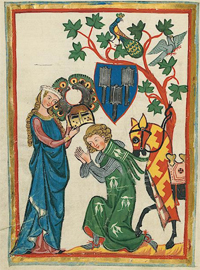
Cod. Pal. germ. 848, Große Heidelberger Liederhandschrift (Codex Manesse), Zürich, c.1300-c.1340, fol. 82v.

Cod. Pal. germ. 848, Große Heidelberger Liederhandschrift (Codex Manesse), Zürich, c.1300-c.1340, fol. 82v.

Members are invited to submit nominations to the Fellows and Corresponding Fellows of the Medieval Academy. Fellows will cast ballots in January for the 2015 election, which will operate under by-laws and procedures adopted in 2013. Under the established rules, the number of slots available in 2015 for new Fellows is nine, for which there must be at least eighteen nominations. There is no established minimum number of nominations for Corresponding Fellows, although there are eleven openings.

Nominations for the 2015 elections must be received by 15 October 2014.

Instructions for nominations are available here:
http://www.medievalacademy.org/?page=Election_Procedure

Lists of Fellows, Corresponding Fellows and Emeriti/ae Fellows are available here:
http://www.medievalacademy.org/?page=Fellows

Nominations should be submitted to the Executive Director at LFD@TheMedievalAcademy.org or mailed to:

Lisa Fagin Davis, Executive Director
Medieval Academy of America
17 Dunster St., Suite 202
Cambridge, Mass., 02138

Please note that nominations are to be kept in strictest confidence, from the nominee as well as from others.

Posted in MAA Newsletter | Leave a comment

Call for Submissions – Digital Philology

Call for Submissions

Digital Philology: A Journal of Medieval Cultures

/Digital Philology/ is a peer-reviewed journal devoted to the study of medieval vernacular texts and cultures. Founded by Stephen G. Nichols and Nadia R. Altschul, the journal aims to foster scholarship that crosses disciplines upsetting traditional fields of study, national boundaries, and periodizations. /Digital Philology/ also encourages both applied and theoretical research that engages with the digital humanities and shows why and how digital resources require new questions, new approaches, and yield radical results.

You may browse the journal’s contents here: <http://muse.jhu.edu/journals/digital_philology/

/Digital Philology/ is welcoming submissions. Inquiries and articles may be sent to dph@jhu.edu, to the attention of the Managing Editor. Correspondence regarding manuscript studies may be addressed to Jeanette Patterson at jpatterson09@gmail.com. For reviews of digital projects and publications, please contact Timothy Stinson at tlstinson@gmail.com.

Posted in Announcements | Leave a comment

MAA News – Speculum News

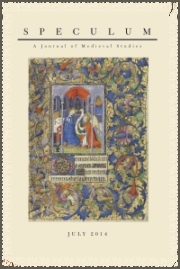
Spec14The July 2014 issue of Speculum is now available online here along with the entire Speculum archive. This issue includes five articles (below) and seventy-five reviews:

Maryanne Kowaleski, “Medieval People in Town and Country: New Perspectives from Demography and Bioarchaeology” (pp. 573-600)

Michael Lower, “The Papacy and Christian Mercenaries of Thirteenth-Century North Africa” (pp. 601-631)

Laura Saetveit Miles, “The Origins and Development of the Virgin Mary’s Book at the Annunciation” (pp. 632-669)

William D. Paden, “An Occitan Prayer against the Plague and Its Tradition in Italy, France, and Catalonia” (pp. 670-692)

Kathleen E. Kennedy, “Reintroducing the English Books of Hours, or “English Primers” (pp. 693-723)

Members can access Speculum online free of charge as a perquisite of membership. The easiest way to do so is through the Medieval Academy website; click here for instructions. You will need to sign into the Academy’s website using your member name and password, after which no further sign-ins will be necessary. Once you make your way to the Cambridge University Press Speculum site, you can sign up for Speculum-related notifications if you wish.

Posted in MAA Newsletter | Leave a comment

MAA News – Parenting in Academia

By J. A. T. Smithjatsmith

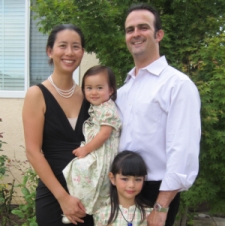
N.B. from the Executive Director: A recurring theme in special sessions and over lunch tables at several conferences I attended this year (most notably the Medieval Academy, Kalamazoo and Leeds) was the work being done on campuses around North America and Europe to identify systemic issues and improve working conditions for graduate students and junior faculty who happen to be parents of young children or children with medical and/or behavioral challenges. Campuses across North America show significant variety in approaches to supporting parents among their faculty or student body, by pausing the tenure clock, providing childcare, and/or making allowances for parental or medical leave. J. A. T. Smith, newly-hired Assistant Professor of English Literature at Pepperdine University, spoke eloquently about this issue at the Medieval Academy Annual Meeting session sponsored by the Graduate Student Committee and agreed to revise her comments for publication here. She distributed several resources to the audience at the session, resources that have been made available on the Academy website here and here. – Lisa

********

There haven’t been too many graduate students with children in the program I attended at UCLA, though I did notice a trend. The daddies stuck around, coming in to the office regularly, finishing and getting jobs (to the extent that anyone got jobs). But it seemed as if all the mommies, even if they didn’t drop out of the program, ended up moving away to places where they could get better childcare–to be with spouses with steady income, to be with their own parents who would help to raise their grandchildren. That is, the mommies were invisible. They were gone. And how they managed to balance both motherhood and academia was a mystery to me.

When I got pregnant in March of 2007, my third year in the program, I felt certain that this was going to be the end of my academic dream as I knew it.  There would be no months spent in the archive or summers teaching Shakespeare in London. There would be no moving to a dream job once I finished the degree. And really, what were the odds that I would get a job as a medievalist within driving distance of my current home?

Highly unlikely but, as I recently learned, not impossible. This is the story of how I and my husband started a family while I was in graduate school and the lessons I learned along the way.

********

I took my comprehensive oral exam 8 months pregnant–the day before my baby shower. I remember thinking, “I’d better pass or it was going to be a really terrible party.” My three examiners were childless men. And the first words I heard when summoned back into the room after the deliberations had ended were: “Congratulations! You can go have your baby now.”

I was both relieved and happy that these people who controlled my professional future were literally giving me permission to continue on the dual path of parenthood and scholarship. It wasn’t until many years later that I realized how much I sought after just this sort of approval–as problematic as it was–to continue my work. I believed, as academic wisdom taught me, that my family was a problem to be handled and my continued support was a dispensation, not a right.

I was on fellowship at the time that my first daughter, Josephine, was born, and I started teaching again in Fall of 2008 when she was about 9 months old.  I successfully defended my prospectus in Spring of 2009 and my second daughter, Virginia, was born in Winter of 2011. I walked just six months later.

I was rather naïve when I was pregnant with my older daughter, Josie.  I had visions of her playing on the floor with toys or taking a nap while I sat at my desk writing my dissertation.  But I was delusional.  After she was born, I very quickly realized that I could not do anything while watching my daughter–maybe read a few emails. (Why none of the dozens of people I told this plan to didn’t disabuse me of this fantasy, I don’t know.)  The nature of academic work made it virtually impossible to do anything scholarly while watching my children because I couldn’t hold a thought in my head long enough without interruption.  So, practically speaking, I had to be prepared to work only when I was away from my children and to be ruthless in how I managed my time.  No more going to every stray lecture that seemed interesting; no more going out for drinks in the evenings; no more chatting for hours in the hallway about the dozens of exciting ideas/people/texts that I encountered.

Over time, I developed many different techniques to manage my time better. (I made a handout of these when I talked on this subject at the last MAA meeting at UCLA). Yet, with all that said, I think having two children added at least a year and a half to two years to my time to degree.  Children take time. And though I learned to be more efficient and more focused, I never learned how to work miracles.

One of the first lessons I learned about having children is that the saying “time is money” was really true. Childcare in the LA area costs about $13-17/hour and I didn’t make much more than that per hour as an instructor or RA, especially when factoring commute times. I’m pretty certain that I made less, because, in addition to working on my dissertation, I adjuncted from 2010-2014, and we all know how well that pays.

When my daughters were really young (0-9 months), my husband, mom, and mother-in-law took turns taking vacation days so that I could study or work.  When my children got a little older, I supplemented that by hiring my next door neighbor, who’s a stay-at-home mom with school age kids, a couple hours a day.  As soon as both children turned 2 and pre-school seemed like a better option, we started them in part-time programs, though still relied on regular help from the grandmas.  Throughout it all, I’ve worked many, many late nights and weekends.  I’ve also worked many very long days when my daughters spent the night with my mom or mother-in-law.

What I found was that despite the difficulty, I could still have a rich, productive graduate experience while being a parent, even if it wasn’t the version of graduate school that I had imagined.  Even after my daughters’ births, I attended conferences every year (I had a second handout on traveling with breastmilk), served on the committees for professional organizations, and arranged meetings and talks for colleagues. In fact, I’m writing this very article from a convent in Minnesota where I’m on a week-long writing retreat for busy academics. I think the key to making it work is having a strong network around you with people whom you trust to care for your child, because otherwise the guilt for being away will make the separation extremely difficult.  Despite popular media’s attempts to villify working moms, I also learned that there are a lot of benefits.  It forced my children to have better relationships with other people, especially their father and their grandparents. I believe that makes for a more balanced childhood: my children learned to love and to trust many people beyond me.

If I can close this column, following Laura Morreale’s example, by giving a few words of advice, this is what I would say to young academic parents and future parents:

  1. Choose a good advisor.  This is key.  You’re not always going to be able to produce work on a regular schedule.  There may be weeks (or months!) when you fall off the radar.  You need to find someone who understands that you take your parenting seriously and respects you for it AND takes your scholarship seriously and respects you for it.
  2. Think of yourself and present yourself as a professional. When you get to the point in your career where you can say this-tell people that you’re an instructor at N. University and working on a book.  Believe me, the response you get from people is a lot better than when you tell them you’re a graduate student. And that response will be important when you begin to doubt yourself.  If you think of yourself as a professional, it will positively inform your interactions with professors, students, and others.
  3. Remember who you are when applying for jobs and then only apply for the jobs that allow you to be who you are. I know that this seems like corny advice, but I went on the job market two times and one time I stretched myself so far from my traditional boundaries that I became a miserable distortion of who I was. I applied for everything that I was remotely qualified for within a sixty mile radius of my house. It not only took a lot of time, but it also took far more emotional energy than I had ever imagined. The second time I went on the market, I applied for two postdocs and the TT job I eventually accepted. (Yes, this was a little extreme.) I realized that in a market as competitive as this one, I only wanted to apply for jobs that I could reasonably believe I was the best candidate to fill. I was also able to craft better applications, create a personal website, update my Academia.edu and LinkedIn accounts. That is, I realized I could behave like an aphid–sending out lots of applications just hoping one would stick–or like a mammal–sending out just a handful of applications and nurturing them with care. I was lucky enough to find an institution where I didn’t feel pressure to hide my children and one that takes my responsibilities as a parent seriously and respects me for it AND takes my scholarship seriously and respects me for it.

Finally, everything that I’ve said is based on my own unique situation.  Everyone is different and what works for me may not work for you.  I have a colleague whose husband was and still is a stay-at-home dad.  I have other friends whose moms are able to watch their children full time.  So, do what’s best for you and your family.  Enjoy it all.  Enjoy the graduate school experience and the parenting-especially the parenting.  Having your own child is every bit as good and even better than everyone says.  It’s like falling in love.

Bio
J. A. T. Smith is an Assistant Professor of English Literature at Pepperdine University, as well as an Affiliate of the Center for Medieval and Renaissance Studies at UCLA. She earned earned her PhD in 2012 in English Literature. She works on issues in late medieval English pedagogy and language. She is also the mother of two children, Josephine (6 yrs.) and Virginia (2 yrs.).

Posted in MAA Newsletter | Leave a comment

Jobs for Medievalists

Assistant Professor of English Literature

The English Department of the University of New Hampshire invites applications for an assistant professor with a specialty in medieval English literature and Digital Humanities beginning in August 2015. UNH actively creates an educational environment that fosters diversity, inclusion, and quality engagement for all.

The candidate should have his or her PhD in hand or a defense scheduled before July 2015. In addition to expertise in medieval English literature and Digital Humanities, experience in teaching composition, introduction to literary studies, and surveys of literature before 1800 is especially desirable (2/2 course load).

Candidates should demonstrate the ability to contribute to an increasingly diverse cultural, social and ethnic community by including issues of such diversity in their teaching of medieval texts. Although candidates are not required to have a research project that addresses these issues directly, they should have competency in talking with students about issues of gender, sexuality, class, religion, and race or ethnicity in medieval literature.

Candidates should apply online through the UNH jobsite at https://jobs.usnh.edu by 11:59 PM October 17, 2014.

Please upload the following materials: a letter of application, curriculum vita, unofficial graduate transcripts, and writing sample.

Please submit three (3) letters of recommendation. These can be sent confidentially via email to Ms. Sabina Foote (Sabina.Foote@unh.edu).

The University of New Hampshire is a major research institution, providing comprehensive, high-quality undergraduate programs and graduate programs of distinction. UNH is located in Durham on a 188-acre campus, 60 miles north of Boston and 8 miles from the Atlantic coast, and is convenient to New Hampshire’s lakes and mountains. There is a student enrollment of 13,000 students. The full-time faculty of over 600 offers 90 undergraduate and more than-70 graduate programs.

The University seeks excellence through diversity among its administrators, faculty, staff, and students. The university prohibits discrimination on the basis of race, color, religion, sex, age, national origin, sexual orientation, gender identity or expression, disability, veteran status, or marital status. Application by members of all underrepresented groups is encouraged.

Contact Us: Sabina.Foote@unh.edu

http://jobs.timeshighereducation.co.uk/jobs_jobdetails.asp?source=jobalert&ac=120016

Posted in Jobs for Medievalists | Leave a comment

2015 Yale Law Library Rare Book Fellowship

Applications are now being accepted for the 2015 Yale Law Library Rare Book Fellowship. Here are the details.

Yale Law LIbrary Rare Book Fellowship
Lillian Goldman Law Library, Yale Law School

FIXED DURATION POSITION: 6 months from date of hire; non-renewable

EXPECTED START DATE: Jan/Feb 2015 (flexible start date)

POSITION FOCUS: The Lillian Goldman Law Library has established this fellowship to train the next generation of rare book librarians to serve the growing number of special collections departments in academic law libraries. The Rare Book Fellow will be trained in special collections librarianship including acquisitions, collection development, cataloging, reference services, exhibit preparation & design, bibliographic instruction, preservation, and digital projects. The Fellow will be charged with completing a major project involving our Kuttner Institute Library materials, focusing on medieval canon law.

[For more on the Kuttner Institute Library, visit <http://library.law.yale.edu/news/kuttner-institute-library-comes-yale>.]

RESPONSIBILITIES: Under the direction of the Rare Book Librarian, the Rare Book Fellow will spend time learning special collections librarianship with an emphasis on law material. The Fellow will: follow a curriculum designed by the Rare Book Librarian that includes a general orientation to Yale University, librarianship, and rare law book librarianship; gain experience in collection development and management, preservation, reference and outreach, exhibition planning, and cataloging rare books; contribute to ongoing digital initiatives; develop and complete a special project pertaining to the Kuttner Institute Library materials in consultation with the Rare Book Librarian; participate in professional activities, Law Library committees, policy discussions, and other library-wide activities. The Fellow will be fully integrated into the Law Library’s professional staff. More information about the Fellowship can be found here:

http://library.law.yale.edu/rare-book-fellowship.

QUALIFICATIONS: The Rare Book Fellowship will be open to those who have (or will have by Jan. 2015) a Master’s degree from an ALA-accredited program for library and information science (or foreign equivalent), and who are in the initial stages of a career as a librarian. Candidates must have excellent written and oral communication skills, and must be able to work in a complex and changing environment with diverse staff and users. It is imperative that candidates have reading knowledge of Latin and a demonstrated interest in rare books. (Please note this is not an archivist position).

Preference will be given to candidates with knowledge of and/or experience working with canon law, legal history, and/or medieval history; preference will also be given to candidates with skills in the foreign languages most heavily represented in Yale Law Library special collections (Italian, German, French, Spanish, Dutch).

SALARY: The Rare Book Fellow will work for six months (Jan/Feb 2015 flexible start date) at a stipend of $4,500 per month, plus benefits including health insurance through membership in the Yale Health Plan.

The Fellow will be given generous support for professional development.

APPLICATION PROCESS: The Rare Book Fellowship is a competitive fellowship. Applications consisting of a cover letter summarizing the applicant’s qualifications and describing how this position will contribute to long-term career goals, CV or resume, and names and contact information of three (3) professional references should be sent electronically to Teresa Miguel-Stearns (teresa.miguel@yale.edu), Deputy Director, no later than October 15, 2014. There is no application form.

Please be sure to include “Rare Book Fellowship” in the e-mail subject and cover letter. Offer is contingent upon successful completion of a background check.

MIKE WIDENER
Rare Book Librarian & Lecturer in Legal Research Lillian Goldman Law Library, Yale Law School P.O. Box 208215, New Haven, CT 06520-8215

Phone: (203) 432-4494
http://library.law.yale.edu/rarebooks
Yale Law Library – Rare Books Blog:
http://library.law.yale.edu/blogs/rare-books

Posted in Fellowships | Leave a comment

Jobs for Medievalists

Special Collections Cataloger, Cataloging and Metadata Services
The Temple University Libraries seek a librarian to lead ongoing cataloging of special collections material. Paley Library is the main library located on the main campus of Temple, a vibrant, urban research university with over 1,700 full-time faculty and a student body of 36,000 that is among the most diverse in the nation. For more information about Temple and Philadelphia, visit http://www.temple.edu/about/.

Primary Duties and Responsibilities:
Reporting to the Head of Cataloging and Metadata Services, the Special Collections Cataloging Librarian creates, and leads other staff in creating, original and adaptive bibliographic records to facilitate discovery of special collections and other materials held by the Temple University Libraries, primarily those in the Special Collections Research Center (SCRC).  The position requires production and editing of name and subject records and other quality assurance tasks for all Temple University Libraries collections represented in our integrated library system.

  • Creates original adaptive bibliographic records for print monographs and serials and for other special collections materials using multiple online systems in accordance with accepted local practices and applicable national standards. Maintains awareness of special collections and general cataloging issues and standards, metadata standards, and librarianship.
  • Manages workflows for other Cataloging staff working on special collections or related projects.
  • Designs, implements, and documents policies and procedures for special collections materials and projects, in collaboration with SCRC and cataloging staff.
  • Performs quality control on descriptive and other metadata associated with special collections cataloging and other departmental production.
  • Joins cataloging and other Libraries staff to create authorized access points to increase the discoverability of our special collections resources.
  • Participates in library-wide projects and activities and is expected to be active professionally. The incumbent also will be expected to meet requirements for contract renewals, promotion and regular appointment.
  • Catalog materials for circulating and other collections, as needed.
  • Indirect supervision of other work, in the absence of department head or as assigned.
  • Perform other duties as may arise periodically and which are assigned.

Required Education and Experience:
ALA-accredited Master’s degree in library and information science and one year of experience cataloging special collections monographs and/or serials, including original cataloging.

Required Skills and Abilities:

  • Demonstrated Experience with OCLC bibliographic utility/Connexion interface
  • Demonstrated knowledge of current cataloging standards and data formats (RDA/FRBR/MARC21.)
  • Knowledge of current rare materials cataloging (DCRM) and special vocabularies (RBMS vocabularies.)

Preferred Skills and Abilities:

  • Experience cataloging special collections materials in multiple languages, formats, and from various time periods
  • Experience with serials cataloging, particularly rare serials
  • Knowledge of Innovative Interfaces Millennium
  • Knowledge of one or more western European languages: especially Latin and/or German
  • NACO training/experience in creating authority records
  • Advanced degree or other academic background relevant to Temple University Libraries Collections
  • Knowledge of non-MARC metadata formats, standards, and schemata; for example: Dublin Core, METS, MODS, TEI, AAT
  • Prior attendance at Rare Book School or similar training

Compensation:
Competitive salary and benefits package, including relocation allowance.  Rank and salary will be commensurate with qualifications and experience. Salary range: $50-55k.

To apply:
To apply for this position, please visit www.temple.edu, click on Careers@Temple, and reference TU-18264.  For full consideration, please submit your completed electronic application, along with a cover letter and resume. Review of applications will begin immediately and will continue until the position is filled.

Temple University is an Affirmative Action/Equal Opportunity Employer with a strong commitment to cultural diversity.

Posted in Jobs for Medievalists | Leave a comment

Call for Papers – 41st Annual Sewanee Medieval Colloquium

41st Annual Sewanee Medieval Colloquium

April 10-11, 2015

Sewanee, TN

Theme: Peace and War

This colloquium will explore peace and war in medieval culture, history, literature, philosophy, theology, and the arts. How did medieval men and women make peace and make war? What were the relationships between individual and social conflicts? How do the processes of peace and war shape, and how are they shaped by, institutions and artistic productions? Papers and panels might include such topics as the culture of the crusades, the politics of peace-making, military history, psychomachia and other forms of allegorical warfare, peace and penitence, the use of spolia, just war theory, ethnic conflict, the culture of knighthood, and the economics of war. We welcome papers considering medieval European, Asian, and African, and cross-cultural perspectives. Our plenary speakers will be Ardis Butterfield (Yale University) and Jonathan Phillips (Royal Holloway, University of London).

We invite 20-minute papers from all disciplines on any aspect of medieval peace and war.  We also welcome proposals for 3-paper sessions on particular topics related to the theme.  Please submit an abstract (approx. 250 words) and brief c.v., electronically if possible, no later than 21 November 2014. If you wish to propose a session, please submit abstracts and vitae for all participants in the session. Commentary is traditionally provided for each paper presented; completed papers, including notes, will be due no later than 10 March 2015.

We are pleased to announce the Susan J. Ridyard Prize ($500), to be awarded to a paper that is especially exceptional in its response to the year’s theme. Prize papers are nominated by respondents.

The Sewanee Medieval Colloquium Graduate Prize ($250) will be awarded for the best paper by a graduate student or recent PhD recipient (degree awarded since July 2011).

For more information, contact:

Dr. Matthew W. Irvin
Director, Sewanee Medieval Colloquium
medievalcolloquium@sewanee.edu

http://medievalcolloquium.sewanee.edu

Posted in Call for Papers | Leave a comment

Third Annual Symposium on Medieval and Renaissance Studies

The Third Annual Symposium on Medieval and Renaissance Studies (June 15-17, 2015) is a convenient summer venue in North America for scholars to present papers, organize sessions, participate in roundtables, and engage in interdisciplinary discussion. The goal of the Symposium is to promote serious scholarly investigation into all topics and in all disciplines of medieval and early modern studies.

The Symposium is held annually on the beautiful midtown campus of Saint Louis University. On campus housing options include affordable, air-conditioned apartments as well as a luxurious boutique hotel. Inexpensive meal plans are also available, although there is a wealth of restaurants, bars, and cultural venues within easy walking distance of campus.

While attending the Symposium participants are free to use the Vatican Film Library, the Rare Book and Manuscripts Collection, and the general collection at Saint Louis University’s Pius XII Memorial Library.

The Third Annual Symposium on Medieval and Renaissance Studies invites proposals for papers, complete sessions, and roundtables. Any topics regarding the scholarly investigation of the medieval and early modern world are welcome. Papers are normally twenty minutes each and sessions are scheduled for ninety minutes. Scholarly organizations are especially encouraged to sponsor proposals for complete sessions.

The deadline for all submissions is December 31. Decisions will be made in January and the final program will be published in February.

For more information or to submit your proposal online go to: http://smrs.slu.edu

Posted in Symposiums | Leave a comment