Call for Papers – Henry of Blois and the Twelfth-Century Renaissance

Grandson of William the Conqueror and brother to King Stephen, Henry of Blois
(1101-1171) was undoubtedly one of the most significant figures in twelfth-century England, yet no substantial academic study of him in English exists. By turns, kingmaker, ecclesiastical politician, diplomat, and elder statesman, Henry of Blois played a central role in shaping the course of the Anarchy that characterized much of his brother’s reign and, towards the end of his life, presided over the trial of Thomas Becket. For over four decades he held the bishopric of Winchester and the abbacy of Glastonbury in plurality and, between 1139 and 1143, effectively governed the English Church as Papal Legate. Raised and tonsured at Cluny, he considered himself a spiritual son of Peter the Venerable and, if no great thinker or writer himself, he was intimately engaged with those that were. Henry’s influence and activities extended across Europe; he travelled extensively and became twelfth-century England’s most prolific collector and patron of the arts. Despite all this, the only major monograph written on him was published in German (by Lena Voss) as long ago as 1932, and remains untranslated. In part, this surprising omission in the literature results from the extraordinary range of Henry’s own activities and spheres of influence. Scholars have tended to focus on his importance only within their discipline, and as such there remains no comprehensive account of this influential and complex figure, nor any study that posits Henry in relation to the wider intellectual and cultural developments associated with the Twelfth-Century Renaissance.

Papers are therefore sought for a volume of collected essays from across the relevant disciplines that explore the breadth of Henry of Blois’ life, influence and legacy. The aim of this volume is to bring together a range of scholars working on Henry of Blois in a variety of disciplines. A number of distinguished academics have already undertaken to contribute, including historians, art and architectural historians, manuscript specialists and archaeologists, from Europe, the United States and Australia.

Please send a brief CV (no longer than 2 pages) and abstracts of no more than 500 words by 15th September 2013 to: henryofbloisconference@gmail.com

We will solicit first drafts in August 2014 in order to go to press in the third quarter of 2015 with a publication date in spring or summer 2016.

For further details please contact the editors: Dr John Munns (Cambridge) and Dr William Kynan-Wilson (Cambridge) on the email address above.
Posted in Call for Papers | Leave a comment

Clark Symposium: Science, Ethics, and the Transformations of Art in the Thirteenth and Fourteenth Centuries

Saturday, September 28, 2013
9:30 am

This symposium—convened by Herbert L. Kessler, Johns Hopkins University, and Richard Newhauser, Arizona State University, Tempe—will examine developments in later-medieval art as part of the same continuum of transformations that were taking place in natural philosophy and moral theology.

Much has been written recently regarding the development of perspective in artistic practice. The familiar historical narrative describes a radical transformation occasioned by the reception of ancient Greek optics in the West transmitted through Arabic translations in the twelfth and thirteenth centuries. But the story is more complicated. As we now understand it, Greek optical science was known during the earlier Middle Ages, and painters and sculptors experimented with perspectival effects as early as the twelfth century. In addition, Christian theories of vision since Augustine had included writings on the metaphoric association of light with God and directionality of vision correlating to morality. These ideas conditioned the ways in which Arabic science was received during the thirteenth century and eventually deployed by artists.

These interests also were played out with particular inventiveness in a major text that is still relatively unknown to most medievalists: Peter of Limoges’ Moral Treatise on the Eye. This compilation had an important influence on the development of perspective and the moralization of optics. It made the scientific discourse of Alhacen, Bacon, and others fit for use in the pulpit. As significantly, it glossed the physiology of the eye and the theories of perception in terms of Christian ethics and moralization, thereby making esoteric learning accessible to the public (including artists) through preaching. In addition to situating this recontextualization of vision during the period, the symposium seeks to draw attention to Peter’s treatise.

Participants include: Donal Cooper, University of Warwick; Dallas Denery, Bowdoin College; Samuel Edgerton, Williams College; Jeffrey Hamburger, Harvard University; Herbert L. Kessler, Johns Hopkins University; Aden Kumler, University of Chicago; Christopher Lakey, Johns Hopkins University; Carolyn Muessig, University of Bristol; Richard Newhauser, Arizona State University, Tempe; Larry Scanlon, Rutgers University; A. Mark Smith, University of Missouri-Columbia.

Posted in Symposiums | Leave a comment

Call for Papers – Revisiting the Legacy of Boethius in the Middle Ages

Paper proposals are now being accepted for “Revisiting the Legacy of Boethius in the Middle Ages,” an interdisciplinary conference sponsored by the Department of English and the Committee on Medieval Studies with support from the Morton Bloomfield Fund and the International Boethius Society. The legacy of Boethius in the Middle Ages has been enjoying a resurgence of interest in recent years, with new editions, translations, and studies that place his profound influence in a new light. The Alfredian Boethius project of Oxford University, to pick just one example, has produced a critical edition of the Old English Boethius (2009), and the spinoff database of the commentary tradition will almost certainly change our understanding of the broader reception of The Consolation of Philosophy across medieval Europe. Other recent work has revisited the legacy of Boethius in the fields of music, philosophy, poetry, and theology, and the Companion to Boethius in the Middle Ages (2012) wi  ll stimulate future scholarship and teaching.

The conference will feature plenary addresses by Ann Astell (University of Notre Dame), Susan Irvine (University College London), and Eleanor Johnson (Columbia University). The organizers invite abstracts of c. 250 words for twenty-minute presentations on the early reception of Boethius and his influence on readers and writers in medieval England and continental Europe. Possible topics include vernacular translations and transformations; Neoplatonism and the philosophical tradition; adaptations of Boethian prosimetrum; Boethian afterlives in poetry, music, and the visual arts; and new findings from the Latin commentary tradition. Please send abstracts to HarvardBoethius@gmail.com; the submission deadline is 1 October 2013. For more information, please visit the conference website (http://harvardboethius.wordpress.com).

Posted in Call for Papers | Leave a comment

Call for Papers – Schoenberg Database of Manuscripts

Call for Papers
Schoenberg Database of Manuscripts Sponsored Session
at the 49
th International Congress on Medieval Studies
Western Michigan University, Kalamazoo, May 8-11, 2014

The Schoenberg Database of Manuscripts Project at the University of Pennsylvania seeks proposals for the following sponsored session:

Tracking Medieval Manuscript Books and Documents through Time: Networks of Transmission and Practices of Collecting

This session will focus on the mapping of those networks of sale and purchase through which medieval manuscripts have been pursued and on the collectors and collecting that have catalyzed this transmission across the centuries. This session – like The Schoenberg Database of Manuscripts itself – is rooted in the belief that studying manuscripts’ provenance can have dynamic and profound effects not only on our understanding of these medieval materials as objects to be bought and sold but also on their texts through mapping their circulation and reception. We particularly welcome proposals that explore diverse topics from the role of digital technologies such as the SDBM in conducting provenance research, the relationship between institutional and private ownership of manuscripts, specific case studies of collecting practices, the transatlantic travels of medieval materials, collectors’ roles in the dispersal of libraries and the fragmentation of manuscripts, collectors and manuscript preservation, and how a manuscript’s provenance history can effect its value and collectability on the rare books market, to how collectors and the act of collecting can shape and influence interpretations of manuscript evidence.

Please send proposals with a one-page abstract and Participant Information Form (www.wmich.edu/medieval/congress/submissions/index.html) to the organizers, Lynn Ransom (lransom@upenn.edu ) & Alexander Devine (aldevine@sas.upenn.edu ) by September 1, 2014.

Posted in Call for Papers | Leave a comment

Launch of the Digital Index of Middle English Verse

Linne Mooney, Dan Mosser, Elizabeth Solopova, and David Radcliffe are pleased to take this opportunity at the Thirteenth Biennial Early Book Society Conference in St Andrews to announce the launch of The Digital Index of Middle English Verse. The project, begun in 1995 under the auspices of funding from the National Endowment for the Humanities (NEH), has been available as a prototype since 2008, and in its current structure since 2011. Additional support from the University of Maine, the Leverhulme Trust, University of York Department of English and Related Literature, the Association for Manuscripts and Archives in Research Collections (AMARC), the Modern Humanities Research Association (MHRA), College of Liberal Arts and Human Sciences (Virginia Tech), and the NEH, have allowed us to realize almost all of what was envisioned in 1995: transcriptions of the first two and last two lines of every witness to every scrap of Middle English verse; a searchable database, with “SEARCH RECORDS” options  enabling searches by specific DIMEV, IMEV, and NIMEV numbers, browsing by alphabetic or number ranges, searches by AUTHOR, TITLE, SCRIBE, SUBJECT, VERSE FORM, and VERSE PATTERN (or combinations of these); the “SEARCH WITNESSES” option allows one to search MANUSCRIPTS by LOCATION and/or REPOSITORY; lists of early PRINTED BOOKS and INSCRIPTIONS are also available. Where witnesses (MS shelfmarks, etc.) are highlighted, clicking on the witness name will compile a list of that manuscript’s Middle English verse contents in their order of appearance in that witness.

Where difficult or obsolete words are retained in the standardized headings, these are highlighted and linked to glosses, which may also be accessed by selecting GLOSSARY from the menu on the SEARCH RECORDS page. There, too, are menu selections DELETED RECORDS, or NEW RECORDS. Linguistic information is prepended to many manuscripts when their records are viewed by clicking on their shelfmarks. An extensive BIBLIOGRAPHY of editions and facsimiles of Middle English Verse is also available through a menu selection.

Should users detect any errors or be able to supply any missing transcriptions or other data, or wish to make suggestions for improvement, please feel free to contact us:

Dan Mosser (dmosser@vt.edu)

Linne Mooney (linne.mooney@york.ac.uk)

Posted in Announcements | Leave a comment

Call for Papers – Nineteenth Biennial New College Conference on Medieval and Renaissance Studies

Nineteenth biennial New College Conference on Medieval
and Renaissance Studies

*****CALL FOR PAPERS******

The nineteenth biennial New College Conference on Medieval and Renaissance Studies will take place 6–9 March 2014 in Sarasota, Florida. The program committee invites 250-word abstracts of proposed twenty-minute papers on topics in European and Mediterranean history, literature, art, music and religion from the fourth to the seventeenth centuries. Interdisciplinary work is particularly appropriate to the conference’s broad historical and disciplinary scope. Planned sessions are welcome; please see the new guidelines at http://www.newcollegeconference.org/cfp.

In memory of the conference’s founder Lee Daniel Snyder (1933–2012), we are pleased to announce the establishment of the Snyder Prize, which will be awarded for the first time in 2014. The prize carries an honorarium of $400 and will be given to the best paper presented at the conference by a junior scholar. Further details are available at the conference website.

The conference will be held on the campus of New College of Florida, the honors college of the Florida state system. The college, located on Sarasota Bay, is adjacent to the John and Mable Ringling Museum of Art, which will offer tours arranged for conference participants. Sarasota is noted for its beautiful public beaches, theater, food, art and music. Average temperatures in March are a pleasant high of 77F (25C) and a low of 57F (14C).

More information will be posted on the conference website as it becomes available, including submission guidelines, prize details, plenary speakers, conference events, and area attractions:

http://www.newcollegeconference.org

The deadline for abstracts is 15 September 2013. Send inquiries to info@newcollegeconference.org and abstracts to:

abstracts@newcollegeconference.org

Posted in Call for Papers | Leave a comment

MAA News – MAA Graduate Student Committee News

Click here to see what the Medieval Academy’s Graduate Student Committee has been up to, and feel free to forward the link to any grad students in your department or program who might not know about all the Academy and the GSC have to offer.

Posted in MAA Newsletter | Leave a comment

MAA News – Deadlines: Medieval Academy Grants and Awards

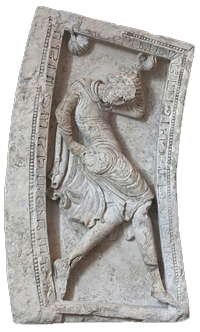
Juggler, limestone sculpture, third quarter of the 12th century. Museum of Fine Arts of Lyon

Juggler, limestone sculpture, third quarter of the 12th century. Museum of Fine Arts of Lyon

The Medieval Academy of America has long provided a variety of benefits of membership, including numerous fellowships, prizes and grants for travel, research and publications. Please see the list below with their deadlines, then follow the links for complete descriptions and application information. We encourage all eligible members to apply for these grants.

Graduate Student Fellowships and Awards
Birgit Baldwin Fellowship
(Deadline 15 November 2013)
Schallek Fellowship  (Deadline 15 October 2013)
Schallek Awards  (Deadline 15 February 2014)
Medieval Academy Dissertation Grants  (Deadline 15 February 2014)
Leyerle-CARA Prize  (Deadline 31 January 2014)

Service Awards
Kindrick-CARA Award for Outstanding Service (Deadline 15 November 2013)

Teaching Awards
CARA Award for Excellence in Teaching  (Deadline 15 November 2013)

Independent Scholars/Unaffiliated Faculty
Travel Grants  (Deadline 1 November 2013 for meetings to be held between 1 March and 31 August 2014)

Book Awards
Haskins Medal  (Deadline 15 October 2013)
John Nicholas Brown Prize  (Deadline 15 October 2013)
Van Courtlandt Elliott Prize  (Deadline 15 October 2013)
MAA Book Subventions  (Deadline 1 May 2014)

Posted in MAA Newsletter | Leave a comment

MAA News – MAA Award Winners

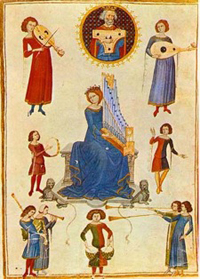
Boethius, De Musica, from Naples, Biblioteca Nazionale Vittorio Emanuele III, MS V. A. 14.

Boethius, De Musica, from Naples, Biblioteca Nazionale Vittorio Emanuele III, MS V. A. 14.

The MAA is delighted to announce an impressive collection of awards garnered by MAA members during the past fellowship season.

The American Council of Learned Societies announced eleven MAA winners.

Three in the Collaborative Research Fellowship competition:
Heather Blurton (University of California, Santa Barbara)
Hannah Johnson (University of Pittsburgh)
Michael Edward Kulikowski (Pennsylvania State University)

Two in the Frederick Burkhardt Residential Fellowship competition:
Jessica Brantley (Yale University)
Carol Symes (University of Illinois, Urbana-Champaign)

Three in the Mellon/ACLS Dissertation Completion Fellowship competition:
Paul A. Broyles (University of Virginia)
Timothy S. Miller (University of Notre Dame)
Benjamin A. Saltzman (Univ. of California, Berkeley)

One in the general Fellowship competition:
Hussein Fancy (University of Michigan)

One in the Digital Innovation Fellowship competition:
William A. Kretzschmar (University of Georgia)

One in the New Faculty Fellows Program competition:
Theresa O’Byrne (Rutgers University)

Karen Sullivan of Bard College was awarded a Fellowship by the John Simon Guggenheim Memorial Foundation.

The MAA’s own Dissertation Grant and Schallek Award winners were announced in early May.

Schallek – Richard III Society Awards:
Esther Liberman Cuenca (Fordham University)
“The Making of Borough Customary Law in Medieval Britain”

Karrie Fuller (University of Notre Dame)
“Reading Beyond the Borders: Visions of Christendom and the Shared Reception of Piers Plowman and The Book of Sir John Mandeville”

Cynthia Anne Rogers (Indiana University)
“‘Make thereof a game’: The Lyrics of the Findern Manuscript and their Late Medieval Textual Community”

Kristin Uscinski (Fordham University)
“Recipes for Women’s Healthcare in Medieval England”

Hannah Zdansky (University of Notre Dame)
“Romance Reconsidered: The Religious Significance of a Secular Genre in Late Medieval Britain”

MAA Dissertation Grants:
Hope Emily Allen Dissertation Grant
Katie Ann-Marie Bugyis (University of Notre Dame)
“Ministers of Christ: Women Religious in Early and Central Medieval England”

John Boswell Dissertation Grant
Alexander Harper (University of Toronto)
“Patronage in the re-Christianized Landscape of Angevin Apulia: The Rebuilding of Luceria Sarracenorum into Civitas Sanctae Mariae'”

Helen Maud Cam Dissertation Grant
Lisandra Costiner (Oxford University)
“Vernacular Narratives of the Life of Christ and the Characteristics of Popular Devotion in Late-Medieval Venice'”

Grace Frank Dissertation Grant
A. Sheree Brown (University of Michigan)
“‘That peace shall always dwell among them and true love be upheld’: Charity, Neighborliness, and Lay Fellowship in Late Medieval and Early Reformation England”

Etienne Gilson Dissertation Grant
David Morris (University of Notre Dame)
“Apocalypse Now or Later: The Super Prophetas of Pseudo-Joachim of Fiore”

Frederic C. Lane Dissertation Grant
Talia Zajac (University of Toronto)
“Women between West and East: the Orthodox-Catholic Marriages of the Kyivan Rus Dynasty, ca. 1000-1250”

E.K. Rand Dissertation Grant
Rebecca Scharbach Wollenberg (University of Chicago Divinity School)
“‘And They Became the People of the Book’: Tracing the Turn to Text in Medieval Jewish Genres”

Charles T. Wood Dissertation Grant
Jennifer Lyons (Emory University)
“The Theophilus Legend and the Virgin Mary: Image, Miracle, and Cult in Medieval France”

Posted in MAA Newsletter | Leave a comment

MAA News – MAA@Kalamazoo

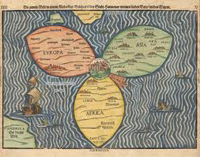
Bünting clover-leaf map. A woodcut made in 1581 in Magdeburg.

Bünting clover-leaf map. A woodcut made in 1581 in Magdeburg.

In May 2013, as always, the Medieval Academy had a strong presence at the Congress on Medieval Studies at Kalamazoo. Several hundred people attended the Friday morning MAA plenary lecture by Peregrine Horden (Royal Holloway College and the University of Oxford) titled “Poseidon’s Oar: Horizons of the Medieval Mediterranean.” The related Academy-sponsored sessions later in the day, continuing the Mediterranean theme, were packed. These sessions were organized by the MAA’s Kalamazoo Program Committee, comprised of Diane Reilly (Indiana University, Chair), Samantha Kelly (Rutgers Univ.), Sharon Kinoshita (Univ. of California, Santa Cruz), and Stephen Lahey (Univ. of Nebraska).

The Medieval Academy’s Committee on Centers and Regional Associations (CARA) sponsored a successful roundtable on “Programming, Pedagogy, and Outreach” and a poster session on “The Multi-lingual Classroom, Text Editing, and New Media,” both organized by Thomas A. Goodmann (University of Miami).

The Medieval Academy’s Graduate Student Committee (GSC) sponsored a roundtable discussion titled “What Now? What Next? A Roundtable Discussion on Graduate Studies and Employment” with Jerome E. Singerman (U. Penn Press), Steven F. Kruger (Queens College and Graduate Center, CUNY), Dot Porter (Univ. of Pennsylvania) and Joshua Boggs. Ethan Zadoff (Graduate Center, CUNY) organized and presided at the roundtable, which, like the GSC reception that followed, was very well attended.

Posted in MAA Newsletter | Leave a comment