
Institute for Advanced Study, Opportunities for Scholars 2014-2015

INSTITUTE FOR ADVANCED STUDY, School of Historical Studies, Opportunities for Scholars 2014-2015.  The Institute is an independent private institution founded in 1930 to create a community of scholars focused on intellectual inquiry, free from teaching and other university obligations.  Scholars from around the world come to the Institute to pursue their own research.  Candidates of any nationality may apply for a single term or a full academic year.  Scholars may apply for a stipend, but those with sabbatical funding, other grants, retirement funding or other means are also invited to apply for a non-stipendiary membership.  Some short-term visitorships (for less than a full term, and without stipend) are also available on an ad-hoc basis.  Open to all fields of historical research, the School of Historical Studies= principal interests are the history of western, near eastern and Asian civilizations, with particular emphasis upon Greek and Roman civilization, the history of Europe (medieval, early modern, and modern), the Islamic world, East Asian studies, art history, the history of science and philosophy, modern international relations, and music studies.   Residence in Princeton during term time is required.  The only other obligation of Members is to pursue their own research.  The Ph.D. (or equivalent) and substantial publications are required.  Information and application forms may be found on the School=s web site, www.hs.ias.edu, or contact the School of Historical Studies, Institute for Advanced Study, Einstein Dr., Princeton, N.J. 08540 (E-mail address: mzelazny@ias.edu).  Deadline: November 1 2013
Posted in Announcements | Leave a comment

Call for Papers – Medieval Copper, Bronze and Brass – Dinant-Namur 2014

History, archaeology and archaeometry of the production of brass, bronze and other copper alloy objects in medieval Europe (12th-16th centuries)

15, 16 and 17 May 2014 – Dinant and Namur (Belgium)

The circular of the conference can be also downloaded from the website www.laitonmosan.org via this link:

http://www.laitonmosan.org/symposium_2014.pdf

The proposals should be sent to this address, as soon as possible and before September 30th: laiton.mosan@gmail.com

Posted in Call for Papers | Leave a comment

Ligatus Summer School 2013

The History of European Bookbinding 1450-1830
and
Identifying and recording bookbinding structures of the Eastern Mediterranean.

26 – 30 August and 2 – 7 September 2013
University of Uppsala, Uppsala, Sweden

The 8th Ligatus Summer School, following the success of the courses in Volos, Patmos, Thessaloniki, Wolfenbüttel, Venice, and Paris is to be held this year at Uppsala University in Sweden, where we have access to its magnificent library. The university was founded in 1477, and it is the oldest university in Sweden, and still dominates the old centre of the city, itself historically an important archiepiscopal see and trading centre. The University Library’s collections of early printed books are made up of donations, ‘war booty’ (from the conquests of Gustavus Adolphus in the Thirty Years’ War and including the greater part of Copernicus’ own library), purchases and a large collection of Swedish editions, which is particularly comprehensive because of the system of legal deposits that was introduced at the end of the seventeenth century.

The library holds a copy of Sweden’s oldest printed book, ‘Dyalogus Creaturarum Moralizatus’, printed in Stockholm in 1483, as well as the first book published in the Swedish language, ‘Aff Dyäffwlsens Frästilse’ (“On the temptations of the devil”), printed in 1495. There is also a notable collection of school textbooks from the seventeenth century up to the present day.

Printed books and manuscripts from the library will be shown in both weeks of the summer school, and additional visits to the libraries of Count Carl Gustaf Wrangel in Skokloster Castle and Charles de Geer at Leufstabruk are planned for the first week.

More info is available by clicking here.

Posted in Summer Programs | Leave a comment

Message to Members

To All Members of the Medieval Academy:

We are pleased to announce that, with the advice and approval of Council, we have found a short-term administrative solution so that the work of the Medieval Academy can continue smoothly. As of May 1, Lisa Fagin Davis has returned to the office where she has previously worked to take on the role of Acting Executive Director. Jacqueline Brown, well-known to members for her many years of service and devotion, has kindly agreed to come on board and edit Speculum, as well as take on responsibility for all other Academy publications. Her title is Acting Editor of Speculum and Director of Medieval Academy Publications. Please contact Jackie Brown [JB@TheMedievalAcademy.org] for all matters to do with publications and Lisa Fagin Davis [LFD@TheMedievalAcademy.org] on all other issues that may arise.

Since the Academy’s lease expires on May 31, the former Executive Director had already planned a move to new, more economical office space, which we anticipate will be close to the present office. Please be patient for the next two months as the shift to our new home is completed. Lisa Fagin Davis will be in touch over the next two weeks with details of the new site.

The division between the roles of Acting Executive Director and Acting Editor of Speculum is in place only for the short run, as their contracts expire on 15 September.  This leaves the Council a limited, clearly defined period of time to decide what kind of permanent structure it wants for the administration of the Academy and to find personnel to carry out that administration.  In case those decisions should require more time, both Davis and Brown have indicated a willingness to stay on until the end of the calendar year.  But we have no commitment to the acting staff beyond the terms of their contracts. The temporary arrangements involve an increase in expenditure on an annualized basis of 1.4% of the total budgeted Academy disbursements for 2013. This small increase is well within the financial resources of the Academy.

As the Council deliberates over the next months on the best arrangements for the future, its members welcome suggestions, ideas, and comments. In the meantime, we would like to thank those who have assisted us with the short-term arrangements: members of Council, treasurer Gene Lyman, past president Maryanne Kowaleski, and our previous Executive Director, Rick Emmerson. We are grateful to Lisa Fagin Davis and Jacqueline Brown for their willingness to come forward on short notice and assure that the Academy will continue to fulfill its functions efficiently and effectively.

Richard Unger
William Jordan
Barbara Newman

Posted in Announcements | Leave a comment

Call for Papers: Brown University Conference on Captivity in Medieval and Early Modern Society

Prisons of Stone, Word, and Flesh: Medieval and Early Modern Captivity An Interdisciplinary Symposium at Brown University, 21 February 2014

We invite submissions for a one-day interdisciplinary symposium to take place at Brown University on February 21, 2014, hosted by the Cogut Center for the Humanities and sponsored by the Department of French Studies, the Department of Comparative Literature, the Medieval Studies Program, and the Department of History. Our theme will be “Prisons of Stone, Word, and Flesh: Medieval and Early Modern Captivity.” Professor Adam Kosto (History, Columbia University), author of Hostages in the Middle Ages (Oxford University Press, 2012), will serve as the keynote speaker.

If, following the thought of Michel Foucault and others, the prison is an essentially modern invention, how can we best conceptualize captivity in the time beforehand? Historical records of the medieval and early modern period (roughly 400-1800 AD) offer countless examples of human bondage, including the capture and detention of prisoners of war and the voluntary submission of hostages, as well as evolving forms of punitive incarceration. During the same time, art and literature are replete with depictions of imprisonment, often employed as a master metaphor for concepts like erotic love or mankind’s enslavement to the Devil and the body. Being held against their will even seems to have been something of a rite of passage for numerous medieval and early modern authors (such as Marco Polo, François Villon, Charles d’Orléans, Thomas Malory, and Cervantes) who found in various forms of captivity the time and inspiration necessary to create some of the most enduring works of western literature.

Submissions are sought from graduate students, faculty members, and other scholars in fields including—but not limited to—history, literature, languages, philosophy, religious studies, art and architectural history, and music. Particularly welcome are submissions which offer new methodological or theoretical approaches to issues of medieval and early modern captivity, or which examine the relationship of captivity to cultural production and/or intercultural exchange. Papers should be no more than twenty minutes in length and should be in English. Please send a 250-word abstract, along with brief contact information, to John Moreau, Mellon Postdoctoral Fellow in French Studies and Comparative Literature, at John_Moreau@Brown.edu. The submission deadline is November 1, 2013.

Posted in Call for Papers | Leave a comment

Message to Members

Dear Members,

The report of the resignation of the Executive Director, sent to you last Friday, summarized events and also looked forward to a resolution of the difficult position in which the Academy now finds itself, due to the sudden loss of its administrative officers.  That message generated dismay, sadness and puzzlement, a response we share.  Ron Musto, in statements quoted in Inside Higher Ed, has now given more information about the decision to resign than he and Eileen Gardiner gave when their resignation was announced to the Council on 9 April.  If correctly reported, the statement restricts the limits of what has been at times wild speculation.

The date Ron Musto and Eileen Gardiner chose to leave their post was 19 April, the same day on which you received notice of their departure.  Members of the Council had written to them earlier, asking them to reconsider their decision, but they did not.  Of course, the Council could not force them to stay.  Their resignation had to be accepted, along with wishes for their future success.  We can now report that they have left and that a smooth transition has taken place.  We are indebted to William Stoneman of the Finance Committee, who oversaw their departure.

In the press, Eileen Gardiner and Ron Musto are reported to have said they were fearful that excessive oversight would bring their agenda to a halt.  Their considerable progress over the fifteen months they were in office, however, suggested to the Executive Committee of the Council that all parties could work together to effect further positive change.  Unfortunately, the Executive Director/s did not share this opinion.  Hence, the resignation.  We will regret not having the benefit of their energy in the future, and we are sorry that any differences or misunderstandings about future directions could not be resolved, despite our offering to continue the dialog.

In any case, we are now concerned that the momentum recently created under their leadership not be lost.  In consultation with all members of the Council, we are searching for new staff to take up an acting role or roles in the office so that the normal business of the Academy may continue.  Finding the right people, given the time constraints we face, will not be easy, but we are making progress and hope to have an announcement for you in the next two or three weeks.  Until new members are added to the staff, Sheryl Mullane-Corvi, the Assistant to the Executive Director, and Christopher Cole, the Communications and Membership Coordinator, will endeavor to carry out the work of the Academy.  They have been doing an excellent job for all of us.  We would only ask that, given the sharply increased workload they face, you will be patient in the coming weeks with any requests or enquiries you make of the office.

Once acting staff is in place, the Council will turn its attention to the structure of the office in Cambridge.  This topic was already on the agenda of the Action Planning Committee, a group formed by the Council at the meeting in Knoxville, and has been under consideration ever since Rick Emmerson pointed out, on his departure in May 2005, that the job of Executive Director and Editor of Speculum had become more than a full-time post.  The Council will consider options to guarantee that the expanding range of services of the Academy are effectively handled, as well as creating circumstances for more fruitful cooperation between paid staff and the elected officers.  In the meantime, all Council members will welcome comments and suggestions from members   Once a structure is in place, a proper search will be undertaken to find the right permanent staff for the Academy.

Some of you have written to us directly in recent days.  We will share your comments with the Council and reply to you when possible.  Despite this sudden change in staffing, we are sure the Academy will continue its well-established pattern of contributing to the scholarly work of members and to the good of our field.

Richard Unger
William Jordan
Barbara Newman

Posted in Announcements | Leave a comment

A Message from the President

Dear Members,

Sadly I must report that Eileen Gardiner and Ron Musto have tendered their resignation as Executive Director of the Medieval Academy, effective Friday, 19 April.  Their sudden departure is regrettable but I am sure all of members of the Academy join me in wishing both of them the best of luck in the future.  The three presidential officers jointly and with the support of the Executive Committee and the Council are working to ease the transition to new personnel in the office in Cambridge, MA.  Any delays in actions of or responses from the office should be temporary and patience in coming days will be appreciated.

Richard W. Unger
President, Medieval Academy of America

Posted in Announcements | Leave a comment

Call for Papers – Medieval Anchorites in their Commumities

The 5th International Anchoritic Society Conference
Gregynog Hall, Newtown, Powys, Wales
April 22-24, 2014
Call for Papers
Medieval Anchorites in their Communities

Keynote Speakers:
Diane Watt (Surrey)
Tom Licence (UEA)
Eddie Jones (Exeter)

Much of the work undertaken in the field of medieval anchoritism, particularly within an English context, has concentrated on the vocation’s role within the history of Christian spirituality, its function as a locus of (gendered) sacred space and its extensive ideological cultural work. Indeed, in the hundred years since Rotha Mary Clay’s foundational 1914 study of  English anchoritism, The Hermits and Anchorites of England (1914), only sporadic attention has been given to the English anchorite as part of a community – whether social, intellectual, spiritual or religious – and as part of a widespread ‘virtual’ community of other anchorites and religious or ‘semi-religious’ figures spread across England and beyond.

In its focus on anchorites within their multifarious communities, this conference seeks papers attempting to unpick the paradox of the ‘communal anchorite’ and the central role often played by her/him within local and (inter)national political contexts, and within the arenas of church ideology, critique and reform.

It also seeks contributions for a Roundtable discussion on any aspect of Mary Rotha Clay’s work, its lasting legacies and the debt to her scholarship owed by new generations of scholars in the twenty-first century.

Offers of 20-minute papers are sought on any aspect of medieval anchorites in their communities including (but not restricted to):

•Spiritual circles
•Communities of discourse
•Anchoritic/lay interaction
•Anchorites and church reform
•Networks of patronage
•Networks of anchorites
•Anchorite case studies
•Anchoritic friendship groups
•Book ownership/ borrowing/ lending/ circulation
•Communities of texts: ‘anchoritic’ miscellanies/ textual travelling companions
•Textual translation, circulation and mouvance
•Non-insular influence
•Gendered communities

Abstracts of up to 500 words should be sent to Dr Liz Herbert McAvoy at anchorites2014@swan.ac.uk by Friday, August 30th 2013

Posted in Call for Papers | Leave a comment

MAA News – MAA Membership Renewals

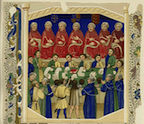
Court of Common Pleas

Court of Common Pleas

Your membership in the Medieval Academy provides you with a growing list of benefits, ranging from the print and digital editions of Speculum, to our MAA News, Conference Calendar and Blog to book discounts and our annual meeting.

As important, your dues also help fund our growing program of support to younger scholars in the form of book subventions, research and travel grants and awards. In so many ways your dues help support medieval studies and humanistic scholarship at a time of shrinking resources and cultural change.

Paper renewal forms have now been mailed to all members who have not yet renewed their memberships online for 2013.  We hope that you will respond to this mailing at your earliest convenience or visit the website at: http://www.medievalacademy.org.
Please be as generous as you can.

Posted in MAA Newsletter | Leave a comment

MAA News – Dissertation Grant Matching Fund

Michael Psellos (left) with his student, Byzantine Emperor Michael VII Doukas., Mount Athos, Pantokrator Monastery, Codex 234, fol. 245a

Michael Psellos (left) with his student, Byzantine Emperor Michael VII Doukas., Mount Athos, Pantokrator Monastery, Codex 234, fol. 245a

The Freeman Foundation and its founder Weston Milliken have generously offered a $10,000 matching grant to the MAA to enable the Academy to award the John Boswell Dissertation Grant annually. To receive these funds, the MAA will need to raise $10,000 by June 30th. So far we have raised $3,775 of this total with $6,255 more to go.

A successful campaign would bring the number of MAA Dissertation Grants to eight annually, each named for a prominent medievalist. The Committee for Professional Development judges this award competition.

With the money already raised, the Boswell Grant is now biennial, and the first award will be made in 2013.

With $5 from each graduate student member of the MAA — or $50 from each Fellow — the MAA would easily meet this challenge. We urge them and everyone in between to make a donation in any amount to support graduate-student funding and to honor the legacy of John Boswell. Online donations can be made here.

John Boswell, a medieval historian who taught at Yale University from 1975 until his death in 1994 at age 47, was a pioneer in two fields that have developed significantly over the past two decades: the study of Christian-Muslim-Jewish relations, especially in the Iberian Peninsula, and GLBT studies. His scholarly legacy is found not only in his four monographs but also in the many students, both undergraduate and graduate, who followed him into the profession. Before his death he also served on the board of the Freeman Foundation, which has now offered this matching grant in his honor.

Posted in MAA Newsletter | Leave a comment