
Jobs For Medievalists

Tenure-Track Assistant Professor of French/Francophone Literature at Hunter College, CUNY

The Department of Romance Languages at Hunter College invites applications for a full-time tenure-track Assistant Professor in French beginning Fall 2023. The area of specialization is open, although we are especially interested in candidates with scholarly expertise in Francophone literature, particularly as it relates to the Caribbean, the Maghreb, Sub-Saharan Africa, Quebec, and the Indian Ocean, and with research and teaching interests related to literary and political theory, Marxism, and aesthetics.

Located on the Upper East Side of Manhattan, Hunter College is the largest school in the network of public institutions that comprise the City University of New York. It maintains a strong commitment to providing a rigorous and affordable education in the liberal arts and sciences to a diverse student body.

RESPONSIBILITIES:

The candidate will be expected to teach three courses per semester, pursue original scholarly research in their field, and participate in the administrative life of the department and the college. They should be prepared to advise majors, minors, and undergraduates in French courses as well as MA students. This position can also entail opportunities for collaboration with Hunter’s Honors Colleges, its Public Humanities initiative, and the CUNY Graduate Center.

QUALIFICATIONS:

The successful candidate will have a Ph.D. in French or Comparative Literature (with a specialization in French/Francophone studies) in hand by Summer 2023. They will be well-versed in teaching all levels of an undergraduate and graduate French curriculum, dedicated to working with students from a wide variety of socio-cultural backgrounds, experienced and interested in language pedagogy, and able to demonstrate native or near-native proficiency in French and English.

VACCINE REQUIREMENT:

Candidates will be required to provide proof of being fully vaccinated against COVID-19 upon commencing employment. Exemption (medical or religious) requests to this requirement will be considered in accordance with applicable law. Being fully vaccinated is defined for this purpose as being at least two weeks past their final dose of an authorized COVID-19 vaccine regimen. Final candidates must be fully vaccinated as of their first day of employment.

COMPENSATION:

CUNY offers faculty a competitive compensation and benefits package covering health insurance, pension and retirement benefits, paid parental leave, and savings programs. We also provide mentoring and support for research, scholarship, and publication as part of our commitment to ongoing faculty professional development.

Assistant Professor – $51,242 – $97,580

HOW TO APPLY:

Applications must be submitted online by accessing the CUNY Portal on City University of New York job website: www.cuny.edu/employment

To search for this vacancy, click on SEARCH ALL POSTINGS and in the SEARCH JOBS field, enter the Job Opening ID number 25053

Click on the “APPLY NOW” button and follow the application instructions. Current users of the site should access their established accounts; new users should follow the instructions to set up an account.

Please have your documents available to attach into the application before you begin. Note, the required material must be uploaded as ONE document under CV/ Resume (do not upload individual files for a cover letter, references, etc.). The document must be in .doc, .docx, .pdf, .rtf, or text format– and the name of the file should not exceed ten (10) characters – also DO NOT USE SYMBOLS (such as accents (é, è, (â, î or ô), ñ, ü, ï , –, _ or ç)). Incomplete applications will not be considered.

Please include:

– A cover letter that briefly addresses the candidate’s research agenda and teaching philosophy

– A CV

– A transcript of Graduate coursework

– A sample of written scholarship in French or English (no longer than 25 pages)

Upload all documents as ONE single file– PDF format preferred.

– In addition, please have three confidential letters of reference e-mailed by the recommenders to: Frenchsearch@hunter.cuny.edu

One of these letters should address the candidate’s teaching experience.

CLOSING DATE:

The search will remain open until the position is filled. The committee will begin reviewing complete applications on December 1st. Applications submitted after the deadline will only be considered if the position/s remain open after the initial round.
Posted in Jobs for Medievalists | Leave a comment

Jobs For Medievalists

Position Title: Assistant Professor (Tenure Track) Medieval History

Position Description
The Historical Studies program at Bard College invites applications for a tenure-track position at the rank of Assistant Professor in Medieval History, to begin in Fall 2023.

Time period, regional focus, and topical specialization are all open for consideration. The successful candidate will be expected to teach a mix of survey and field-specific thematic courses, contributing to a dynamic, interdisciplinary program in Medieval Studies.

Bard College is a highly selective college of liberal arts and sciences with 2000 students and is located in the Hudson valley, 90 miles north of NYC. For more information on Bard visit www.bard.edu.

The successful candidate will be expected to teach a mix of survey and field-specific thematic courses as well as First-year Seminar, the college’s common course for first-year students.

Candidates holding a doctorate will be given preference, but those at the dissertation stage will also be considered.

To Apply
Please submit a letter of application, current C.V., and three confidential letters of reference via Interfolio at: http://apply.interfolio.com/113876

Course syllabi and teaching statements are not required but will also be considered.

We will begin reviewing application materials on October 25, 2022. For fullest consideration, all materials should be submitted by November 25, 2022.

Posted in Jobs for Medievalists | Leave a comment

Jobs For Medievalists

The Department of Art History in the Dana and David Dornsife College of Letters, Arts and Sciences at the University of Southern California (Los Angeles, CA) invites applications for a tenure-track Assistant Professor position in Premodern Art, Architecture, and/or Visual or Material Culture, ca. 400–1400 CE.

We welcome applications from candidates working in any region or cultural area. We seek a scholar with a dynamic research agenda who is committed to innovative methodologies applicable to the broader discipline of art history. The successful applicant will diversify our course offerings, at both undergraduate and graduate levels, will complement existing faculty scholarship, and will contribute to interdisciplinary strengths within and beyond the Art History Department. This position is expected to begin August 2023.

Candidates must possess a Ph.D. at the time of appointment and show exceptional scholarly promise. Interested candidates should provide: 1) a cover letter that includes a discussion of research and teaching as well as their experience or commitment to diversity, equity and inclusion through activities such as fostering an inclusive classroom environment or incorporating diverse perspectives in their own scholarship, 2) a curriculum vitae, 3) two writing samples, at least one of which should be a chapter from a dissertation or book manuscript, and 4) the names and contact information of three referees who will be contacted in a system-generated email to provide letters. In order to be considered for this position, applicants are also required to submit an electronic USC application; follow this job link or paste in a browser: https://usccareers.usc.edu/job/los-angeles/assistant-professor-in-premodern-art/1209/37579805168. Deadline for applications is November 30, 2022. Questions can be directed to Elizabeth Massari, massari@usc.edu.

USC is an equal-opportunity educator and employer, proudly pluralistic and firmly committed to providing equal opportunity for outstanding persons of every race, gender, creed and background. The university particularly encourages members of underrepresented groups, veterans and individuals with disabilities to apply. USC will make reasonable accommodations for qualified individuals with known disabilities unless doing so would result in an undue hardship. Further information is available by contacting uschr@usc.edu.

Posted in Jobs for Medievalists | Leave a comment

Rare Book School Now Accepting Scholarship & Fellowship Applications

Rare Book School is now accepting applications for its scholarships and fellowships. As we look forward to sharing our 2023 schedule of in-person and online courses later this year, we hope you and your colleagues will consider some of the many forms of support we offer:

Scholarships
Each year, RBS awards some 40 scholarships to new and returning students, with special consideration given to applicants with demonstrable financial need, as well as applicants early in their careers who represent underserved communities (or whose institutions do so). Everyone is welcome to apply. Scholarships are awarded in January and may be redeemed within two calendar years. Most scholarships cover tuition for one in-person course, or for either one 22-hour online course or two short online courses.
Deadline: 1 November
Details: https://rarebookschool.org/admissions-awards/scholarships/

Mellon Society of Fellows in Critical Bibliography: Junior Fellows Program
The Andrew W. Mellon Society of Fellows in Critical Bibliography is now inviting applications for its 2023–25 cohort of Junior Fellows. This program offers unique professional development opportunities for early career, U.S.-based scholars working across disciplines to advance the study of texts, images, and artifacts as material objects. Fellows attend two RBS courses, participate in one bibliographical field school, and receive funding to organize a symposium at their home institution.
Deadline: 18 November
Details: https://rarebookschool.org/admissions-awards/fellowships/sofcb/

M. C. Lang Fellowship in Book History, Bibliography, and Humanities Teaching with Historical Sources
The M. C. Lang Fellowship in Book History, Bibliography, and Humanities Teaching with Historical Sources is now accepting applications for its fourth cohort. This two-year program is designed to animate humanities teaching by equipping educators to inculcate wonder in their students by enlarging the students’ understanding of original historical sources. Lang Fellows take two RBS courses and learn how to use special collections resources to teach undergraduates to understand and interpret textual historical objects as evidence of the people and cultures that produced them, and those that have encountered them since. Fellows are encouraged to enlist others on and near their campuses who could help create a community of practice (using available matching funds), so that book-historical humanities teaching with original primary sources is not merely a matter of individual preference, but a central aspect of the local educational culture. Librarians, faculty, and staff instructing undergraduates at small universities and liberal arts colleges in the U.S. are eligible to apply.
Deadline: 1 December
Details: https://rarebookschool.org/admissions-awards/fellowships/lang/

Courses

The scholarship and fellowship resources offered by RBS can create opportunities for students to attend engaging courses, such as:

About RBS

RBS supports the study of bibliography and the history of books and printing and related subjects. At various times during the year, RBS offers about 40 five-day, non-credit courses on topics concerning old and rare books, manuscripts, and special collections. Offerings now include a selection of online courses. Find more information at https://rarebookschool.org.

Posted in Announcements | Leave a comment

Marco Manuscript Workshop 2023 

Writing the World 
Marco Manuscript Workshop 2023 

February 3-4, 2023 
Marco Institute for Medieval & Renaissance Studies 
The University of Tennessee, Knoxville 

The eighteenth annual Marco Manuscript Workshop will take place Friday, February 3, and Saturday, February 4, 2023, at the University of Tennessee, Knoxville. The workshop is organized by Professors Charles Sanft (History) and Roy M. Liuzza (English) and is hosted by the Marco Institute for Medieval & Renaissance Studies.

This year’s theme is, broadly, manuscripts in and of the world. We imagine two aspects to this theme. The first is manuscripts that travel: manuscripts always bear the marks of the time and place of their creation, and many remain rooted to their place of origin, but others range widely in the world as cargo, gifts, devotional or collectible objects, or simply baggage that can be left behind. How do some texts get from one place to another, and why? What evidence of their travels do they bear? The second aspect of our theme concerns texts that try to convey the world beyond their pages. How do they describe the world? How is it depicted? Where is the center? What lies at the margins? What ideas and doctrines exist in the broader world? Understandings about the size and shape of the world have changed considerably since the ancient world and vary greatly from one culture to another. How have texts adapted to new information and ideas? We invite participants to consider manuscripts that connect the reader to the world—descriptions, travelogues, maps, accounts of distant places, cosmologies, stories of other worlds—or that record or reflect encounters between people in different places. As always, we welcome presentations on any aspect of this topic, broadly imagined. We are especially interested in presentations that address these questions from a non-European perspective.

The workshop is open to scholars and students in any field who are engaged in or interested in textual editing, manuscript studies, or epigraphy. Individual 75-minute sessions will be devoted to each presentation and discussion; participants will be asked to introduce their text and its context, discuss their approach to working with their material, and exchange ideas and information with other participants. As in previous years, the workshop is intended to be more like a class than a conference; participants are encouraged to share new discoveries and unfinished work, to discuss both their successes and frustrations, to offer practical advice and theoretical insights, and to work together towards developing better professional skills for textual and codicological work. We particularly invite the presentation of works in progress, unusual problems, practical difficulties, and new or experimental models for studying or representing manuscript texts. Presenters will receive a $500 honorarium for their participation.

The deadline for applications is October 15, 2022. Applicants are asked to submit a current CV and a two-page abstract of their project to Roy M. Liuzza, preferably via email to rliuzza@utk.edu, or by mail to the Department of English, University of Tennessee, 301 McClung Tower, Knoxville, TN 37996-0430.

The workshop is also open at no cost to scholars and students who do not wish to present their own work but are interested in sharing a lively weekend of discussion and ideas about manuscript studies. Further details will be available later in the year; please visit marco.utk.edu/ms-workshop or contact the Marco Institute at marco@utk.edu for more information.

Posted in Workshops | Leave a comment

Newberry Library’s Fellowships

The Newberry Library’s long-standing fellowship program provides outstanding scholars with the time, space, and community required to pursue innovative and ground-breaking scholarship.

In addition to the library’s collections, fellows are supported by a collegial interdisciplinary community of researchers, curators, and librarians. An array of scholarly and public programs also contributes to an engaging intellectual environment.

We invite interested individuals to apply for the Newberry’s many fellowship opportunities:

Long-Term Fellowships are available to postdoctoral scholars for continuous residence at the Newberry for periods of 4 to 9 months; the stipend is $5,000 per month. Applicants must hold a PhD by the application deadline in order to be eligible. Long-Term Fellowships are intended to support individual scholarly research and promote serious intellectual exchange through active participation in the fellowship program. The deadline for long-term fellowships is
November 1
.

Short-Term Fellowships are available to postdoctoral scholars, PhD candidates, and those who hold other terminal degrees. Short-Term Fellowships are generally awarded for 1 to 2 months; unless otherwise noted the stipend is $3,000 per month. These fellowships support individual scholarly research for those who have a specific need for the Newberry’s collection. The deadline for short-term opportunities is December 15.

Learn about eligibility requirements for our various fellowships.

Posted in Fellowships | Leave a comment

Call for applications – Visiting Researchers

The ERC Advanced Grant AGRELITA Project n° 101018777, “The reception of ancient Greece in pre-modern French literature and illustrations of manuscripts and printed books (1320-1550) : how invented memories shaped the identity of European communities”, directed by Prof. Catherine Gaullier-Bougassas (Principal Investigator), opens guest researchers residences.

The Hypotheses academic blog presents the project and its team : https://agrelita.hypotheses.org/

This call for applications is open to anyone, of French or foreign nationality, who holds a PhD in literature, art history, or history, whose work focuses on the history of books, cultural and political history, visual studies, or memory studies, wherein the competence and project are deemed to be complementary to the ones of the AGRELITA team.

These residencies indeed aim to open the reflections carried out by the team, to enhance its scientific activity through interactions with other scholars and other universities. The guest researchers will have the exceptional opportunity to contribute to a major project, to work with a dynamic team that conducts a wide range of activities at the University of Lille and within the research laboratory ALITHILA where many Medieval and Renaissance times specialists work, as well as to publish in a prestigious setting.

The AGRELITA project is based at the University of Lille. Located in the north of France, Lille is a city in the heart of Europe : 35 minutes from Brussels, 1 hour from Paris, 1 hour 20 minutes from London, 2 hours 40 minutes from Amsterdam, and 2 hours 30 minutes from Aachen. Residing in this metropolis offers the chance to discover the rich medieval heritage of Flanders and to carry out research in nearby libraries, museums, and archives, with very rich collections (Lille, Saint-Omer, Valenciennes, Boulogne-sur-Mer, Cambrai, Arras, Brussels).

Click here for more information.

Posted in Uncategorized | Leave a comment

Tenth Annual Symposium on Medieval and Renaissance Studies

CALL FOR PAPERS
Tenth Annual Symposium on Medieval and Renaissance Studies
June 12-14, 2023
Saint Louis University
St. Louis, Missouri

The Tenth Annual Symposium on Medieval and Renaissance Studies (June 12-14, 2023) is a convenient summer venue in North America for scholars to present papers, organize sessions, participate in roundtables, and engage in interdisciplinary discussion. The goal of the Symposium is to promote serious scholarly investigation into all topics and in all disciplines of medieval and Renaissance studies.

The plenary speakers for this year will be Uta-Renate Blumenthal, of the Catholic University of America, and Lia Markey, of the Newberry Library, Chicago.

The Symposium is held annually on the beautiful midtown St. Louis campus of Saint Louis University. On campus housing options include affordable, air-conditioned apartments as well as a more luxurious hotel. Inexpensive meal plans are also available, although there is a wealth of restaurants, bars, and cultural venues within easy walking distance of campus.

While attending the Symposium, participants are free to use the Vatican Film Library, the Rare Books Division, and the general collection at Saint Louis University’s Pius XII Memorial Library. These collections offer access to tens of thousands of medieval and early modern manuscripts on microfilm as well as strong holdings in medieval and Renaissance history, literature, languages, manuscript studies, theology, philosophy, and canon law. The Jesuit Archives & Research Center is adjacent to the university and also accessible to Symposium attendees.

The Tenth Annual Symposium on Medieval and Renaissance Studies invites proposals for papers, complete sessions, and roundtables. Any topics regarding the scholarly investigation of the medieval and early modern world are welcome. Papers are normally twenty minutes each and sessions are scheduled for ninety minutes. Scholarly organizations are especially encouraged to sponsor proposals for complete sessions, and organizing at least two sessions in coordination with each other is highly recommended.

Submission are currently open and the dealine for all proposals is December 31, 2023. Decisions will be made by the end of January and the final program will be published in March.

For more information or to submit your proposal online go to: https://www.smrs-slu.org/.

Posted in Call for Papers | Leave a comment

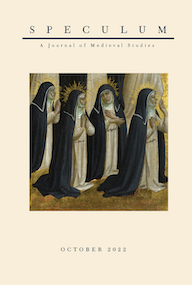
Latest Issue of Speculum is Now Available Online

The latest issue of Speculum is now available on the University of Chicago Press Journals website.

To access your members-only journal subscription, log in to the MAA website using your username and password associated with your membership (contact us at info@themedievalacademy.org if you have forgotten either), and choose “Speculum Online” from the “Speculum” menu. As a reminder, your MAA membership provides exclusive online access to the full run of Speculum in full text, PDF, and e-Book editions – at no additional charge.

Speculum, Volume 97, Number 4 (October 2022)

Articles

Personification and Gender Fluidity in the Psychomachia and Its Early Reception
Katharine Breen

“It Will Help Him Wonderfully”: Placebo and Meaning Responses in Early Medieval English Medicine
Rebecca Brackmann

Roman Women: Female Religious, the Papacy, and a Growing Dominican Order
Mary Harvey Doyno

Comparative Economy and Martial Corporatism: Toward an Understanding of Florentine City Leagues, 1332–92
William Caferro

Word as Bond in an Age of Division: John Eugenikos as Orator, Partisan, and Poet
Nathanael Aschenbrenner and Krystina Kubina

Book Reviews

This issue of Speculum features more than 75 book reviews, including:

Thomas N. Bisson, ed. and trans., The Chronography of Robert of Torigni. Vol. 1, The Chronicle, A.D. 1100–1186. Vol. 2, Related Historical Texts
Reviewed by Sean McGlynn

David Crook, Robin Hood: Legend and Reality
Reviewed by Peter Coss

Matthew Gabriele and David M. Perry, The Bright Ages: A New History of Medieval Europe
Reviewed by Esther Liberman Cuenca

Peter Haidu, The “Philomena” of Chrétien the Jew: The Semiotics of Evil, ed. Matilda Tomaryn Bruckner
Reviewed by Irit Ruth Kleiman

M. Lindsay Kaplan, Figuring Racism in Medieval Christianity
Reviewed by Magda Teter

Verena Krebs, Medieval Ethiopian Kingship, Craft, and Diplomacy with Latin Europe
Reviewed by Andrew Kurt

Liz Herbert McAvoy, The Enclosed Garden and the Medieval Religious Imaginary
Reviewed by Barbara Newman

Alessandro Palazzo and Anna Rodolfi, eds., Prophecy and Prophets in the Middle Ages
Reviewed by Brian FitzGerald

Andrew Rabin, Crime and Punishment in Anglo-Saxon England
Reviewed by Benjamin A. Saltzman

Achim Timmermann, Memory and Redemption: Public Monuments and the Making of Late Medieval Landscape
Reviewed by Jana Gajdošová

MAA members also receive a 30% discount on all books and e-Books published by the University of Chicago Press, and a 20% discount on individual subscriptions. To access your discount code, log in to your MAA account, and click here. Please include this code while checking out from the University of Chicago Press website.

Sincerely,

The Medieval Academy of America

Posted in Speculum | Leave a comment

Reminder – Call for Papers: MAA Centennial Special Issue of Speculum

The Medieval Academy of America Centennial Special Issue
to be published in Speculum: A Journal of Medieval Studies.
Proposals due October 15

Editors: Karla Mallette (University of Michigan)
and Roland Betancourt (University of California, Irvine)

Founded in 1925, the Medieval Academy of America has served as a gathering space for scholars of the Middle Ages to forge new directions and collaborations across disciplines and subfields. In recent decades, the purview of the medieval has expanded to take on a global perspective, broadening the remit of our organization, and urging medievalists to rethink our place–in territorial and temporal terms–in the academy. The contributions of feminism, queer theory, trans studies, critical race theory, and indigenous studies have further redefined how we approach the medieval world and its peoples. Our own positionality–in systems of gender and race identity and as scholars working in North America, a continent excluded from the “medieval” by traditional historiography–inflects our scholarship in crucial ways. These observations lead us to ask, what is the role of our institutions–departments and disciplines, professional and social organizations, the guilds of the twentieth and twenty-first centuries–in the practices of knowledge making?

To mark the Medieval Academy of America’s centennial in 2025, Speculum invites articles for a special issue that reflect on the history of Medieval Studies in North America and its institutions. In this dedicated issue, we wish to address how schools, universities, libraries, archival repositories, professional societies, amateur organizations, and other para-academic and non-academic groups have organized and constructed the limits and articulations of our knowledge. How has Medieval Studies been shaped by its institutions? How have para-academic groups subverted and modeled new ways of maneuvering around conventional spaces? How has an evolving sense of community and belonging formulated and challenged many of the methods, theories, and interventions that have redefined our understanding of the Middle Ages? In the era of social media and social distancing, how have our online platforms provided added modes of collaboration, critique, and activism that have dared to imagine new horizons for the undertaking of our work and for the audiences that our research can reach?

The editors encourage a variety of approaches, including conventional studies on medieval materials that reflect on the state of the field and historiographic essays that consider the development of methodologies, intellectual communities, or critical figures in our disciplines. All contributions, however, should be written as timely interventions in and provocations to Medieval Studies. The editors are happy to consider proposals that break with some of the more established modes of academic writing. We encourage collaboration and will be happy to consider co- or multi-authored articles, and shorter interventions in addition to long-form articles. The editors are particularly interested in works that think critically and expansively about the terms medieval, academy, and America.

Please make sure to note the scale of your proposed contribution, authors, as well as any unique requirements or ideas. All contributions will be double-blind peer reviewed. Please submit a 500-word abstract of your proposed article and a current CV to Roland Betancourt (roland.betancourt@uci.edu) and Karla Mallette (alrak@umich.edu), with the subject line, “MAA Special Issue,” no later than 15 October 2022.

Posted in Call for Papers | Leave a comment