Call for Papers – Questioning the Crime of Witchcraft, Definitions, Receptions and Realities (14th-16th Centuries)

In the last decades, the multiplications of works in the field of Witchcraft Studies made it possible to profoundly renew the approaches and the study designs of the repression of witchcraft in the late Middle Ages and in the beginning of the Early Modern Era. Consequently, research has substantially specified the methods and configurations (ideological, political and doctrinal) that contribute to the genesis of the “witch-hunt”. Research also uncovered that the repression of witchcraft could take a number of different forms depending on the contexts, the spaces studied, the sources and the aims they seem to pursue. It underlines the extreme plasticity of the accusation of witchcraft and the categories of such a crime. Hence, the conference aims to focus the discussions on three main areas: the definition of the crime of witchcraft, its different receptions and the question of its reality.

The goal of the conference is also to discuss the crime of witchcraft by highlighting new fields of research and unstudied sources. The variety of definitions, the modalities of reception and the different realities that the crime of witchcraft had undergone in the late Middle Ages and at the beginning of the Early Modern Era (14th-16th centuries) will be addressed and debated.

Defining the crime of witchcraft: issues, concepts and debates

Historiography has frequently emphasized the richness of the lexicon involved in medieval and early modern sources to name witchcraft and those who practice it. Such a typological abundance is to be seen in the context of the numerous areas where the repression of the crime of witchcraft expanded, starting at the end of the 13th century. The most recent work, in particular those concerning the Alpine region, the Pyrenees and the Kingdom of France, have shown the specific features and the distinctive regional identities of the vocabulary used to define witchcraft.

Moreover, the crime of witchcraft appears as a criminal category with a flexible and dynamic definition where the wording is closely tied to the studied sources. Therefore, the study of witchcraft seems to bear witness that this crime is a concept under construction and in debate at the end of the Middle Ages. If these elements are relatively understood today, a comprehensive review from a comparative perspective remains to be done. The confrontation of various terrains of study mobilizing various materials (judicial, normative, theological sources, pardons, literature, predication) and highlight different production backgrounds (laypersons, clergy, inquisition) would enable us to lead a global reflection on the modalities of the emergence of the crime of witchcraft in the late Middle Ages. It would also help us to clarify the issues of the use of a certain type of vocabulary by highlighting what is at stake depending on the different regional or political units.

Finally, this comparative approach could enable to point out the modalities of diffusion and circulation of the words defining the crime of witchcraft. Therefore, it could permit us to specify the conditions of their reception and their possible influences of the repressive practices against witchcraft.

Reception of the crime of witchcraft: between support and resistance

Beyond its definition, a crime can be diversely received. It is clear that before the beginning the European witch hunt a notion of witchcraft preexists and differs depending on social classes or regions. It corresponds only partially with the concept of Sabbath that emerges in courts starting in the 15th century. It can be seen in the debates of theologians on the reality or fiction of nocturnal flights. It can also be seen in the denunciations generally targeting individuals instead of groups which could be perceived as acting secretly and collectively.

The question of the role of the population in repression is a key element to understand the phenomenon, both in the impact of the popular perception of witchcraft, and in individual actions. If the repression of the diabolical sect could, in certain cases, be exploited by individuals to satisfy their own agenda, oppositions to the concept of Sabbath or to specific trials existed. They are generally difficult to grasp since justice is exercised by the dominant. Those who wanted to contest, to avoid an open revolt, had to accept disguised ways to dodge any sanction. Nevertheless, the study of medieval and early modern bookkeeping enables us to provide elements to understand the adherence of populations to the phenomenon of repression.

Realities of the crime of witchcraft: accusations under tension

In historiography, there exists broad consensus stating that the Sabbath as well as most crimes of which the defendants were accused did not actually occur. Based on this hypothesis generally demonstrated since the 1970s, most historians are now asking the question of the reality which lies behind the crime. If most of the charges against the individuals accused of witchcraft cannot be proven, what pieces of information can be extracted from these documents? The points of view are many. Should the trials be read in a way that picks out elements falling outside the expected framework of their production? Should this information be compared with other sources informing us about social and political tensions within the communities or about the agenda of judges? And finally, what is the influence of the conservation of certain sources on our own vision of the phenomenon?

Papers with topics related to these different themes are particularly welcomed.

The conference will be in French and in English.

The conference is open to young researchers, PhD students, Post-doctoral researchers as well as advanced graduate students.

Submission:
You are invited to submit a 300-word abstract with key words in either English or French by November 30th, 2020 to the following email address: maxime.perbellini@ehess.fr. Please include: a brief résumé, the title of your presentation, as well as your name and your academic affiliation. Please send any additional questions you may have to the aforementioned email address. The presentations will have to be 20 minutes long maximum.

Practical information:

The conference is organized by Maxime Gelly-Perbellini (PhD student at the School for Advanced Studies in the Social Sciences (EHESS, Paris, France) and at the Free University of Brussels, Belgium, Research and Teaching Assistant at the University of Reims Champagne-Ardennes, France) and Olivier Silberstein (PhD student at the University of Neufchâtel, Switzerland). It is sponsored by the School for Advanced Studies in the Social Sciences (EHESS, Paris, France). It will take place on the premises of the School for Advanced Studies in the Social Sciences (EHESS, Paris, France) on May 20th-21st 2021. The conference would start on May 20th at 2pm and would end on May 21st at 5pm.
Posted in Call for Papers | Leave a comment

Panel Discussion: Multilingualism, Translation, Directionality in Global Medieval DH

Please join the Vanderbilt University Center for Digital Humanities and the Global Middle Ages Project on October 16 from 11:00 a.m. – 12:30 CDT / 12:00 – 1:30 p.m EDT  for a panel discussion about global digital projects and their use of languages.

New technologies allow us to experience the past more intimately than humans have ever been able to do before, and we can share our work more efficiently and completely than our predecessors could. But new problems arise, particularly as multi-national groups of scholars work on the histories and cultures of communities that lay claim to their own past and yet often cannot access the research results, often presented in English. In addition, scholars commonly structure databases using English and do their coding in English. How does language use exclude certain communities, and what are best practices for language use in global digital projects? We will discuss techniques and unsolved problems in an effort to make recommendations for global medieval projects.

This panel will bring together scholars working on global digital projects along with an expert in translation to talk about their perspectives on language use in global digital humanities projects.

Our panelists:

  • Zrinka Stahuljak, Professor of Comparative Literature and French, UCLA, and Director, UCLA Center for Medieval and Renaissance Studies – expertise in translation, interpreting, and multilingualism

  • David Michelson, Associate Professor of the History of Christianity, Vanderbilt University – General editor of Syriaca.org and expertise in multi-national collaboration on digital projects with experience in establishing digital humanities standards for Semitic languages

  • David Joseph Wrisley, Associate Professor of Digital Humanities, NYU Abu Dhabi – multitext alignment methods, multilingual/multidirectional language data, politics and practice of interface localization, machine learning medieval scripta, directionality in digital projects, unidirectional fallacy

  • Roger Martinez-Davila, Associate Professor of History, University of Colorado – Colorado Springs – expertise in MOOCs, crowd-sourced research of manuscripts, virtual and augmented reality, and multi-national projects

  • Solomon Gebreyes Beyene, Research Fellow, University of Hamburg – expertise in multi-national manuscript editing and annotating Gǝʾǝz texts using TEI/XML.

The conversation will be moderated by Lynn Ramey (Vanderbilt University) and Dorothy Kim (Brandeis University).

All are welcome. There will be a question and answer period after panelists have spoken. You may submit your questions in advance (lynn.ramey@vanderbilt.edu) or live at the panel. The panel will be recorded and posted on the globalmiddleages.org portal.

Zoom link for the colloquium: https://tinyurl.com/globalmedieval

Posted in Announcements | Leave a comment

Continuing Blog Post Series: Medievalists Beyond the Tenure Track

Danielle Griego received her PhD in History from the University of Missouri-Columbia in 2018. She is currently an Independent Scholar, editing her manuscript and working on an essay in a forthcoming edited volume on medieval childhood. Her work focuses on emotional responses to child death in later medieval England. 

What are you going to do with the PhD when you graduate? Are you going to teach? These are perhaps the most daunting questions to hear as a graduate student in medieval studies for many reasons. For one, the academic job market is increasingly precarious and is even more uncertain now because of the economic challenges caused by COVID-19. But also because of the tremendous amount of pressure placed on students to find viable tenure-track careers after graduation.

Many times, the term “alt-ac” is used as a negative, suggesting that a career outside of academia is unfulfilling or an indication of failure. For many medievalists like myself, however, jobs in museums, historical societies, and libraries are neither unfulfilling nor alternative. While I enjoyed teaching in the university classroom, I knew early on that I also wanted to pursue jobs in public history. As I started to navigate the job market, I realized that those types of careers are rewarding and can provide a platform to teach, research, write, and remain active in the field of medieval studies.

My Journey:

Growing up in rural New Mexico, in a predominately Hispanic and Native American community, I drove by the Spanish landmarks and native pueblos that dotted the landscape every day. My experiences shaped the way I thought about contributing to history and inspired my desire to learn about material culture. I decided to enter the Archaeology program at The University of New Mexico and quickly became interested in the courses surrounding the Middle Ages. Wanting to know more about the historical aspect of the period, I went on to get an MPhil in Medieval History at Cambridge University and decided to continue my studies by entering the History PhD program at The University of Missouri-Columbia in 2012.

While finishing graduate coursework and working as a TA, a former archaeology colleague from New Mexico asked if I would be interested in freelancing (remotely) as a historian with her South Dakota based cultural resource management group. The organization specialized in archaeology, history, geophysics, and paleontology and needed someone with an archaeology/history background to research potential archaeological sites throughout Missouri before the construction of businesses or residences took place. The job was rewarding; the position’s flexibility allowed me to earn an extra income while keeping up with dissertation research. Moreover, I felt an increased connection to the material record and realized I was also bringing awareness to the value of cultural preservation.

In  May 2018, I defended my dissertation on the textual and physical representations of grief in medieval accounts of child death. Afterwards, I continued to freelance, but without the support of graduate funding, I eventually sought out a more consistent form of income. With sparse listings in the academic job market, I looked for a variety of history-related positions and noticed a part-time job opening, involving educational programming, at The State Historical Society of Missouri in Columbia. At first, I didn’t think that I would qualify for the position because I did not study Missouri history, but I decided to apply for the job anyway, since I did have experience writing, researching, organizing history conferences, and planning history outreach events. Later that summer, I was offered the position and eventually moved into a full-time role until July of 2020. Through this role, I was able to combine my love of history and archaeology and continue to promote the importance of historical preservation. I researched and designed exhibits about Missouri history based on local collections and implemented outreach programs geared towards youth, adult-learners, faculty, and students. I also served as the coordinator for the National History Day in Missouri program and organized the Society’s annual history conference, The Missouri Conference on History, which encourages the participation of all scholars, including medievalists.

Even though I did not follow the traditional tenure-track trajectory after the PhD, I continue to call myself a medieval historian. I publish essays, keep up with languages, present at conferences, and continue to work on edits for my manuscript. More recently, I’ve had the opportunity to be a part of the Ad Hoc Committee for Professional Diversity and to participate in the Medieval Academy of America Graduate Student Mentorship Program for the International Medieval Congress at Leeds.

Working at the Historical Society and freelancing allowed me to set aside time so that I could keep up with my research and remain active in the field. My work at the Historical Society, specifically, gave me a chance to bring awareness to medieval studies through National History Day in Missouri and The Missouri Conference on History. National History Day in Missouri is a program designed to encourage the study of history in grades 6-12. Students can research any topic of their choosing (as long as it relates to the yearly theme) and display their findings through websites, documentaries, exhibits, papers, or performances. Their projects then compete at the local, regional, state, and national level. I worked with students on projects centered on The Black Death and The Wars of the Roses, as well as with educators to add  medieval resources to their curricula. In addition, I was able to work with medieval scholars at The Missouri Conference on History and actively promote the participation of medieval studies students on the European Panel.

My goal has always been to teach and get people excited about history, both through textual and material analysis. Through my experiences freelancing and in educational programming, I realized that teaching comes in many forms and that jobs outside of academia can be used in conjunction with the university classroom to reach wide and diverse audiences.

My advice to those seeking jobs outside of academia or to those who are currently on the job market is DON’T LOSE HOPE. While the job market may seem overwhelming, medievalists have skills that are marketable for a variety of careers that will allow them to participate in the field and contribute in exciting ways. If and when it is possible, intern at museums and galleries, volunteer at historical societies and libraries, and explore the world of digital humanities. Not only will these be great opportunities to add to your resume and to see what type of work you enjoy, but you never know who you will meet and where these experiences can lead you in the future..

Posted in MAA, Medievalists Beyond the Tenure Track | Leave a comment

Text Manuscripts at Les Enluminures: New Update

Les Enluminures is happy to announce that we just added new manuscripts to our text manuscripts site (https://www.textmanuscripts.com/medieval?inventorySearch=1).

Some highlights: a French translation of the Decretals of Gregory IX (TM 1097); a reportatio of the sermons of St. Bernardino of Siena (TM 999); Donato Accaiuoli, Life of Charlemagne (TM 1063) ; Ludovico de Guastis, Epitome of Pliny’s Natural History (TM 1098); Epistole Phalaridis (TM 1081); and a membrane from an illuminated Universal Chronicle roll (TM 1139).

There are currently 1021 manuscripts accessible on the site, including current and sold inventory, all with complete descriptions and images. The default on the site is to display current inventory (111 manuscripts, https://www.textmanuscripts.com/medieval).  To access the archives when searching, specify “archives” or “all items” under the drop-down menu, “more options/ inventory” at the top of the page.  From the Advanced Search page, you will find “inventory” as the last option on the page.

Laura Light
Director and Senior Specialist, Text Manuscripts, Les Enluminures

Posted in Announcements | Leave a comment

MAA and NHC Launch Online Course, “Medieval Africa and Africans”

The Medieval Academy of America is pleased to announce the launch of “Medieval Africa and Africans,”  an online course for K-12 Educators developed in collaboration with the National Humanities Center.

Given the wide popularity of Eurocentric medieval fantasies, it has never been more important that we teach our students about the reality of the Middle Ages rather than the fictionalized fantasies with which they are accustomed. In order to examine Medieval Studies and expand the “Global Middle Ages” beyond the traditional boundaries of Western Europe, this course will concentrate on premodern Africa. While often overlooked, the civilizations that spanned the vast African continent produced great achievements, in conditions of relative parity with their European contemporaries, before the oceanic dominance of a few Western powers. This course will contextualize Medieval Africa in terms of its contemporary relationships with the medieval globe as well as its modern impact.

The course will run in January and February of 2021. Professional development credit for K-12 educators is available in some states.

Click here for more information and to register:

http://events.r20.constantcontact.com/register/event?oeidk=a07ehbykfao8ae9ba81&llr=kb46kgcab

Posted in Announcements | Leave a comment

MAA News – From the Executive Director

Dear Colleagues,

During the COVID-19 shutdown, the Medieval Academy of America staff, governance, and volunteers have been hard at work. We have kept the business of the Academy moving forward. We have supplemented our regular programming with online webinars, all of which were recorded and are available here. In collaboration with the National Humanities Center, we’ve nearly completed the development of our upcoming online course for K-12 educators on Africa and Africans in the Middle Ages. We’ve developed and begun implementation of several inclusivity and diversity initiatives and programs. We’ve continued adding to our Database of Medieval Digital Resources and moved forward with several monograph publications. We’ve initiated a blog series on working beyond the tenure track. And Speculum  continues to publish forward-looking research.

We hope you will continue to join us in our work by renewing your membership for 2021. If your membership is set to expire at the end of 2020, you’ll hear from us in a few days by email with a renewal notice. I hope you have found your membership in the Medieval Academy to be worthwhile this year. I value each and every interaction I have with members, and I hope you will continue to be part of the conversation as we work to build a better Medieval Studies in 2021 and beyond.

The Medieval Academy office has been closed since mid-March but is gradually reopening, with myself or other staff coming in periodically as Boston and Massachusetts health protocols allow. I am exceedingly grateful to the MAA office staff – Sheryl Mullane-Corvi and Christopher Cole – for their efforts during this period, and to the Speculum staff working under the guidance of editor Katherine Jansen – Assistant Editor Carol Anderson and Editorial Assistant Austin Powell, along with Speculum Editorial Interns Maia Driggers and Paul Smith. In addition, we offer our congratulations to Speculum Associate Editor Taylor McCall on the birth of her son and look forward to welcoming her back after her maternity leave.

The “old normal” is long gone and the future is uncertain. Even as we move to adapt to the “new normal,” the Medieval Academy continues its vital work of promoting and supporting medievalists and medieval studies through publication, funding, and advocacy. Our work is even more important now. In the wake of COVID-19, jobs are being eliminated, research funds zeroed out, and admissions slots frozen or cut. The outside world looks pretty grim right about now. But during these difficult months, I have also seen extraordinary acts of empathy, kindness, and generosity. Online classes, meetings, and conferences are morphing into spaces for learning, sharing, and dialogue. We’ve all honed new skills in the last few months (it’s hard to believe there was a time, not so long ago, when I didn’t know the difference between an online “meeting” and an online “webinar”). Like many of you, I am learning to adapt to online modes of pedagogy and have assembled a collection of Zoom backgrounds for every occasion. But we miss seeing each other in person. I miss seeing you in person.

I don’t know yet what the world will look like next April, when our Annual Meeting is scheduled to take place at Indiana University, Bloomington. I hope that we will be able to greet you there in person. We will keep you posted if circumstances require us to change our plans.

In the meantime, I wish you well. Please don’t hesitate to reach out to me with any questions or concerns about your membership or about the work of the Medieval Academy of America.

Lisa

Lisa Fagin Davis
Executive Director
LFD@TheMedievalAcademy.org

Posted in MAA Newsletter | Leave a comment

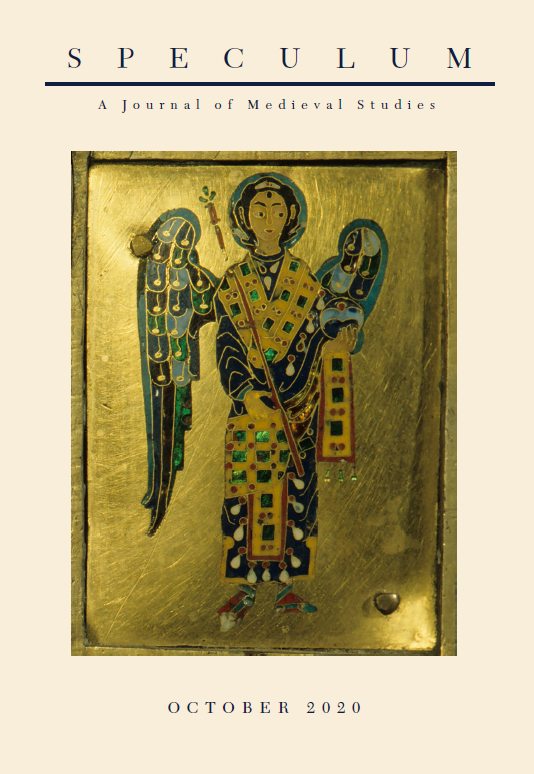
MAA News – The October Issue of Speculum is Online

The latest issue of Speculum is now available on the University of Chicago Press Journals website.

To access your members-only journal subscription, log in to the MAA website using your username and password associated with your membership (contact us at info@themedievalacademy.org if you have forgotten either), and choose “Speculum Online” from the “Speculum” menu. As a reminder, your MAA membership provides exclusive online access to the full run of Speculum in full text, PDF, and e-Book editions – at no additional charge.

Speculum, Volume 95, Number 4 (October 2020)

Articles
The Regulation of “Sodomy” in the Latin East and West
Ruth Mazo Karras

Chosen Peoples and New Israels in the Early Medieval West
Conor O’Brien

Made for a Templar, Fit for an Abbess: The Psalter, Cambridge, St. John’s College, MS C.18 (68)
Katie Ann-Marie Bugyis

Origen’s Story: Heresy, Book Production, and Monastic Reform at Saint-Laurent de Liège
Jay Diehl

Nivelon de Quierzy, the Cathedral of Soissons, and the Relics of 1205: Liturgy and Devotion in the Aftermath of the Fourth Crusade
M. Cecilia Gaposchkin

Book Reviews
This issue of Speculum features more than 70 book reviews, including:

Kathleen Bickford Berzock, ed., Caravans of Gold, Fragments in Time: Art, Culture, and Exchange Across Medieval Saharan Africa
Reviewed by Shirin Fozi

Philip Butterworth and Katie Normington, eds., Medieval Theatre Performance: Actors, Dancers, Automata and Their Audiences
Reviewed by Seeta Chaganti

Gaël Chenard, L’Administration d’Alphonse de Poitiers (1241-1271)
Reviewed by William Chester Jordan

Deborah Deliyannis, Hendrik Dey, and Paolo Squatriti, Fifty Early Medieval Things: Materials of Culture in Late Antiquity and the Early Middle Ages
Reviewed by Beatrice Kitzinger

Sean L. Field, Courting Sanctity: Holy Women and the Capetians
Reviewed by Barbara Newman

Christopher M. Gerrard and Alejandra Gutiérrez, eds., The Oxford Handbook of Later Medieval Archaeology in Britain
Reviewed by Roberta Gilchrist

Bryan C. Keene, ed., Toward a Global Middle Ages: Encountering the World through Illuminated Manuscripts
Reviewed by Sarah M. Guérin

Ronald G. Musto, Writing Southern Italy Before the Renaissance: Trecento Historians of the Mezzogiorno
Reviewed by Frances Andrews

Karen A. Winstead, The Oxford History of Life-Writing, vol. 1, The Middle Ages
Reviewed by John V. Fleming

MAA members also receive a 30% discount on all books and e-Books published by the University of Chicago Press, and a 20% discount on individual Chicago Manual of Style Online subscriptions. To access your discount code, log in to your MAA account, and click here. Please include this code while checking out from the University of Chicago Press website.

Sincerely,
The Medieval Academy of America

Posted in MAA Newsletter | Leave a comment

MAA News – MAA/GSC New Horizons Grants Awarded

We are very pleased to announce the awardees of the MAA/GSC New Horizons Grants, supporting graduate student research projects that uniquely engage with the current research environment created by the COVID-19 pandemic:

Carly B. Boxer (University of Chicago) will use the North Eastern Penitentiary (now USP Lewisburg in Pennsylvania) as a case study to analyze how modern cultural ideas of the Middle Ages influenced physical and systemic changes in the federal prison system in the 1930s.

Emmalee Dove (University of Virginia), working with UVA undergraduate Lauren Kim, will create and analyze a dataset of more than 500 Books of Hours from four US institutions, analyzing the data with the goal of producing a flexible definition of the manuscript Book of Hours as well as an online tool that will allow scholars to compare this data easily across manuscripts.

Ryan Low (Harvard University) will create a database of the more than 15,000 records of notarial registers recorded by Robert-Henri Bautier and Janine Sornay in their 1968 publication, Les Sources de l’histoire économique et sociale du moyen âge, improving access to and study of these important resources.

Jenna Marie McKellips (University of Toronto) will explore medieval drama in digital spaces through a performance of the Digby Mary Magdalene for modern audiences over Zoom.

We look forward to seeing these projects come to fruition and are very pleased to have been able to support them. The New Horizons Grant program was made possible by the generosity of the Medieval Academy of America’s Graduate Student Committee, which elected to redirect budgeted resources to increase support of MAA student members.

Posted in MAA Newsletter | Leave a comment

MAA News – CARA News

Kindrick-CARA Award for Outstanding Service to Medieval Studies
The Robert L. Kindrick-CARA Award for Outstanding Service to Medieval Studies recognizes Medieval Academy members who have provided leadership in developing, organizing, promoting, and sponsoring medieval studies through the extensive administrative work that is so crucial to the health of medieval studies but that often goes unrecognized by the profession at large.

CARA Award for Excellence in Teaching
The CARA Award for Excellence in Teaching Medieval Studies recognizes Medieval Academy members who are outstanding teachers and who have contributed to the profession by inspiring students at the undergraduate or graduate levels or by creating innovative and influential textbooks or other materials for teaching medieval subjects.

The CARA Awards will be presented at the 2021 MAA Annual Meeting (IU Bloomington, 15-18 April). Nominations and supporting materials must be received by Nov. 15.

Posted in MAA Newsletter | Leave a comment

MAA News – Call for Prize Submissions

Photo: The Haskins Medal. The Medieval Academy of America

The Medieval Academy of America invites submissions for the following prizes to be awarded at the 2021 MAA Annual Meeting (Indiana University, Bloomington, 15-18 April). Submission instructions vary, but all dossiers must complete by 15 October 2020.

PLEASE NOTE: because of the ongoing MAA office closure, PDF review copies of nominated books may be submitted instead of hardcopies (PDFs should be emailed to the Executive Director). In addition, the residency restrictions limiting eligibility for some book prizes to residents of North America have been lifted.

Haskins Medal
Awarded to a distinguished monograph in the field of medieval studies.

Digital Humanities Prize
Awarded to an outstanding digital research project or resource in the field of medieval studies.

Karen Gould Prize
Awarded to a monograph of outstanding quality in medieval art history.

John Nicholas Brown Prize
Awarded to a first monograph of outstanding quality in the field of medieval studies.

Van Courtlandt Elliott Prize
Awarded to a first article of outstanding quality in the field of medieval studies.

MAA Article Prize in Critical Race Studies
Awarded to an article in the field of medieval studies, published in a scholarly journal, that explores questions of race and the medieval world.

Posted in MAA Newsletter | Leave a comment