MAA News – MAA/GSC Grant Winners

Two MAA/GSC Grants for Innovation in Community Building and Professionalization have been awarded this year: to District Medievalists to help support a three-part series of symposia organized and presented by medieval studies graduate students in the Washington DC area; and to the 2020 Vagantes Conference on Medieval Studies at the University of Connecticut. We are very pleased to be able to support these programs that provide valuable conference-planning experience and promote graduate-student scholarship.

Posted in MAA Newsletter | Leave a comment

Winner of the Belle Da Costa Greene Award

Letter of Commendation to Tarren Andrews,
winner of the Inaugural Belle da Costa Greene Award

In 2018, the Medieval Academy of America established the Belle da Costa Greene Award to support the work of a medievalist of color. Da Costa Greene (1883-1950) was a prominent American art historian and the first librarian of the Pierpont Morgan Library in New York. She was also the second woman, and first person of color, to be elected a Fellow of the Medieval Academy. Throughout her career, she passed as a white woman. This award explicitly acknowledges that the Medieval Academy of America has been, and remains, enmeshed in a world where racial ideologies have material effects that are often deleterious—for individuals and for scholarship alike. Tarren Andrews’s project, “Indigeneity Outside Indigenous Studies: Encounters with Indigenous Futures and Medieval Pasts,” responds to the challenges of practicing an intellectually rigorous and responsible medieval studies in a racialized world by offering a truly global approach to medieval studies. The Inclusivity and Diversity Committee is impressed by the project’s deeply historical approach to the concepts of time that arise at the intersections of medieval and indigenous pre- and postcolonial studies.

Andrews will use the award to travel to an indigenous studies conference in New Zealand, with the objective of interrogating the methodologies and the ethical positions of Indigenous and Eurocentric studies. Andrews’s project promises to enlarge our definitions of the “medieval,” and thereby to expand our understanding of our past, present, and future worlds. This is a project we are honored to support.

Posted in Announcements | Leave a comment

Visiting Scholar Program: Call for Applications

In order to promote scholarly research, exchange, and conversation about the medieval world, Harvards Committee on Medieval Studies welcomes a small number of Visiting Scholars each academic year. Visiting Scholars may work in any field dealing with some aspect of medieval society, religion, or culture in Europe, Africa, or Eurasia, and are welcomed as full members of Harvard’s rich intellectual and social community of medievalists.

Visiting Scholars may be appointed to terms ranging from three to six months. They enjoy full access to Harvard libraries and many other university facilities, an email account, and shared office space during the period of their appointment. They are expected to be engaged in research projects that draw upon Harvard’s manuscript, library, and other resources; to remain in residence in the Cambridge/Boston area during their appointment; to participate fully in the seminars, colloquia, and other activities of the Committee on Medieval Studies; and to share the results of their research in a seminar or other public venue.

Please note that these are unpaid research positions. Visiting Scholars are responsible for providing their own funding and securing their own accommodations during the term of their appointment. Researchers who are not U.S. citizens or permanent residents must obtain a visa to enter the U.S., and must demonstrate that they will be able to support themselves and any dependents traveling with them for the duration of their visit.

Applications are accepted twice yearly. Those expecting to hold a visiting position at Harvard in Fall 2019 must submit all materials no later than 12 April 2019; those applying for a term beginning in Spring 2020 should submit applications by 6 September 2019. Application information and forms can be found at the Committee on Medieval Studies website here.

Posted in Announcements | Leave a comment

ACMRS Short-Term Residencies

ACMRS Short-Term Residencies

Applications due April 1st

Flexible research residency with $7,500 stipend

https://acmrs.org/content/short-term-residencies

The Arizona Center for Medieval & Renaissance Studies (ACMRS) is pleased to announce two, new short-term residencies. The annual ACMRS Short-Term Residency will enable scholars who have earned a Ph.D. in a pre-modern field to pursue their research for a period of four to six weeks. The residency is designed to allow scholars to focus on finishing projects for publication. The Director of ACMRS and senior members of ACMRS’ in-house press can provide publishing advice and mentoring. Each resident will present their work in a public lecture, showcasing their scholarship. Opportunities for graduate student mentorship are also available.

A new model: In line with ACMRS’ mission, the ACMRS Short-Term Residencies are designed to be as inclusive as possible and allow maximum flexibility. As such, the residencies may be held for a period of four to six weeks; a portion of the residency may be conducted remotely; or the residency may be divided into shorter segments over the course of the award year. Each residency carries a stipend of $7500.

Eligibility: Candidates must have earned the doctoral degree in a pre-modern field by the time of application. Scholars of color and members of groups that have been traditionally underrepresented in the academy are particularly encouraged to apply.

Application: Please submit a project description of no more than 1,000 words, outlining the research that will be undertaken during the period of residency; a curriculum vitae; and 2 letters of recommendation by April 1st, 2019 to Ayanna Thompson, Director of ACMRS, at ayanna.thompson [at] asu [dot] edu. Please indicate your preferred residency period and how you wish to structure the tenure of the award in your cover letter. This year’s residencies should be held between July 2019 and June 2020.

Posted in Uncategorized | Leave a comment

Medieval Celtic sessions at MLA 2020

PROPOSALS DUE March 15, 2019

  1. Migration and the Diaspora

From our vantage point in Seattle in 2020, far adrift from the Celtic ‘homelands’, CLCS Celtic invites papers that consider the concept of migration and the place of the diaspora in Celtic-language texts and in Celtic Studies more broadly.

Historical or fictional, migration is a regularly occurring theme in Celtic texts from the medieval to the modern periods. In recent history, migrations have carried Celtic languages and narrative traditions far afield. Scholars, moreover, have advanced the study of Celtic languages and literatures from diasporic outposts since the founding of the discipline.

Papers could consider shifting relationships to and perspectives of the homeland/region; shifting perspectives of the self as Gael/Welsh/Breton/Celt; loss of home, exile, and/or renewal; Celts on the continent, in the Americas, or elsewhere; indigenous peoples’ experience of the Celtic diaspora; Celtic peoples and colonization/post-colonial studies; the immigrant experience in the early modern and modern eras; the exportation and adaptation of popular ‘Celtic’ culture; Celticism and Celticists in the diaspora; or the place of diaspora studies within Celtic Studies.

Submit 250-word abstracts for 15-minute papers to Natasha Sumner (nsumner@g.harvard.edu) and Melissa Ridley Elmes (MElmes@lindenwood.edu) by March 15.

  1. Arthurian Archipelagos

The CLCS Celtic and Arthurian forums are proposing a joint-sponsored special session based on the concept of Arthurian Archipelagos. The governing concept of “archipelago,” understood as a loosely related chain of islands connected by water (much like the British Isles where the Arthurian legend originated), asks us to think “archipelagically”—to bring together loosely-connected ideas, texts, and concepts that link to one another across a broader or more far-flung area than we might otherwise consider. Papers may also think geographically, broadening the purview of the “Arthurian world” by considering Arthur in Europe, Africa, the Mediterranean, the Americas, India, Asia, Australia—as if the landmasses of this world might be viewed as sets of archipelagos. Papers may also emphasize the very real, smaller archipelagos of the North Atlantic, focusing on motifs in Arthurian literature like sea travel, islands, boats, navigation, etc.—or, in the digital realm, thinking of the Internet as a sea, of digital data points as archipelagos in a virtual Arthurian world. To focus our ideas, the session emphasizes “archipelago” as a metaphor for a particular methodology, expanded geographical purview, or motif study. We are open to studies focusing on the Arthurian legend in any time, place, or format.

Submit 250-word abstracts for 15-minute papers and a short bio to Melissa Ridley Elmes (MElmes@lindenwood.edu) and Molly Martin (martinma@uindy.edu) by March 15.

Panel co-sponsored by the Celtic and Arthurian CLCS forums. This panel is not guaranteed.

Posted in Uncategorized | Leave a comment

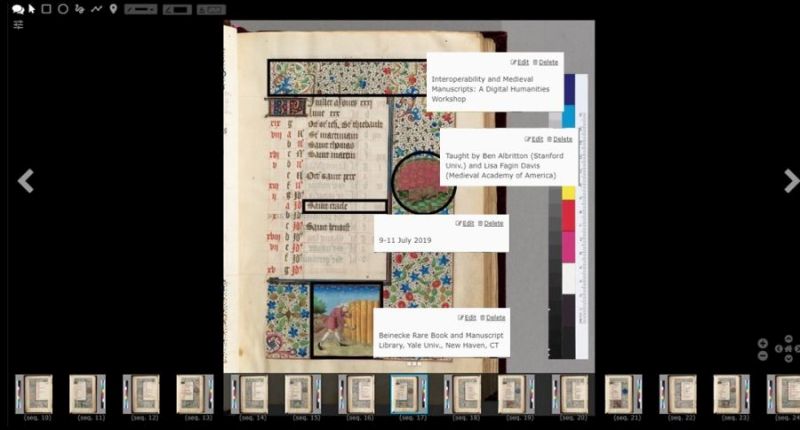
Interoperability and Medieval Manuscripts: A Digital Humanities Workshop

We are now accepting applications for “Interoperability and Medieval Manuscripts,” a three-day digital humanities workshop co-sponsored by The Medieval Academy of America and the Beinecke Rare Book and Manuscript Library. Co-taught by Benjamin Albritton (Computing Info Systems Analyst, Stanford University Libraries) and Lisa Fagin Davis (Executive Director, Medieval Academy of America), the workshop will take place at the Beinecke Rare Book and Manuscript Library at Yale University from 9-11 July 2019.

So much of the work currently being undertaken by medievalists is dependent on primary resources that may not be close at hand, and digital imagery alone can only take us so far. We have limited storage space for the enormous images we want to work with, and so we need to work in an online environment. In keeping with digital best-practices, we want to avoid siloing of files in sealed-off digital repositories. We need to make these images, and our work, discoverable, and so we need consistent metadata and annotation tools. We want to work with open data, including our own, data that can be shared, downloaded, manipulated, visualized, and mined. As scholars, we have limited funding and technical support, and so we need tools that are free, open-access, and easily implemented. The combination of the International Image Interoperability Framework (IIIF) and shared-canvas viewers opens new avenues for researchers and students to discover, access, compare, annotate, and share images of and data pertaining to artifacts and manuscripts in a context that is cloud-based, flexible, open-access, and easily implementable.

Participants in this three-day intensive workshop will be introduced to the International Image Interoperability Framework (IIIF) in combination with shared-canvas viewers and annotation servers, learning how this technology can facilitate new methodologies in manuscript and art history research. Working with their own images, participants will 1) upload their images into a IIIF server (if they aren’t already served by a IIIF-compliant platform); 2) present the images in a shared-canvas viewer; 3) work with the instructors to develop annotations and tags in keeping with their research project. Due to physical space limitations, the course is limited to twelve participants. Applications are welcomed from medievalists at all levels and will be judged primarily on the potential that interoperable images hold for the applicant’s research project or professional goals. Participants should already have access to or possession of the images they will be working with, if the images are not already online and IIIF-compliant. The workshop is tuition-free, but participants are responsible for travel, lodging, and incidental expenses. To help offset these costs, all participants traveling and staying overnight for the workshop will receive a $300 stipend courtesy of the Beinecke Rare Book and Manuscript Library.

Applications must be received by June 1. Click here for more information and to apply.

Instructors:

Benjamin Albritton is Associate Curator for Paleography and Digital Medieval Materials and is the Digital Manuscripts Program Manager at Stanford University Libraries. He oversees a number of digital manuscript projects, including Parker Library on the Web, and projects devoted to interoperability and improving access to manuscript images for pedagogical and research purposes. His research interests include the intersection of words and music in the fourteenth century, primarily in the monophonic works of Guillaume de Machaut; the uses of digital medieval resources in scholarly communication; and transmission models in the later Middle Ages.

Lisa Fagin Davis has been engaged in the development and implementation of manuscript metadata standards and the promotion of digital methodologies for twenty years, taking part in the original Electronic Access to Medieval Manuscripts workshops in the late 1990s and serving on advisory boards for Digital Scriptorium, Fragmentarium, the Schoenberg Database of Manuscripts, and Digital Medievalist. In addition to serving as Executive Director of the Medieval Academy of America, she is an Adjunct Professor at the Simmons School of Library and Information Science. IIIF and shared canvas workspaces are integral to her ongoing projects reconstructing dismembered medieval manuscripts in Fragmentarium (with her Simmons students) and reconstructing the Beauvais Missal as part of the Broken Books project.

Posted in Announcements | Leave a comment

“Sisters No Longer? Continuity and Change in Church and Synagogue”

If you’re attending the Medieval Academy of America Annual Meeting in Philadelphia next week and will be arriving early, don’t miss this lecture by Miri Rubin:

“Sisters No Longer? Continuity and Change in Church and Synagogue”
Miri Rubin, Professor of Early Modern History at Queen Mary University of London
Wednesday, March 6 at 4 p.m.
McShain Hall, 5th floor, Large Lapsley Conference Room One
Saint Joseph’s University
5600 City Avenue
Philadelphia, PA 19131

Professor Rubin will discuss the complexities of the relationship between Judaism and Catholicism from the Middle Ages to present through the changing role of the Ecclesia and Synagoga statues, including the Saint Joseph’s University sculpture, Ecclesia and Synagoga in Our Time.

Sponsored by the Saint Joseph’s University Department of English and the Institute for Jewish-Catholic Relations

Posted in Annual Meeting | Leave a comment

Medieval Latin Courses at the Centre for Medieval Studies at the University of Toronto

In 2019, the Centre for Medieval Studies at the University of Toronto will offer the following courses in Medieval Latin:

Beginning Latin (8 hours of instruction weekly, 21 May to 12 July 2019, with an optional three-week reading course thereafter). Textbook: Moreland and Fleischer, Latin: an Intensive Course.

Level One Medieval Latin (7.5 hours weekly, 27 May to 5 July 2019, with an optional two-week grammar review before the course).

Level Two Medieval Latin (7.5 hours weekly, 8 July to 16 August 2019).

Enrollment in the Level One and Level Two courses will be restricted and will depend on performance in the April Level One Latin examination. Information on the examinations and the summer program is available on line (medieval.utoronto.ca).

The fee for each course is $1,200 (Can) for Canadian residents, or its equivalent in US dollars for non-Canadian residents. The deadline to apply for all courses is 1 May 2019. Enrollment in each course is limited.

A limited number of stipends are available for graduate students participating in summer courses in medieval languages or manuscript studies, and Level One and Level Two Latin at the Centre for Medieval Studies. The stipend will be paid directly to the program to offset a portion of the tuition cost and is contingent on acceptance into the program. Applicants must be members of the Medieval Academy in good standing with at least one year of graduate school remaining and must demonstrate both the importance of the summer course to their program of study and their home institution’s inability to offer analogous coursework.

To apply, please submit a statement of purpose, CV, and two letters of recommendation, to:

MAA/CARA Summer Scholarships
Medieval Academy of America
17 Dunster St., Suite 202
Cambridge, Mass. 02138
USA

Applications must be received by 15 March and will be judged by the Committee for Professional Development and the Chair of the CARA Committee. There will be between four and eight awards yearly, depending upon the number of worthy applicants and the cost of the summer programs.

ASSESSMENT IN MEDIEVAL LATIN

The Centre for Medieval Studies in Toronto continues to offer its Level One and Level Two Medieval Latin examinations to external students. Examinations will be as follows: Level One, 15 April 2019 and 4 September 2019; Level Two, 17 April 2019 and 6 September 2019. Fee for examinations: $50 (US) for non-Canadians, $50 (Can.) for Canadians. For details and application forms, please visit the Centre’s website: medieval.utoronto.ca. Note that admission into the Summer Medieval Latin Level One and Level Two courses will be decided on the basis of the April Level One Latin examination.

Posted in Summer Programs | Leave a comment

Call for Papers – IIIF 2019 Conference

The Call for proposals for the 2019 IIIF conference in Göttingen, Germany is open until the Friday the 1st of March. We would welcome submissions showing the use of IIIF to support digital humanities research. We have the following slots available:

• Up to a ½ day workshop
• 7 to 10 minute lightning talks
• 20 minute presentations (plus 10 mins questions)
• 90 minute open block (Could be panel session or grouped presentations)

If you are working with IIIF in your research please consider submitting a proposal. If you have any questions feel free to get in contact with me or another member of the program committee. Further details on the conference can be seen at:

https://iiif.io/event/2019/goettingen/

And the link to submit your proposal is:

https://goo.gl/forms/qNOT6i2IAW75C6NS2

Thank you!

– IIIF 2019 Conference program committee:
Ben Albritton (Stanford University)
Glen Robson (IIIF-C)
Jack Reed (Stanford University)
Jeff Mixter (OCLC Research)
Josh Hadro (IIIF-C)
Julien A. Raemy (HES-SO University of Applied Sciences and Arts, Haute école de gestion de Genève)
Nuno Freire (Europeana)
Rachel Di Cresce (University of Toronto)
Rashmi Singhal (Harvard University)
Rebecca Hirsch (Yale University)
Regine Stein (Göttingen State and University Library)
Sara Brumfield (Brumfield Labs)
Scott Renton (University of Edinburgh)
Stacey Redick (Folger Shakespeare Library)

Posted in Call for Papers | Leave a comment

Call for Papers – Medieval Gateways: Threshold, Transition, Exchange

SEMA 2019
November 14-16, 2019
Greensboro, NC
~~~~~
Medieval Gateways: Threshold, Transition, Exchange

The Southeastern Medieval Association is pleased to announce the Call for Papers for its 2019 Conference to be held at UNC-Greensboro, co-sponsored by UNCG, North Carolina Wesleyan College and Wake Forest University. 

We invite proposals for individual papers, whole sessions, or round tables on the conference theme of “medieval gateways.” Papers might consider the notion of transforming places and identities within medieval history, literature, and culture; the role of liminality in literary and cultural productions; diaspora and migration in the medieval period; instances of ideological reform; transitions from the medieval to the modern; the rise of the vernacular, or iconoclasm.

The organizers are extremely proud that Greensboro was one of the earliest sites of the “sit-in” lunch counter protests that sparked the Civil Rights movement in the 1960s. Our downtown is home to the International Civil Rights Center and Museum, which is located in the Woolworth Building and houses the original lunch counter where non-violent protesters sat in early 1960. In honor of this important aspect of our area’s history, the conference organizers also propose a secondary thematic thread for the conference on “Resistance.” Papers on this sub-topic might consider the various means of transgressing the physical, religious, social, political, legal, and economic boundaries imposed during the Middle Ages and beyond.

Proposals for individual papers should be limited to 300 words. Session proposals or round tables should include abstracts for the three papers for a session, or 5-6 abstracts for a round table, as well as the contact information for all presenters.

Abstracts on any aspect of medieval studies are welcome, but we will give preference to submissions related to the conference theme. Please submit proposals to semagso2019@gmail.com no later than June 3, 2019.

Posted in Call for Papers | Leave a comment