Jobs for Medievalists

Lecturer in History (Medieval History)

http://jobs.flinders.edu.au/cw/en/job/497013/lecturer-in-history-medieval-history

Job no: 497013
Work type: Full time
Location: Bedford Park
Categories: Level B, College of Humanities, Arts and Social Sciences

Classification: Academic Level B
Salary Range: $94,323 to $112,006 pa
Employment Type: Continuing, full-time
Position Reports to: Dean (People and Resources)
Please Direct Application Enquiries to: Professor Vanessa Lemm
Closing date:

Position Summary:

The Lecturer will contribute to quality research and the planning and delivery of topics within the suite of undergraduate and/or postgraduate topics/courses in Medieval History. This includes the development of teaching materials, delivery of lectures/tutorials or other innovative teaching and learning strategies.

The incumbent will also contribute to strengthening existing partnerships or exploring new partnerships with external stakeholders that have potential for providing improved teaching, learning and research outcomes for the University.

The research profile of the Lecturer will be aligned with one of the College’s Research Themes.

Please note: Pursuant to the Children’s Protection Act 1993 (SA) this position has been deemed prescribed.  It is an inherent requirement of the position that the successful candidate maintains a current Child Related Employment Screening which is satisfactory to the University.

Information For Applicants:

You are required to provide a suitability statement of no more than three pages, addressing the key capabilities of the position description. In addition, you are required to upload your CV.

Posted in Jobs for Medievalists | Leave a comment

Important Changes to MAA Election Procedures and Governance

To the Members of the Medieval Academy of America:

I am very pleased to announce the following important changes to the Medieval Academy of America By-Laws, as recommended by the Centennial Committee and recently approved by the Council:

Article 23. There shall be a Nominating Committee composed of six members and a chair. Of the six members, two will be elected each year to serve for three years. Each year the President will nominate four members of the Academy to stand for election to the Nominating Committee, and other members may be nominated by petition as specified below (Article 26). The chair of the Committee will be appointed by the President from among members of former Nominating Committees to serve for one year.

What this means: The Nominating Committee formerly consisted of four elected members serving in classes of two for two-year staggered terms, in addition to an appointed Chair. From now on, the Nominating Committee will be expanded to six elected members serving in classes of two for three-year staggered terms, in addition to an appointed Chair. The impending change to Article 24 (see below) will give the Nominating Committee more work to do, and so the Committee will be expanded accordingly.

Article 24. The Nominating Committee shall nominate at least two members of the Academy for each vacancy among the Councillors. It shall nominate one member of the Academy for vacancies in the offices of President and First Vice-President, and, as of 1 February 2020, three members for the office of Second Vice-President. Normally, the Second Vice-President will proceed to the first vice-presidency, and First Vice-President to the presidency. Should the office of Second or First Vice-President be vacant, the Nominating Committee shall nominate three members of the Academy for the office of First Vice-President or President respectively.

The Nominating Committee exercises its powers independent of the Officers and the Council. It may consult with anyone whom it chooses. The Executive Director shall provide the Nominating Committee with such information as it requires in advance of its deliberation and shall attend such portions of its meetings as he or she is invited to attend to provide further information about members. On completion of the Committee’s deliberation, the Executive Director, if asked to do so by the Committee, shall as promptly as possible ascertain potential candidates’ willingness to appear on the ballot and report back to the Committee. In making its choice of candidates the Committee shall take into consideration factors leading to diversity of nominees.

What this means: Beginning with the 2021 governance election – to be held in the fall of 2020 – the Second Vice-President will be selected from a slate of three nominees instead of running unopposed.

Article 27: The elected officers of the Academy, the Councillors, and the members of the Nominating Committee shall be elected by electronic or mail ballot by a majority vote of all members of the Academy who vote. Such ballot shall include all members nominated by the Nominating Committee and those nominated by petition as specified in Article 26. The ballot for positions with two or more candidates shall be conducted by ranked choice voting. Every non-institutional member of the Academy shall be entitled to one vote for each position on the election ballot and one vote in person upon each subject properly submitted to a vote of the members at the annual meeting or any special meeting. Institutional members are not entitled to vote. The terms of the newly-elected officers, Councillors, and members of the Nominating Committee shall begin at the end of the annual meeting.

What this means: This change asserts the validity of online voting and clarifies the process for determining the results of the online governance election.

Article 37: These By-Laws may be amended by an affirmative vote of two-thirds of the members of the Council. Any amendment to the by-laws adopted by the Council shall be noticed to the members in the announcement of the next meeting of the members, and any amendment adopted by the Council may be amended or repealed by the members at that meeting.

What this means: It is no longer required that the Fellows be consulted regarding proposed changes to the By-Laws. To ensure compliance with the previous version of this Article, the Fellows were consulted at the recent Fellows’ Meeting and gave their assent.

The updated By-Laws are posted on our website.

Please consult our FAQ page for additional information about our governance and organizational structure. As always, please feel free to contact me with any questions about the Medieval Academy of America.

– Lisa

Lisa Fagin Davis
Executive Director
Medieval Academy of America

Posted in Announcements, MAA | Leave a comment

2019-2020 Schoenberg Institute Visiting Research Fellowships

The University of Pennsylvania Libraries is accepting applications for the 2019-2020 Schoenberg Institute for Manuscript Studies (SIMS) Visiting Research Fellowship program. Guided by the vision of its founders, Lawrence J. Schoenberg and Barbara Brizdle Schoenberg, SIMS aims to bring manuscript culture, modern technology, and people together to provide access to and understanding of our shared intellectual heritage. Part of the Penn Libraries, SIMS oversees an extensive collection of premodern manuscripts from around the world (https://dla.library.upenn.edu/dla/medren), with a special focus on the history of philosophy and science, and creates open-access digital content to support the study of its collections. SIMS also hosts the Schoenberg Database of Manuscripts (https://sdbm.library.upenn.edu/) and the annual Schoenberg Symposium on Manuscript Studies in the Digital Age (http://www.library.upenn.edu/about/exhibits-events/ljs-symposium).

The SIMS Visiting Research Fellowships have been established to encourage research relating to the premodern manuscript collections at the University of Pennsylvania Libraries, including the Schoenberg Collection. Affiliated with the University of Pennsylvania, located near other manuscript-rich research collections (the University of Pennsylvania Museum of Archaeology and Anthropology, the Free Library of Philadelphia, the Science History Institute, and the Rosenbach Museum and Library, among many others), and linked to the local and international scholarly communities, SIMS offers fellows a network of resources and opportunities for collaboration. Fellows will be encouraged to interact with SIMS staff, Penn faculty, and other medieval and early modern scholars in the Philadelphia area. Fellows will also be expected to present their research at Penn Libraries either during the term of the fellowship or on a selected date following the completion of the term.

Applicants can apply to spend 1 month (minimum of 4 work weeks) at SIMS between July 1, 2019, and June 30, 2020. To be considered, applications are due May 15, 2019. For more information and to apply, please visit: https://schoenberginstitute.org/visiting-research-fellowships-2/

Posted in Fellowships | Leave a comment

CARA News

MAA CARA Report: The Catholic University of America
2018-2019

The Center for Medieval & Byzantine Studies at The Catholic University of America in Washington, D.C. is a community of over thirty scholars and a group of graduate students from various Schools and Departments across campus. It administers both graduate and undergraduate programs in Medieval and Byzantine Studies with an interdisciplinary focus, and runs a series of extracurricular events. On the undergraduate side, we have a small but steady number of minors and majors, and an active club called Medieval Society, which attracts enthusiasts of the Middle Ages from all majors. In 2018-19, we have embarked on a revision of our undergraduate curriculum to make the major and minor more accessible to students by streamlining requirements and aligning them with the course offerings in existing programs. We have also made minor changes to the graduate curriculum in order to cut time to degree. At the same time, the Center is undergoing a self-study to chart a new course for the future and to better align its operation with the goals of the University. As usual, the Center continues to have robust extracurricular programming: we co-sponsored two one-day workshops (on Christian Scrolls, and on The Quran and Ethiopia), numerous public lectures by renown scholars (on medieval history by William Chester Jordan and Yitzhak Hen, on art by Alison Perchuk, and on public medievalism by Paul Sturtevant). The Medieval Society offered museum visits throughout DC, musical events, film screenings, and social gatherings on campus, and organized two signature events, a multi-course Medieval Banquet with entertainment, and Medieval Day, a public celebration with medieval crafts, music, games, reenactors, and food. These events draw many participants from across campus and the local community at large.

Submitted by Lilla Kopár, Director

Posted in CARA | Leave a comment

East of Byzantium Lecture and Workshop, April 11 & 12, 2019

The Arthur H. Dadian and Ara Oztemel Chair of Armenian Art at Tufts University and the Mary Jaharis Center for Byzantine Art and Culture at Hellenic College Holy Cross in Brookline, MA, are pleased to announce the final East of Byzantium events for 2018–2019.

Thursday, April 11, 2019, 6:15–7:45 pm
Harvard Faculty Club, 20 Quincy Street, Cambridge, MA

Armenian Merchant Patronage of Early Modern Iran
A lecture by Amy Landau, Freer|Sackler, Smithsonian Institution, discussing the patronage of New Julfa’s Armenian merchant community.

Friday, April 12, 2019, 10:00 am–12:00 pm
Harvard Faculty Club, 20 Quincy Street, Cambridge, MA

Image-making and Anxiety among New Julfa’s Armenian Artists, Theologians & Merchants
A workshop for students exploring how Armenian artists, theologians, merchants, among others, thought about images and image-making in early modern Iran. Led by Amy Landau, Freer|Sackler, Smithsonian Institution.

Advance registration required. Registration closes April 9. Additional information and registration at https://eastofbyzantium.org/upcoming-events/image-making-and-anxiety/

East of Byzantium is a partnership between the Arthur H. Dadian and Ara Oztemel Chair of Armenian Art at Tufts University and the Mary Jaharis Center for Byzantine Art and Culture at Hellenic College Holy Cross in Brookline, MA, that explores the cultures of the eastern frontier of the Byzantine empire in the late antique and medieval periods.

For questions, contact Brandie Ratliff, Director, Mary Jaharis Center for Byzantine Art and Culture (mjcbac@hchc.edu).

Posted in Uncategorized | Leave a comment

Call for Papers – 16th International Congress of Medieval Canon Law

CALL FOR PAPERS
16th International Congress of Medieval Canon Law
Saint Louis University
19 – 25 July 2020

The 16th International Congress of Medieval Canon Law, co-sponsored by ICMAC (Iuris Canonici Medii Aevi Consociatio/International Society of Medieval Canon Law) and Saint Louis University, will take place on the university’s campus in St. Louis, Missouri, USA, from Sunday, July 19, through Saturday, July 25, 2020.  These quadrennial Congresses, alternating sides of the Atlantic, constitute the premier academic conference in the field of medieval canon law.  Traditionally they have drawn scholars from many countries, including not only medievalists and canonists, but also those who study related fields, such as Western jurisprudence and legal norms, Roman law, ecclesiastical and papal history, theology and biblical exegesis, manuscript studies, and the history of culture, society, and ideas.

ICMAC and the Congress organizers, Steven A. Schoenig, S.J., and Atria A. Larson, are pleased to announce the following plenary speakers for the Congress:

Professor Bruce Brasington (West Texas A&M University, USA)

Prof. Dr. Gisela Drossbach (University of Augsburg, Germany)

Professor Mia Korpiola (University of Turku, Finland)

Dr. Titus Lenherr (Diocese of Sankt Gallen, Switzerland)

Professor Rob Meens (Utrecht University, The Netherlands)

Professor Kenneth Pennington (The Catholic University of America, USA)

Professor Robert Somerville (Columbia University, USA)

The Academic Committee welcomes proposals on any topic touching upon medieval canon law, including, but not limited to, the following themes:

  • Texts and Jurisprudence
  • The Influence of the ius commune on the Western Legal Tradition and International Law
  • Canon Law and Local Ecclesiastical History
  • Canon Law, Theology, and Pastoral Care
  • Medieval Law in Comparative Perspective

The chronological focus of the Congress is typically on c. 500 – c. 1500, but select papers or sessions may also be accepted on Early Christian Canon Law and, in light of the 500th anniversary of Martin Luther’s burning of the Corpus iuris canonici, Canon Law and the Reformation.

The Academic Committee invites proposals for individual 20-minute papers or complete sessions of four 20-minute papers.  Papers may be delivered in the following languages:  English, French, German, Italian, or Spanish.  Scholars not presenting in English are encouraged to utilize PowerPoint presentations and/or to provide written English summaries of their papers.

Regular sessions will not feature papers on text-editing projects.  Updates on critical editions or other text-editing projects will be showcased in a poster session during the Congress.  Scholars who wish to present on such projects may submit two proposals if they desire, one for the text-editing poster session and another for a regular session.

All proposals must include, for each participant, the following information:  name (with title); position and institutional affiliation; email address; postal address; language of presentation; working title of paper (or poster presentation); and a 200-250 word abstract of the paper (or poster project).  Proposals for papers, poster presentations, or sessions should be submitted through a Google Form on the Congress website (icmcl2020.wordpress.com).

Proposals are due on August 15, 2019.

More information about the Congress, its sessions, special instructions for the poster session, accommodations, travel, and Saint Louis University will eventually be found on the Congress website (icmcl2020.wordpress.com).  Questions may be directed to icmcl2020@gmail.com.

Posted in Call for Papers | Leave a comment

The Arthur H. Dadian and Ara Oztemel Chair of Armenian Art at Tufts University and the Mary Jaharis Center for Byzantine Art and Culture at Hellenic College Holy Cross in Brookline, MA, are pleased to announce our next East of Byzantium workshop. Friday, March 29, 2019, 10:00 am–1:00 pm Harvard Faculty Club, 20 Quincy Street, Cambridge, MA A Medieval Armenian Text in its Eurasian Context A workshop for students focusing on a history of the Islamic conquest and rule of Armenia by the 8th-century Armenian priest Łewond. Led by Sergio La Porta, Fresno State, and Alison M. Vacca, University of Tennessee, Knoxville Advance registration required. Registration closes March 26. Additional information and registration at https://eastofbyzantium.org/upcoming-events/a-medieval-armenian-text-in-its-eurasian-context/. East of Byzantium is a partnership between the Arthur H. Dadian and Ara Oztemel Chair of Armenian Art at Tufts University and the Mary Jaharis Center for Byzantine Art and Culture at Hellenic College Holy Cross in Brookline, MA, that explores the cultures of the eastern frontier of the Byzantine empire in the late antique and medieval periods. For questions, contact Brandie Ratliff, Director, Mary Jaharis Center for Byzantine Art and Culture (mjcbac@hchc.edu).

The London International Palaeography Summer School (LIPSS) at the Institute of English Studies, University of London is now accepting applications for its summer programme. Applications are accepted on a rolling basis until a course is full.

The London International Palaeography Summer School is a series of intensive courses in Palaeography and Manuscript Studies. Courses range from a half to two days duration and are given by experts in their respective fields from a wide range of institutions.

Courses fees range from Half-Day fees of £50 (standard) and £45 (student), to Five-Day fees of £450 (standard) and £400 (student). The full breakdown of fees can be found here.

Posted in Summer Programs | Leave a comment

East of Byzantium Workshop, March 29, 2019

The Arthur H. Dadian and Ara Oztemel Chair of Armenian Art at Tufts University and the Mary Jaharis Center for Byzantine Art and Culture at Hellenic College Holy Cross in Brookline, MA, are pleased to announce our next East of Byzantium workshop.

Friday, March 29, 2019, 10:00 am–1:00 pm
Harvard Faculty Club, 20 Quincy Street, Cambridge, MA

A Medieval Armenian Text in its Eurasian Context
A workshop for students focusing on a history of the Islamic conquest and rule of Armenia by the 8th-century Armenian priest Łewond. Led by Sergio La Porta, Fresno State, and Alison M. Vacca, University of Tennessee, Knoxville

Advance registration required. Registration closes March 26. Additional information and registration at https://eastofbyzantium.org/upcoming-events/a-medieval-armenian-text-in-its-eurasian-context/.

East of Byzantium is a partnership between the Arthur H. Dadian and Ara Oztemel Chair of Armenian Art at Tufts University and the Mary Jaharis Center for Byzantine Art and Culture at Hellenic College Holy Cross in Brookline, MA, that explores the cultures of the eastern frontier of the Byzantine empire in the late antique and medieval periods.

For questions, contact Brandie Ratliff, Director, Mary Jaharis Center for Byzantine Art and Culture (mjcbac@hchc.edu).

Posted in Announcements | Leave a comment

Mary Jaharis Center Lecture, March 28, 2019

The Mary Jaharis Center for Byzantine Art and Culture at Hellenic College Holy Cross in Brookline, MA, is pleased to announce the spring lecture in its 2018–2019 lecture series:

Thursday, March 28, 2019, 6:15–7:45 pm
Harvard Faculty Club, 20 Quincy Street, Cambridge, MA

Dropping a Medieval Chronicle (and Putting it Back Together): Reading the Byzantine Chronography of Theophanes and George the Synkellos through Manuscripts, Maps, and Text Analysis
Jesse W. Torgerson, Wesleyan University

Jesse W. Torgerson reconsiders the Chronography of George the Synkellos and Theophanes and looks to rejuvenate study of medieval chronicles.

Details at https://maryjahariscenter.org/events/dropping-a-medieval-chronicle-and-putting-it-back-together.

Mary Jaharis Center lectures are co-sponsored by Harvard University Standing Committee on Medieval Studies.

For questions, contact Brandie Ratliff, Director, Mary Jaharis Center for Byzantine Art and Culture (mjcbac@hchc.edu).

Posted in Announcements | Leave a comment

MAA News – 2019 Annual Meeting Roundup, part 1: The Program

The 2019 Annual Meeting (University of Pennsylvania, 7-9 March) was a great success, with more than 500 attendees, four plenary sessions, more than 200 papers, receptions at the Penn Museum of Art and Archaeology and at the Philadelphia Museum of Art, hands-on workshops, pop-up manuscript exhibits, and more. The full program, which was centered on idea of “The Global Middle Ages,” is available here.
The opening plenary, “Interconnection and Separation: Medieval Perspectives on a Modern Problem,” was delivered by Nora Berend (University of Cambridge), who charged the attendees to think carefully about the use of the term “Global Middle Ages.” MAA President David Wallace (University of Pennsylvania) focused his plenary lecture on Medieval Studies in the 1930s, discussing the work of medievalists in Europe and in the United States and considering how their work reflected the time in which they lived and foreshadowed the uses (and mis-uses) of medieval history and narrative then and now. The Fellows’ Plenary was delivered by Father Columba Stewart (Hill Museum and Manuscript Library (HMML), and St. John’s School of Theology and Seminary), who spoke movingly and powerfully about the critical work being carried out by HMML to digitize, preserve, and protect ancient libraries in the Middle East and other war-torn regions of the world.

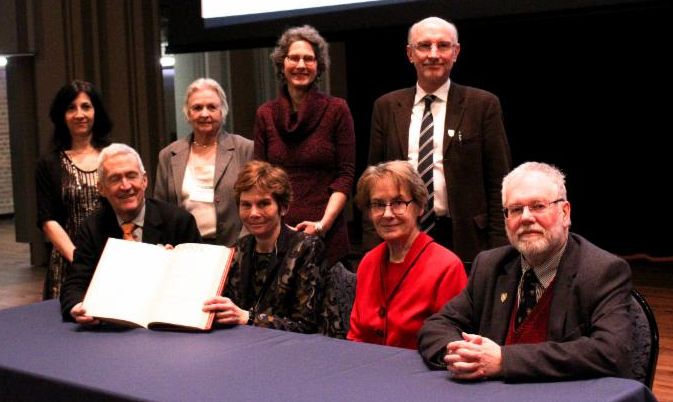
Newly-inducted Fellows of the Medieval Academy of America (L-R, T-B): Sara Lipton, Susan Mosher Stuard, Amy Remensnyder, Walter Pohl, Thomas Kelly, Celia Chazelle, Linne Mooney, and Keith Busby

In the CARA plenary roundtable “Working in the Middle: Writing the Global Medieval Textbook,” five scholars presented their work on a forthcoming textbook that will introduce students to a wider view of what we mean when we talk about the Middle Ages – broadening the traditional scope of European medieval studies to include Africa, Byzantium, the Middle East, India, the Mediterranean, and Asia. The K-12 Committee session addressed questions of how K-12 educators can participate in these globalizing efforts. The Graduate Student Committee and the Inclusivity and Diversity Committees’ joint session “MOC (Medievalists of Color), Graduate Students, and Race: Classes We Teach, Classes We Take” addressed the importance of developing curricula that are both expansive and inclusive, and the necessity of outreach to and mentoring of students of color.

Mentoring was a thread that ran throughout the conference, with several dozen mentoring pairings arranged by the Graduate Student Committee and a new event on Friday morning, a Mentorship Reception co-sponsored by the Inclusivity and Diversity Commitee and by the Graduate Student Committee. We hope to continue to host this event in the future. The annual meeting of the Committee on Centers and Regional Associations (CARA) took place on Sunday morning and was attended by more than forty CARA delegates, each of whom was there representing their program or department. The morning began with a roundtable that continued the valuable discussions of the previous days, “Taking Up the Global Challenge: Expanding the Purview of Medieval Studies–Questions, Solutions, Innovations.”

The Annual Meeting was supplemented by a graduate student workshop centered on digitized manuscripts; several “pop-up” manuscript exhibits curated by graduate students; five hands-on workshops; and a lightening-round session showcasing more than a dozen digital humanities projects.

We are extremely grateful to Lynn Ransom, Julia Verkholantsev, the Program Committee, the graduate student volunteers, and the University of Pennslvania staff for their work in organizing and implementing such a splendid meeting. We look forward to seeing you at UC Berkeley next year!

Posted in MAA Newsletter | Leave a comment