MAA News – 2016 Medieval Academy of America Publication Prizes

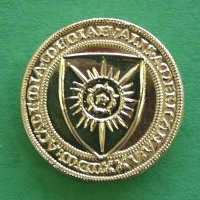
Photo: The Haskins Medal.   The Medieval Academy of America

Photo: The Haskins Medal. The Medieval Academy of America

The Medieval Academy of America is proud to announce the recipients of its 2016 publication prizes:

The Haskins Medal

The 2016 Haskins Medal is awarded to Francis Oakley (Williams College) for his trilogy, The Emergence of Western Political Thought in the Latin Middle Ages (Yale University Press, 2010-2015). Of this three-volume work, the Haskins Medal Committee writes: “The culmination of a stellar academic career, the trilogy dazzlingly substantiates a simple thesis:  the secular nature of modern political thought emerged not from ancient Greece and Rome but from the Latin Middle Ages….Deeply learned, engagingly written, encyclopedic, and wise, The Emergence of Western Political Thought is already regarded as a monument in the history of ideas, a masterful explication of the interplay among religion, politics, and education in the West. It richly deserves this honor.” The complete citation is available here.

The Haskins Medal is awarded annually by the Medieval Academy of America for a distinguished book in the field of medieval studies. First presented in 1940, the award honors Charles Homer Haskins, the noted medieval historian, who was a founder of the Medieval Academy and its second President. The selection committee consisted of Robert E. Bjork (Arizona State Univ.) (Chair), Annemarie Weyl Carr (Emerita, Southern Methodist University), and Richard Kaeuper (Univ. of Rochester).

The John Nicholas Brown Prize

Two Brown Prizes are being awarded in 2016, to Marisa Galvez (Stanford University) for  Songbook: How Lyrics became Poetry in Medieval Europe (University of Chicago Press, 2012) and to Nicholas L. Paul (Fordham University) for To Follow in their Footsteps: The Crusades and Family Memory in the High Middle Ages (Cornell University Press, 2012).

According to the Brown Committee, “Marisa Galvez has offered a fresh and ambitious interpretation of the medieval songbook…Drawing upon a wide range of primary manuscript materials in Latin, German, Old French, Occitan, and Castilian,  Galvez explores the concept of authorship in an emerging literary genre across more than 200 years of medieval culture.” In commending Nicholas Paul, the Committee writes that he “… offers an original investigation into collective memory in the first crusading century….His conclusion about the failure of Henry II of England and Alfonso II of Aragon ‘to take the cross’ brings the study to a well-defined and compelling conclusion.” The complete citations are available here.

The John Nicholas Brown Prize, established by the Medieval Academy of America in 1978, is awarded annually for a first book or monograph on a medieval subject judged by the selection committee to be of outstanding quality. John Nicholas Brown was one of the founders of the Medieval Academy and for fifty years served as its Treasurer. The selection committee consisted of Barbara Shailor (Yale Univ.) (Chair), Meredith Lillich (Univ. of Syracuse), and David Nirenberg (Univ. of Chicago).

The Van Courtlandt Elliott Prize

The 2016 Van Courtlandt Elliott Prize is awarded to David Shyovitz (Northwestern University) for his article, “Christian and Jews in the Twelfth-Century Werewolf Renaissance,” Journal of the History of Ideas 75/4 (2014), 521-43.

Of this article, the Elliott Prize Committee writes that “the essay, at its broadest level, echoes many cultural and intellectual historians in its emphasis on medieval alterity…For the elegance of its prose, its synthesis of a range of primary and secondary sources, and the significant breadth of its claims, David Shyovitz’s essay is an outstanding model of how much can be accomplished in a scholar’s first medieval article.” The complete citation is available here.

The Van Courtlandt Elliott Prize, established by the Medieval Academy of America in 1971, is awarded annually for a first article in the field of medieval studies, published in a scholarly journal, judged by the selection committee to be of outstanding quality. Van Courtlandt Elliott was Executive Secretary of the Academy and Editor of Speculum from 1965 to 1970. The selection committee consisted of Tim William Machan (Univ. of Notre Dame) (Chair), David Hult (UC Berkeley), and Caroline Walker Bynum (Institute for Advanced Study).

The 2016 publication prizes will be presented at the upcoming Annual Meeting of the Medieval Academy of America in Boston. The presentation of prizes and the reading of citations will take place preceding the Presidential Address on Saturday, 27 February, at 10:45 AM in the Grand Ballroom, Hyatt Regency Boston.
Posted in MAA Newsletter | Leave a comment

MAA News – January 2016 Issue of Speculum

SpeculumThe January issue of Speculum is on its way to your mailbox and includes the following articles:

Anthony Bale, “God’s Cell: Christ as Prisoner and Pilgrimage to the Prison of Christ”

Gur Zak, “The Ethics and Poetics of Consolation in Petrarch’s Bucolicum carmen”

William J. Courtenay, “Magisterial Authority, Philosophical Identity, and the Growth of Marian Devotion: The Seals of Parisian Masters, 1190-1308”

David Malkiel, “The Rabbi and the Crocodile: Interrogating Nature in the Late Quattrocento”

Tiffany D. Vann Sprecher, “The Marketplace of the Ministry: The Impact of Sacerdotal Piecework on the Care of Souls in Paris, 1483 -1505”

Online access to Speculum is a perquisite of membership in the Medieval Academy. To access Speculum online, you must first sign in to your account on the Medieval Academy website, http://www.medievalacademy.org. After signing in, follow the link on the “Speculum Online” page to access the journal through the University of Chicago Press site.

As part of our partnership with the University of Chicago Press, members now receive a 30% discount on the publications of the University of Chicago Press and a 20% discount to the online Chicago Manual of Style. For more information about Speculum and the new University of Chicago Press member benefits, click here.

Posted in MAA Newsletter | Leave a comment

MAA News – Upcoming Deadlines: MAA Grants and Awards

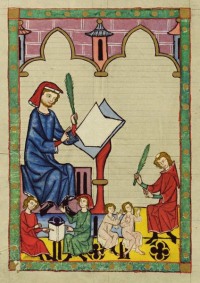
Der Schulmeister von Eßlingen, from Heidelberg, Cod. Pal. germ. 848, Große Heidelberger Liederhandschrift (Codex Manesse), Zürich, c.1300-c.1340, fol. 292v.

Der Schulmeister von Eßlingen, from Heidelberg, Cod. Pal. germ. 848, Große Heidelberger Liederhandschrift (Codex Manesse), Zürich, c.1300-c.1340, fol. 292v.

MAA Dissertation Grants (deadline 15 February):
The nine annual Medieval Academy Dissertation Grants support advanced graduate students who are writing Ph.D. dissertations on medieval topics. The $2,000 grants help defray research expenses.  Click here for more information.

Schallek Awards (deadline 15 February):
The five annual Schallek awards support graduate students conducting doctoral research in any relevant discipline dealing with late-medieval Britain (ca. 1350-1500). The $2,000 awards help defray research expenses.  Click here for more information.

MAA/GSC Grant for Innovation in Community-Building and Professionalization (deadline 15 February):
MAA/GSC Grants will be awarded to an individual or graduate student group from one or more universities. The purpose of this grant is to stimulate new and innovative efforts that support pre-professionalization, encourage communication and collaboration across diverse groups of graduate students, and build communities among graduate student medievalists. Click here for more information.

Olivia Remie Constable Award (deadline 15 February):
Four Olivia Remie Constable Awards of $1,500 each will be granted to emerging junior faculty, adjunct, or unaffiliated scholars (broadly understood: post-doctoral, pre-tenure) for research and travel.  Click here for more information.

Applicants for these and other MAA programs must be members in good standing of the Medieval Academy. Please contact the Executive Director for more information about these and other MAA programs.

Posted in MAA Newsletter | Leave a comment

MAA News – Medieval Academy Fellowships Awarded

The Medieval Academy of America is proud to announce the winners of the 2016 Baldwin and Schallek Fellowships.

Cuenca

Esther Cuenca

The 2016 Schallek Fellowship has been awarded to Esther Cuenca (History, Fordham University). About her thesis, “The Making of Borough Customary Law in Medieval Britain,” Cuenca writes: “My project examines the development of local borough laws, or customs, from the twelfth to the sixteenth centuries. Borough customs were practices or traditions that over time acquired the force of law within a town. Borough customary law was ubiquitous in the arbitration of civil and mercantile disputes, critical to urban governance, and fundamental to the concerns of both civic rulers and their subjects. The study of borough custom, however, has been virtually ignored in medieval legal historiography despite its importance to the rise of merchant capitalism and urbanization in the twelfth and thirteenth centuries. For this project I have developed two databases to explore the content, evolution, and meanings of borough custom. One of the databases tracks the chronological and geographic spread of borough custumals, which are collections of customs, and the other categorizes the content of such custumals. My analytical goals for this project are twofold: to contribute to a deeper understanding of the place of urban customary law within the British legal system, and to reveal custom’s role in the emergence of a distinct bourgeois identity in medieval Britain.”

Claire Jenson

Claire Jenson

The 2016 Baldwin Fellowship has been awarded to Claire Jenson (Art History, University of Chicago). Her thesis is titled “Power and Politics in the Liturgical Manuscripts of Renaud de Bar.” In summarizing her project, Jenson writes: “Although it was common for medieval bishops to commission liturgical manuscripts for their own use, the survival of a single bishop’s ‘set’ of books for the liturgy is unusual. More exceptional are the innovative, and at times enigmatic paintings in the manuscripts illuminated for Renaud de Bar – and the elaborate fictions about Renaud’s position that they represent. My dissertation examines the corpus of illuminated liturgical books owned by the bishop of Metz Renaud de Bar (1303-1316) – a collection once encompassing a two-volume breviary, a missal, a ritual, and a two-volume pontifical – in relation to the historical spaces, rituals, ideas, and visual cultures that together formed a contested landscape of power. Renaud assumed episcopal office in a politically unstable context, after communal leaders had been actively working to reduce the economic and juridical sovereignty of the bishop in Metz for two centuries and finally seized the city from the bishop’s control in 1234. Following the decline of the Metz episcopate, Renaud’s episcopal reign defined a crucial moment in the history of the diocese and provides an opportunity for a critical analysis of the role played by art and performance in the representation and exercise of a bishop’s authority. By investigating how art and liturgy were mobilized to sustain episcopal power as one prince-bishop faced grave challenges to his sovereignty, my aim in this project is to offer a new perspective on how visual art and ritual – mediated by liturgical manuscripts – intervened in political debate and conflict in the Gothic period.”

The Medieval Academy, in collaboration with the Richard III Society-American Branch, offers the one-year Schallek Fellowship of $30,000 to support Ph.D. dissertation research in any relevant discipline dealing with late-medieval Britain (ca. 1350-1500). The Birgit Baldwin Fellowship in French Medieval History was established in 2004 by John W. Baldwin and Jenny Jochens in memory of their daughter Birgit. The Baldwin Fellowship provides a grant of $20,000 to support a graduate student in a North American university who is researching and writing a significant dissertation for the Ph.D. on any subject in French medieval history that can be realized only by sustained research in the archives and libraries of France.

Posted in MAA Newsletter | Leave a comment

MAA News – MAA@AHA

The Medieval Academy of America invites proposals for panels at the 2017 meeting of the American Historical Association in Denver, Colorado, January 5-8, 2017. The theme of the 2017 Meeting is “Historical Scale: Linking Levels of Experience.”

Each year the Medieval Academy co-sponsors with the AHA several sessions at this meeting that are likely to be of particular interest to MAA members and general interest to a broader audience.

There is a two-stage process. First, members of the Medieval Academy submit draft session descriptions to the MAA’s AHA Program Committee by emailing them to the committee chair, Samantha Kahn Herrick (sherrick@maxwell.syr.edu) by February 1, 2016. Descriptions should include the session title, session abstract, paper titles, names and affiliations of the organizer, presenters, and (if relevant) respondent.

Individual paper abstracts are requested but not required. Guidelines for sessions and submitting proposals can be found on the AHA website here.

Second, if approved by the committee, the organizer submits the session proposal directly to the AHA (using their on-line system) by the deadline of February 16, 2016, indicating that the session has the sponsorship of the Medieval Academy of America.

Please note that only sessions approved by the AHA Program Committee will appear as sponsored by the MAA and AHA on the program and that the MAA does not independently sponsor sessions.

Posted in MAA Newsletter | Leave a comment

MAA News – MAA Graduate Student Committee Mentoring Program

The Graduate Student Committee of the Medieval Academy of America invites those attending the Medieval Academy Annual Meeting, Kalamazoo ICMS, or Leeds IMC to participate in the Medieval Academy’s Graduate Student Mentorship Program.

The program facilitates networking between graduate students and established scholars by pairing a student and scholar according to discipline. One need not be a member of the Medieval Academy to participate. The mentorship exchanges are meant to help students establish professional contacts with scholars who can offer them career advice. The primary objective of this mentoring exchange is that the relationship be active during the conference, although mentors and mentees sometimes decide to continue communication after a conference has ended.

To volunteer as a mentor (faculty and independent scholars only) or to sign up as a mentee, please submit this online form: GSC Mentoring Form

For the 2016 Annual Meeting of the Medieval Academy of America (February 25-27 in Boston), the deadline to sign up is Friday, January 22.

Please contact the Mentorship Program co-ordinators,  Justin Barker and Timothy Nelson, for additional information.

Posted in MAA Newsletter | Leave a comment

2016 Medieval Academy of America Publication Prizes

The Medieval Academy of America is proud to announce the recipients of its 2016 publication prizes:
The Haskins Medal
The 2016 Haskins Medal is awarded to Francis Oakley (Williams College) for his trilogy, The Emergence of Western Political Thought in the Latin Middle Ages (Yale University Press, 2010-2015). Of this three-volume work, the Haskins Medal Committee writes: “The culmination of a stellar academic career, the trilogy dazzlingly substantiates a simple thesis:  the secular nature of modern political thought emerged not from ancient Greece and Rome but from the Latin Middle Ages….Deeply learned, engagingly written, encyclopedic, and wise, The Emergence of Western Political Thought is already regarded as a monument in the history of ideas, a masterful explication of the interplay among religion, politics, and education in the West. It richly deserves this honor.” The complete citation is available here.
The Haskins Medal is awarded annually by the Medieval Academy of America for a distinguished book in the field of medieval studies. First presented in 1940, the award honors Charles Homer Haskins, the noted medieval historian, who was a founder of the Medieval Academy and its second President. The selection committee consisted of Robert E. Bjork (Arizona State Univ.) (Chair), Annemarie Weyl Carr (Emerita, Southern Methodist University), and Richard Kaeuper (Univ. of Rochester).
The John Nicholas Brown Prize
Two Brown Prizes are being awarded in 2016, to Marisa Galvez (Stanford University) for Songbook: How Lyrics became Poetry in Medieval Europe (University of Chicago Press, 2012) and to Nicholas L. Paul (Fordham University) for To Follow in their Footsteps: The Crusades and Family Memory in the High Middle Ages (Cornell University Press, 2012).
According to the Brown Committee, “Marisa Galvez has offered a fresh and ambitious interpretation of the medieval songbook…Drawing upon a wide range of primary manuscript materials in Latin, German, Old French, Occitan, and Castilian,  Galvez explores the concept of authorship in an emerging literary genre across more than 200 years of medieval culture.” In commending Nicholas Paul, the Committee writes that he “… offers an original investigation into collective memory in the first crusading century….His conclusion about the failure of Henry II of England and Alfonso II of Aragon ‘to take the cross’ brings the study to a well-defined and compelling conclusion.” The complete citations are available here.
The John Nicholas Brown Prize, established by the Medieval Academy of America in 1978, is awarded annually for a first book or monograph on a medieval subject judged by the selection committee to be of outstanding quality. John Nicholas Brown was one of the founders of the Medieval Academy and for fifty years served as its Treasurer. The selection committee consisted of Barbara Shailor (Yale Univ.) (Chair), Meredith Lillich (Univ. of Syracuse), and David Nirenberg (Univ. of Chicago).
The Van Courtlandt Elliott Prize
The 2016 Van Courtlandt Elliott Prize is awarded to David Shyovitz (Northwestern University) for his article, “Christian and Jews in the Twelfth-Century Werewolf Renaissance,”Journal of the History of Ideas 75/4 (2014), 521-43.
Of this article, the Elliott Prize Committee writes that “the essay, at its broadest level, echoes many cultural and intellectual historians in its emphasis on medieval alterity…For the elegance of its prose, its synthesis of a range of primary and secondary sources, and the significant breadth of its claims, David Shyovitz’s essay is an outstanding model of how much can be accomplished in a scholar’s first medieval article.” The complete citation is available here.
The Van Courtlandt Elliott Prize, established by the Medieval Academy of America in 1971, is awarded annually for a first article in the field of medieval studies, published in a scholarly journal, judged by the selection committee to be of outstanding quality. Van Courtlandt Elliott was Executive Secretary of the Academy and Editor of Speculum from 1965 to 1970. The selection committee consisted of Tim William Machan (Univ. of Notre Dame) (Chair), David Hult (UC Berkeley), and Caroline Walker Bynum (Institute for Advanced Study).
* * * * * *
The 2016 publication prizes will be presented at the upcoming Annual Meeting of the Medieval Academy of America in Boston. The presentation of prizes and the reading of citations will take place preceding the Presidential Address on Saturday, 27 February, at 10:45 AM in the Grand Ballroom, Hyatt Regency Boston.
The Medieval Academy of America, the world’s oldest and largest organization of medievalists, supports research and teaching in medieval records, literature, languages, arts, archaeology, history, religion, philosophy, science, life, and all other aspects of medieval civilization. The Medieval Academy publishes Speculum, the internationally acclaimed journal of medieval studies, in partnership with the University of Chicago Press. In addition, the Academy awards more than $100,000 every year in grants and fellowships, publishes the series Medieval Academy Books in partnership with the University of Toronto Press, and hosts an Annual Meeting. For more information about the Medieval Academy, please visit http://medievalacademy.org.
Posted in Grants & Prizes | Leave a comment

2016 Annual Meeting Registration reminder

Early registration closes on 24 January.
 
Register now to take advantage of
discounted hotel rooms and registration!
 
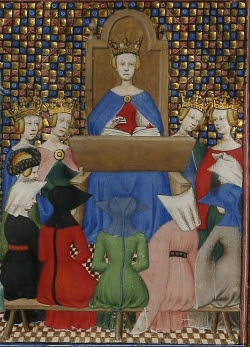
Boston Public Library MS f. Med. 101, f. 1r detail
Christine de Pizan, Le livre des trois vertus
[image courtesy of the Boston Public Library]
Registration for the 2016 Annual Meeting of the
Medieval Academy of America is now open:
The Program, hotel information, and additional details
are available on the Annual Meeting website:
Please contact the Medieval Academy of America
 with any questions about the Annual Meeting:
We look forward to seeing you in Boston!
@MedievalAcademy
#MAA2016
Posted in Annual Meeting, MAA | Leave a comment

Jobs for Medievalists

From http://www.jobs.cam.ac.uk/job/9091/

Medieval Manuscripts Specialist


This is an exciting opportunity for a highly motivated and proactive individual to work at the heart of one of the world’s major research libraries with an outstanding collection of western medieval manuscripts.

The successful candidate will lead the development of high quality reader-focused services to support scholarship on the manuscripts, promoting them to the research community at local, national and international level. He/she with deal with all aspects of the care and administration of medieval manuscripts and will be outward-looking in developing innovative digital services alongside traditional methods to support the University in its teaching, learning and research and to make the medieval manuscripts accessible to the widest possible audience. He/she will have the necessary skills and enthusiasm to exploit the opportunities created by the Cambridge Digital Library (http://cudl.lib.cam.ac.uk) and to take a leading part in developing and implementing a new online catalogue of medieval manuscripts.

To apply online for this vacancy, please click on the ‘Apply’ button below. This will route you to the University’s Web Recruitment System, where you will need to register an account (if you have not already) and log in before completing the online application form.

Informal enquiries are welcomed by Dr Suzanne Paul, Keeper of Manuscripts and University Archives (tel: 01223 333149; email: sp510@cam.ac.uk).

Please quote reference VE07968 on your application and in any correspondence about this vacancy.

The University values diversity and is committed to equality of opportunity.

The University has a responsibility to ensure that all employees are eligible to live and work in the UK.

Posted in Jobs for Medievalists | Leave a comment

Jobs for Medievalists

Assistant Professor of Pre-1800 English Literature

The Missouri State University Department of English invites applicants for a tenure-track Assistant Professor in English whose specialty is pre-1800 English Literature. Applicants must be able to teach courses in Old English, Medieval Literature, and History of the English Language. Teaching responsibilities will also include upper-level and graduate courses as well as introductory and general education courses in literature. Applicants should have a strong secondary interest in one of the following: Critical Theory, Digital Humanities, Drama, or Trans-Atlantic/World Literature. The position requires student advising, an active research agenda (including publication), and engagement in service activities. Successful candidates must be committed to working with diverse student and community populations.

Ph.D. in English (or closely related field); ABD considered with completion of degree by December 31, 2016; evidence of potential for significant scholarship and teaching effectiveness. Applicants should specialize in pre-1800 English Literature and demonstrate interest in online and/or blended teaching.

Complete online application at  https://jobs.missouristate.edu/postings/24069

Applicants should be prepared to upload the following documents when applying online: cover letter; curriculum vitae; transcripts (unofficial); three letters of recommendation, and 15 to 25 page writing sample.

Employment will require a criminal background check at University expense.

Review of Applications will begin on January 18, 2016, and continue until finalists are identified.

Posted in Jobs for Medievalists | Leave a comment