Call for Papers – Ancient Abbeys of Brittany Project Colloquium

Projet Anciennes Abbayes de Bretagne Colloque – 5-6 mai 2016
Université de Toronto, Toronto, Canada – aabp.info.yorku.ca

Appel à communications

Monastères, convergences, échanges et  confrontations dans l’Ouest de l’Europe au Moyen Âge/Monasteries, convergences, exchanges and confrontations in the West of Europe in the Middle Ages

Nous sollicitons des communications sur tous les aspects touchant à ce sujet.
Les langues du colloque sont le français et l’anglais.

Si vous désirez participer, veuillez envoyer un titre et un précis avant le 31 octobre 2015 à l’adresse suivante claude.evans@utoronto.ca .


Ancient Abbeys of Brittany Project  Colloquium – May 5-6, 2016
University of Toronto, Toronto, Canada – aabp.info.yorku.ca

Call for Papers

Monasteries, convergences, exchanges and confrontations in the West of Europe in the Middle Ages/Monastères, convergences, échanges et confrontations dans l’Ouest de l’Europe au Moyen Âge

Papers are welcome concerning any aspect of this topic.
The languages of the conference are English and French.

If you would like to participate please send a title and a short abstract to claude.evans@utoronto.ca  by October 31, 2015.

Posted in Call for Papers | Leave a comment

MAA News – From the President

bnewmanAs I announced at our Notre Dame meeting, I will use my bully pulpit as president to focus on K-12 outreach, especially secondary teaching. I had paid little attention to high school curricula until my niece and granddaughter, who were both taking AP (Advanced Placement) European History at different schools, confessed that their curriculum began with the Renaissance. It seems that Greece and Rome are covered briefly in World History; the Middle Ages, not at all.

To fill the thousand-year gap, my granddaughter was assigned William Manchester’s 1992 book, A World Lit Only by Fire, as summer reading. This notorious work, written as recreation by a journalist who actually boasts that he read no primary sources, peddles the stereotype that for a thousand years, “nothing of real consequence had either improved or declined.  … No startling new ideas had appeared, no new territories outside Europe had been exploited.  Everything was as it had been for as long as the oldest European could remember.” (Note the covert praise of colonialism.) Medieval stagnation continues until, with a heraldic blast of the trumpet, the Renaissance begins: “The mighty storm was swiftly approaching, but Europeans were not only unaware of it; they were convinced that such a phenomenon could not exist.  Shackled in ignorance, disciplined by fear, and sheathed in superstition, they trudged into the sixteenth century in the clumsy, hunched, pigeon-toed gait of rickets victims, their vacant faces, pocked by smallpox, turned blindly toward the future they thought they knew-gullible, pitiful innocents who were about to be swept up in the most powerful, incomprehensible, irresistible vortex since Alaric had led his Visigoths and Huns [sic] across the Alps, fallen on Rome, and extinguished the lamps of learning a thousand years before.”

Of course my husband and I protested this egregious assignment to the school board. That’s how we learned that the Manchester book is, or at any rate was, on a list of texts recommended by the national AP Development Committee. This is an arm of the College Board, with close ties to the Educational Testing Service (ETS) in Princeton. Its guidelines state explicitly that the European History course begins in 1450. Clearly, some intervention by medievalists is needed!

While it may be difficult to infiltrate the AP curriculum because of state and national standards, it’s worth a try. We may have more leeway with curricula in English, as well as Honors History, which is not bound so tightly to the Common Core standards. Needless to say, private and charter schools also afford more liberty for curricular innovation than public ones.

In conjunction with TEAMS and CARA, the Academy has now formed a Committee on K-12 Outreach to pursue a variety of issues. Its members are:

  • Tom Burman (Chair) (University of Tennessee at Knoxville), CARA committee
  • Kara Crawford (Bishop’s School, La Jolla), TEAMS curricular award winner
  • Tom Goodmann (University of Miami), TEAMS board member
  • Anne Lester (University of Colorado at Boulder), CARA committee chair
  • Beth Morrison (J. Paul Getty Museum), MAA Councillor
  • Anita Obermeier (University of New Mexico), president of TEAMS
  • Barbara Newman (Northwestern University), President of the Medieval Academy of America, ex officio
  • Lisa Fagin Davis (Medieval Academy of America), ex officio

We held an initial, highly productive meeting at Kalamazoo, which led to several action items. First, our annual meeting in Boston next year will begin with a pre-session for high school teachers, coordinated by Anita Obermeier on behalf of TEAMS. The session will take place late Wednesday afternoon (24 Feb. 2016), and discounted registration will be offered to any K-12 teachers who want to attend the annual meeting itself. This session-and similar ones in the future-may draw higher attendance if we can arrange for local public school teachers to receive professional development credit for participating. Kara Crawford, who is on the program committee for the New Chaucer Society’s London meeting (June 10-15, 2016), will look into secondary school outreach at that biennial extravaganza.

The National Council of Teachers of English, a huge organization that includes teachers at primary, secondary, and collegiate levels, meets annually in November. Tom Burman will investigate the possibility of a Medieval Academy presentation at its meeting this year in Minneapolis. Finally, Tom Goodmann has volunteered to see how members of the Academy might engage with ETS itself and seek to have an impact on AP and Common Core standards.

TEAMS already offers three prizes for curricular innovation at the K-8, secondary, and collegiate levels. Their “Once and Future Classroom” website (www.teamsmedieval.org/ofc/) offers ample resources to promote the teaching of the Middle Ages in grades K-12. The Academy itself could do more to bring these superb materials to the attention of our own members, as well as primary and secondary teachers who are unaware of them.

If you would like to join this committee or have any additional ideas for outreach, please contact Tom Burman at tburman@utk.edu, or drop a line to Lisa or me.

Barbara Newman, President

Posted in MAA Newsletter | Leave a comment

MAA News – MAA @ Kalamazoo

MaatableThe 50th International Congress on Medieval Studies in Kalamazoo was boisterous as always, and the Medieval Academy was an active participant. Cary J. Nederman’s MAA plenary was well-attended and -received, as were the associated sessions on the theme of Tolerance and Toleration. Our three roundtables (two sponsored by CARA and one by the GSC, which also sponsored a crowded reception) covered topics of current import and sparked lively discussions about new developments in digital humanities, being a public medievalist, and medievalists in the media.

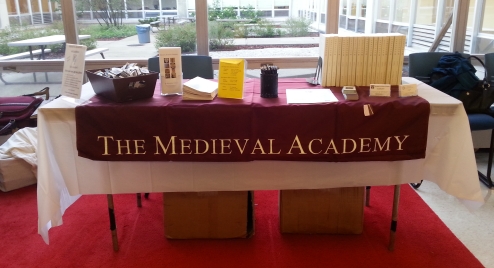
Friday’s CARA Luncheon was attended by nearly forty representatives of medieval studies programs, departments, associations, and libraries, focusing this year on small-group discussions of topics such as fundraising, public engagement, international collaboration, and curriculum development. The MAA table in the exhibit hall was the sight of impromptu meetings, recruitment of new members, and chocolate distribution. If you didn’t stop by this year, we hope you’ll visit next time!

Posted in MAA Newsletter | Leave a comment

MAA News – MAA and Leeds

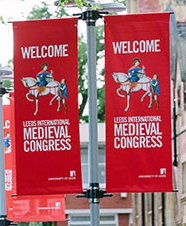
IMCIf you’re going to be at the International Medieval Congress at Leeds this year, please join the Medieval Academy on Tuesday evening (7 July) at 7 PM for the MAA Annual Lecture, to be delivered by Sara Lipton (SUNY – Stony Brook): “The Vulgate of Experience – Preaching, Art, and the Material World.” Afterwards, join Executive Director Lisa Fagin Davis for the Medieval Academy’s open-bar wine reception. For more information, click here. We hope to see you there!

Posted in MAA Newsletter | Leave a comment

MAA News – MAA/GSC Grants Awarded

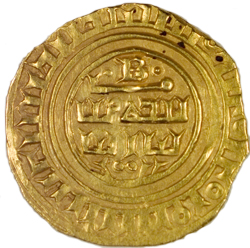
Tripoli, Bohemond VI or VII, gold bezant, 1251-87. Courtesy of Princeton University Numismatic Collection.

Tripoli, Bohemond VI or VII, gold bezant, 1251-87. Courtesy of Princeton University Numismatic Collection.

The inaugural MAA/GSC Grants in Innovation in Community Building and Professionalization have been awarded to three collaborative projects:

“English Manuscript Rolls 1200-1600: A Collaborative Digitization Project” (Anya Adair, Yale University; Katherine Hindley, Yale University; Jessica Henderson, Univ. of Toronto; Micah Goodrich, Univ. of Connecticut)

“Methods and Middle English” (Graduate Student conference) (Zachary Stone, Univ. of Virginia; Ryan D. Perry, Univ. of California, Berkeley; Spencer Strub, Univ. of California, Berkeley)

“15th annual Vagantes Medieval Graduate Student Conference” (Kyle G. Sweeney, Rice Univ.)

These projects, conceived and developed by teams of graduate students, are models of collaboration and innovation. The Academy is very pleased to be able to support these initiatives.

Posted in MAA Newsletter | Leave a comment

MAA News – MAA/CARA Summer Scholarships Awarded

This is the first year that the Academy has offered support to an expanded group of summer programs, and we are pleased to announce that scholarships to support summer coursework in languages or paleography have been awarded to:

Casey Ireland (Univ. of Virginia): London International Palaeography Summer School

Sun Young Lee (Arizona State University): London International Palaeography Summer School

Rachel McNellis (Case Western Reserve Univ.): The MARCO Institute for Medieval and Renaissance Studies

Matthew Parker (St. Louis Univ.): Michelangelo Italian Language and Culture School, Rome

Hilary Rhodes (Univ. of Leeds): The Rare Book School, Univ. of Virginia

Jonathan Sapp (Duke Univ.): University of Notre Dame

Courtney Selvage (Sweet Briar College): University of Toronto

Posted in MAA Newsletter | Leave a comment

MAA News – Medievalists Garner Awards

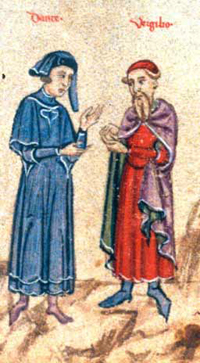
"Dante and Virgil in Conversation," from Oxford: Bodleian Library, MS. Holkham Misc. 48, p. 67. © Bodleian Library, University of Oxford.

“Dante and Virgil in Conversation,” from Oxford: Bodleian Library, MS. Holkham Misc. 48, p. 67. © Bodleian Library, University of Oxford.

Carmela Vircillo Franklin (Columbia Univ.), who will be President of the Medieval Academy in 2016-17, was recently awarded a Guggenheim Fellowship in Medieval and Renaissance History to support her work on a critical edition of the Liber Pontificalis.

Former Academy President Maryanne Kowaleski has been awarded a 2015-16 Fellowship from the Radcliffe Institute for Advanced Study for her project, “Living by the Sea: An Ethnography of Maritime Communities in Medieval England.” Shane Bobrycki has been awarded a Radcliffe Institute Graduate Student Fellowship for a project entitled “The Crowd in the Early Middle Ages c.500-1000.”

Neslihan Senocak (Columbia University) has been awarded a 2015-16 Fellowship from the national Humanities Center for her project, “Care of Souls in Medieval Italy, 1050-1300.”

Posted in MAA Newsletter | Leave a comment

MAA News – Medieval Academy Books in MESA

mesalogoThirty-seven out-of-print volumes of Medieval Academy Books, digitized several years ago as part of an NEH-funded project and available as PDFs on our website, are now also retrievable by searching the Medieval Electronic Scholarly Alliance. Among other goals, MESA “aggregates the best scholarly resources in medieval studies and makes them fully searchable and interoperable.” Adding these volumes of Medieval Academy Books to the MESA library will help bring these open-access editions to a wider audience.

Many out-of-print Medieval Academy publications are also accessible online in the Humanities e-Book library, a subscription-based service available to Medieval Academy members at a discount. For other MAB volumes in various formats, including print-on-demand paperbacks and first-edition hardcopies, see our publications page.

Posted in MAA Newsletter | Leave a comment

Call for Papers – Beyond Exceptionalism

Beyond Exceptionalism

Extended CFP – 22 June 2015

In 1973, Joann McNamara and Suzanne Fonay Wemple wrote “The Power of Women through the Family” which established the paradigm for understanding elite women’s access to power in the early medieval period, and its decline starting in the late eleventh century. Since the early 1980s, the study of elite women (noble and royal) has flourished and undermined both the timing and extent of elite women’s loss of power during the Central Middle Ages.  This body of work has disproved the “exceptional” status accorded to elite women who exercised power.

This interdisciplinary conference aims to foster new avenues and interpretations of elite women and power in the high medieval period, c. 1100-c. 1400 to move the field “beyond exceptionalism”.

Possible topics include but are not limited to:

elite women and bureaucracy
networks and alliances
lordship
feudalism
monarchy
patronage
warfare
monasticism

Invited Speakers: Miriam Shadis (Ohio University) & Theresa Earenfight (Seattle University)

This conference will be held at The Ohio State University at Mansfield (Mansfield, Ohio), 18-19 September 2015.

The deadline for proposals [panels, round-tables, graduate student work in progress workshop sessions (pre-circulated papers), or individual papers] is June 22, 2015. Session chairs and individual presenters will be informed of acceptance no later than June 30, 2015. Those wishing to participate should please submit an abstract of approximately 250 words to tanner.87@osu.edu. Please attach your abstract to your email as a Microsoft Word or PDF file. Included with 250-word abstracts or session proposals (including individual abstracts) should be the following information:

• name of presenter(s)
• mailing & email address
• college/university affiliation
• audio/visual requirements & other special requests

Posted in Call for Papers | Leave a comment

Call for Papers – Haskins Society 2015 Conference

The Call for Papers for the 34th Annual Haskins Society Conference, 6-8 November 2015, held at Carleton College, is now available on the Haskins Society website at: http://www.haskinssociety.org/conference2015 with a deadline of July 17, 2015. We welcome proposals for individual papers and full sessions, and we will host two additional kinds of forums for scholarly discussion and exchange, one focused on new research or research in progress, the other on using the interdisciplinary expertise of Haskins attendees to explore problems in objects and manuscripts. See the Call for Papers for more details.

Posted in Call for Papers | Leave a comment