2014 Bibliographical Society of America Fellowships

2014 Fellowship Program Announcement

Application Deadline: December 15, 2013

The BSA invites applications for its seventh annual Katharine Pantzer Senior Fellowship in Bibliography and the British Book Trades as well as its annual short-term fellowship program, all of which support bibliographical inquiry and research in the history of the book trades and in publishing history. Eligible topics may concentrate on books and documents in any field, but should focus on the book or manuscript (the physical object) as historical evidence. Such topics may include establishing a text or studying the history of book production, publication, distribution, collecting, or reading. Thanks to the generosity of donors, certain special fellowships support research in particular areas of study. Applicants should therefore read the fellowship titles and guidelines here to determine project eligibility and fit. Please note: these fellowships do not support enumerative bibliography (i.e. the preparation of lists). Individuals who have not received support in the previous five years will be given preference. All fellowships require a project report within one year of receipt of the award, and a copy of any subsequent publications resulting from the project, to be sent to the BSA.

Fellowships:

The Senior Katharine Pantzer Fellowship ($6,000); Supports research in topics relating to book production and distribution in Britain during the hand-press period as well as studies of authorship, reading and collecting based on the examination of British books published in that period, with a special emphasis on descriptive bibliography.

The BSA-ASECS Fellowship for Bibliographical Studies in the Eighteenth Century ($3,000); Recipients must be a member of the American Society for Eighteenth-Century Studies at the time of the award.

The BSA Fellowship in Cartographical Bibliography ($3,000); Supports projects dealing with all aspects of the history, presentation, printing, design, distribution and reception of cartographical documents from Renaissance times to the present, with a special emphasis on eighteenth-century cartography.

The BSA-Mercantile Library Fellowship in North American Bibliography ($2,000). Supports scholarship in North American Bibliography, including studies in the North American book trade, production and distribution of North American books, North American book illustration and design, North American collecting and connoisseurship and North American bibliographical history in general.

The Folter Fellowship in the History of Bibliography ($2,000); Supports projects in the history and development of bibliography and/or the book trade before 1900.

The Katharine Pantzer Fellowship in the British Book Trades ($2,000); Supports bibliographical inquiry as well as research in the history of the book trades and publishing history in Britain.

The McCorison Fellowship for the History and Bibliography of Printing in Canada and the United States: the Gift of Donald Oresman($2,000).

The Reese Fellowship for American Bibliography and the History of the Book in the Americas ($2,000).

BSA General Fellowships ($2,000); The Society also offers a number of unnamed fellowships supporting bibliographical research as described above.

For full details, see: http://bibsocamer.org/fellows.htm

NOTE: This year the Society has introduced an on-line application form as a simpler alternative to e-mail or postal submission:

 http://www.bsafellowships.org/bsa/application_form.php.

This page features fill-in fields for all the information contained in the traditional application form as well as buttons for electronically submitting curriculum vitae and Project Description files.

For more information, contact the Society Secretary at fellowships@bibsocamer.org

Posted in Announcements | Leave a comment

Dante’s Immortal Remains: From Florentine Martyr to Global Icon

The Newberry Center for Renaissance Studies presents:

Friday, November 15, 2:00 pm
Dante Lecture
Guy Raffa, University of Texas at Austin
Dante’s Immortal Remains: From Florentine Martyr to Global Icon

http://www.newberry.org/11152013-guy-raffa

A reception will follow the lecture.

This program is free and open to the public, but space is limited and registration in advance is required by 10 am Thursday, November 14.

Keep up with the Center for Renaissance Studies by following our blog: http://www.newberry.org/center-renaissance-studies-blog

Posted in Announcements | Leave a comment

Jobs For Medievalists

RESEARCHER. Cataloguer for rare book company located in New York City.  Excellent writing, communication and organizational skills, proficiency in multiple languages essential (esp German, French and some Latin). Advanced academic degree and experience with rare books and background in history of science a plus. This is a part-time job which could eventually become full-time. PT salary based on an annual FT salary of between $40 – $50,000. to start. Send cover letter and resume to resumes@martayanlan.com or fax it to 212 308 0074.

Posted in Jobs for Medievalists | Leave a comment

Jobs For Medievalists

Assistant Professor of Art History, Before 1750 (Position Number: 00053519)

The Department of Art History, Meadows School of the Arts at SMU, invites
applications for an endowed faculty chair specializing in cultural production and the built
environment with any geographic and historical focus before the mid-eighteenth century.
While an appointment at the rank of assistant professor tenure track is anticipated,
extraordinary candidates at the associate level will be considered.

The successful candidate will demonstrate a commitment to interdisciplinarity, strong
visual analytic skills, theoretical fluency, and research interests that do not duplicate but
complement current faculty strengths in the Americas and Western Europe, including
north Africa, west or south Asia, northern Europe (but not excluding other areas).
Possible research interests might include issues of material exchange across cultures;
visual aspects of political diplomacy or subversion and of religious conviction,
conversion or apostasy; technologies of personal or communal identities; interwoven
histories of exploration, collecting, and surveillance; concerns raised by patronage;
formal languages of artistic world-making; sacred/political landscapes. We encourage
candidates whose teaching would engage the resources and programs of area cultural
institutions, including SMU’s Meadows Museum, the Dallas Museum of Art, and the
Kimbell Museum.

Minimum Qualifications: ABD, with completed degree expected no later than spring
2015; demonstrated potential in teaching and scholarship; expertise to teach courses for
undergraduate majors and non-majors and graduate students in the candidate’s area of
specialization.

Preferred Qualifications: completed PhD strongly preferred; preference will be given to those scholars with demonstrated excellence in teaching and publications, as appropriate
to their experience.

The successful candidate will participate actively in shaping the future of research,
curriculum, and pedagogy in SMU Art History’s vibrant interdisciplinary degree
program, RASC/a: Rhetorics of Art Space and Culture. The candidate will develop
courses for undergraduate and graduate students, from general surveys to focused
research seminars; mentor students at all levels; supervise MA theses and PhD
dissertations; and contribute to the overall vitality of the university through engagement
with interdisciplinary programs within the Meadows School of the Arts and across
campus.

Faculty in the Department of Art History receive leaves, as well as research and travel
support. In general the teaching load is 2/2.

Proposed starting date: August 2014.

Application:
Applicants should submit a detailed letter of application, CV, samples of publications or
dissertation chapters, and evidence of teaching experience. Please request three letters of
recommendation be sent directly to: Pamela Patton, Chair of Division of Art History,
Southern Methodist University, Meadows School of the Arts, PO Box 750356, Dallas,
TX 75275-0356. Inquiries may be directed to Rosa Reifsnyder (rreifsnyder@smu.edu) or
214.768.1222.

We encourage digital applications: E-mailed files should be saved to smallest size. To
retain font and formatting integrity, save documents in .pdf format. Letters of
recommendation may be scanned and sent as .jpg files. All digital material must be fully
functioning on both PC and Mac platforms. Send digital applications to Rosa Reifsnyder
at rreifsnyde@smu.edu

To ensure full consideration for the position, the application must be postmarked by
January 4, 2014, but the committee will continue to accept applications until the
position is filled. The committee will notify applicants of its employment decisions after
the position is filled.

SMU:
SMU is a private university of 11,000 undergraduate and graduate students, located in
north Dallas. Established in 1911, SMU offers an intellectually diverse, nondenominational
campus environment dedicated to the University’s founding principles of
education in the liberal arts.

SMU will not discriminate on the basis of race, color, religion, national origin, sex,
age, disability, genetic information, or veteran status. SMU’s commitment to equal
opportunity includes nondiscrimination on the basis of sexual orientation and gender
identity and expression. Hiring is contingent upon the successful completion of a
background check.

Posted in Jobs for Medievalists | Leave a comment

Jobs For Medievalists

Assistant Professor of Art History, Ancient/Classical Greece (Position Number:
00053520)

The Department of Art History, Meadows School of the Arts at SMU, invites
applications for an endowed faculty chair specializing in the arts of Greece and the
ancient Hellenic cultural tradition. This position has been endowed in honor of the
distinguished specialist in Classical art and myth Karl Kilinski. While an appointment at
the rank of assistant professor tenure track is anticipated, extraordinary candidates at the
associate level will be considered.

The successful candidate will demonstrate a commitment to interdisciplinarity, strong
visual analytic skills, theoretical fluency, and a broad knowledge of ancient Greek visual
culture and its intersections with adjacent artistic traditions, such as those of Rome and
the ancient Near East. Potential research interests may address questions of art and
thought in the Hellenic tradition; institutional and social/historical critique of visual
production and reception; history and theories of vision, artistic media, and spatial
practice; cultural poetics of gender and sexuality, social identity, and the political
imaginary; cross-cultural exchange and interculture. We invite applications from
scholars in a variety of disciplines, including art and architectural history, cultural
studies, classical studies, archaeology, performance studies, women’s and gender studies,
and other related fields. We encourage candidates whose teaching would engage the
resources and programs of area cultural institutions, including the ancient art collections
at the Dallas Museum of Art and the Kimbell Museum.

Minimum Qualifications: ABD, with completed degree expected no later than spring
2015; demonstrated potential in teaching and scholarship; expertise to teach courses for
undergraduate majors and non-majors and graduate students in the arts of Greece and the
ancient Hellenic cultural tradition.

Preferred Qualifications: completed PhD strongly preferred; preference will be given
to those scholars with demonstrated excellence in teaching and publications, as
appropriate to their experience.

The successful candidate will participate actively in shaping the future of research,
curriculum, and pedagogy in SMU Art History’s vibrant interdisciplinary degree
program, RASC/a: Rhetorics of Art Space and Culture. The candidate will develop
courses for undergraduate and graduate students, from general surveys to focused
research seminars; mentor students at all levels; supervise MA theses and PhD
dissertations; and contribute to the overall vitality of the university through engagement
with interdisciplinary programs within the Meadows School of the Arts and across
campus. SMU boasts a generously endowed research library in Classical Studies.

Faculty in the Division of Art History receive leaves, as well as research and travel
support. In general the teaching load is 2/2.

Proposed starting date: August 2014.

Application:
Applicants should submit a detailed letter of application, CV, samples of publications or
dissertation chapters, and evidence of teaching experience. Please request three letters of
recommendation be sent directly to: Pamela Patton, Chair of Division of Art History,
Southern Methodist University, Meadows School of the Arts, PO Box 750356, Dallas,
TX 75275-0356. Inquiries may be directed to Rosa Reifsnyder (rreifsnyde.smu.edu) or
214.768.1222.

We encourage digital applications: E-mailed files should be saved to smallest size. To
retain font and formatting integrity, save documents in .pdf format. Letters of
recommendation may be scanned and sent as .jpg files. All digital material must be fully
functioning on both PC and Mac platforms. Send digital applications to Rosa Reifsnyder
at rreifsnyde@smu.edu

To ensure full consideration for the position, the application must be postmarked by
January 4, 2014, but the committee will continue to accept applications until the
position is filled. The committee will notify applicants of its employment decisions after
the position is filled.

SMU:

SMU is a private university of 11,000 undergraduate and graduate students, located in
north Dallas. Established in 1911, SMU offers an intellectually diverse, nondenominational
campus environment dedicated to the University’s founding principles of
education in the liberal arts.

SMU will not discriminate on the basis of race, color, religion, national origin, sex,
age, disability, genetic information, or veteran status. SMU’s commitment to equal
opportunity includes nondiscrimination on the basis of sexual orientation and gender
identity and expression. Hiring is contingent upon the successful completion of a

Posted in Jobs for Medievalists | Leave a comment

MAA News – Letter from the President

UngerThe twenty-first century has brought many changes to the Academy, a sign of the organization keeping up with the times. New services for members and ways of delivering those services combined with maintaining traditional functions have increasingly pressed the existing structure of administration. The staff in the Cambridge office and the members of many committees have been largely successful in getting all the jobs done, but there were increasing signs that old forms, in place since the middle of the last century, were under stress. The sudden, unexpected resignation of the former Executive Directors in April of this year led the Council to seize the initiative and address what were growing problems for the proper functioning of the Academy.

First, the Council had to address immediately the staffing of the Cambridge office. We were extremely fortunate to find two people, both of them with experience of the operations of the Academy, both in the Boston area, and both willing to take on work for us, who stepped in on very short notice. Jacqueline Brown immediately set to work as Acting Editor of Speculum and Director of Academy Publications to be sure no momentum was lost in maintaining the quality of our journal. She has accomplished a great deal in her short time in office, speeding up the process of publication so that the periodicity of

Speculum can be restored and readers as well as authors need not wait as long to see work in print, or online. Jackie has taken on the task temporarily because of her devotion to the Academy and to the journal she has been involved with for some years. We are deeply indebted to her for returning to the Academy to help in dramatically changed circumstances. Lisa Fagin Davis was able to reorganize her scholarly and teaching commitments and reallocate her work so that she could work four-fifths time as Acting Executive Director. She took charge of the office exactly one month before the move which brought the Academy to a new address. She was able, in between packing and then unpacking, to be sure that all day-to-day membership services continued and were kept up to date. Her familiarity with operations from an earlier period of work in the office certainly has proven an asset. She has been very important to continuity in this period of transition.

Second, the Council decided to divide the tasks of Executive Director and Editor of Speculum. Rick Emmerson, when he stepped down from the combined post in 2006, pointed to the rising workload and the difficulties for one individual to edit the journal while dealing with a growing range of responsibilities from the expanded publication program and increased membership activities. Over the next few years the presidential officers and the Council were involved in a series of actions taken to clarify and solidify the administration of the Academy, in the process addressing some of the problems Rick Emmerson had identified. Peggy Brown oversaw an extensive revision of the by-laws, the first in many years. It was a process that called on the expertise of an ad hoc committee and involved lengthy deliberation by the full Council. Her successor, Alice Mary Talbot, guided the Council and staff through the production of an Administrative Handbook. That detailed description of the activities of the Academy and of the responsibilities of various committees and officers is available online and is updated periodically. The Treasurer, Gene Lyman, and the Finance Committee he chairs have in recent years brought in fuller and more up-to-date financial reporting, making the books more transparent and assuring compliance with existing legislation. The Executive Directors, Ron Musto and Eileen Gardiner, took on the task of drafting an Employee Handbook so staff would enjoy a level of information about their responsibilities and benefits which the Administrative Handbook gives to the volunteer members who serve the Academy. They expanded the role of electronic communication in the functioning of the organization, in the editing of Speculum, and, more obviously, in improvements in the web site as well as making the journal available in electronic as well as print form. Last year Maryanne Kowaleski oversaw the last revisions of the Handbooks and took on the task of implementing many of the changes set in motion by her immediate predecessors.

Despite all those accomplishments it was clear by this Spring that the growth in Academy activities was placing extremely varied burdens on the Executive Director, so testing the limits of the skills of anyone in that office. The Action Planning Committee, approved by the Council at the Knoxville meeting, was to take on a number of matters to do with Academy operations, exploiting the hardwon opportunity for new directions created by the hard work of the previous years. The need to deal with urgent matters of staffing forced the suspension of the work of that Committee. The Council decided to attack one major issue immediately and that was to separate the responsibilities of the journal editor and the Executive Director. Many other societies, larger and smaller than the Academy, have a separate editorial team, often located at a university and so located a distance from the administrative offices. For some years there had been discussion of dividing off some of the responsibilities of the Executive Director. The Council chose in May to create something similar to the pattern in similar learned societies. The goal was, above all, to address what appeared to be essential structural problems. A search is now under way for a new editor of Speculum.

Because of the reliance on electronic communication the new editor will not have to be resident in Cambridge, a clear advantage. The considerable interest in the job and the range of qualified applicants who have put their names forward will make the task of selecting the individual or individuals responsible a difficult one for the search committee composed of Christopher Baswell, Susan Einbinder, Cynthia Hahn, and Cary Nederman with me as chair.

With what will be, I am confident, a successful search for a new officer responsible for Speculum the Academy will set about looking for an Executive Director to take on the operations of the office in Cambridge. The Council will in the next few weeks be working on drafting a precise job description and with it an advertisement for the post. That will not be easy since the responsibilities of the incumbent will be so varied and different from what the Executive Director has done in the past. Despite the difficulties of establishing the parameters of the post the search, chaired by the current First Vice President, Bill Jordan, will be under way by the end of the year.   Once the two new staff members are in place, the Council will turn to the task of revising the bylaws and the Administrative Handbook to reflect the new arrangements. There will be a short period of adjustment during the transition to a new structure, but recent experience suggests that the process will be a smooth one.

During all of the dramatic changes of the last five years and more the Academy has continued to thrive, with the time from submission of articles to decision for Speculum shortening, the journal being made available solely online for those who opt for it, an expansion of digital initiatives, a series of successful meetings held at different sites across the continent, all while sharply improving the financial health of the organization, the last accomplished despite a world-wide financial meltdown. All this has been achieved through the good work of the staff, past and present, of the office in Cambridge. The results have come thanks to the efforts of my predecessors and of my successors, of the Treasurer and all those who have served on the Council, volunteers all of whom have given of their time and energy to ensure the success of the Academy and of medieval studies both in North America and around the globe. All of us are grateful to them for what they have done. The commitment of those medievalists indicates the strength of the field and the chances for success of the scholarly enterprise over the long term. Historians especially but medievalists in general do, of necessity, think in terms of lengthy periods of time. All of us should keep on doing just that.

Richard W. Unger
President

Posted in MAA Newsletter | Leave a comment

MAA News – MAA Fellowship and Prize Deadlines Approaching

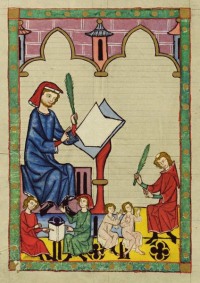
Der Schulmeister von Eßlingen, from Heidelberg, Cod. Pal. germ. 848, Große Heidelberger Liederhandschrift (Codex Manesse), Zürich, c.1300-c.1340, fol. 292v.

Der Schulmeister von Eßlingen, from Heidelberg, Cod. Pal. germ. 848, Große Heidelberger Liederhandschrift (Codex Manesse), Zürich, c.1300-c.1340, fol. 292v.

The Medieval Academy of America has long provided a variety of benefits of membership, including numerous fellowships, prizes and grants for travel, research and publications. Please see the list below for prizes and fellowships with looming deadlines, then follow the links for complete descriptions and application information. We encourage all eligible members to apply for these grants.

Graduate Student Fellowships and Awards
Birgit Baldwin Fellowship
(Deadline 15 November 2013)

Service Awards
Kindrick-CARA Award for Outstanding Service
(Deadline 15 November 2013)

Teaching Awards
CARA Award for Excellence in Teaching
(Deadline 15 November 2013)

Independent Scholars/Unaffiliated Faculty
Travel Grants
(Deadline 1 November 2013 for meetings to be held between 1 March and 31 August 2014) 

Please see the MAA website for other grants and prizes offered by the Academy.

Posted in MAA Newsletter | Leave a comment

MAA News – Grants to Medievalists

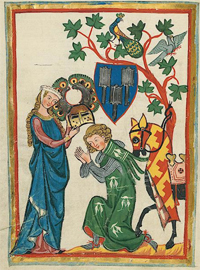
Cod. Pal. germ. 848, Große Heidelberger Liederhandschrift (Codex Manesse), Zürich, c.1300-c.1340, fol. 82v.

Cod. Pal. germ. 848, Große Heidelberger Liederhandschrift (Codex Manesse), Zürich, c.1300-c.1340, fol. 82v.

The MAA is delighted to announce that the following members will be conducting research at the Princeton Institute for Advanced Studies, School of Historical Studies, in 2013-14: Mark Cruse, Bonnie Effros, Monica Green, Katherine Jansen, and Jocelyn Wogan-Browne.

Additional NEH Fellowships have been awarded to several MAA members: Bonnie Effros of the University of Florida received a Summer Stipend, and Cecilia Gaposchkin (Dartmouth College) and Dan Hobbins (Univ. of Notre Dame) are currently serving Fellowships awarded in 2012. Kristina Markman, a graduate student in the Dept. of History at UCLA, has been awarded a Dissertation Fellowship from the ACLS Program in East Europe Studies.

Posted in MAA Newsletter | Leave a comment

MAA News – MAA Graduate Student Committee News

Click here to see what the Medieval Academy’s Graduate Student Committee has been up to, and feel free to forward the link to any grad students in your department or program who might not know about all the Academy and the GSC have to offer.

Posted in MAA Newsletter | Leave a comment

Jobs for Medievalists

Rare Books Curator

The Special Collections Research Center of the Georgetown University Library seeks a Curator of Rare Books to oversee and manage Lauinger Library’s collections of rare books. The Curator develops the collections; prioritizes and coordinates cataloging efforts, collection maintenance, and reference services; teaches research sessions relating to rare books holdings and the use of primary sources; and plans and develops exhibitions and events highlighting the collections.

The Special Collections Research Center collects, organizes, interprets, preserves, makes available and promotes the use of the Library’s rare and unique materials in art, archives, manuscripts and rare books. It supports primary source research and instruction by undergraduate and graduate students, faculty and the broader scholarly community. Georgetown’s rich collections range over the historical aspects of almost every humanistic discipline and many scientific fields of study. Areas of special strength include Jesuit history; early American Catholicism; English recusant history; English and American literature with emphasis on Catholic literary figures; American printmakers and book illustrators; intelligence and espionage; diplomacy and international affairs with special concentrations on the Middle East and on Latin America; and Georgetown history. More information about the collections is available at: http://www.library.georgetown.edu/search-special-collections/subjects

Responsibilities:
Primary curatorial responsibility for the rare book collections within Georgetown University Library’s Special Collections Research Center, under the general guidance of the director of the SCRC, and in cooperation with other curatorial staff.

  • ·Develops rare books collections, by both purchase and gift, in line with the pedagogical and research needs of the University, as well as its history and existing collection strengths.
  • ·Prioritizes and coordinates cataloging efforts with the Library’s Metadata Services unit.
  • ·Supervises collection maintenance to provide scholarly access and to ensure long-term preservation
  • ·Provides and supervises reference service for the rare book collections.
  • ·Consults with faculty to learn about their research and curricular needs. Interprets and analyzes the information needs of students, faculty, and other researchers.
  • ·Monitors collection development and scholarly publishing trends in research libraries and the commercial sector.
  • ·Monitors the collections budget in the assigned areas of responsibility.
  • ·Initiates and engages in outreach activities, such as exhibitions, publications and classroom presentations and research sessions, to highlight Special Collections and to promote the use of its holdings.
  • ·Coordinates with faculty and librarians on designing research assignments using rare materials.
  • ·Sets priorities for digitization.


Requirements:

  • ·A Master’s degree: an ALA-accredited MLS or equivalent experience; additional Master’s degree or equivalent experience in a humanities-related field
  • ·Demonstrated knowledge of the history of books and printing and the principles of bibliography
  • ·At least three years’ experience in special collections librarianship
  • ·Knowledge of the organization and administrative policies and procedures in libraries and archives
  • ·Bibliographic literacy in the widest possible range of languages is helpful
  • ·Strong communication and analytical skills
  • ·The ability to work independently and with others and excel in a dynamic team environment
  • ·Well-developed organizational and research skills

Salary/Benefits/Rank: Salary commensurate with experience; minimum $44,939. Comprehensive benefits package including 21 days/year paid leave; medical; TIAA/CREF; tuition assistance. This is a 12-month, Academic/Administrative Professional (AAP) appointment.

Apply online at http://www.library.georgetown.edu/employment/index.htm.

Review of applications begins immediately and continues until filled.

Georgetown University is an Equal Opportunity, Affirmative Action Employer

Posted in Jobs for Medievalists | Leave a comment