MAA News – MAA Election Results

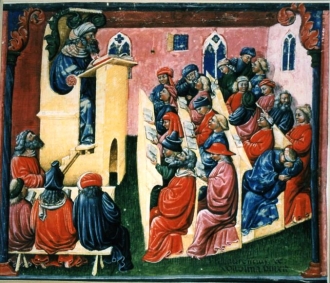
Golden Haggadah, Spain. c. 1320, British Library, Add. MS 27210, f. 15r, detail.

Golden Haggadah, Spain. c. 1320, British Library, Add. MS 27210, f. 15r, detail.

The MAA elections closed on 15 January 2013. Almost 25 percent of the membership voted in the election, up 15% from last year and well above the average for learned society participation. Thank you!

The ballots will be presented at the Annual Business Meeting of the Medieval Academy in Knoxville on Friday, 5 April at 1:00 PM in Hilton Knoxville Ballroom on the Mezzanine Level.

The newly elected Officers are:
President: Richard W. Unger (History, University of British Columbia)
First Vice-President: William Chester Jordan (History, Princeton University)
Second Vice-President: Barbara Newman (English, Northwestern University)

The new Councillors are:
Susan Einbinder (Literature, University of Connecticut)
Thomas Madden (History, St. Louis University)
Elizabeth Morrison (Manuscript Studies, Getty Museum)
Anders Winroth (History, Yale University)

The new members of the Nominating Committee are:
Scott Bruce (History, University of Colorado, Boulder)
Ken Pennington (History, Catholic University)

The members of the Medieval Academy congratulate their new officers and councillors, who will begin their terms at the close of the 2013 Annual Meeting, and the new members of the Nominating Committee, who will begin their terms at their meeting during the 2013 Annual Meeting.

The members also extend thanks to all those who generously stood for election.

Posted in MAA Newsletter | Leave a comment

MAA News – President’s Column


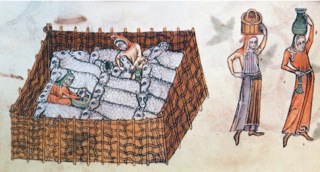
From the Luttrell Psalter. London, British Library, MS Add. 42130, fol. 163v.

From the Luttrell Psalter. London, British Library, MS Add. 42130, fol. 163v.

Occupy the Middle Ages


Maryanne Kowaleski 


Peasants — a catch-all term for rural dwellers who made their living by farming land or raising livestock — represented about 80 to 90 percent of the population during the Middle Ages, but they rarely receive the scholarly attention they deserve. Twice in the last six years, I have had the opportunity (as part of searches for a new medievalist colleague at Fordham) to read dozens of syllabi for medieval survey courses. Both times I have been struck by how few of these syllabi even contained the word “peasant” or “agriculture.” Royalty, aristocrats, clergy, heretics, mystics, barbarians, Muslims, Jews, Crusaders, merchants, and even marginal people such as lepers and criminals make the cut, but not the social group responsible for the vast majority of the pre-industrial economy. Medieval peasants cannot rise up and shout “We are the 90 percent!” so I want to use my final presidential column to shout out on their behalf, even though they do not quite reach the 99 percent of the Occupy Wall Street movement.


I have received varied answers when asking teachers why they spend so little class time on the peasantry. Some claim to “cover” the subject (in, for example, a primary-source reading on the Great Famine, or in introducing the Commercial Revolution and growth of towns). Others answer that with only fifteen weeks in the semester, they had to make hard choices, and decided it was more important to expose students to the medieval roots of contemporary issues such as women and work or medieval multiculturalism. Still others suggest that the powerlessness of illiterate peasants make them easier to omit than kings or popes. And finally, some respond that the urban and suburban backgrounds of most of our students render the agricultural world of the medieval peasantry too foreign and seemingly irrelevant. All these are reasonable responses, but none justifies virtually obliterating such a crucial component of medieval life. Peasants were individually powerless but collectively powerful — witness the impact of new agricultural technologies on the food supply and urbanization, or peasant revolts, and even the eventual waning of serfdom. And peasants are most certainly not irrelevant in our global world, in which income inequality, agricultural productivity, and land reform are compelling and unresolved concerns.


Graduate students also need to encounter peasants in our courses. They too often have little idea of the life of the working majority in the Middle Ages. Some have been introduced to the classic manorial system of England and northern France, but few have heard anything about sharecropping peasants in Tuscany or transhumance in Spain and the Alps. As a result, graduate students are rarely interested in researching anything to do with agriculture; the cultural turn has been bad for peasants. Of almost two hundred applications that I read between 2007 and 2012 for my school’s openings in medieval history, none concentrated on peasants or agriculture. I’d like to think that the focus on cultural and intellectual history in our most recent search precluded applications from those working on rural economy and society, but given the proclivity for recent PhDs to apply widely in the field, I may be wrong. On the upside, for reasons I am hard-pressed to explain, scholarly interest in the medieval peasantry has not waned nearly as much in Europe as it has in North America.


Perhaps Europeans know how fascinating and relevant medieval peasants can be and have discovered the rich resources available to teachers in this field. New textbooks that highlight social history can provide good coverage. A recent spate of secondary works that draw on documentary evidence with “disciplined imagination” have also been written with a student audience in mind. Abundant printed translations of primary sources — ranging from court rolls, account rolls, lists of customs, rentals, and charters to archaeological and demographic sources — are readily available to undergraduates seeking material for a senior thesis. These resources make it easy to integrate sections on the peasantry into classes on women, family, lay devotion, crime, and national surveys of, for example, medieval England. For graduate students, the opportunities for comparative work, particularly between northern and southern Europe, or across the English Channel, have tremendous potential. There are also many possibilities for studies that explain regional differences in inheritance regimes, or images of the peasant in medieval literary or religious texts, or the material culture of the peasantry as evident in inventories, references to pledged goods, and archaeological evidence. In both our teaching and our research, we can and should make more use of this rich trove of scholarship and sources about the 90 percent on whom all the rest of medieval society and culture so depended.

Posted in MAA Newsletter | Leave a comment

Call for Proposals: Geopolitical Transition in the Mediterranean

Proposals for papers are being accept for the first international conference on “A New Research Agenda for Mediterranean Studies” with the theme, “Geopolitical transition in the Mediterranean: a challenge for Mediterranean Studies” hosted by the Centre de la Méditerranée moderne et contemporaine- MSH Sud-Est of the Université de Nice Sophia-Antipolis, in partnership with l’Institut Universitaire de France and Science-Po Menton, to be held at Nice & Menton on 8-9 November 2013

A maritime space which separates -and unites- three continents, the Mediterranean is also, and perhaps above all else, a representation of a series of myths that have developed throughout the centuries. These images and the transmission of these images forms the substratum behind both political actions and the main themes and directives of foreign policy. Mutual incomprehension and problems working together despite a willingness to do so, often arise from conflicts between these different representations or myths.

Recently, recalling the fact that talking about the Mediterranean does not necessarily lead to a shared memory of the area, Philippe Dugot said,”the Mediterranean is first and foremost a European idea.” This idea has, however, now become a geopolitical possibility that seems to have broken away from negative stereotypes identifying it as a space unable to adapt to a Western model perceived as a definitive goal. Within the framework of globalisation, some large scale regional associations between North and South are being created both in the Americas and in Asia. These constructions are founded on the potential to complement each other, particularly from the point of view of demography and resources, but also on common goals, particularly in ecology. The Mediterranean could thus become an area that puts together developing and developed nations giving them a voice within these larger regional assemblies that are fast becoming key forums in the ongoing globalization process.

In the context of these transformations a series of projects have seen the light – the Euro-Mediterranean partnership, the Union for the Mediterranean, which followed a series of older projects like the Inter-Parliamentary Conference on Security and Cooperation in the Mediterranean, and the 5+4 Conference – which left the impression of an excess of propositions and visions. Many differences remain and commercial exchanges between the two shores are relatively modest; only 2.3% of the European Union’s direct investments are on the Southern shore of the Mediterranean.

Various recent political initiatives seem more like propositions than programs with real concrete results. In addition, the destabilization caused by the Arab Spring, the internal collapse taking place in Syria, and the increasing strength of AQMI, have brutally recalled the fragility of this area. It is therefore necessary to place the political issues involvedbin a long-term perspective, as is shown by the determined support given bybRussia to its Syrian ally, which is part of a logic that hails back to theb1950s and even further back to Imperial Russia’s desire for navalbfacilities in the Mediterranean.

Scientific issues :

We propose an inquiry into the myths and representations that support these projects and into what lies behind the persistent difficulties encountered in trying to turn them into reality. The answer lies both in the different national policies but also in the reasoning behind the development of a Mediterranean policy for the European Union. The different ways of conceiving foreign policy, the historical traditions, the different visions associated with creation and education of elites, the role of specialized bureaucracies and the opportunities and collateral effects of Mediterranean programs are some of the elements which form representations of the Mediterranean and lead to political projects which aren’t always able to erase their different matrices.  Thus, France and Italy both have strong and ancient but divergent Mediterranean policies, Germany has recently shown its desire to have a say in Mediterranean issues, and the European Union has become a fully fledged, and likely a major, actor in Mediterranean policies. In the face of these European initiatives and ambitions, it is worthwhile to look at the perceptions of the other Mediterranean rim countries, whose relationship with Europe is often conditioned by the rewriting of a recent past that is not easily forgotten and is at the origin of national myths. Algeria offers a good example of the reactions of Southern shore countries when faced with a series of policies coming from the European shore.
This analysis of the history and geopolitics of the contemporary Mediterranean is closely linked to a more general desire to reflect on the emergence of a specific field of study dedicated to the Mediterranean. With this in mind, an edition of the Cahiers de la Méditerranée (both paper and electronic editions) programmed for 2014 –peer review publication, registered by the Agence d’Evaluation de la Recherche et de l’Enseignement supérieur- will continue the work of this conference by placing its contributions in a dossier entitled “Rebuilding Mediterranean Studies ».
This international conference will therefore kick off a series of meetings that are part of the cycle “a new agenda of research for Mediterranean Studies” aimed at finding the most promising areas within Mediterranean Studies. The goal is clear, to gather researchers also involving different generations of scholars, and identify together the most promising perspectives for future study, so that they may be studied by research laboratories as well as senior researchers and their doctoral students.
*Please e-mail your proposals to the three organizers before May 15, 2013. Proposals should be short texts about 15 lines long (500 words) accompanied by a CV which includes your most recent publications and should be sent to the following e-mail addresses: pybeaurepaire@gmail.com Jean-Pierre.DARNIS@unice.fr joseph.martinetti@orange.fr

Scientific committee:
*Pierre-Yves Beaurepaire (Université de Nice Sophia-Antipolis-CMMC et
Institut Universitaire de France ; *
*Jean-Pierre Darnis (Université de Nice Sophia-Antipolis-CMMC) ; Joseph
Martinetti  (Université de Nice Sophia-Antipolis-CMMC) *
*in collaboration with Anthony Jones (Northeastern University & Harvard
University)*
Pierre-Yves Beaurepaire

Posted in Uncategorized | Leave a comment

Call for Papers – Rethinking Early Modernity: Methodological and Critical Innovation since the Ritual Turn

CRRS 50TH ANNIVERSARY ANNUAL CONFERENCE

Rethinking Early Modernity: Methodological and Critical Innovation since the Ritual Turn

Toronto, Ontario, June 26-27, 2014

http://crrs.ca/crrs-conferences/50th

The Centre for Reformation and Renaissance Studies is celebrating its fiftieth anniversary with a conference in honor of Edward Muir, whose innovative studies of Venetian politics and culture helped to establish cultural anthropology and ritual as major analytical frameworks for scholarship on early modern European history. Building from Muir’s contribution to the field, the conference hopes to focus on the significance of the methodological changes that have characterized early modern research in history, literature and art history over the last thirty years and to reflect upon how these changes have affected our understanding of the importance of the period.

The conference will take place at Victoria University in the University of Toronto on June 26 and 27.

Call for Papers

Interested scholars are invited to submit a paper proposal on topics that exemplify new directions of critical inquiry spurred by the methodological developments over this period, including, but not limited to, the meaning of popular culture, the role of gender, microhistory, the discovery of the body, the importance of ritual, etc. Topics are also welcome that consider how methodological innovations in early modern scholarship—particularly in recent years—have informed changes in the nature of humanities inquiry, broadly conceived.

We welcome papers from all disciplines, geographical areas, and periods housed within the rubric of early modern Europe. Scholars of all ranks are welcome to submit papers, including graduate students.

The deadline for submissions is September 30, 2013.  Please submit a title, short abstract (250 words maximum), and brief CV to Mark Jurdjevic and Rolf Strom-Olsen at crrs50th@gmail.com.

Conference Information

Further information about the event will be posted on the conference website: http://crrs.ca/crrs-conferences/50th/.  Scheduling, travel and hotel information will be available in early 2014.

Posted in Call for Papers | Leave a comment

Ritual, State and Lordship in Medieval England, c.900-1300

Registration is now open for ‘Ritual, State and Lordship in Medieval England, c.900-1300’, a one-day conference to be held on 16 July 1213 at the New College of the Humanities in London. The conference will explore the relationship between ritualised communication, the lordship of kings and magnates, and government in the context of the comparatively powerful structure of the English state. Key topics for discussion will be both how inspiration from early medieval and continental studies of rituals can advance studies of the English Middle Ages, and how study of the rituals of medieval England, with its rich source materials and particular social and political conditions, can contribute to the wider debate about ritualised communication in the medieval period.

Registration cost: £5 for students, £10 for salaried attendees, to be paid on the day. To register please email the organisers at RitualsConference@hotmail.co.uk no later than 7 July.


http://events.history.ac.uk/event/show/9753
Organisers: Lars Kjær (NCH), Levi Roach (Exeter), Sophie Ambler (KCL)

Posted in Conferences | Leave a comment

I Tatti Prize: Call for Applicants

The I Tatti Prize for Best Essay by a Junior Scholar is awarded to a junior scholar for the best scholarly article on an Italian Renaissance topic, published in English or Italian. The subject can be any aspect of the Italian Renaissance, broadly defined as the period ranging from the thirteenth to the seventeenth centuries, including historiography. The selection committee looks for rigorous and original research, and convincing results expressed in clear and effective prose. The winning article(s) will be posted on the I Tatti website.

To apply, please visit http://itatti.harvard.edu/content/prize-application-best-essay-junior-scholar. Applicants must have received a PhD, dottorato di ricerca or equivalent between 1 January 2008 and 30 June 2013. Please include the title of the journal, volume number, and page range. Only articles printed in 2012 are eligible. If the date on the title page is not 2012, please include proof of publication date below. Current employees of I Tatti, or appointees from academic years 2012/13 or 2013/14 are not eligible.

Posted in Announcements | Leave a comment

Seven Teams of Scholars Awarded 2013 ACLS Collaborative Research Fellowships

The American Council of Learned Societies is pleased to announce the recipients of the 2013 Collaborative Research Fellowships.

Two of the seven were awarded to medieval projects:

Historian Michael E. Kulikowski (Professor, Pennsylvania State University, College Park) and classicist Gavin A. J. Kelly (Associate Professor, University of Edinburgh) will publish The Landmark Ammianus Marcellinus, an accessible, critical translation of the understudied fourth-century historian, whose writings provide an invaluable window into the dynamics of the late Roman empire.

English literature scholars Heather Blurton (Associate Professor, University of California, Santa Barbara) and Hannah Johnson (Associate Professor, University of Pittsburgh) reconsider the medieval and modern receptions of Chaucer’s anti-Semitic poetry in their proposed monograph Ethics, Criticism, Anti-Semitism: Chaucer’s Prioress and the Jews.

Posted in Fellowships | Leave a comment

Call for Papers – MAA 2013 Annual Meeting

annualmeetingcallAnnual Meeting, Los  Angeles, 2014: Call for Papers
Deadline for submission is 15 June 2013

The 2014 Annual Meeting of the Medieval Academy of America will be held jointly with the Medieval Association of the Pacific on 10-12 April, in Los Angeles at the University of California, Los Angeles (UCLA) and hosted by the UCLA Center for Medieval and Renaissance Studies.

The Program Committee invites proposals for papers on all topics and in all disciplines and periods of medieval studies. Any member of the Medieval Academy may submit a paper proposal, excepting those who presented papers at the annual meetings of the Medieval Academy in 2012 and 2013; others may submit proposals as well but must become members in order to present papers at the meeting. Special consideration can be given to individuals whose specialty would not normally involve membership in the Medieval Academy.

The complete Call for Papers with additional information, submission procedures, selections guidelines, and organizers is available here.

Please contact Prof. Massimo Ciavolella at UCLA, if you have any questions.

SESSIONS

  1. Encountering Byzantium: The Empire through the Gaze of Others
  2. Byzantine Art as a Site of Encounter
  3. Architecture and Encounter
  4. On Teaching the Middle Ages to K-12 [two sessions]
  5. Travel and Pilgrimage Literature
  6. The Postcolonial Encounter in Medieval English Literature
  7. The Traffic in Religions
  8. Encounters between Cultures: Conflicts and Conflict Resolution
  9. Medicine and Literature
  10. Shipwrecks and Shipping
  11. What’s New in Medieval Studies?
  12. Empires of Fantasy
  13. Encountering the Past and the Page in Medieval English Literature
  14. Digital Humanities
  15. Museums and the Presentation of the Middle Ages
  16. Medievalism: The Middle Ages in Film and Video Games
  17. Cartography: Visual Representation of Encounters
  18. Preconceptions of the World outside Europe
  19. Medieval Culture of Empire Language Communities
  20. Frederick II and the Islamic World
  21. Sites of Encounter: Armenia
  22. Sites of Encounter: Norman Sicily
  23. Sites of Encounter: North Africa
  24. Sites of Encounter: Iberia
  25. Scandinavians and Empire
  26. Charlemagne
  27. Queens, Empresses, and Women of Power
  28. Diversity of Religious Communities in the Medieval West
  29. Gifts and Exchange
  30. Travel to Different Worlds
  31. Ritual Encounters: Festivals, Processions, Parades and Triumphs
  32. Exploration
  33. Identifying Cultural Encounters and Networks from Archaeological Evidence
  34. German Manuscripts and Imperial Authority: Routes of Transmission
  35. Manuscript Illumination
  36. Rome’s Revival: Encounters with Rome in the Middle Ages
  37. Crusade Encounters
  38. Sites of Encounter in Medieval Literature
Posted in Call for Papers | Leave a comment

Jobs for Medievalists

Visiting Full-Time Position in History

The Department of History at the College of the Holy Cross invites applications for a visiting full-time faculty appointment for the 2013-14 academic year to begin in August 2013.  Candidates should possess expertise in the history of pre-modern/pre-industrial Europe and be able to contribute to the major’s thematic offerings, particularly in the fields of Religion and Society, and Gender in Public and Private Life.  Teaching responsibilities include some combination of introductory surveys of medieval and early modern Europe, topics courses for first-year students, and intermediate-level courses in the candidate’s fields of specialty.

Candidates must demonstrate commitment to, and excellence in, undergraduate teaching as informed by current practice and scholarship in the field.  Visiting full-time faculty teach 3 courses each semester and are eligible for conference travel support and reimbursement of relocation costs within the College’s published policies.  All full-time appointments offer competitive salaries and include full benefits.  The College of the Holy Cross uses Interfolio to collect all faculty job applications electronically. Please submit a current curriculum vitae, a statement on teaching philosophy and interest, a statement on current scholarship, undergraduate and graduate transcripts (Ph.D. preferred), and two letters of recommendation to https://secure.interfolio.com/apply/21340. Questions about the position may be directed to Mark Lincicome, Department of History, College of the Holy Cross, One College Street, Worcester, MA 01610-2395 or at (508) 793-2465.  Review of applications will begin on March 25 and continue until the position has been filled.

The College of the Holy Cross is a highly selective Catholic liberal arts college in the Jesuit tradition. It enrolls about 2,800 students and is located in the second-largest city in New England, 45 miles west of Boston. The College seeks faculty members whose scholarship, teaching, advising, and on- and off-campus service demonstrate commitment to the mission statement of the College (http://offices.holycross.edu/about/president/mission) and the educational benefits of a richly diverse community. Holy Cross aspires to meet the needs of dual-career couples, in part through its membership in the Colleges of Worcester Consortium (http://www.cowc.org) and the New England Higher Education Recruitment Consortium (http://www.newenglandherc.org). The College is an Equal Employment Opportunity Employer and complies with all Federal and Massachusetts laws concerning equal opportunity and affirmative action in the workplace.

Posted in Jobs for Medievalists | Leave a comment

Rare Book School Summer Programs

M-10 Introduction to Paleography, taking place July 22–26 in Charlottesville, VA. Taught by Consuelo Dutschke (Columbia University). This course provides an introduction to the book-based scripts and the text typologies of the western European Middle Ages and the Renaissance from 800 to 1500, from Caroline minuscule through early print. The goal is to learn to read the texts (mainly in Latin). Students will learn the basic tools for working with medieval codices and begin to assess areas that can provide information on localizing and dating the manuscripts. For more information: http://www.rarebookschool.org/courses/manuscripts/m10/

L-70. XML in Action: Creating Text Encoding Initiative (TEI) Texts, taking place June 17­–21 in Charlottesville, VA. Taught by David Seaman (Dartmouth College Library). In this practical exploration of the creation, preservation, and use of electronic texts and their associated images in the humanities, students will learn about the creation and manipulation of XML texts. This course is ideal for scholars keen to develop, use, publish, and control electronic texts for library, research, scholarly communication, or teaching purposes. For more information:http://www.rarebookschool.org/courses/libraries/l70/

B-40 Medieval & Early Renaissance Bookbinding Structures, taking place June 17–21 in New Haven, CT. Taught by Christopher Clarkson (independent conservator). Learn about European bookbinding structures, including the identification of the main types of binding structures, their dating and provenance, and the recognition and recording of materials and techniques. The course is aimed at librarians, archivists, and art historians specializing in early books and manuscripts, and others who handle such material. The course will emphasize studies of the physical book and binding craft techniques of the period. For more information: http://www.rarebookschool.org/courses/binding/b40/

Posted in Summer Programs | Leave a comment