MAA News – CARA Awards for Service and Teaching

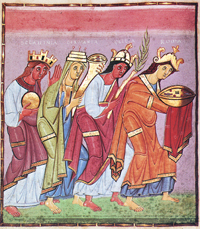
The four provinces of the empire paying homage to Emperor Otto. From the Gospel Book of Otto III, probably Reichenau c.998. Munich, Bayerische Staatsbibliothek, CLM 4453, fol. 23v.

CARA, the MAA’s Committee on Centers and Regional Associations, recognizes distinction among medievalists with two awards annually. The first is the Robert L. Kindrick-CARA Award for Outstanding Service to Medieval Studies. This award of $1000 is presented at the Annual Meeting to a Medieval Academy member who has provided leadership in developing, organizing, promoting, and sponsoring medieval studies through the extensive administrative work that is so crucial to the health of medieval studies but that often goes unrecognized by the profession at large.

The second is the CARA Award for Excellence in Teaching Medieval Studies, which recognizes a Medieval Academy member and outstanding teacher who has contributed to the profession by inspiring students at the undergraduate or graduate level or by creating innovative and influential textbooks or other materials for teaching medieval subjects. This award of $1000 is also presented at the Annual Meeting.

Deadlines for nominations are 15 November. These awards, as well as the CARA scholarships, are paid for through the dues of CARA members.

Posted in MAA Newsletter | Leave a comment

MAA News – The John Boswell Dissertation Fund

The Medieval Academy seeks contributions to fund a Dissertation Grant in memory of John Boswell. Boswell, the medieval historian who taught at Yale University from 1975 until his death in 1994 at age 47, was a pioneer in two fields that have developed significantly over the past two decades: the study of Christian-Muslim-Jewish relations, especially in the Iberian peninsula, and GLBT studies. His scholarly legacy is found not only in his four monographs but in the many students, both undergraduate and graduate, who followed him into the profession.

A Medieval Academy Dissertation Grant — a $2000 award that helps defray the research expenses of advanced graduate students — is thus a particularly appropriate memorial. Thanks to the generosity of a group of his students, colleagues, and friends, substantial funding has already been raised toward an endowment of $40,000 that will enable the Academy to offer this award every year. Academy members are invited to join this effort by making a contribution online or mailing contributions payable to the Medieval Academy to:

The Boswell Fund
Medieval Academy of America
104 Mount Auburn St., 5th Floor
Cambridge, MA 01238

Posted in MAA Newsletter | Leave a comment

MAA News – CARA Annual Meetings

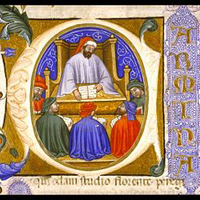
Historiated initial from Boethius, On the Consolation of Philosophy, Italy c.1385. Glasgow University Library, MS Hunter 374 (V.1.11), fol. 4r.

The 2012 CARA Annual Meeting took place at the University of Saskatchewan, Saskatoon, Canada, 4-6 October. The committee meeting was coordinated by Chair James Murray (Western Michigan University). Committee members present included Robert E. Bjork (Arizona State University), Richard Firth Green (Ohio State University) and Lilla Kopar (Catholic University of America); Director of Conference Programs, Thomas Goodmann (University of Miami), and Ex Officio, Non-Voting Members, Eileen Gardiner and Ronald Musto, Executive Directors of the MAA.

The CARA meeting added ten additional representatives: Maureen Boulton (University of Notre Dame), Massimo Ciavolella (UCLA), Lois Huneycutt (University of Missouri), Maryanne Kowaleski (Fordham University), Felice Lifschitz (University of Alberta), Michael Ryan (University of New Mexico) and Nancy Van Deusen (Claremont Graduate School), along with institutional hosts Frank Klaasen and Sarah Powrie from the University of Saskatchewan. The discussion centered on projects and problems at medieval centers and associations, as well as CARA’s support of graduate students through its various summer scholarships.

The Saturday morning program included a visit to Wanuskewin Heritage Park, a national historic site of the Northern Plains Indians located north of Saskatoon. The afternoon program, the centerpiece of the conference, was “Conversations through Time: The Cree Wanderer” with a trilingual reading of the Old English poem Swa cwæð eardstapa in Cree, Old English, and modern English, followed by a round table discussing the process of translation into Cree and the ways in which this process informs the text.

Our thanks to the local arrangements committee for a well-run and productive meeting.

Next year’s CARA Annual Meeting is scheduled to take place in Chicago at the Newberry Library from October 4-6.  CARA is planning its 2014 annual meeting in conjunction with the Annual Meeting of the Medieval Academy at UCLA (10-13) April.

Posted in MAA Newsletter | Leave a comment

MAA News – Annual Meeting 2013, Knoxville, TN

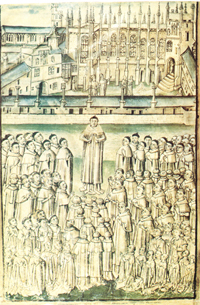
Chaundler Manuscript, Oxford c.1461-65. Oxford, New College MS 288, second frontispiece.

The 2013 Annual Meeting of the Medieval Academy of America will take place April 4-6 and will be hosted by the University of Tennessee, the Marco Institute for Medieval and Renaissance Studies and the Sewanee Medieval Colloquium. It will be held in downtown Knoxville, Tennessee, in the heart of the Tennessee Valley and at the foothills of the Great Smoky Mountains National Park.

The meeting will feature nearly sixty sessions from a wide range of disciplines and methodologies based around the theme of regions and regional identity.

Plenary speakers will include Christopher de Hamel (Donnelley Fellow Librarian of Corpus Christi College, Cambridge), Jan Ziolkowski (Arthur Kingsley Porter Professor of Medieval Latin at Harvard University and Director of the Dumbarton Oaks Research Library and Collection), and Maryanne Kowaleski (Joseph Fitzpatrick S.J. Distinguished Professor and Director of Medieval Studies at Fordham University).

This year’s CARA session will be chaired by Patrick J. Geary (Professor of Western Medieval History at the Institute for Advanced Study, Princeton) and will focus on the topic, “A New Age of Exploration: Scholars and Digitized Manuscripts.” Participants will include Claudia Fabian (Head of Manuscripts and Rare Books Department at the Bayerische Staatsbibliothek), Charlotte Denoël (Curator of medieval manuscripts at the Bibliothèque nationale de France), Fr. Columba Stewart (Executive Director of the Hill Museum and Monastic Library) and William Stoneman (Florence Fearrington Librarian of Houghton Library at Harvard University).

All sessions, lectures, meetings and the reception and banquet on Friday evening will be held at the Hilton Knoxville. The opening reception will be held at the Knoxville Museum of Art, a five-minute walk from the Hilton. The closing reception will be held at the Sunsphere, which was designed for the 1982 World’s Fair and offers striking views of the city and its surroundings. It too is a short walk from the hotel.

Participants can also register for optional tours that offer further regional enrichment. In addition to local excursions Thursday morning, a trip is planned for Sunday morning to the acclaimed Museum of Appalachia, with its original pioneer and early twentieth-century barns, cabins, and thousands of hand-made artifacts. More information will soon be available at the dedicated online registration page.

Accommodations are available at the Hilton (http://www3.hilton.com/en/hotels/tennessee/hilton-knoxville-KNXKHHF/index.html) as well as at the nearby Holiday Inn-World’s Fair Park (http://www.holidayinn.com/hotels/us/en/knoxville/tysec/hoteldetail), both newly renovated full-service hotels. Both hotels are within easy walking distance of the gracious fountains and lawns of the World’s Fair Park as well as the cafes, bars, restaurants and art galleries that fill Knoxville’s downtown area, historic Market Square, and the Old City. Hotel reservations can now be made via the following customized group reservation links: the Hilton Knoxville (http://goo.gl/VOFVK); the Holiday Inn-World’s Fair Park (http://goo.gl/WGhPs).

Conference visitors may also wish to extend their visit to East Tennessee to experience the Great Smoky Mountains National Park (the most visited national park in America), the spectacular scenery of the Cumberland Gap, or the family-friendly attractions in Gatlinburg and Pigeon Forge. Knoxville itself will be celebrating its annual Dogwood Arts Festival, when the area is in full bloom; and musicians, artists, and craftspeople at local fairs and festivals will be sharing the culture typical of this region.

The Marco Institute will provide a complimentary shuttle service at regular intervals on Thursday and again on Friday morning from the nearby McGhee Tyson airport to the Hilton and Holiday Inn Hotels.

Complete registration information as well as table reservation forms for publishers are forthcoming and will be accessible beginning January via the Marco Institute’s website at http://web.utk.edu/~marco under “2013 Annual Meeting of the Medieval Academy of America” and at http://www.medievalacademy.org/.

Book exhibitors should call or email the Institute directly with any questions in advance of the registration period.

To advertise in the print program, please email info@themedievalacademy.org.

For additional details, please contact us either per phone at 865.974.1859 or email marco@utk.edu.  We look forward to welcoming our colleagues to the Medieval Academy meeting in Knoxville in April!

Posted in MAA Newsletter | Leave a comment

MAA News – MAA Member Directory

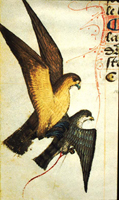
Detail of Illustration from Guillaume Tardif, Venerie et la Chasse, fol. 7r. France, between 1399 and 1499. Glasgow University Library, MS Hunter 269 (U.5.9).

One of the major features of the new MAA website is its Members section, which now provides a robust, up-to-date membership directory. This MAA Members Directory is available to all members of the Medieval Academy, but you need to be logged in to access the directory. The directory is expanded over the former print version, which provided only contact information. Now members can add information to their professional profiles about their work and publications and upload a copy of their CVs. A photo can be added as well.

Members can also provide information about their disciplines, fields and specialties and indicate their willingness to review books and article submissions for Speculum. You can also search the online directory for other members in their fields or geographical regions or by any number of other criteria.

To access the directory, go to any page on the MAA website, sign in to the site, then pull down the Members tab and select Members Directory. There you will find both basic and advanced options for searching the directory.

We encourage members to sign in and update their own profiles to make this a valuable resource for the entire community of medievalists.

Posted in MAA Newsletter | Leave a comment

Jobs For Medievalists

Director of the Special Collections Research Center at The Earl Greg Swem Library
The College of William and Mary

Established in 1693, the College of William & Mary continues a long tradition of excellence by combining the best features of an undergraduate college with the opportunities offered by a modern research university. Adjacent to historic Colonial Williamsburg, the College is approximately 150 miles south of Washington, D.C. and located midway between Richmond and Norfolk, offering the ideal setting for a liberal arts education.

The Earl Gregg Swem Library seeks a creative and enthusiastic individual to lead the Special Collections Research Center consisting of six full-time and two part-time staff members, over twenty undergraduate and graduate students, and over twenty volunteers. The 25,000 square foot Warren E. Burger wing of Swem Library opened in 2005 and houses over one million manuscripts, documenting Virginia and American history, more than 45,000 rare books, a growing international collection, university archives and the papers of Chief Justice Warren E. Burger. In addition to serving a wide range of national and international researchers, Special Collections is an integral part of undergraduate instructions in a wide range of academic disciplines. The staff works closely with faculty to ensure primary resources are part of the students’ research experience as demonstrated by the number of students and classes that utilize the collections each semester.

The Marian & Alan McLeod Director of the Special Collections Research Center reports to the Dean of University Libraries and is responsible for administering the department and its budget, and providing leadership and vision for the staff, including: planning and policy Development, collection development, and the expansion of digital initiatives. The Director provides instruction and outreach to students, faculty and the community at large and works collaboratively with development staff to engage the community and promote the collections. The ideal candidate will have a broad understanding of emerging technologies and how they expand access to local collections. As a member of the Library’s senior management team, the Director will be a member of the Dean’s Council, and regularly work with Associate Deans and other library leaders.

This is a non-tenure track professional faculty position with a competitive salary that is commensurate with experience. Benefits include 24 days of annual leave per year in addition to 12 paid holidays.
Required Qualifications:
* Master’s degree from an accredited program in library and information studies, information science, or archival studies;
* Seven years progressive experience in a special collections environment;
* Demonstrated success as a manager and leader;
* An understanding of current archival standards and best practices;
* Familiarity with pertinent legal and ethical issues including intellectual property and copyright issues;
* Experience in outreach and community engagement;
* Budget management.

Preferred:
* A second Master’s degree in American History, American Studies or other relevant disciplines;
* Experience building special collections through gifts and purchases;
* Success in attracting grants, foundations and private support for library projects;
* Experience leading digital projects using established/and emerging technologies;
* Excellent teaching and presentation skills;
* Experience in fundraising.

To apply for this position, visit https://jobs.wm.edu/ . The Search Committee will begin review of applications on January 15, 2013.

The College of William and Mary conducts background checks on applicants for employment.

William & Mary is an Equal Opportunity/Affirmative Action/Equal Access employer and actively encourages applications from minorities, women, disabled persons and veterans.

Posted in Jobs for Medievalists | Leave a comment

Call for Papers – Light Colour Line – Perceiving the Mediterranean: Conflicting Narratives and Ritual Dynamics

The Mediterranean Seminar is proud to collaborate with the
5th International Conference of Mediterranean Worlds:
Light Colour Line – Perceiving the Mediterranean: Conflicting Narratives and Ritual Dynamics,
to be held at Bern (Switzerland), September 9-11, 2013

The theme of this interdisciplinary conference will focus on three issues:

1. The light, the colour, the horizon line are parameters for the perception of the Mediterranean. A statement such as “the colour of the Mediterranean is only turquoise in the indirect light of Capri’s Blue Grotto” is an example of the utopian metaphors that have shaped the image of this region. From classical times to today, the subjective image of the Mediterranean has moved so close to its object that it is perceived to have substantially converged with it. The subjective image has altered the history of its object, its linguistic, sectarian and social structures, giving rise to incomprehension or even rejection between ‘Occident’ and ‘Orient’. At the same time, however, it has also set a process of cultural osmosis in motion. Is there a valid image, a correlative or interactive visualization of the Mediterranean and its inhabitants?

2. Using narrative forms of representation, literary, filmic and photographic media require modes of perceiving the Mediterranean that in comparison with perceived reality reveal – on both sides – fractures and contradictions, conflicting narratives. Pictorial and textual narratives are attempts to perceive a region, a space, or a utopia which have their origin in and reflect the oral tradition of their inhabitants in the ports, trading posts and caravanserais. For this purpose the oral tradition has used predominant narratives and counter-narratives, heroes and anti-heroes, realities and utopias. How has this dialectic form of oral tradition been represented in pictorial and textual media from ancient times to the present day?

3. The title colour line is deliberately ambivalent, touching in equal measure on both the history of perception, epistemology, social anthropology and the political history of the Mediterranean. Thus, the Mediterranean is not only Europe’s most lethal border, located between three continents, three religions and ethnicities, but also the ‘transmission belt’ of an osmotic network that defines the dynamic development of the whole region. An important factor for this osmosis is the exchange, interdependence and transformation of ritual practices – linguistic, religious and political ceremonials. Accordingly, the aim of the symposium is to show that ritual dynamics have functions that integrate as well as exclude. Could ritual dynamics in fact constitute the mainspring for a mental affinity between the various Mediterranean cultures, for a mutual sense of cultural curiosity that traditional Mediterraneanism has sought to elucidate through the concepts of the cultural unity (Braudel) or connectivity (Horden-Purcell) of the Mediterranean?

SUBJECT AREAS:
Papers are required to be thought-provoking and methodically inventive, preferably addressing the following subjects:
– Light and Colour in Mediterranean Arts and Architecture.
– Perspectivism, Optics and Islam.
– Cinematographic Views: Perception and Reconstruction of the Mediterranean.
– Predominant and Counter-Narratives in Literature and Mythology.
– Oral Tradition and Artistic Performance: Means of Communication.
– Conflicting Narratives: Respect and War.
– The Osmosis of Honour and Shame.
– Inconsistence and Resistance.
– Performance of Mediterranean Rituals.
– Ritual Perception of History in the Mediterranean.
– The Mediterranean Sea as Colour Line.
– Migration: Sought Horizons and Lines of Sight.

ABSTRACT SUBMISSIONS:
Participants are invited to submit 300-word abstracts for 25-minute presentations. Abstracts should include at least three descriptive keywords, the presenter’s name, organization, email and mailing address. The language of the conference will be English. Please send your abstracts to: agnes.sebestyen@ikg.unibe.ch

DEADLINE FOR ABSTRACTS: March 1, 2013

PROCEEDINGS:
The publication of selected papers is planned.

CONFERENCE ORGANIZER:
Prof. Dr. Thomas Dittelbach
Department of the History of Art – TransMediterraneanStudies
University of Bern
www.ikg.unibe.ch

FURTHER INFORMATION:
www.medworlds5.com

CONTACT:
Ágnes Sebestyén
Organizing Assistant
Department of the History of Art – TransMediterraneanStudies
University of Bern
E-Mail: agnes.sebestyen@ikg.unibe.ch

Posted in Call for Papers | Leave a comment

Call for Papers – Chant and Culture

The University of British Columbia’s
Committee for Medieval Studies
presents
CHANT AND CULTURE
8th Annual Colloquium of
The Gregorian Institute of Canada
August 6-9, 2013
University of British Columbia
Vancouver, British Columbia

The Gregorian Institute of Canada has focused from its inception on performance, providing a unique opportunity for scholars and performers from Canada and around the world to share and discuss their ideas, research, and experience. This year’s theme—Chant and Culture—is inspired by an essay currently found in WILLIAM MAHRT’s book, The Musical Shape of the Liturgy, and which also originally appeared as “Gregorian Chant as a Fundamentum of Western Musical Culture”, in Sacred Music 102.1 (Spring 1975): 3–21. WILLIAM MAHRT, Professor Emeritus of Music at Stanford University, will be giving this year’s keynote address. In addition to academic papers, there will be workshops in chant performance. Vancouver Early Music Programme & Festival will have concerts on campus at the same time, including one on the medieval Carmina Burana by BENJAMIN BAGBY and the ensemble SEQUENTIA.

Submissions on any topic of chant research are welcome, but paper and workshop proposals that address the broadly conceived colloquium theme—Chant and Culture— are particularly encouraged and will be favored over others in the selection process. Suggested topics include anything related to Mahrt’s thesis: i.e., “Gregorian chant was not only the historical predecessor of a great development of polyphonic music; it was
also the actual structural basis of the better part of medieval and renaissance sacred music. One could chart this history in great detail, but more interesting are the ways in which it played the role of a fundamentum, and the part it played in the development of a polyphonic fundamentum. From the high middle ages onward, there existed a polyphonic sacred music which used the materials and even the thought processes of each age. A creative interaction between the traditional fundamentals of sacred music and the ideas of the time is a hallmark of the entire history. If at times it seems that the ideas of the time prevailed, it must not be forgotten that polyphonic sacred music always existed in the context of some kind of performance of Gregorian chant as chant.”

Please send a 250-word abstract to the program committee at chant@gregorian.ca. Abstracts may be sent and papers presented in either English or French. Conference papers will be limited to 30 minutes, followed by a 10-minute discussion period. Performance practice workshops will last 40 minutes.

The deadline for proposals is January 15, 2013.
For further information, registration, and conference updates,
please visit the Gregorian Institute of Canada website at www.gregorian.ca.

Posted in Call for Papers | Leave a comment

Jobs for Medievalists

Fifteenth-Century Studies, a refereed interdisciplinary medieval studies journal which publishes in English, French, German, and Spanish, seeks a senior editor who will then assemble an editorial team. The journal currently publishes yearly, sponsors five sessions at the Medieval Congress held annually at Kalamazoo, and co-sponsors European conferences held at certain intervals. At present, the journal has an Editorial Advisory Board and a Book Review Editor. FCS was founded in 1977 by Edelgard Dubruck and has been published in 38 volumes (of approximately 250 pages each) to date. The book is brought out by Camden House, an imprint of Boydell & Brewer. Since 2007, FCS has been published digitally through LION (ProQuest) as well as in hard-cover format and thus has acquired a much wider readership. Besides being published in the USA, Germany, France, and Spain, academic institutions in the following countries subscribe: Korea, Japan, South Africa, Poland, Hungary, Switzerland, Austria, Mexico, China, Ireland, Taiwan, Singapore, Turkey, Israel, India, Portugal, Kuwait, Denmark, and the Czech Republic. This is an unpaid position with enormous potential for developing the journal into the future. The interested scholar should have a background in French, German, or Spanish; experience publishing a yearly volume; and the ability to elicit institutional support. Camden House, the publisher, incurs the expense of typesetting, yet funds amassed by the journal are minimal, having been generated through readers’ subscribership to the Fifteenth Century Society, a professional organization associated with the journal and its associated activities; namely, the symposia held yearly in Kalamazoo. See the following URL for information about the contents of the last few volumes:

http://www.boydellandbrewer.com/store/listcategoriesandproducts.asp?idcategory=95

For additional information on this position contact: Barbara I. Gusick, Professor Emerita, English, Troy University, bgusick@troy.edu.

Posted in Jobs for Medievalists | Leave a comment

Call for Papers – Gender and Transgression in the Middle Ages

Gender and Transgression in the Middle Ages

2nd – 4th May 2013

Saint Andrews Institute of Mediaeval Studies, University of St Andrews

We are pleased to announce the call for papers for Gender and Transgression in the Middle Ages 2013, a three-day interdisciplinary conference for postgraduate and early career researchers hosted by The University of St Andrews Institute of Medieval Studies (SAIMS). Now in its fifth year, the conference aims to create a lively and welcoming forum for speakers to present their research, make contacts, and participate in creative discussion on the topics of gender and transgression in the Middle Ages.

This year’s keynote speaker will be Professor Pauline Stafford, Emeritus Professor in Early Medieval History at the University of Liverpool, who will be speaking on reading gender in chronicles, with special reference to the old English vernacular.

We invite postgraduate, postdoctoral and early career researchers from departments of History, Modern and Mediaeval Languages, English, Art History, Theology and Divinity, in addition to scholars working in any other relevant subject area, to submit a papers of approximately 20 minutes that engage with the themes of gender and/or transgression in the mediaeval period. Possible topics for papers might include, but are by no means limited to gender and/or transgression in the fields of:

  • Politics: kingship, queenship, the nobility, royal/noble household, royal favourites and mistresses, royal ritual, display and chivalry.
  • Legal Studies: men, women and the law, court cases, law-breaking, marriage and divorce.
  • Social and economic history: urban and rural communities, domestic household, motherhood and children, widows, working women, prostitution and crime.
  • Religion: monastic communities, saints and saints’ lives, mysticism and lay religion.
  • Literature: chivalric texts, romances, poetry, vernacular works.
  • Visual culture: depictions, architecture, art, material culture and patronage.
  • Masculinity and femininity in the middle ages and their application in current historiography.
  • Homosexuality, sexual deviancy and cross-dressing.

To mark the launch of St Andrews Centre for Mediaeval and Early Modern Law and Literature (CMEMLL) we shall be holding a session on medieval law and literature within the broader conference theme of gender and transgression and therefore particularly welcome papers within this field.

Those wishing to give a paper please submit an abstract of no more than 300 words to genderandtransgression@st-andrews.ac.uk by Monday 11 February 2013. Your abstract should be attached to your email as a Microsoft Word or PDF file and include your name, home institution and what stage of your postgraduate or postdoctoral career you are currently at.

Registration for the conference will be £5 for students/unwaged, £10 for staff, which will cover tea, coffee and lunch on two days, and two wine receptions. All delegates are also warmly invited to the conference meal on Friday 3 May, the cost of which will be covered for speakers. Further details can be found at our website http://www.st-andrews.ac.uk/saims/gender/index.html as they come available and we can be followed on twitter @gandt2013.

Posted in Call for Papers | Leave a comment